Pairs with the Adjacency / Synergy Map — a ready-to-use strategy tool, filled for Mondelez. Included in the The Adjacency Expansion Casebook →
On October 1, 2012, a company changed its name and kept its phone number. Kraft Foods Inc. — the corporate entity, the SEC registration, the NASDAQ listing — became Mondelez International. It did not split off and float away. It stayed exactly where it was, retired its old KFT ticker for MDLZ, and ejected its North American grocery business out the back door as a brand-new company called Kraft Foods Group.23 Everyone remembers this as the day Mondelez was born from Kraft. It was actually the day Kraft renamed itself Mondelez and gave the name 'Kraft' away.
The official story is that Mondelez was spun off from Kraft in 2012 to become a $32 billion snacking company. Nearly every load-bearing word of that sentence is wrong. The split was announced in August 2011, not 2012.1 Mondelez wasn't spun off — it's the legal parent that did the spinning.3 The $32 billion was a forecast, not a fact.1 And 'pure snacking company' is still, more than a decade later, an aspiration the company writes in its proxy as a goal.5
The split that ran in reverse
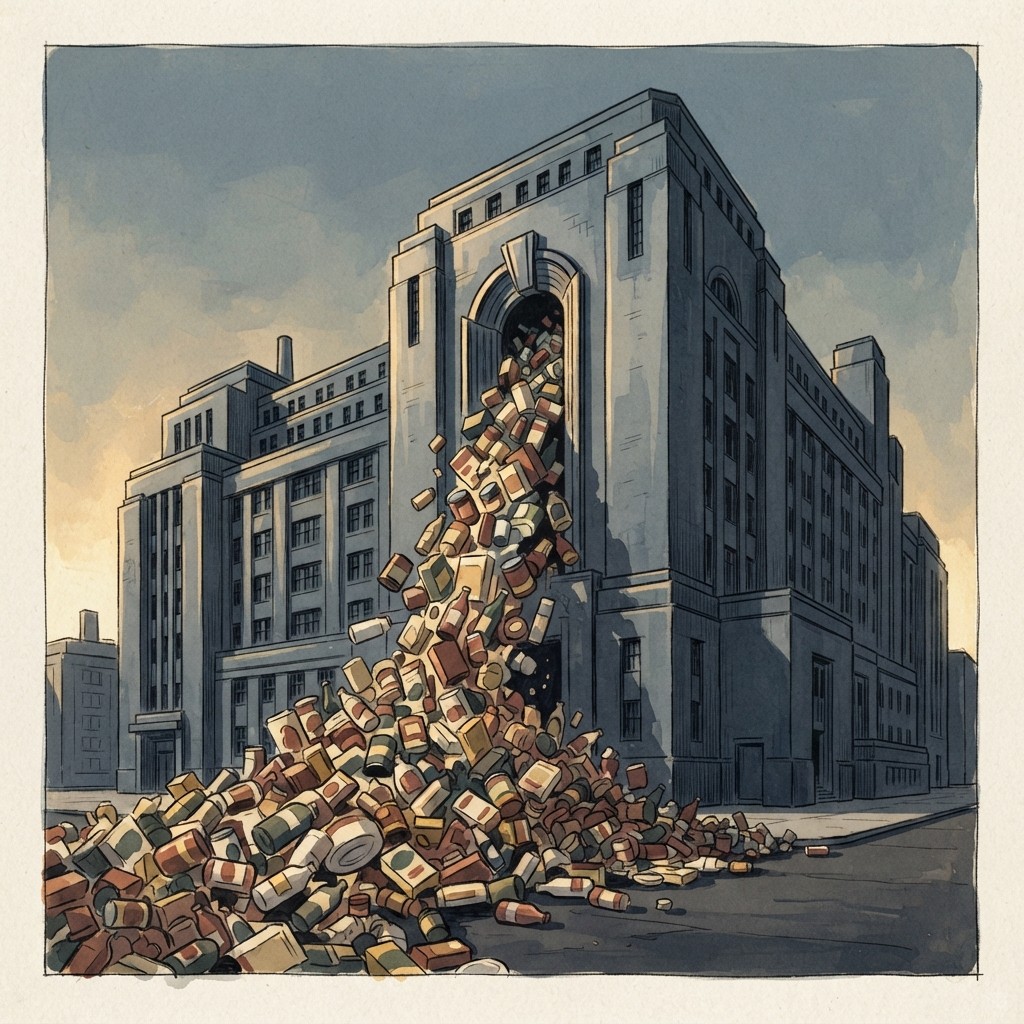
Here is the move almost everyone gets backwards. When a company splits in two, intuition says the famous brand keeps the old shell and the new venture gets the new name. Kraft did the opposite. The high-growth global snacks business — Oreo, Cadbury, Toblerone, Trident — kept the incumbent corporate body, the listing, the institutional history, and slapped a new name on it: Mondelez.3 The slower-growth North American grocery business — the boxed mac and cheese, the Jell-O, the Philadelphia cream cheese sold in the U.S. — got carved out as the genuinely new entity, Kraft Foods Group, and handed to shareholders at one new share for every three they held.2 Three years later that grocery offspring merged into Kraft Heinz.9 So the snacks business was never the child of this transaction. It was the survivor of it. The grocery half was the part sent away, and the 'split from Kraft' framing quietly inverts who left whom.
“Kraft Foods Announces Intent to Create Two Independent, Publicly Traded Companies: a high-growth global snacks business with estimated revenue of approximately $32 billion, and a high-margin North American grocery business with estimated revenue of approximately $16 billion.”1
Why bother with the surgery at all? Because the two halves wanted opposite things from their owners. A high-margin North American grocery business is a cash machine: it grows slowly, throws off dividends, and is best run for steady margin. A global snacks business is a growth story that needs reinvestment, scale in developing markets, and a stock priced for expansion — at announcement, Kraft projected a substantial share of the snacks company's revenue would come from developing markets.1 Bolted together, each half dragged the other's valuation toward an unhappy middle. Apart, each could be priced for what it actually was. The snacks half kept the shell precisely because it was the part with the future worth protecting.
The 90% that's still a goal
The cleaner story would end with a pure snacking machine. The real numbers refuse to be that tidy. In FY2024 Mondelez reported $36.4 billion in net revenue — already far past the 2011 estimate, which is why citing $32 billion as 'what Mondelez is' has been wrong for years.4 Inside that revenue, biscuits and baked snacks ran about 49%, chocolate about 31%, and gum and candy about 12%.4 That leaves a tail nobody talks about: roughly 6% cheese and grocery, and roughly 3% beverages.4 Nine cents of every revenue dollar still comes from categories the pivot was supposed to be about leaving behind. Mondelez itself frames ~90% core-category revenue not as something it has achieved but as something it is working toward — a stated objective in its 2024 proxy.5 A pivot you're still narrating in the future tense isn't finished.
| The popular story | The 10-K reality | |
|---|---|---|
| What Mondelez is | A pure-play snacks company | ~91% snacks, ~9% cheese, grocery & beverages |
| Core-category share | Achieved | A stated ~90% goal, not yet reached |
| Total revenue | ~$32 billion | $36.4B (FY2024), ~$38.5B (FY2025) |
| Origin | Spun off from Kraft | Renamed Kraft Foods Inc. itself |
And the focus is an active project, not a one-time event. In August 2022 Mondelez bought Clif Bar, explicitly to expand its global snack-bar business and round out its refrigerated and performance-nutrition snacking shelves.10 That's the same logic the 2012 split ran on, applied at the edges: keep buying deeper into the chosen lane, keep pruning the categories that don't belong. The snacking focus isn't a state Mondelez arrived at. It's a direction it keeps walking, acquisition by acquisition, divestiture by divestiture, with a 9% tail still in tow.
Does the messy reality undercut the strategy?
The fair objection is that none of this corrects the thesis — it just nitpicks the trivia. Who cares which entity kept the listing, or whether the snacking share is 91% versus a round 100%? The strategy worked: Mondelez grew from a ~$32 billion estimate to $36.4 billion, then to roughly $38.5 billion in FY2025, with about three-quarters of revenue now earned outside the United States.6 That is exactly the geographically diversified growth engine the split was designed to free. The objection is right that the strategy is real. But the details aren't trivia — they're the difference between understanding a focus pivot and mythologizing one. A company that 'became pure snacking in 2012' teaches you that focus is a clean break you make once. A company that is still 91% snacking in 2024, still writing 90% as a goal, still buying bars and shedding grocery — that teaches you what focus actually costs: a decade of continuous editing, and a tail you never fully cut. The honest version is the more useful one precisely because it's harder.
The seductive version of the Mondelez story is the press-release version: declare the new identity, spin off the old weight, and emerge transformed on day one. The real version is slower and more honest. Twelve years after the split, Mondelez still earns ~9% of revenue from the categories it's 'focused away' from, still describes 90% core-category revenue as a target rather than a result, and is still acquiring and divesting to inch closer. When you read that a company 'pivoted' or 'became a pure-play,' check the proxy: the most disciplined focusers are usually the ones still calling it a goal, because they know the work is never quite done. Beware any focus story told entirely in the past tense — it's probably marketing, not the mechanism.
Mondelez is what's left when you take Kraft Foods Inc., keep the body, and ask it to become one thing instead of two. It didn't split off from Kraft; it shed the part of itself it no longer wanted to be, kept the shell, and renamed what remained for the future it was choosing. The lesson isn't that focus is a clean break. It's that focus is the most expensive kind of patience — a company narrating in the future tense, a decade in, the one identity it still hasn't quite finished becoming.
When a company decides what it no longer wants to be
Adjacency / Synergy Map
A one-page canvas for an adjacency play: the new business next door, the shared assets that justify entering it, the synergies that actually transfer versus the ones that evaporate on contact, and the dis-synergies nobody put on the deck. Blank to test your own expansion; filled as the worked example showing where the story's 'natural adjacency' was real and where it was wishful.
Included, filled and blank, in the The Adjacency Expansion Casebook. See the set → · Preview the blank →
Sources
Where this comes from — the filings, records, and reporting behind it.
- 1Kraft Foods Inc. announced on August 4, 2011 its intent to create two independent public companies: a high-growth global snacks business with estimated revenue of ~$32 billion and a high-margin North American grocery business with estimated revenue of ~$16 billion.
- 2On October 1, 2012, Kraft Foods Inc. completed the spin-off of its North American grocery business as Kraft Foods Group, Inc., and concurrently renamed itself Mondelez International, Inc. Each Kraft Foods Inc. shareholder received one share of Kraft Foods Group for every three shares of Kraft Foods Inc. held.
- 3Mondelez International is the legal successor to Kraft Foods Inc. (not a spinoff from it); concurrent with the spin-off, Kraft Foods Inc. changed its name to Mondelez International and began trading on NASDAQ under ticker MDLZ on October 2, 2012, retiring the KFT ticker.
- 4In FY2024, Mondelez International reported net revenues of $36,441 million (up 1.2% reported; Organic Net Revenue growth of 4.3%), with biscuits & baked snacks at ~49% of revenue, chocolate at ~31%, gum & candy at ~12%, cheese & grocery at ~6%, and beverages at ~3%.Mondelez International, Inc., Form 10-K FY2024 ↗ · 2025-02-04
- 5Mondelez's stated strategic goal as of 2024 is to generate approximately 90% of revenue through its core categories—chocolate, biscuits, and baked snacks—framed as an ongoing objective, not an achieved result.
- 6Mondelez International reported FY2025 net revenues of approximately $38.5 billion, with approximately 75.8% of revenues coming from outside the United States.
- 7Mondelez acquired Clif Bar & Company on August 1, 2022, describing it as expanding its global snacks bar business and complementing its refrigerated snacking and performance nutrition bar portfolios—a concrete post-split adjacency move.
- 8At the time of the split announcement, Kraft Foods projected the global snacks company would have ~75% of estimated $32 billion revenue coming from snacks and ~42% from developing markets; these were forward estimates made in 2011-2012, not verified post-split actuals.
- 9Kraft Foods Group, Inc. merged with H.J. Heinz Holding Corporation to form The Kraft Heinz Company, with the merger completing on July 2, 2015.
- 10On August 1, 2022, Mondelez acquired 100% of the equity of Clif Bar & Company; the acquisition expands its global snacks bar business and complements its refrigerated snacking and performance nutrition bar portfolios.
More like this — beyond Mondelez
New Strategically analyses as they publish: the defining moves in business, checked against the record. No noise, and one click to leave.