Pairs with the Market-Entry Gambit Canvas — a ready-to-use strategy tool. Included in the The Market-Entry Gambit Casebook →
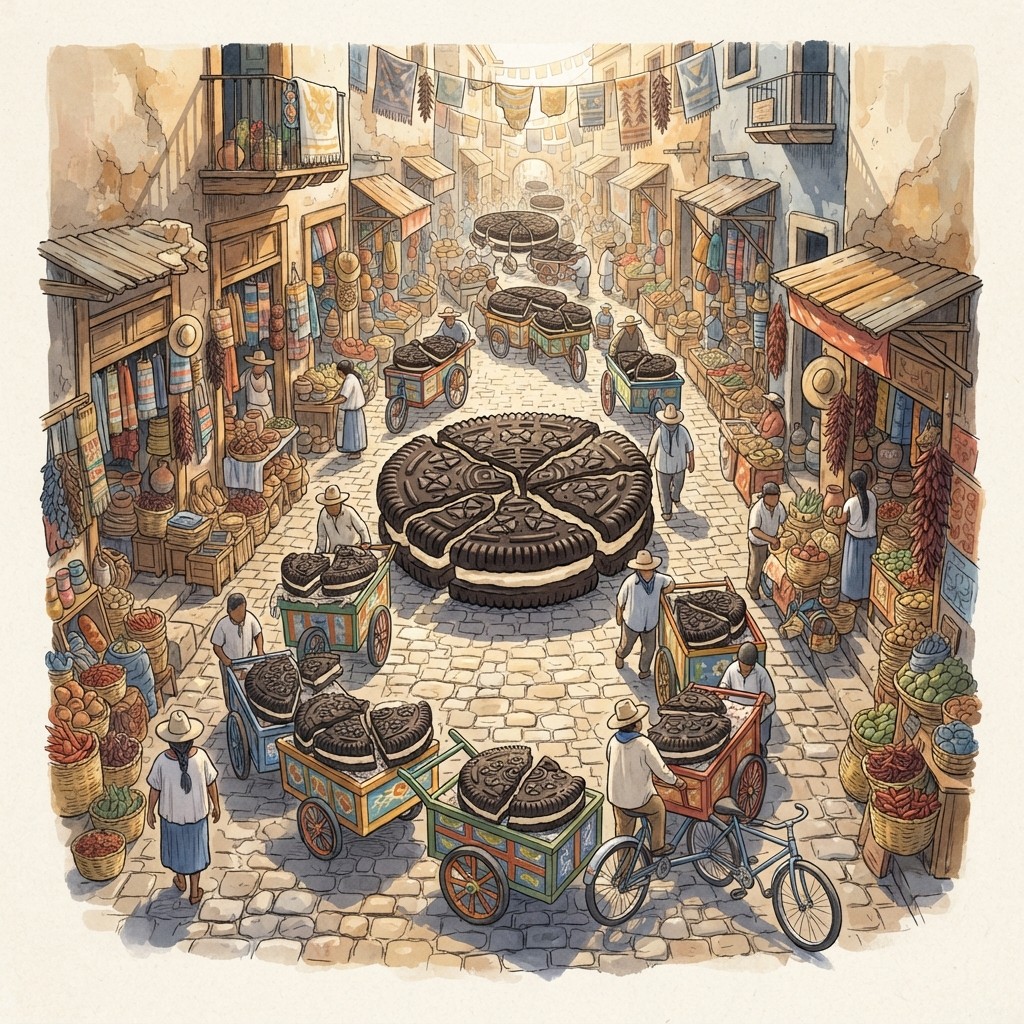
In 2022 Mondelēz wrote a check for about $1.3 billion to buy a Mexican company famous for marshmallows, lollipops and candy bars7 — and the company that owns Oreo, Cadbury and Toblerone freely admitted the candy wasn't the point. Its own finance chief said the deal wasn't about category fit at all. What Mondelēz was actually buying sat behind the candy: more than 2,100 delivery routes and roughly 440,000 traditional-trade outlets7 — the tiny corner shops, kiosks and family stores that no global brand reaches by shipping a pallet to a supermarket. It bought the road, and the candy came along for the ride.
The official story is that Mondelēz grows in emerging markets on the pull of its global brands — that an Oreo simply sells itself once it lands. The truer story is colder and more interesting: emerging-market growth is a logistics problem solved with a checkbook. You don't out-market the local distributor. You buy him, and put your cookies on his truck.
Why a global brand can't just show up
Here is the part the brand-strength narrative skips. In a developed market, demand and distribution arrive together: shoppers fill big-box stores and a handful of retail chains move most of the volume. In much of Latin America and Asia, commerce still runs through hundreds of thousands of small, independent shops — what the industry calls traditional trade. Those shops don't take a planogram from headquarters. They take deliveries from a person they trust, on a route that runs reliably, in quantities and on credit terms tuned to a neighborhood. The hard asset isn't the cookie; it's the relationship between a route driver and 440,000 shopkeepers. That relationship takes decades to build and cannot be airdropped. So Mondelēz stopped trying to build it and started buying it — Ricolino's network in Mexico to carry Oreo7, and a controlling stake in Evirth to ride China's frozen-to-chilled cakes channel6. The brands are the cargo. The distribution is the moat.
“The rationale was distribution scale — more than 2,100 direct-store-delivery routes and around 440,000 traditional-trade outlets — to expand Oreo in Mexico, not category fit in chocolate or biscuits.”7
Selling the slow stuff to fund the fast stuff
The other half of the gambit is subtraction. In December 2022 Mondelēz agreed to sell its developed-market gum business — the US, Canada and Europe — to Perfetti Van Melle, closing in October 2023 for $1.35 billion at roughly 15 times EBITDA45. It is tempting to call this 'Mondelēz exits gum.' It isn't. The company deliberately kept its emerging-market gum business across Latin America and AMEA4. The cut was surgical: shed the mature, low-growth developed-market chunk, keep the version that still grows, and redirect the proceeds and the focus toward a stated goal of 90% of revenue in chocolate, biscuits and baked snacks5. Divest the slow, buy the rails, point the brands at the rails. Same playbook, run in two directions at once.
| Sell developed-market gum | Buy Ricolino / Evirth | |
|---|---|---|
| What changed hands | Mature US/Canada/Europe gum | Local distribution + a foothold category |
| Headline price | $1.35B in (15x EBITDA) | ~$1.3B for Ricolino; majority stake in Evirth |
| The real prize | Cash + focus on core categories | 440,000 outlets; a China cakes channel |
| What was kept / gained | Emerging-market gum, retained | Rails to carry Oreo where it couldn't reach |
The trillion-peso footnote: organic growth that doesn't reach the bank
Now the uncomfortable part the headline numbers hide. Mondelēz reported emerging-market Organic Net Revenue growth of 4.6% for FY2024, and 6.7% in the fourth quarter1 — numbers that make the strategy look like it's printing money. It isn't, not in dollars. Organic Net Revenue is a non-GAAP measure that strips currency out. Put the currency back in and the picture inverts: in FY2024, unfavorable currency translation dragged emerging-market revenue by 13.9 percentage points — an unfavorable swing of $1,945 million — offset only partly by $1,167 million of pricing in high-inflation markets, for a net currency headwind of 5.6 points3. In other words, the local sell-through grew while the reported dollars shrank. The road delivered more boxes; the peso, the lira and the rest delivered fewer dollars per box.
This is why 'Mondelēz is an emerging-markets company' is a flattering exaggeration. Add Latin America's $4,926 million and AMEA's $7,296 million and you reach about $12.2 billion of $36,441 million in FY2024 net revenue — roughly a third1. Europe alone, at $13,309 million, was the single largest segment1. Even though 74% of revenue is generated outside the United States2, the developed world still pays most of the bills. Emerging markets are the growth engine and the volatility engine in the same breath — which is exactly why the company funds the bet by pruning developed-market assets rather than betting the house on it.
Isn't buying distribution just the smart, obvious move?
The fair objection is that this all sounds shrewd, and largely it is: piggybacking a global brand on a trusted local network is a textbook way to short-circuit the decades it would take to build that network from scratch. Each deal is defensible on its own terms — Ricolino's reach, Evirth's position in a roughly $3 billion China cakes category growing near 15% a year6. But the honest counter is that the model has two slow leaks. First, integration debt: every bolt-on is a different country, a different channel, a different culture of route drivers, and Evirth isn't even a clean 100% buy — Mondelēz took a 'significant majority' stake atop a prior minority position6, which means shared control before full control. Each acquisition adds a layer of complexity that compounds. Second, the currency leak above doesn't go away with scale — it gets bigger, because the more revenue sits in soft-currency markets, the more of it the FX line quietly erases each year3. The strategy is genuinely smart. It is also a treadmill: you must keep acquiring distribution faster than translation and integration eat the returns.
When a market's demand is real but its distribution is fragmented — thousands of tiny independent outlets, no chains to ship to — the scarce asset isn't the product, it's the route. The fastest entry is rarely a marketing campaign; it's acquiring the network that already has the shopkeepers' trust and putting your product on its trucks. Two cautions, both visible in Mondelēz's numbers. First, a foothold category you don't really want (candy, when you sell cookies) is the price of admission to the rails — judge the deal on the distribution, not the SKUs. Second, distribution bought in soft-currency markets buys you local volume, not necessarily reported dollars; underwrite the deal on units and share, and assume the FX line will quietly tax the headline for years.
Strip away the brand mythology and Mondelēz's emerging-market growth is a quieter, harder thing than it looks: not the magnetism of an Oreo, but the unglamorous purchase of 440,000 doors and the trucks that reach them. The company sells the mature assets it can spare, buys the local rails it can't build, and rides its global brands into shops a pallet would never find. The genius isn't the cookie. It's the willingness to pay a billion dollars for someone else's delivery routes — and to keep paying, one country at a time, faster than the currency can take it back.
How companies enter markets they don't already own
Market-Entry Gambit Canvas
A one-page canvas for staging an entry into a market you don't own yet: the beachhead you take first, the wedge that gets you in cheaply, the sequence that turns a foothold into a position, and the incumbent's likely counter-move. Blank to plan your own entry; filled as the worked example showing how the story's challenger picked its landing spot and walked the rest in.
Included, filled and blank, in the The Market-Entry Gambit Casebook. See the set → · Preview the blank →
Sources
Where this comes from — the filings, records, and reporting behind it.
- 1Mondelēz FY2024 total net revenues were $36,441M; Latin America $4,926M; AMEA $7,296M; Europe $13,309M; North America $10,910M; Emerging Markets full-year Organic Net Revenue growth was 4.6%; Q4 EM Organic Net Revenue growth was 6.7%.
- 2Mondelēz FY2024 10-K: 74% of net revenues generated outside the United States; net revenues of $36,441M, up 1.2% from 2023; Evirth acquisition completed in China; zero-sugar Oreos launched in China.
- 3In FY2024, EM currency translation dragged Emerging Markets Organic Net Revenue by -13.9pp (unfavorable currency translation of $1,945M), partially offset by extreme pricing of $1,167M (8.3pp), for a net EM currency headwind of -5.6pp.
- 4Mondelēz sold its developed-market gum business (US, Canada, Europe) to Perfetti Van Melle for a headline price of $1.350 billion (15x estimated current-year EBITDA), retaining the emerging-market gum business across Latin America and AMEA; deal announced December 19, 2022.
- 5Mondelēz completed the sale of its developed-market gum business to Perfetti Van Melle on October 2, 2023; the divestiture advances a strategy targeting 90% of revenue in core categories of chocolate, biscuits and baked snacks.
- 6Mondelēz announced September 20, 2024 it signed an agreement to acquire a significant majority stake in Evirth (Shanghai) Industrial Co., Ltd., a China leader in frozen-to-chilled cakes and pastries; the category is estimated at $3B growing at ~15% CAGR; Mondelēz already held a prior minority stake.
- 7Ricolino — a candy business (candy bars, lollipops, marshmallows, gum) headquartered in Mexico City — was acquired from Grupo Bimbo for ~$1.3B in 2022; CFO Zaramella stated the rationale was distribution scale (2,100+ DSD routes, 440,000 traditional trade outlets) to expand Oreo in Mexico, not category fit in chocolate/biscuits.
- 8Mondelēz's emerging-markets definition (per company filings) includes: all of Latin America; AMEA excluding Australia, New Zealand and Japan; and select European countries (Russia, Ukraine, Türkiye, Kazakhstan, Georgia, Poland, Czech Republic, Slovak Republic, Hungary, Bulgaria, Romania, the Baltics and East Adriatic countries).
More like this — beyond Mondelez
New Strategically analyses as they publish: the defining moves in business, checked against the record. No noise, and one click to leave.