Pairs with the Market-Entry Gambit Canvas — a ready-to-use strategy tool, filled for McDonald's. Included in the The Market-Entry Gambit Casebook →
Walk into a McDonald's in Mumbai and the most famous item on earth is missing. There is no Big Mac in the form you know it - no two all-beef patties, because there is no beef at all, and no pork either.7 In its place sits the Maharaja Mac, built on chicken, and below it on the board the McAloo Tikki, a spiced potato patty in a bun.7 The story you've been told is that this is McDonald's listening - a global giant kneeling to local taste out of cultural respect. It's a lovely story. It is also mostly the wrong explanation for the right facts.
The official story is that McDonald's localizes the menu out of cultural empathy. The truer story is that it localizes because the structure of the business gives it no other option - and gives the people closest to the customer both the incentive and the authority to do it. 'Glocalization' is the feel-good label stuck on top of a hard commercial machine.
It isn't really McDonald's serving you - it's a franchisee carrying the risk
Here is the fact almost everyone files away and almost no one connects to the menu. Of McDonald's 41,822 restaurants at the end of 2023, roughly 95% were franchised - not owned and run by the corporation.1 McDonald's describes its job as franchising and operating restaurants that serve 'a locally relevant menu of quality food and beverages' across more than 100 countries.1 Read those two facts side by side and the localization stops looking like sentiment. The company has chosen a model in which someone else puts up the capital, signs the lease, hires the staff, and absorbs the loss if the lunch rush doesn't come. The corporation's own filings call this franchised structure one 'designed to generate stable and predictable revenue.'2 Stable for whom? For McDonald's, which collects rent and royalties. The variability - the weather, the wages, the question of whether anyone in this town actually wants a beef burger - lands on the operator.
And once the operator carries the risk, the operator earns a voice. A local franchisee who will eat the loss on a menu that doesn't sell has every reason to push for items that do. That pressure flows upward through McDonald's approval process - local additions require corporate sign-off - and the result is a menu shaped less by a marketer's empathy than by thousands of risk-bearing operators arguing, in effect, 'this won't sell here, and I'm the one who pays for it.' Localization is what you get when the people who lose money have a seat at the table.
India wasn't an adaptation. It was a precondition.
The cleanest test of the empathy theory is India, and India breaks it. The no-beef menu isn't a touching post-entry adjustment to local feeling - it's overdetermined by things that have nothing to do with respect. Cow slaughter is illegal across many Indian states under legislation the Constitution directs states to enact, with several states banning even the possession of beef.6 You cannot build a national supply chain for a product that is a criminal offense to transport through half the country. The beef came off the menu because the beef could not commercially exist on it, full stop. Pork is gone too, and all Indian outlets serve halal-certified meat - a sourcing choice that in 2019 triggered its own backlash, a #BoycottMcDonalds campaign from Hindu groups after the company confirmed its halal certificates.5 Notice what that episode reveals: 'cultural sensitivity' is not a single dial you can turn to please everyone. The same decision that respects one constituency offends another. What looks like empathy is really a company threading legal mandates and supply-chain reality and competing religious demands all at once - and getting some of them wrong.
| The empathy story | The actual constraint | |
|---|---|---|
| Why no beef | Respect for Hindu beliefs | Cow slaughter banned in many states; distribution unworkable |
| Why no pork | Sensitivity to Muslim customers | Excluded alongside beef from inception |
| The meat that is served | Carefully chosen for locals | Halal-certified - which itself drew a Hindu boycott |
| When it was decided | A thoughtful local adaptation | A condition at market entry, not an adjustment after |
The localization that did happen in India is real and it is operational, not just symbolic: separate kitchens and utensils for vegetarian and non-vegetarian preparation, a chicken-based Maharaja Mac standing in for the Big Mac, the McAloo Tikki engineered for a market where a large minority eat no meat at all.78 That is genuine adaptation. But it grew out of a market McDonald's couldn't enter on its standard template - so the template bent, because the alternative was not entering.
But the BTS Meal sold millions - isn't that empathy paying off?
The strongest objection is the BTS Meal, the 2021 collaboration with the K-pop group that became the poster child for 'local culture drives global sales.' It's pointed to as proof that reading a culture pays in hard dollars - McDonald's same-store sales jumped 40.5% that quarter, the story goes, on the back of a cultural read. The honest answer is that the number is real and the attribution is fiction. That 40.5% was measured against the COVID-collapsed second quarter of 2020; set against pre-pandemic Q2 2019, the increase was 6.9%.3 And McDonald's never claimed the meal did it alone - the company credited a new Crispy Chicken Sandwich, digital and delivery growth, and pandemic reopenings in the same breath, with its CFO citing 'the success of our BTS meal' as one driver among several.4 The fair point survives: cultural collaborations clearly move product. The inflated point - that empathy is the engine - dissolves the moment you check which quarter the 40% is measured from.
“...locally relevant menu of quality food and beverages.”1
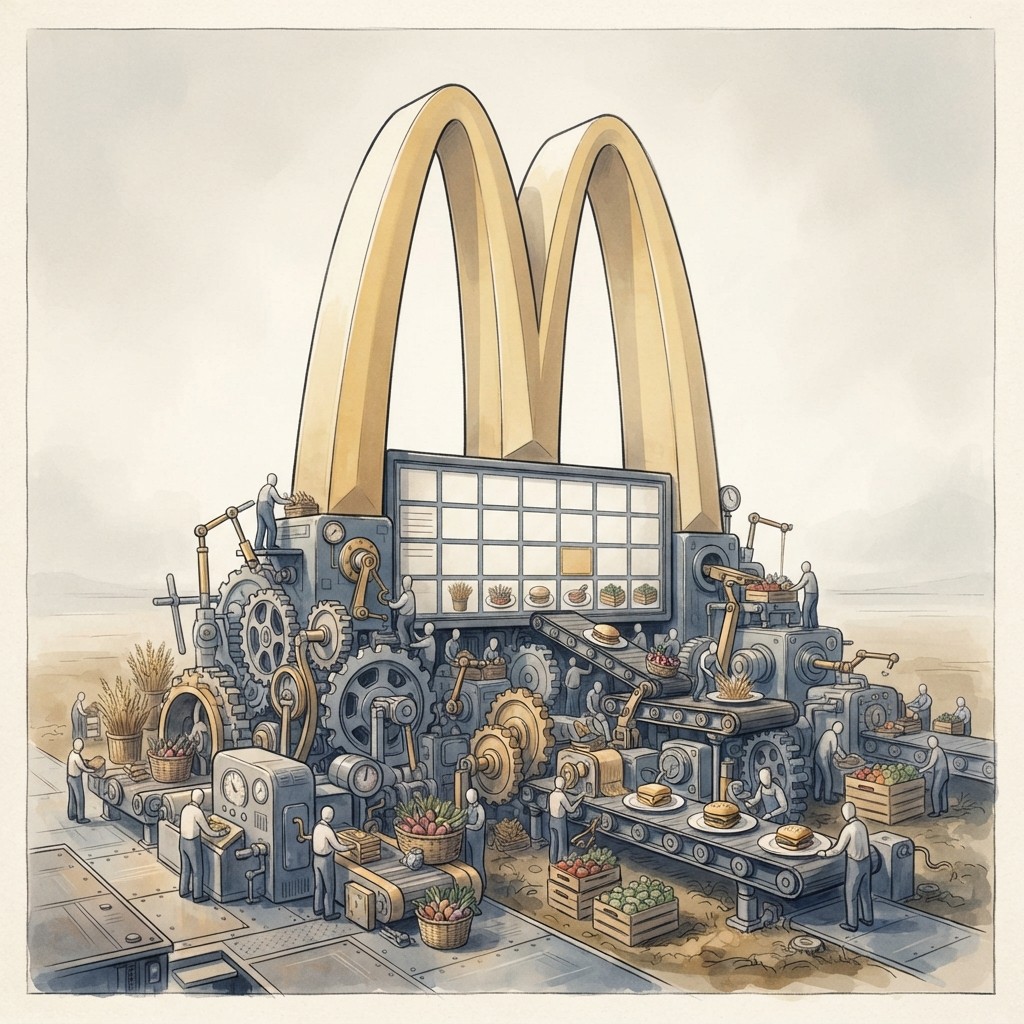
The lesson under McDonald's menu isn't 'understand other cultures.' Every global brand says that and most do it badly. The lesson is structural: if you want a thousand markets adapted correctly, don't try to adapt them from headquarters - put the capital and the downside in the hands of the operator who lives in each one, then make them ask permission rather than beg for budget. Local relevance stops being a corporate virtue you have to fund and becomes a survival reflex you can't switch off. The catch is that the same structure that produces the McAloo Tikki also produces the halal boycott: when you let local risk-bearers drive the menu, you also inherit the local fights you didn't pick. Decentralized empathy and decentralized liability are the same thing seen from two sides.
McDonald's didn't fall in love with the world's cuisines. It built a machine that makes loving them mandatory. The franchisee in Pune who would lose money on a beef burger he can't legally source becomes, in aggregate, the reason the menu fits the country - not because anyone in Chicago felt a pang of cultural feeling, but because the structure routes the risk to the person with the strongest reason to get it right. The genius was never the McAloo Tikki. It was deciding, market by market, to own the brand and let someone else own the loss - and discovering that a menu shaped by who pays for failure fits the local taste better than any focus group ever could.
Market-Entry Gambit Canvas
A one-page canvas for staging an entry into a market you don't own yet: the beachhead you take first, the wedge that gets you in cheaply, the sequence that turns a foothold into a position, and the incumbent's likely counter-move. Blank to plan your own entry; filled as the worked example showing how the story's challenger picked its landing spot and walked the rest in.
Included, filled and blank, in the The Market-Entry Gambit Casebook. See the set → · Preview the blank →
Sources
Where this comes from — the filings, records, and reporting behind it.
- 1McDonald's franchises and operates restaurants serving 'a locally relevant menu of quality food and beverages' in more than 100 countries; of 41,822 restaurants at year-end 2023, approximately 95% were franchised.
- 2McDonald's 2022 10-K states restaurants serve 'a locally relevant menu' across more than 100 countries, with ~95% franchised as of year-end 2022; franchised model is 'designed to generate stable and predictable revenue.'
- 3McDonald's Q2 2021 global same-store sales rose 40.5% vs. COVID-depressed Q2 2020; vs. Q2 2019 the increase was 6.9%. McDonald's credited the BTS Meal with driving 'significant lifts in Chicken McNuggets sales' alongside the Crispy Chicken Sandwich and pandemic reopenings.
- 4McDonald's Q2 2021 global same-store sales up 40.5%, U.S. same-store sales up 25.5%; CFO Kevin Ozan credited 'bold marketing initiatives,' digital offerings, chicken sandwich, and 'the success of our BTS meal' — not the BTS Meal alone.
- 5McDonald's India menu has no beef or pork; all outlets serve halal-certified meat. In 2019, McDonald's India confirmed on Twitter that 'All our restaurants have HALAL certificates,' triggering a #BoycottMcDonalds campaign from Hindu groups.
- 6The absence of beef at McDonald's India is also driven by legal constraints: the Indian Constitution directs states to enact cow-slaughter prohibition legislation, and several states have strict laws banning possession and consumption of beef.
- 7McDonald's India already excluded beef and pork from its menu before 2012; it also separated kitchens for vegetarian and non-vegetarian preparation. The McAloo Tikki and Maharaja Mac (chicken-patty Big Mac substitute) were established localized items.
- 8McDonald's India official blog confirms separate kitchens and utensils for vegetarian and non-vegetarian items, and states it has no vegan menu items (as of the post date).
More like this — beyond McDonald's
New Strategically analyses as they publish: the defining moves in business, checked against the record. No noise, and one click to leave.