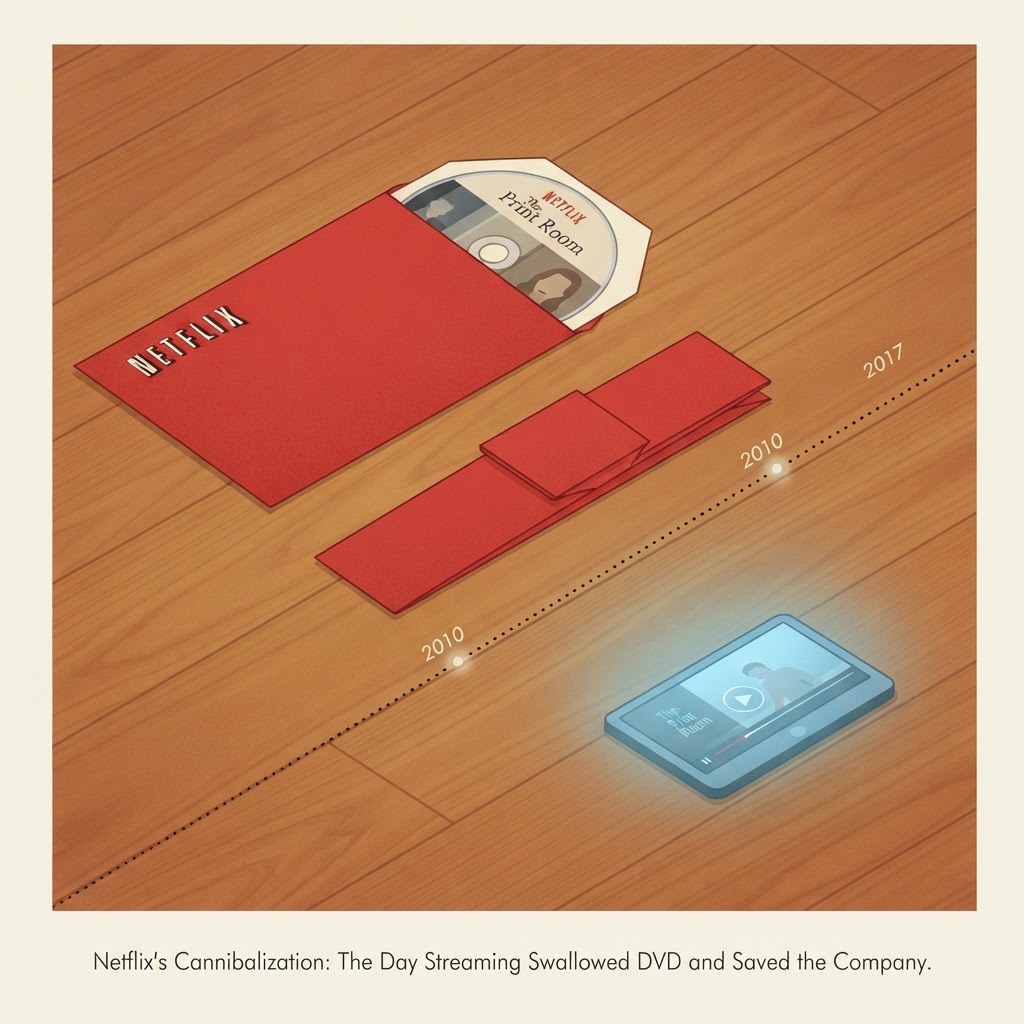
Everyone remembers Qwikster as one of the great unforced errors in business. Almost no one remembers that the strategy underneath it was exactly right — which is the more useful, and far more uncomfortable, story.
Pairs with the Cannibalization Decision Tree — a ready-to-use strategy tool, filled for Netflix. Included in the Cannibalization Choice Casebook →
In the summer of 2011, Netflix was the stock everyone wished they had bought. It had humiliated Blockbuster, signed up more than 24 million subscribers in the United States alone, and touched $304.79 a share.7 Then, over a few months, it shed about 800,000 U.S. subscribers6 and nearly 80% of its market value - the stock bottomed at $62.37 by late November7 - and turned itself into a business-school cautionary tale. Here is the part the cautionary tales skip: Netflix was not punished for a bad strategy. It was punished for the clumsy way it carried out exactly the right one.
The official story is that Netflix won by being online and rode streaming to glory. The real story is stranger. Netflix's profitable business was the red envelopes - DVDs by mail. Streaming, when it launched in January 2007 under the unglamorous name Watch Now,1 was the worse product: a thin catalog, video that stalled to buffer, and movies the studios were willing to license cheaply only because they did not yet take it seriously. By every near-term number, streaming was a downgrade. Netflix poured itself into it anyway, and set out to make its own cash cow obsolete. That decision was correct. The way it asked twenty million people to come along almost ended the company.
The business Netflix set out to destroy was its best one: DVD-by-mail was the high-margin cash cow, and streaming the low-margin future, so Netflix chose the future
DVD-by-mail was a quietly gorgeous business. The most expensive part of it - delivery - was handled by the United States Postal Service, and the discs were cheap to stock: under the first-sale doctrine, Netflix could buy a DVD once and rent it out forever, with no per-title licensing fee. Years later, when the company finally broke out the numbers, the gap was stark. In 2012 its domestic DVD operation ran at a 47.3% contribution margin against just 16.0% for domestic streaming - and Netflix said outright that the high-margin DVD business was there to fund the streaming expansion.2 Streaming inverted every advantage. There was no postal service to lean on, and the studios - once they woke up - charged escalating fees that made content Netflix's largest and fastest-growing cost. Streaming was the worse business on margin, on cost, and on catalog. It had exactly one thing going for it: it was the future, and the future was coming whether Netflix owned it or not. Hastings had named the trap himself - companies great at one thing, like AOL's dial-up or Borders' bookstores, rarely become great at the next thing, because they are afraid to hurt the business they already have.4 He had even said it from a conference stage in 2010, shrugging that streaming merely replaced the delivery mechanism and that Netflix knew this was coming.9
So Netflix did the same thing Apple did when it built an iPhone with an iPod inside: it aimed a new product straight at the heart of its old one.
| DVD-by-mail | Streaming | |
|---|---|---|
| Who handles delivery | The U.S. Postal Service | Netflix's own infrastructure |
| Content cost | Buy the disc once, rent it forever | Escalating per-title licensing |
| 2012 contribution margin | 47.3% | 16.0% |
| Catalog in 2011 | Almost everything, on disc | A fraction - shrinking when deals lapsed |
| The one thing it had | The profitable present | The entire future |
“Companies rarely die from moving too fast, and they frequently die from moving too slowly.”4
Where Apple folded the old product in, Netflix tried to cut it out: the same move as the iPhone eating the iPod, executed with a blade the customer could feel
Here is where Netflix's version split from Apple's - and where it went wrong. Apple folded the iPod into the iPhone: one device, one purchase, the old thing dissolving painlessly into the new. Netflix tried to physically sever its two businesses, and made customers feel the blade. In July 2011 it broke its single $9.99 plan - streaming plus one DVD - into two separate $7.99 plans; anyone who wanted both now paid $15.98, a roughly 60% increase overnight.3 Then, instead of reading the revolt and stopping, it doubled down. In September it announced it would spin DVD-by-mail off into a separately branded company called Qwikster, with its own site, its own login, its own queue and ratings.4 On a strategy whiteboard it was defensible: let the declining business die gracefully on its own track while streaming runs free. To a customer it read as a company deliberately making its product worse and charging more for the privilege. The strategy memo and the customer experience had become two different documents, and Netflix shipped the wrong one. Its own later post-mortem put the deeper failure inside the building: nobody close to Hastings had pushed back hard enough to stop him.10
“I messed up. I owe everyone an explanation.”4
Was it discipline, or just luck?: the bet was right and the timing was lucky, and telling the two apart is the whole lesson
Two honest objections. The first: doesn't the Qwikster fiasco prove Netflix was not disciplined at all - that it cannibalized itself out of panic rather than design? No. The un-bundling and the spin-off were both deliberate attempts to push customers toward streaming faster; the nerve was real, the choreography was a disaster. Those are different failures, and only the second one nearly proved fatal. The second objection cuts deeper: did Netflix simply get lucky? Partly. Had the streaming bet been wrong, 2011 would have been the first chapter of the end rather than a near-miss. But the bet was not a coin flip. It rested on a correct reading of where video was going - the same conviction that let Hastings hold his nerve through the worst quarter of his career instead of crawling back to protect the DVD. Luck rewarded a company that had already made the structurally right call, and would have buried one that had not.
If you are about to cannibalize your own profitable product, war-game the customer's experience on a separate sheet from the business logic - because Netflix got every strategic answer right and shipped a customer experience nobody had stress-tested. Three questions before you launch: What new friction are you adding (logins, bills, steps)? What are you asking people to pay today? And what do they lose on day one versus gain by year three? If the day-one answer is 'more money for a worse experience,' you have a sequencing problem, not a strategy problem - stage it, grandfather it, or price the transition so the people you are trying to keep aren't the ones you punish. Move fast on the bet; move slowly, and with proof, on the people.
Netflix ended up proving both halves of the cannibalization lesson in a single year: the famous half Apple made look effortless, and the brutal half Apple's clean execution let everyone forget. The DVD business it set out to kill finally shipped its last red envelope - fittingly, a copy of True Grit - in September 2023,8 sixteen years after streaming launched. Netflix outlived its own cash cow by a decade and a half, exactly as planned. It just spent one ugly autumn in 2011 learning that being right is only half the job, and that the customers you are trying to save will make you bleed if you forget to bring them with you.
Cannibalization Decision Tree
A decision tree for the moment the new thing threatens the cash cow: is the disruption real, will someone else do it if you don't, and can you afford to bleed your own margin to own the future? Blank to run on your own line; filled as the worked example tracing how the story's incumbent chose to cannibalize — or flinched and got cannibalized.
Included, filled and blank, in the Cannibalization Choice Casebook. See the set → · Preview the blank →
Sources
Where this comes from — the filings, records, and reporting behind it.
- 1Netflix launched its streaming service in January 2007, originally branded 'Watch Now,' as a no-extra-cost add-on to its DVD plans.
- 2For 2012, Netflix's domestic DVD segment had a 47.3% contribution margin versus 16.0% for domestic streaming, and Netflix stated the high-margin DVD business helped fund its streaming and international expansion.
- 3On July 12, 2011, Netflix split its single $9.99 streaming-plus-one-DVD plan into two separate $7.99 plans, so customers who wanted both paid $15.98 - roughly a 60% increase.
- 4In 'An Explanation and Some Reflections' (Netflix blog, Sept 18, 2011), Reed Hastings apologized ('I messed up. I owe everyone an explanation.'), announced the Qwikster DVD spin-off, and wrote that 'companies rarely die from moving too fast, and they frequently die from moving too slowly.' The original post was later removed; its text was reproduced contemporaneously by TechCrunch.
- 5On October 10, 2011 - 23 days after announcing it - Netflix cancelled the Qwikster spin-off, keeping DVDs on netflix.com ('one website, one account, one password'). The July price increase was not reversed.
- 6In Q3 2011 Netflix lost about 800,000 U.S. subscribers (from ~24.6M to ~23.8M) - its first-ever domestic quarterly decline - per its October 24, 2011 letter to shareholders.
- 7Netflix's as-traded share price peaked at an intraday $304.79 in July 2011 and bottomed near $62.37 in late November 2011 - a decline of about 80%. (These are 2011 prices, before Netflix's later 7-for-1 and 10-for-1 stock splits.)
- 8Netflix shipped its final DVD-by-mail discs on September 29, 2023; the last disc sent was the Coen brothers' 'True Grit' (2010).
- 9At TechCrunch Disrupt in October 2010, asked whether streaming would cannibalize DVD-by-mail, Reed Hastings said Netflix was 'just replacing the delivery mechanism and keeping the business intact,' adding that 'we knew this was coming.'
- 10In 'No Rules Rules,' Reed Hastings and Erin Meyer recount the Qwikster episode as a failure of internal candor - colleagues who doubted the plan did not push back hard enough to stop it.Reed Hastings & Erin Meyer, 'No Rules Rules' (Penguin Press, 2020), No Rules Rules: Netflix and the Culture of Reinvention · ISBN 9781984877864 · 2020
- 11Netflix crossed about 20 million total subscribers at the end of 2010, when nearly all of them still rented DVDs; the separately-reported DVD-by-mail metric later peaked near 13.9 million in Q3 2011.
More like this — beyond Netflix
New Strategically analyses as they publish: the defining moves in business, checked against the record. No noise, and one click to leave.