Pairs with the Adjacency / Synergy Map — a ready-to-use strategy tool. Included in the The Adjacency Expansion Casebook →
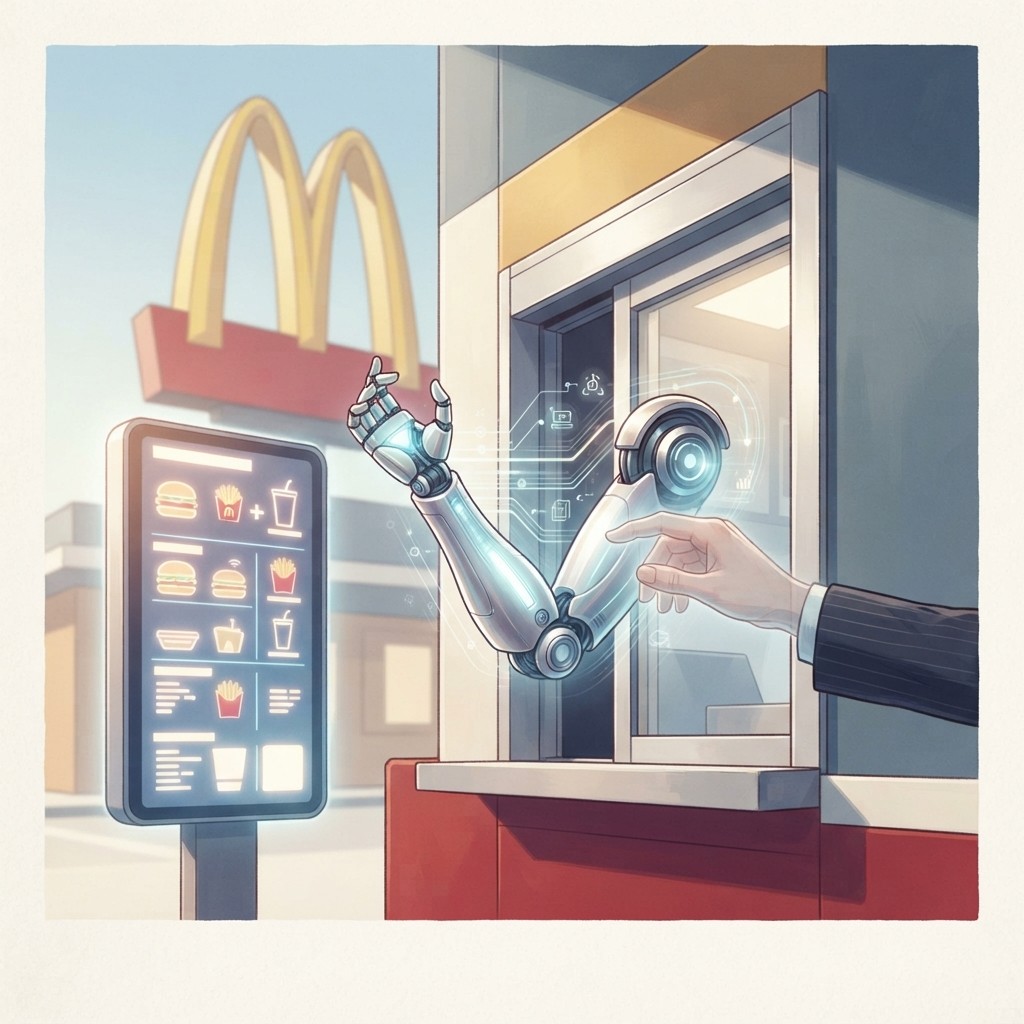
Pull up to a McDonald's drive-thru on a hot afternoon and the menu board reads your situation. It pushes a McFlurry when it's warm, leans on coffee when it's cold, and quietly nudges whatever's already selling at that hour to the top of the screen. The brain behind that board was a personalization engine called Dynamic Yield, which McDonald's bought in 2019 and called 'a leader in personalization and decision logic technology.'1 Three years later, the brain belonged to a credit-card company. And McDonald's walked away with a profit.
The official story is that McDonald's made a bold bet on owning artificial intelligence, then quietly retreated when the bet didn't pay off. That reading misses the whole point. McDonald's didn't lose its nerve on AI. It discovered it never needed to own the AI in the first place.
An acquisition that behaved like a lease
Look at the timeline and a different shape emerges. McDonald's announced the Dynamic Yield acquisition in March 2019 — reportedly for more than $300 million, though the company itself never disclosed a figure.2 It deployed the technology across the drive-thru, learned exactly what personalization could and couldn't do at scale, and then, in December 2021, announced it was selling the business to Mastercard.3 The deal closed on April 1, 2022, and McDonald's booked a $271 million pre-tax gain on the sale.4 Roughly thirty-six months from buy to sell, at a profit. That is not the arc of a failed bet. It is the arc of a company that rented a capability, used it to learn something, and handed it back when it was done — whether that arc was deliberate from day one or crystallized through the process.
The asset was never the algorithm
Here is the part the headlines skipped. A personalization engine is only as valuable as the demand flowing through it, and McDonald's controls the demand. The same years it owned Dynamic Yield, it was busy building the things that actually generate that demand: self-order kiosks that turn a counter line into a screen that never forgets to upsell, and a delivery platform launched in 2017 with Uber Eats that grew from 3,000 restaurants to more than 32,000 across 100 countries by late 2021.5 Delivery, mobile order-and-pay, and Experience of the Future remodels were all named as growth platforms in McDonald's own 2017 annual filing.6 Those are the assets. Each kiosk tap and each delivery order is a stream of structured data about who orders what, when, and where — and that data sits with McDonald's no matter who owns the model that reads it. Owning the algorithm was the easy thing to buy. Owning the firehose of franchisee ordering data was the thing that couldn't be bought at all.
| The AI engine (Dynamic Yield) | The real asset | |
|---|---|---|
| Where it lived | A startup McDonald's bought, then sold | Kiosks, the app, and delivery flowing into McDonald's |
| Could a rival buy it? | Yes — Mastercard did | No — it's tied to McDonald's order volume |
| What it generated | Menu suggestions | Structured data on who orders what, when, where |
| After the 2022 sale | Gone, at a $271M gain | Still entirely McDonald's |
Why renting the AI beat owning it
Owning a software business is a different job than running more than 40,000 restaurants.9 To keep Dynamic Yield competitive, McDonald's would have had to fund engineering roadmaps, defend it against better-resourced AI firms, and justify the cost against franchisees who weren't all convinced it earned its keep — some grumbled the drive-thru sales lift never showed up the way they were promised.7 Mastercard, by contrast, runs personalization as a service for many clients; it can spread the R&D across a customer base McDonald's could never match. So the logical end state was always for McDonald's to be a buyer of the capability, not its owner. The acquisition let McDonald's set the spec, prove the use case on its own terms, and then convert a maturing software asset into cash — while continuing to consume the same personalization as an outsourced service. It built the thing only long enough to know exactly what to buy.
“Mastercard to add to services momentum with acquisition of Dynamic Yield, McDonald's cutting-edge personalization platform.”3
Wasn't this just an expensive admission of defeat?
The honest objection is that this is too flattering — that calling a quick sell-off a 'strategy' is just dressing up a retreat. And there's real weight to it: franchisees did complain the technology never delivered the drive-thru boost they expected, and that grievance is the kind of thing that pushes a board to dump an awkward asset.7 A company that planned a clean rent-and-return arc from day one would be a rare one. But notice what the retreat reading can't explain: the $271 million pre-tax gain.4 A panicked exit rarely ends in a booked gain — and this one did. McDonald's set the spec for what cutting-edge personalization should do, ran it at the largest restaurant scale on earth, and then sold it to a buyer who valued it more — all while keeping the data and the ordering volume that made it worth running. Whether the plan was that crisp at the start or only crystallized along the way, the outcome was the same: McDonald's ended up with the demand, the cash, and the capability-as-a-service, and gave away only the part anyone can buy.
When a hot technology lands in your adjacency, the instinct is to acquire it and own it forever. Often the smarter move is to acquire it long enough to learn what 'good' looks like — then let a specialist own the engine while you keep the thing that can't be bought: the demand, the data, the distribution it runs on. Ask which asset is genuinely yours and which is just a tool any rival could license. If it's a tool, you want it as a service, not a subsidiary. McDonald's owned the firehose of ordering data and the screens it flowed through; the model that read it was always rentable. Buying it briefly cost nothing — it ended in a gain — and bought certainty about exactly what to outsource.
McDonald's tech push looks, from a distance, like a company that fell for AI and then got cold feet. Up close it's the opposite: a company that figured out which part of the future it actually needed to own. The kiosks, the app, the 32,000 delivery restaurants — those it kept, because those are where the orders and the data live.5 The clever menu board it sold, at a profit, the moment it understood that a borrowed brain works just as well as an owned one when you control the body. The genius wasn't buying the AI. It was knowing it was only worth renting.
When owning the technology turns out to be the wrong move
Adjacency / Synergy Map
A one-page canvas for an adjacency play: the new business next door, the shared assets that justify entering it, the synergies that actually transfer versus the ones that evaporate on contact, and the dis-synergies nobody put on the deck. Blank to test your own expansion; filled as the worked example showing where the story's 'natural adjacency' was real and where it was wishful.
Included, filled and blank, in the The Adjacency Expansion Casebook. See the set → · Preview the blank →
Sources
Where this comes from — the filings, records, and reporting behind it.
- 1McDonald's and Dynamic Yield announced an acquisition agreement on March 25, 2019; McDonald's described it as acquiring 'a leader in personalization and decision logic technology' to vary digital drive-thru menu displays based on time of day, weather, and traffic.
- 2The acquisition price was reported by The Wall Street Journal as 'more than $300 million'; McDonald's own press release did not disclose a price figure.
- 3McDonald's and Mastercard announced on December 21, 2021 that Mastercard would acquire Dynamic Yield; terms were not disclosed and the deal was set to close in the first half of 2022.
- 4McDonald's Q2 2022 earnings release confirmed a pre-tax gain of $271 million related to the Company's sale of its Dynamic Yield business; the 10-Q (mcd-20220630) confirms the sale closed April 1, 2022.
- 5McDonald's McDelivery launched in 2017 through an initial partnership with Uber Eats, starting from 3,000 restaurants; by November 2021 it had grown to more than 32,000 restaurants across 100 countries.
- 6McDonald's 2017 Annual Report (10-K filed with SEC) confirms delivery as a stated 2017 growth platform alongside mobile order and pay and Experience of the Future, corroborating the delivery launch year.
- 7Franchisees complained that Dynamic Yield had not delivered the sales boosts they expected at the drive-thru; the sale to Mastercard reflected McDonald's pivot toward outsourcing its technology rather than owning it.
- 8McDonald's Experience of the Future remodels have been cited in trade press as a combined ~$6 billion investment including kiosks; per-restaurant investment was reported by Reuters (May 2017) at $60,000–$300,000 depending on scope. No single primary SEC disclosure confirms a '$6 billion' EOTF line-item commitment.
- 9McDonald's operated 40,031 systemwide restaurants as of December 31, 2021, per the company's Form 10-K filed with the SEC.
More like this — beyond McDonald's
New Strategically analyses as they publish: the defining moves in business, checked against the record. No noise, and one click to leave.