Pairs with the Asset-Light vs Asset-Heavy Comparator — a ready-to-use strategy tool. Included in the The Hidden Business Casebook →
A franchisee signs the McDonald's deal believing he has bought into a hamburger. He has bought into a lease. The corporation that hands him the golden arches generally already owns - or holds a long-term lease on - the land beneath his feet and the building over his head, and he will pay it back two ways at once: a royalty on every sale, and rent for the privilege of standing where he stands.1 The cooking, the fries, the drive-thru queue at lunch - all of that is his job. The corporation's job is to be his landlord. And in 2024, being the landlord paid almost twice as well as being the brand.
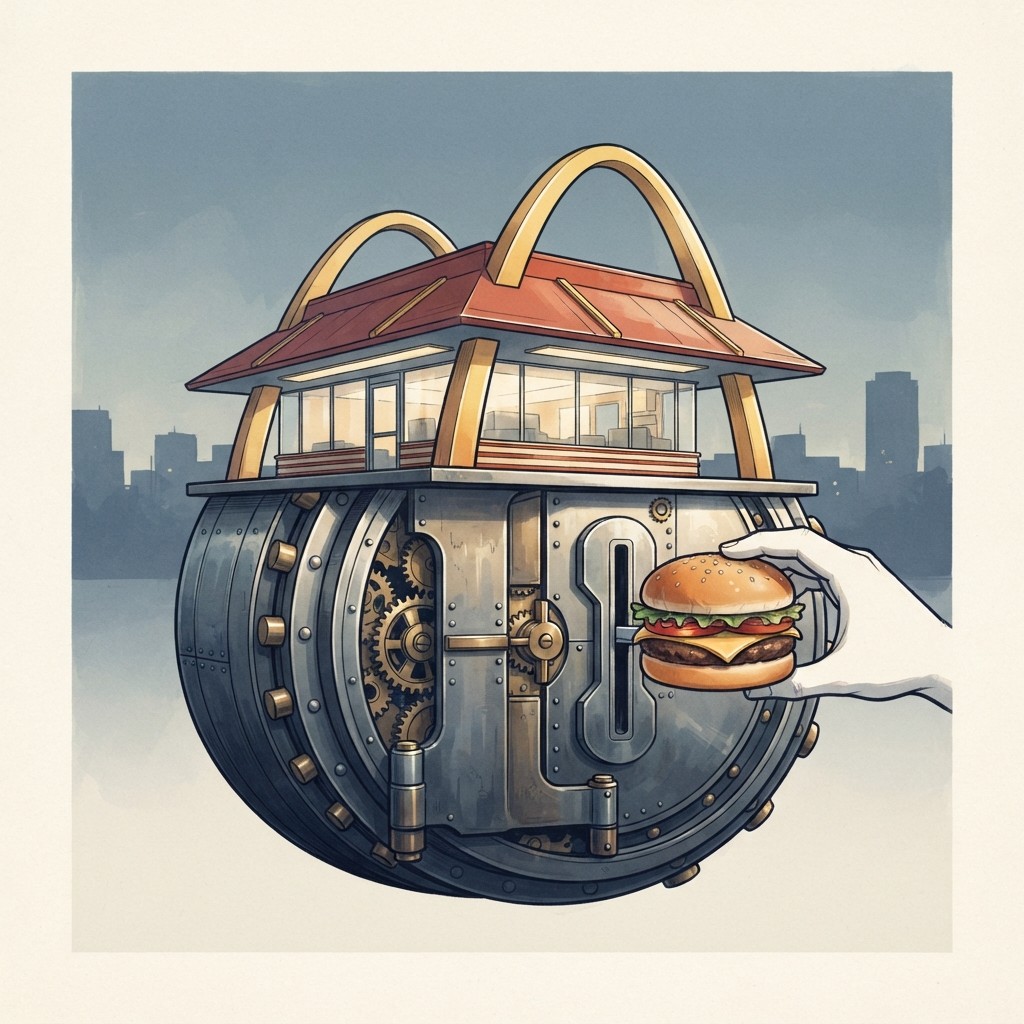
The official story is that McDonald's is the world's most successful fast-food company. That's true, and it's also a costume. Underneath it is a company that figured out, very early, that the surest money in food isn't made by selling food. It's made by selling the right to sell food on land you own.
“We are not technically in the food business. We are in the real estate business. The only reason we sell fifteen-cent hamburgers is because they are the greatest producer of revenue, from which our tenants can pay us our rent.”7
The man who turned a burger chain into a landlord
Notice who said it. Not a real-estate analyst writing decades later, but the man who built the machine - Harry Sonneborn, a former finance executive from Tastee-Freez who walked into early McDonald's and saw something Ray Kroc hadn't yet priced. Kroc was trying to make money on franchise fees and a thin cut of supply, and it wasn't enough to grow on. Sonneborn's move was to put a real-estate company in the middle: McDonald's Franchise Realty Corporation would acquire the site, then sub-lease it to the operator at a markup, with rent tied to a percentage of the store's sales.6 He is remembered, wrongly, as the company's CFO. He was its first president and CEO, and the title matters - this wasn't an accounting trick bolted onto a food business. It was the business, designed from the chair at the top.
Read the Sonneborn quote slowly and you find the whole strategy inverted from how everyone tells it. The hamburger isn't the point; it's the collateral. A landlord's worst fear is a tenant who can't pay. Sonneborn's answer was to hand every tenant a product so reliable - so engineered to produce revenue - that the rent was effectively guaranteed by the business model itself. The burger is the thing that keeps the tenant solvent enough to keep paying the landlord. McDonald's doesn't sell food to make money. It sells food so that the people who owe it rent can afford the rent.
Why the rent line is bigger than the royalty line
You can see the whole thesis sitting in the revenue, split into its two streams. A pure franchisor - the way most people imagine McDonald's - would make its money on royalties: a slice of the brand, licensed out. McDonald's does collect that. But it collects far more in rent, because for the bulk of its system it isn't merely the licensor; it's the landlord too. Rent grew from $6.845 billion in 2020 to $10.017 billion in 2024. Royalties, over the same stretch, grew from $3.832 billion to $5.606 billion.3 The landlord line isn't a rounding detail next to the brand line. It's nearly double it.
| Royalty (the brand) | Rent (the land) | |
|---|---|---|
| What it's a fee for | The right to use the brand and system | Occupying property McDonald's owns or leases |
| 2020 revenue | $3.832B | $6.845B |
| 2024 revenue | $5.606B | $10.017B |
| Tied to | Percent of sales | Percent of sales, with a minimum rent floor |
| Who has the leverage | Brand can be re-licensed | Tenant can't move the restaurant |
And there's a second teeth in the rent that the royalty doesn't have. Conventional franchisees don't just pay a percentage of sales - they pay rent with a specified minimum floor.2 A royalty falls when a bad month hits. The rent has a basement it cannot fall through. That is the structural signature of a landlord, not a brand licensor: McDonald's gets the upside of a percentage and the downside protection of a fixed minimum, on a tenant who physically cannot relocate the asset. This is why the company can describe its heavily franchised model as built to generate 'stable and predictable revenue' - the predictability is engineered into the lease.4
The asset hiding inside a restaurant stock
Spread this across roughly 45,000 stores and you stop looking at a restaurant company and start looking at a property portfolio with a deep-frying tenant in each unit. Estimates derived from the balance sheet put McDonald's at owning about 80% of its buildings and roughly 56% of the land underneath them, even as independent operators run some 95% of locations.8 Those figures deserve a caveat: McDonald's 10-K doesn't publish a single consolidated ownership-percentage table, so the numbers are reverse-engineered from property disclosures by outside analysts, and they wobble a few points outlet to outlet.8 But the direction is unambiguous and the company doesn't hide it. The corporation owns the dirt. The franchisee owns the apron. That is why this 'restaurant stock' carries a balance sheet that looks like a landlord's and a revenue stream with a rent floor under it - asset value atypical for the sector it's filed under.
So is McDonald's really a real-estate company, or is that just a clever line?
Here's the honest objection, and it's a good one: the slogan is half costume too. Two parts of the legend don't survive a careful read. First, the claim that McDonald's is 'the world's largest real-estate company' or a top-five landlord is a rhetorical flourish with no cited methodology behind it - skip it. Second, and more important, the real-estate thesis is a U.S.-conventional-franchise truth wearing a global disguise. Roughly a quarter of McDonald's restaurants worldwide run under developmental-license or affiliate deals, and in those, the licensee provides the real-estate interest themselves; McDonald's holds no property and collects only a royalty on sales.5 For that whole slice of the system, the landlord story simply isn't operating. The company spells out the distinction in every 10-K precisely because the two models are different businesses.
There's a delicious irony buried here, too. McDonald's is routinely called 'asset-light' - and for its conventional franchise model that label is close to backwards. Owning land and buildings under tens of thousands of restaurants is asset-heavy by definition.5 The genuinely asset-light operators in the system are the developmental licensees, the very ones the real-estate thesis doesn't describe. So the slogan is true where it matters most - the conventional franchises, where rent dwarfs royalties - and mythologized where it's been stretched into a global, top-of-the-rankings boast. The right read isn't 'McDonald's is secretly a real-estate company.' It's sharper than that: McDonald's runs a rent-extracting landlord business for most of its system and uses the most reliable product in food as the mechanism that guarantees the rent gets paid.
The most durable seat in a franchise-style system isn't the brand fee that rises and falls with sales - it's the structural claim that has a floor underneath it. McDonald's gets the upside of a percentage of sales AND the downside protection of a minimum rent, on a tenant who physically cannot move the asset. When you're evaluating any 'platform' or 'licensor,' ask the Sonneborn question: where does this business actually get paid, and does that line have a basement it can't fall through? But hold the slogan honestly - the same company can be a landlord in one model and a pure licensor in another, and 'they're really a real-estate company' is only true for the part of the system where it owns the dirt.
Sonneborn said the quiet part in 1959, and six decades later the income statement still agrees with him: rent above royalties, a minimum floor under the rent, the land owned and the apron rented. The hamburger was never the asset. It was the device - the most dependable revenue producer ever engineered, built for one purpose above all the others, which was to make absolutely sure the tenant could pay the rent. McDonald's didn't get rich selling fifteen-cent hamburgers. It got rich making sure fifteen-cent hamburgers could pay its rent.
Companies that earn where you'd never look
Asset-Light vs Asset-Heavy Comparator
A side-by-side matrix that pits owning the assets against renting or orchestrating them, dimension by dimension. Blank to weigh your own model choice; filled as the worked example showing why the story's company went capital-light — or planted its money in concrete and steel.
Included, filled and blank, in the The Hidden Business Casebook. See the set → · Preview the blank →
Sources
Where this comes from — the filings, records, and reporting behind it.
- 1Under a conventional franchise arrangement, McDonald's generally owns or secures a long-term lease on the land and building for the restaurant location; conventional franchisees pay rent and royalties based on a percent of sales with specified minimum rent payments.
- 2McDonald's Corporation Form 10-K for fiscal year ended December 31, 2023 (filed February 2024) confirms: revenues from conventional franchised restaurants include rent and royalties based on a percent of sales with minimum rent payments, and initial fees; franchised restaurants represented approximately 95% of McDonald's restaurants worldwide at December 31, 2023.
- 3McDonald's rent revenue grew from $6.845B in 2020 to $10.017B in 2024; royalties grew from $3.832B in 2020 to $5.606B in 2024, derived from McDonald's SEC filings.
- 4McDonald's 2025 full-year 10-K (FY2025, filed 2026): total revenue $26.9B; systemwide sales $139.4B; 2,276 new restaurant openings; the company's heavily franchised model is designed to generate stable and predictable revenue.
- 5Under developmental license or affiliate arrangements (~25% of restaurants worldwide), licensees are responsible for providing the real estate interest themselves; McDonald's collects only a royalty based on percent of sales, not rent. This materially qualifies the 'McDonald's is a real estate company' thesis.
- 6Harry J. Sonneborn (June 12, 1916 – September 21, 1992) was McDonald's first president and CEO (appointed 1959, resigned 1967). A former VP of finances at Tastee-Freez, he approached Kroc with the concept of owning the land and leasing to franchisees, executing it via 'McDonald's Franchise Realty Corp.' The famous quote — 'We are not technically in the food business. We are in the real estate business…' — is attributed to him; the canonical source is John F. Love, McDonald's: Behind the Arches (Bantam Books, 1995). The 2016 film The Founder popularized a paraphrased version.
- 7The primary book-length source for the Sonneborn real estate model and quote attribution is: Love, John F. McDonald's: Behind the Arches. New York: Bantam Books, 1995. ISBN 0-553-34759-4. This is the earliest cited secondary source for the Sonneborn quote and the Franchise Realty Corp history.Bantam Books, McDonald's: Behind the Arches · 1995
- 8As of February 2026, McDonald's owns 80% of the buildings and 56% of the land across its ~45,000 stores, while independent operators run 95% of locations; rent and royalties are collected as a percentage of franchisee sales, and this structure provides shareholders asset value atypical for restaurant stocks.
More like this — beyond McDonald's
New Strategically analyses as they publish: the defining moves in business, checked against the record. No noise, and one click to leave.