Pairs with the Profit-Engine Map — a ready-to-use strategy tool, filled for Robinhood. Included in the The Loss Leader Casebook →
You tap 'buy,' and a stock appears in your account in a second, and you pay nothing. No commission, no fee, no line item. It feels like a gift, and gifts make people suspicious, so the standard explanation arrived quickly: Robinhood sells your order to a high-speed trading firm, and that's how 'free' gets paid for. That's true, but it's the smaller half of the truth — and treating it as the whole truth has hidden the more durable engine entirely. The order you placed is only the first thing Robinhood monetizes. The bigger one is everything you left sitting in the account afterward.
The official story is that Robinhood is a brokerage that gives away trades and makes it back on payment for order flow. The real story is that Robinhood is a machine for assembling a base of retail assets — cash, stock, margin balances — by giving away the one thing customers can see the price of, and charging for the parts they can't.
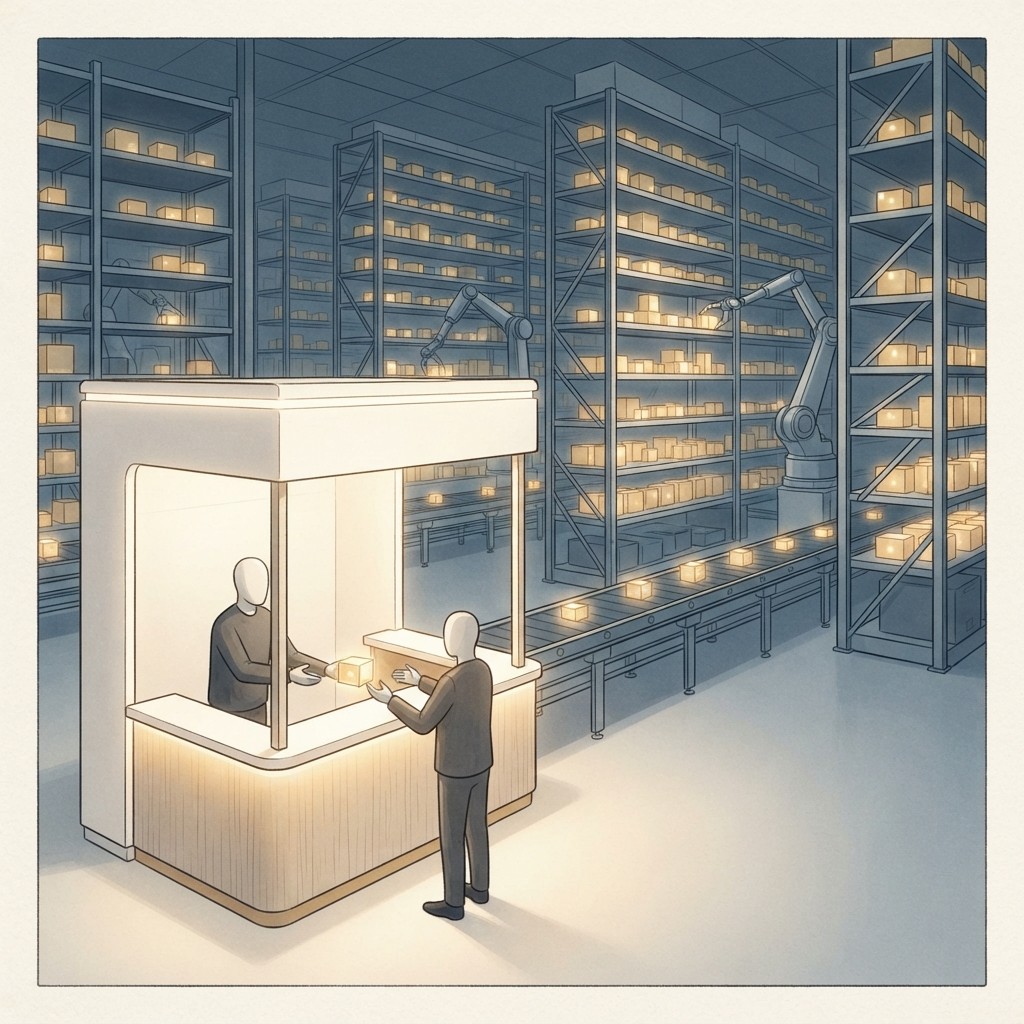
You aren't the customer. You're the inventory.
When you place a market order, Robinhood doesn't take it to an exchange itself. It routes it to a market maker — Citadel Securities, Virtu, Jane Street, and a handful of others receive substantially all of its non-directed order flow — and those firms pay Robinhood for the privilege of filling it.7 That payment is the famous PFOF. It is real money: in 2020, Robinhood was the second-largest recipient of order-flow payments among the major retail brokers, taking in over $680 million.6 But here's what the PFOF-only story misses. A retail order is worth paying for because retail flow is, on average, less informed and easier to fill profitably than institutional flow. You are not the buyer of a service. You are the product being routed — and 'free' is the price of admission that keeps the flow coming.
“We expect SEC final rules to lead to a decrease in PFOF earned from equities orders.”2
The engine nobody talks about earns more than the one everybody does
If PFOF were the whole model, the SEC's threat to phase it down from equities orders would be existential. It isn't — and the reason is sitting in plain sight in the financials. In fiscal 2024, Robinhood's net interest revenue was roughly $1.1 billion, larger than its transaction-based line.1 Net interest is what you earn on the asset base the free trades attract: interest on margin loans extended to customers, fees from lending out customers' securities, and the spread on uninvested cash swept into interest-bearing accounts. None of it requires a single new commission. The free trade is the loss leader; the dollars and shares it parks on the platform are the real product, and Robinhood rents them out continuously. Total net revenues hit $2.95 billion in 2024, up 58% — and the growth came not from squeezing more out of each trade but from owning more of the assets behind it.1
| Payment for order flow | Net interest income | |
|---|---|---|
| What it monetizes | Your individual orders | The cash and stock you leave behind |
| Who pays | Market makers (Citadel, Virtu, Jane Street) | Borrowers, securities-lending desks, the spread on cash |
| Regulatory exposure | SEC rules expected to reduce it on equities | Far less exposed |
| FY2024 scale | Part of transaction-based revenue | ≈ $1.1 billion, the larger line |
Robinhood didn't invent free trading — Interactive Brokers and others got there first, and brokers had quietly taken order-flow payments for decades. What Robinhood did was make 'free' the default for mobile retail, and the proof of how disruptive that was came in October 2019, when Schwab, TD Ameritrade, E-Trade, and Interactive Brokers all cut to zero commissions within days of each other, roughly four years after Robinhood's 2015 launch.58 The incumbents could afford the cut precisely because they, too, monetized the asset base behind the trade. Robinhood just forced everyone to admit, out loud, that the commission was never where the money was.
The original sin wasn't the model. It was hiding the model.
Here is where the cross-subsidy turns into a cautionary tale. In December 2020 the SEC charged Robinhood with misleading customers about PFOF being its primary revenue source, and with failing its best-execution duty between 2015 and 2018. The settlement was $65 million.3 Read the substance carefully, because it is widely misread. The SEC did not rule that payment for order flow is illegal. It ruled that Robinhood hid it — and that in chasing higher order-flow payments, customers got worse prices, to the tune of $34.1 million in aggregate even after counting the savings from zero commissions.3 That's the tell. A loss leader is only honest if the customer comes out ahead overall. For a stretch, by the SEC's accounting, they didn't. The following year FINRA piled on with a $57 million fine plus about $12.6 million in restitution for supervisory failures and outages — at the time, its largest-ever penalty.4
Isn't this whole thing one regulatory pen-stroke from collapse?
The fair objection: if the SEC is moving to shrink PFOF from equities orders — and Robinhood says in its own 10-K that it expects exactly that — then the free-trading model is built on a pillar regulators are actively sawing.2 True, and Robinhood doesn't pretend otherwise; it lists PFOF reliance as a top risk in its filings. But the objection assumes the pillar is load-bearing, and the 2024 numbers say it no longer is. Net interest revenue already exceeds the transaction line, and that engine barely touches PFOF.1 More tellingly, when Robinhood expanded crypto, it didn't extend its equities PFOF arrangement to it — it introduced a separate fee-based model, ring-fencing crypto revenue from the specific SEC proposals aimed at equities order flow.2 That's not a company chained to one revenue source. That's a company that watched its original sin nearly cost it everything and has spent the years since building exits the regulator can't close.
The most durable loss leaders give away the one thing the customer can price-check — the commission, the trade, the headline number — and monetize the thing the customer never thinks to value: the balance left sitting on the platform, the data, the float. Banks do it with free checking and net interest margin; Robinhood does it with free trades and the asset base behind them. Two cautions, both written in Robinhood's own penalties. First, the cross-subsidy is only honest if the customer truly comes out ahead — the moment your hidden monetization degrades the free product (worse fills, worse prices), it stops being a loss leader and becomes a bait-and-switch a regulator can quantify. Second, never build the architecture on a single revenue pillar a regulator can remove; diversify the monetization before you're forced to, not after.
Robinhood's genius was never the zero on the commission line. Anyone can charge zero; the trick is making zero pay. It saw that the visible price — the fee a customer notices and resents — was the worst place to make money, and the invisible asset base — the cash and stock a customer forgets they're holding — was the best. The free trade was never the product. It was the bait that brings the inventory in the door, and the inventory is what gets sold, quietly, again and again, every day the account stays open.
Companies that make money where you'd never look
Profit-Engine Map
A one-page map that pulls a business apart into the hook that gets the customer in the door and the engine that quietly earns the margin. Use it to see where the real profit lives, how the two halves are wired together, and what breaks if the link is cut. Blank to dissect your own P&L; filled as the worked example of a business whose advertised product is not where it makes its money.
Included, filled and blank, in the The Loss Leader Casebook. See the set → · Preview the blank →
Sources
Where this comes from — the filings, records, and reporting behind it.
- 1Robinhood FY2024 total net revenues were $2.951 billion, a 58% increase year-over-year; Q4 2024 transaction-based revenues increased over 200% YoY to $672 million, driven by crypto ($358M), options ($222M), and equities ($61M); full-year net interest revenues were approximately $1.1 billion.
- 2Robinhood's Form 10-K for FY2024 discloses ongoing reliance on payment for order flow (PFOF) as a key risk and notes that SEC final rules are expected to lead to a decrease in PFOF earned from equities orders; the company also introduced a new fee-based model for cryptocurrency, separating it from traditional PFOF.
- 3The SEC charged Robinhood Financial with misleading customers about PFOF as its primary revenue source and with failing its best-execution duty between 2015 and 2018; Robinhood agreed to pay a $65 million civil penalty; the SEC found customers received inferior prices that deprived them of $34.1 million in aggregate even after accounting for zero commissions.
- 4FINRA settled with Robinhood Financial LLC on June 30, 2021 for systemic supervisory failures, false and misleading customer communications, options approval failures, and systems outages; the penalty comprised a $57 million fine plus approximately $12.6 million in restitution — the largest financial penalty ever ordered by FINRA at that time.
- 5Robinhood Markets was incorporated on April 18, 2013, by Vladimir Tenev and Baiju Bhatt; the public trading app launched in 2015, not 2013. Options trading was added in 2017 and cryptocurrency trading in 2018.
- 6In 2020, approximately 75% of Robinhood's $958.8 million in revenue came from PFOF; in Q1 2021 (per its S-1 filing), Robinhood received over $331 million in PFOF — approximately 81% of its revenue that quarter. In 2020, total PFOF paid to the seven leading retail brokerages was $2.6 billion; Robinhood was the second-largest recipient with over $680 million.
- 7Robinhood's SEC order routing public reports (Rule 606 filings) show that primary PFOF counterparties — Citadel Securities, Virtu Americas, G1 Execution Services, and Jane Street Capital — received substantially all non-directed order flow; revenue from third-party market centers is shared between Robinhood Securities LLC and Robinhood Financial LLC per a revenue and cost allocation agreement.
- 8In October 2019, Charles Schwab, TD Ameritrade, Interactive Brokers, and E-Trade all announced cuts to zero commissions within days of each other, confirming that Robinhood's commission-free model forced industry-wide adoption roughly four years after Robinhood's 2015 launch.
More like this — beyond Robinhood
New Strategically analyses as they publish: the defining moves in business, checked against the record. No noise, and one click to leave.