Pairs with the Founder Doctrine Canvas — a ready-to-use strategy tool, filled for FTX. Included in the The Founder Doctrine Casebook →
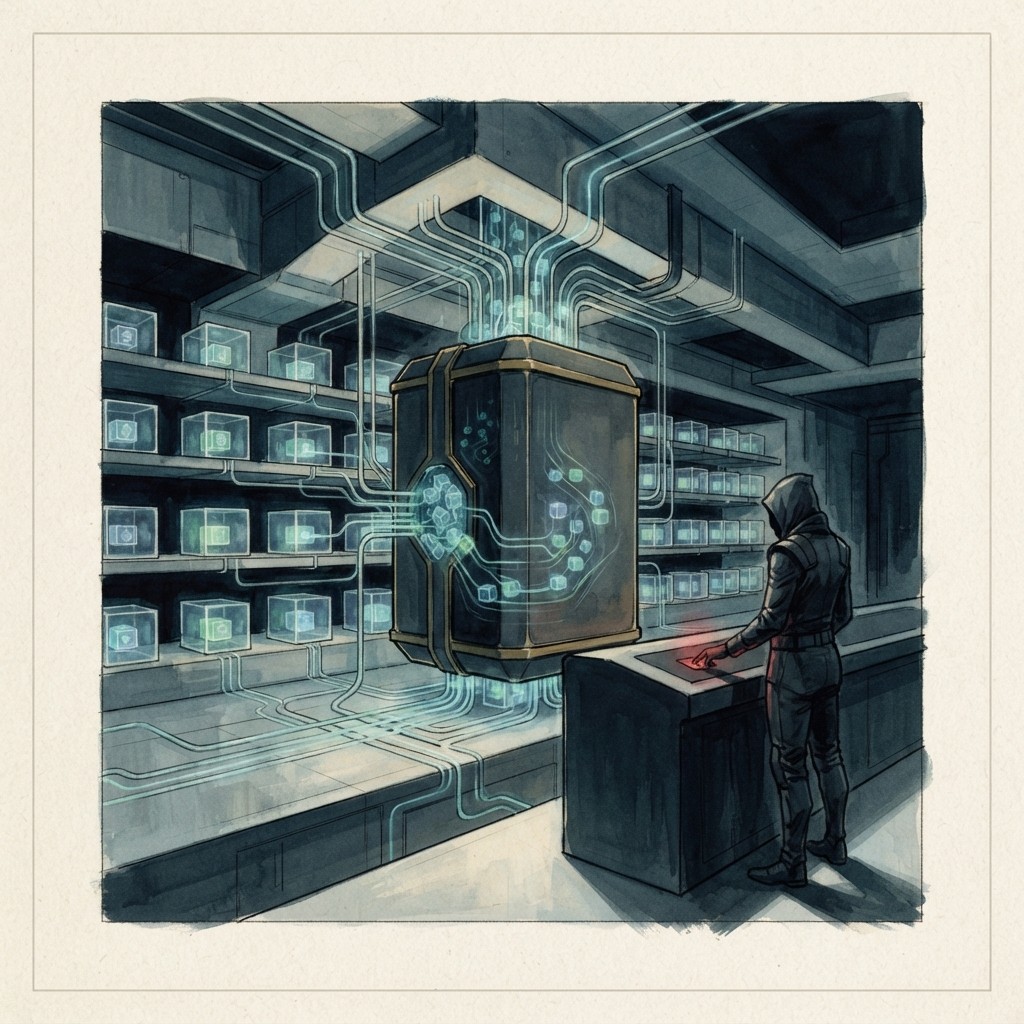
Somewhere in FTX's matching engine — the code that decided, in milliseconds, who got liquidated when a trade went bad — there was a setting. For every customer on earth, it was off: trade too big, lose too much, and the machine sold you out automatically to protect the exchange. For one account, it was on. That account could run negative. It could keep borrowing past zero, past every limit, with no margin call and no liquidation, drawing on customer money it did not own.2 The account belonged to Alameda Research, the trading firm Sam Bankman-Fried also owned. The shortfall that followed was over $8 billion.2 It did not appear by accident. Someone wrote the flag.
The official story is that SBF was a brilliant, sleep-deprived math nerd who got in over his head — chaotic, not criminal. It is a tidy story, and a jury rejected it in under five hours.4 The real story is colder: the conflict of interest at the center of FTX was not a lapse in oversight. It was the architecture. SBF didn't fail to separate the exchange from the trading firm. He built them as one machine, with himself as the only switch.
“Never in my career have I seen such a complete failure of corporate controls and such a complete absence of trustworthy financial information as occurred here.”3
Three jobs, one person, no firewall
A normal exchange is a referee. It holds your money, matches your trades, and stays out of the game. The entire point is that it has no position in the market it polices. SBF collapsed that separation deliberately. He controlled FTX, the exchange where customers parked their cash. He controlled Alameda, the largest trader on that exchange. And he signed the core agreements and bank accounts for both, while the two firms shared employees, office space, systems, and accounts, moving large sums between them — often with no documentation and no effective tracking at all.6 The referee and the biggest player on the field were the same man, settling his own fouls. When you own both sides, the only thing standing between customer deposits and your trading desk is your own restraint. That is not a control. That is a temptation with a login.
Follow the money and the design becomes unmistakable. Customers thought they were depositing into FTX. They were depositing into bank accounts owned by Alameda — one of them held under a shell company blandly named North Dimension. Alameda commingled the funds and spent them: on trading, and on roughly $5 billion of SBF's outside venture bets in tech companies. The hole this left was recorded internally under the address 'fiat@ftx.com,' and dressed up for outside lenders as a generic 'loan' on Alameda's balance sheet.8 A multibillion-dollar misappropriation of customer cash, filed under an email alias. The disguise tells you they knew exactly what it would look like named honestly.
| The promise | The architecture | |
|---|---|---|
| Customer funds | Segregated and safe | Commingled in Alameda's accounts[[cite:s8]] |
| Alameda's status | A trader like any other | Exempt from liquidation, unlimited secret credit[[cite:s2]] |
| The referee | Neutral exchange | Owned by the biggest player[[cite:s6]] |
| The liability | None — your money is yours | Recorded as 'fiat@ftx.com,' disguised as a loan[[cite:s8]] |
The flag that turned a conflict into an inevitability
Owning both sides is dangerous. Coding the danger into the product is something else. The CFTC's complaint describes an 'allow negative' flag and an effectively limitless line of credit, built into FTX's software, that let Alameda withdraw billions in customer assets without the automatic liquidation that disciplined everyone else.2 This is the hinge of the whole story. A human conflict of interest can be checked — by a board, an auditor, a colleague with the nerve to say no. A coded one cannot. Once the exemption lives in the matching engine, it executes silently, instantly, every microsecond, with nobody in the loop to object. The temptation didn't depend on SBF deciding to give in each morning. It ran on its own. The customers' money flowed toward Alameda's losses the way water flows downhill: because the channel was dug that way.
The end was almost anticlimactic, because the structure had already decided it. In November 2022, CoinDesk reported that 40% of Alameda's $14.6 billion balance sheet sat in FTT — the token FTX itself had minted.7 Alameda's 'assets' were largely a coin its sibling company conjured, propping up loans against customer cash. The moment the market saw that the collateral and the obligation were the same family of paper, the run began. There was nothing real underneath to stop it, because the money that was supposed to be underneath had been spent.
Wasn't it just chaos and incompetence?
The fair objection — and SBF's own defense — is that this looks less like a scheme than a mess: a 30-year-old with no controls, no CFO, no adults, drowning in complexity he never managed. John Ray's own words seem to help that case, describing control concentrated in 'a very small group of inexperienced, unsophisticated and potentially compromised individuals.'3 Incompetence is real here. But incompetence and fraud are not alternatives, and the architecture refuses the innocent reading. You can stumble into a missing audit. You do not stumble into a code path that exempts your own trading firm from liquidation, route customer deposits into a shell company, and file the resulting hole under an email alias.28 Those are choices that required building. The jury saw the difference, convicting on seven counts of fraud and conspiracy; the judge handed down 25 years and $11 billion in forfeiture.4 The 'in over his head' story explains the collapse's timing. It cannot explain the plumbing.
The most dangerous concentration of power isn't a founder who owns everything — it's a founder who owns everything and then encodes the conflict into the product, where no human review can reach it. A policy can be overruled by a board. A documented exception leaves a trail. But a flag buried in the matching engine executes silently, at machine speed, on every transaction, with no one in the loop. So when you evaluate a platform that holds your money, don't ask whether the founder is honest. Ask a structural question: can the house trade against the customers, and what — in the software, not the marketing — actually stops it? If the only firewall is one person's restraint, there is no firewall. There is a switch, and it is already wired to on.
FTX failed where it was designed to fail. The genius of the structure — and it was a kind of dark genius — was to make the theft indistinguishable from the operation: customer deposits and Alameda's trading capital flowing through the same accounts, governed by the same man, exempted by the same code. There was no moment of crime to point to, only a machine doing exactly what it was built to do. SBF's defense asked the world to believe he never understood his own creation. The simpler reading is that he understood it perfectly, and built the one place in the system where every safeguard could be switched off — and put himself in it.
When founder control becomes the whole story
Founder Doctrine Canvas
A one-page canvas for the operating system inside a founder's head: the principles they hold, the formative experiences that forged them, and the specific strategic moves each principle produces. Blank to make your own decision rules legible to the people who execute them; filled as the worked example showing why the story's company keeps making the bets it makes — because the founder can't make any others.
Included, filled and blank, in the The Founder Doctrine Casebook. See the set → · Preview the blank →
Sources
Where this comes from — the filings, records, and reporting behind it.
- 1SEC charged SBF on December 13, 2022 with orchestrating a years-long fraud involving: (1) undisclosed diversion of FTX customer funds to Alameda; (2) Alameda's virtually unlimited undisclosed line of credit funded by customers; (3) undisclosed risk from Alameda's holdings of overvalued illiquid FTX-affiliated tokens; and (4) using commingled customer funds for venture investments, real estate, and political donations.
- 2CFTC complaint (Dec 13 2022, amended Dec 21 2022) charged Bankman-Fried, who controlled both FTX and Alameda, with orchestrating fraud; FTX code included an 'allow negative flag' and effectively limitless line of credit allowing Alameda to withdraw billions in customer assets; defendants' actions caused the loss of over $8 billion in FTX customer deposits.
- 3John J. Ray III, appointed FTX CEO on bankruptcy, stated in his first-day declaration filed November 17, 2022 with the U.S. Bankruptcy Court for the District of Delaware: 'Never in my career have I seen such a complete failure of corporate controls and such a complete absence of trustworthy financial information as occurred here,' describing control concentrated in 'a very small group of inexperienced, unsophisticated and potentially compromised individuals.'
- 4SBF was convicted on November 2, 2023 on seven counts of fraud and conspiracy (wire fraud, securities fraud conspiracy, commodities fraud conspiracy, money laundering conspiracy) by a jury in the U.S. District Court for the Southern District of New York after less than five hours of deliberation; he was sentenced on March 28, 2024 to 25 years in federal prison and ordered to forfeit $11 billion.
- 5The CFTC court order (August 2024) found FTX touted itself as a safe platform that segregated customer assets, 'when in fact customer funds were commingled and misappropriated.' The court ordered FTX to pay $12.7 billion: $8.7 billion in restitution and $4 billion in disgorgement — the largest such recovery in CFTC history.
- 6CFTC Commissioner's statement (Aug 2024) confirms: Bankman-Fried controlled both FTX and Alameda and served as signatory on core corporate agreements and bank accounts for both entities; FTX and Alameda regularly shared employees, office space, systems, and accounts and transferred large amounts of assets between entities, often without documentation or effective tracking.
- 7On November 2, 2022, CoinDesk published a report that Alameda Research held a significant portion of its balance sheet in FTT tokens — FTX's native cryptocurrency — with 40% of Alameda's $14.6 billion in assets in FTT. This disclosure triggered the bank-run that brought down FTX.
- 8FTX customers deposited funds into Alameda-owned bank accounts (including shell entity 'North Dimension'), Alameda commingled these funds and used them for trading operations and SBF's ventures including $5 billion invested in tech companies; the multibillion-dollar liability was recorded internally as 'fiat@ftx.com' and disguised as a generic 'loan' on Alameda's balance sheet provided to third-party lenders.
More like this — beyond FTX
New Strategically analyses as they publish: the defining moves in business, checked against the record. No noise, and one click to leave.