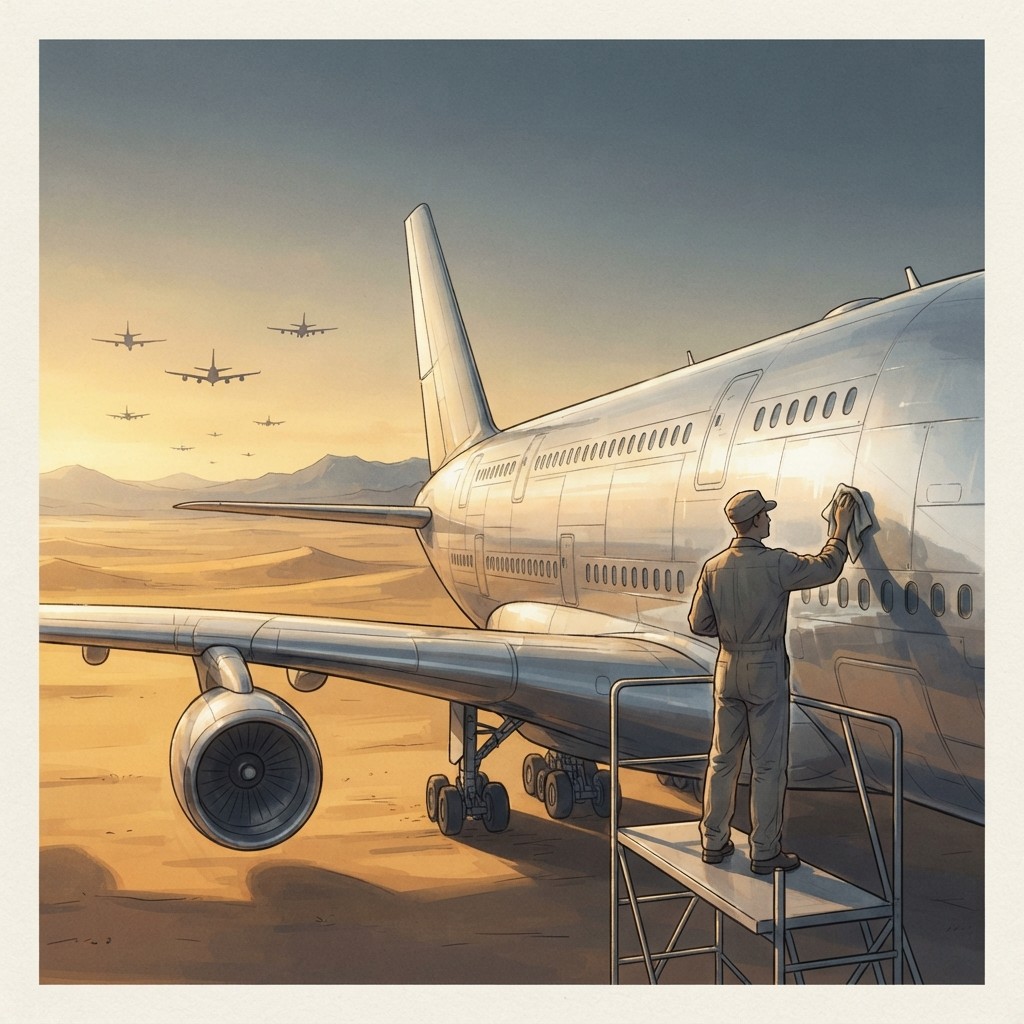
Pairs with the Bet-Sizing Worksheet — a ready-to-use strategy tool, filled for Emirates. Included in the The Fork Casebook →
On 16 December 2021, the last Airbus A380 ever built rolled off the line and was delivered - not to Singapore, not to Lufthansa, not to British Airways, but to Emirates. It was the carrier's 123rd superjumbo.1 Of the 251 of these double-decker giants Airbus managed to sell across its entire production run, this one airline in the desert had bought almost half.5 The plane the rest of aviation had quietly given up on, Emirates kept ordering - through the 2008 crash, through a decade of every rival switching to smaller twins, right up until the factory closed. Most readings of this call the same word: reckless. An airline went all-in on a flop.
The official story is that Emirates made a catastrophic bet on the wrong aircraft and got lucky that Dubai grew fast enough to fill the seats. Almost every part of that is backwards. Emirates didn't bet on the A380. It bought a niche nobody else could afford to want - and the fact that everyone else fled it is precisely what made the position valuable.
The first to announce, and the only one who meant it
Emirates was the first airline to publicly announce an order, at the 2000 Farnborough Air Show, back when the plane was still a concept called the A3XX - five firm aircraft with options for five more.8 It is often called the launch customer. It wasn't. That title belongs to Singapore Airlines, which took the first delivery on 15 October 2007 and flew the first revenue service ten days later, Singapore to Sydney.4 The distinction matters more than it sounds. Emirates' early commitment wasn't enthusiasm for a finished product; it was a bet placed on a drawing - and then, six weeks after 9/11, when every other carrier was retrenching, Emirates went back to the 2001 Dubai Air Show and ordered fifteen more.8 That is not the behaviour of an airline buying capacity. It is the behaviour of an airline buying a strategy that happened to require this airframe.
“When we took the first aircraft in July 2008 and before the pandemic meltdown, 80% of our profits were coming from the A380.”6
Why the wrong plane was the right plane for Dubai
The A380 failed for a reason that had nothing to do with engineering and everything to do with geometry. The industry shifted from hub-and-spoke to point-to-point: travellers wanted a direct flight from their city to yours on an efficient twin-engine jet, not a hop to a megahub and a transfer onto a 500-seat behemoth. Worse, GE and Rolls-Royce delivered engines for the 787 with roughly 15% better fuel burn just three years after the A380 launched, making the four-engine giant structurally uneconomic on almost every route.7 For nearly every airline on earth, that math was fatal. But Emirates wasn't running point-to-point. It was running the purest hub-and-spoke machine in commercial aviation - funnelling traffic between Europe, Asia, Africa and the Americas through a single slot-constrained airport in Dubai. The very model the A380 was built for, and the very model everyone else abandoned, was Emirates' entire reason to exist.
Here is the mechanism that turns a flop into a moat. Major hub airports ration takeoff and landing slots. If you can only operate so many flights a day, the way to grow is to put more seats on each one - and nothing on earth puts more premium-revenue seats behind a single slot than an A380. Emirates wasn't choosing the A380 over a 787; it was choosing to extract more revenue from a fixed number of slots than any competitor could. And because the plane was uneconomic for anyone without that exact hub geometry and that exact premium-cabin mix, no rival could copy the move. They literally couldn't make the same plane pay. Emirates absorbed the supply of a global asset that only it could profitably fly. The plane's universal failure is what guaranteed Emirates' exclusivity.
| A typical global carrier | Emirates | |
|---|---|---|
| Network shape | Point-to-point, fragmenting | Single megahub at Dubai |
| Growth constraint | Demand on each route | Slots at the hub |
| What more seats-per-slot does | Strands empty capacity | Multiplies revenue per slot |
| The fuel-burn penalty vs. twins | Fatal on thin routes | Diluted across dense premium traffic |
| Verdict on the A380 | Uneconomic | Profit engine |
It wasn't 'all-in' - that's the part the story gets wrong
The seductive framing is that Emirates went all-in on one plane and survived by luck. The trouble is the record. Through the same years it was hoovering up superjumbos, Emirates built and operated the world's largest Boeing 777 fleet, and repeatedly placed orders for A350s and 787s. The A380 was a core pillar - never the only pillar. And the financial discipline showed up exactly when it had to. In January 2018 Emirates trumpeted a fresh order described as taking its 'total A380 commitment to 178 aircraft.'3 That number was theatre: it bundled in 16 options that were never firm. Thirteen months later, on 14 February 2019, Emirates cut its actual order book from 162 to 123, cancelled 39 planes, and swapped them for 40 A330neos and 30 A350s instead.2 An airline that was genuinely all-in does not pivot 70 aircraft to smaller twins the moment the economics shift.
But didn't Emirates just kill the plane it depended on?
The honest objection is that Emirates' 2019 cancellation was the proximate trigger for Airbus ending production - so the supposed monopolist torpedoed its own supply.2 True, and worth sitting with. But two things blunt it. First, the program was commercially dead long before February 2019; the shift to efficient twins, the hub-to-spoke disruption, and Airbus's own engine miscalculation had made the A380 unviable for years.7 Emirates didn't kill a healthy plane; it stopped feeding a terminal one. Second - and this is the elegant part - killing future production while owning 123 of the only large fleet that exists doesn't weaken the moat. It seals it. Nobody else can ever assemble a competing A380 operation, because there are no more A380s to buy. Emirates didn't just dominate a niche. It locked the door on the way out. The other honest caveat: Tim Clark's claim that 80% to 85% of pre-COVID profit came from these planes is his own assertion in interviews, never audited in a filing, and it drifts from telling to telling.6 Treat it as a confident operator's account, not a verified number.
The instinct is to flee a category everyone is abandoning. But sometimes the exodus is the opportunity: when an asset only pays for the one buyer whose business model fits it exactly, that buyer can absorb the entire supply and own a position no competitor can replicate - precisely because the asset failed for everyone else. The discipline is knowing which is true. Are you the only one the math works for, with a structural reason it can never work for a rival? Then walking into the empty category is a moat. Or are you simply the last optimist holding a bad bet? The difference is whether your advantage is geometry or hope. Emirates had the geometry: a slot-constrained megahub and a premium-revenue mix nobody else possessed. Then it kept a second fleet of efficient twins so it was never betting the company on being right.
Strip away the romance of the double-decker and what Emirates actually did was unglamorous and shrewd: it found a global asset that was worthless to almost everyone and indispensable to itself, then quietly bought up half the world's supply of it. The fork in the road was never 'should we bet big on the A380.' It was 'should we dominate a niche nobody else can profit from, or diversify into something everyone else is also chasing.' Emirates chose to own the thing no one wanted. The plane that broke Airbus's heart became the one fleet on earth a competitor could never buy - and that, not the size of the bet, was always the point.
When the strategy is the asset nobody else can use
Bet-Sizing Worksheet
Most bets fail on size, not on direction — right call, ruinous stake. This worksheet forces the three numbers that matter: how much of the bankroll is on the table, how strong the conviction really is, and whether the worst case is survivable. Blank, it stops you betting the company on a hunch; filled, it reverse-engineers the story's wager so you can judge whether it was bold or reckless.
Included, filled and blank, in the The Fork Casebook. See the set → · Preview the blank →
Sources
Where this comes from — the filings, records, and reporting behind it.
- 1Emirates was the first airline to announce an order for the A380 at the 2000 Farnborough Air Show when the aircraft was still marketed as the A3XX; its 123rd and final A380 was delivered on 16 December 2021, the last A380 ever built.
- 2On 14 February 2019, Emirates reduced its A380 order book from 162 to 123 aircraft (cancelling 39 planes) and ordered 40 A330-900 and 30 A350-900 instead; Airbus immediately announced it would cease A380 deliveries in 2021 due to lack of backlog.
- 3Emirates' January 2018 order for 36 additional A380s (20 firm, 16 options) worth US$16 billion was described by Emirates as bringing its 'total Airbus A380 commitment to 178 aircraft units'; at that point 101 were already in its fleet.
- 4Singapore Airlines—not Emirates—was the formal launch customer of the A380: the first aircraft (MSN003) was delivered to Singapore Airlines on 15 October 2007 and entered commercial service on 25 October 2007 with flight SQ380 from Singapore to Sydney.
- 5Total firm orders for the A380 stand at 251 aircraft from 14 customers, all delivered by December 2021. Emirates is the largest operator with 116 A380s in service as of 2025–2026, accounting for more than half the active global fleet.
- 6Emirates' Tim Clark stated in a December 2020 interview that 'when we took the first aircraft in July 2008 and before the pandemic meltdown, 80% of our profits were coming from the A380.' In a separate May 2021 interview he cited '85% of our profits prior to COVID.' The figures vary by interview and are unaudited attributions.
- 7Airbus launched the A380 programme formally on 19 December 2000 with an initial €9.5 billion budget; total development cost estimates ranged from €15 billion (Airbus's own 2015 figure) to $25–30 billion (analyst estimates by 2016). The 2008 financial crisis hit just as the first Emirates aircraft were delivered, sharply curtailing the programme's commercial momentum.
- 8Emirates' first A380 order at the 2000 Farnborough show was for 5 firm aircraft with options for 5 more (sometimes described as an LOI for up to 10); a firm commitment and additional 15 units followed at the 2001 Dubai Air Show, described as 'a bold statement just 6 weeks after the events of 9/11.'
More like this — beyond Emirates
New Strategically analyses as they publish: the defining moves in business, checked against the record. No noise, and one click to leave.