
You can invent a market, own its language, and lead it by years — and still lose it. Novo Nordisk just proved how, and the mechanism has almost nothing to do with which drug takes off more weight.
Pairs with the Fork Decision Tree — a ready-to-use strategy tool, filled for Novo Nordisk. Included in the The Fork Casebook →
Semaglutide was Novo's molecule, and Novo's moment. It launched as the diabetes drug Ozempic in 2017 and as the obesity drug Wegovy in 2021, and it did something drugs almost never do: it escaped the pharmacy and entered the culture. Talk-show monologues. A word — "Ozempic" — that became a verb. Novo didn't just lead the obesity market; it was the obesity market. By the summer of 2024 that dominance had made a Danish insulin maker larger than LVMH, the most valuable listed company on the continent.1
Two years later, the company that created the biggest new drug market in a generation is the one losing it. The tidy explanation is chemistry: Lilly's tirzepatide takes off more weight than Novo's semaglutide, so Lilly won. And the head-to-head numbers back it — in the 72-week SURMOUNT-5 trial reported in December 2024, Lilly's Zepbound delivered 20.2% average weight loss against Wegovy's 13.7%.4 Better molecule, better result, game over.
Except that's not how markets this big are won or lost. Novo had a two-year head start, the only household-name brands in the category, and a market growing faster than either company could serve. A head start that large is not surrendered because your rival's drug is a few points stronger. It's surrendered when you can't make enough of your own — and when the one bet meant to leapfrog the rival merely ties. That is what actually happened, and both halves were closer to a choice than to bad luck.
The follow-up that had to leap, and only tied: what a knockout punch looks like when it lands as a handshake
Novo knew semaglutide would eventually be out-gunned, so it built its second act: CagriSema, a combination of semaglutide with a second molecule, cagrilintide. The pitch to investors was explicit — this would be the drug that vaulted Novo back ahead, with weight loss around 25%.5 The whole strategy leaned on it. Retake the efficacy crown, and the head start does the rest.
In December 2024, the pivotal REDEFINE 1 results arrived: about 22.7% weight loss — a genuinely powerful result, and a strategic disaster.5 Not because 22.7% is bad, but because it wasn't the leap Novo had promised or the market had priced. It roughly matched what Lilly already sold. Novo's stock fell about 20% in a single session; the number that was supposed to end the contest instead confirmed Novo had drawn level, at best, with a rival already pulling ahead.5 The knockout punch landed as a handshake.
The market it created, and couldn't fill: a supply you can't meet invites copycats and hands your rival room to scale
Here is the half of the story that never makes the headline, and matters more than the trial data. From 2022 onward, demand for these drugs wasn't a market — it was a stampede. And Novo could not make enough. Wegovy sat on the U.S. Food and Drug Administration's official shortage list, and under U.S. rules a listed shortage does something specific: it makes it legal for compounding pharmacies to sell their own copies of the drug.6 For roughly two years, telehealth sites sold compounded semaglutide to millions of patients Novo could have had — legal copycats, filling the gap Novo's own factories left open.6
Novo understood the problem cold. In February 2024 its parent, Novo Holdings, agreed to buy the contract manufacturer Catalent for $16.5 billion — an enormous check whose entire purpose was to bolt on the fill-finish capacity to make more Wegovy.7 That deal is the confession: the binding constraint on the world's most valuable drug company was never the science. It was the number of pens it could fill. And by the time the capacity arrived, Lilly had spent the same window pouring billions into manufacturing ahead of demand — converting the stampede into its prescriptions while Novo rationed.
The two failures compound. A supply you can't meet invites copycats and hands your rival room to scale. A follow-up that ties instead of leaps means that when the copycats are finally cleared out, the branded customer has a better reason to pick the other brand. Novo lost the top and the bottom of its own market at the same time.
| Novo Nordisk's play | Eli Lilly's play | |
|---|---|---|
| The molecule | Semaglutide, then a moonshot combo that had to leap | Tirzepatide — already stronger, already winning head-to-head |
| The follow-up bet | CagriSema at ~25%; delivered ~22.7% — a tie | No single do-or-die readout; a surer, stronger base drug |
| The supply response | Scrambled after the fact — bought Catalent for $16.5B | Spent billions on capacity ahead of demand |
| The gap that opened | Shortage → compounders sold copies to millions | Capacity to turn the stampede into its own scripts |
| The scoreboard | ~75% of peak value gone; CEO out; revenue decline guided | First $1T healthcare company; the best-selling drug on earth |
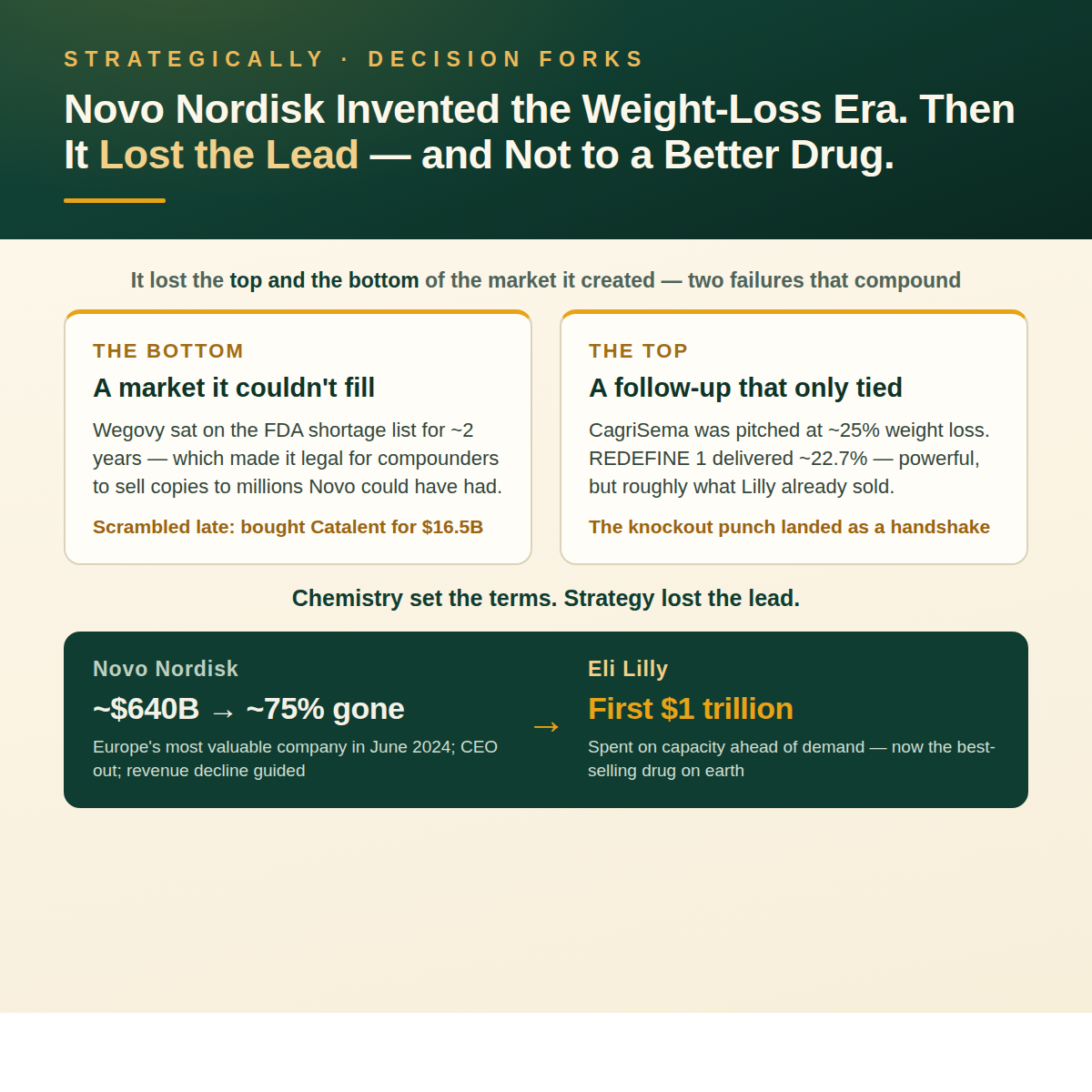
The scoreboard is not subtle. In January 2025 Novo lost its crown as Europe's most valuable company.8 In May 2025 the board parted ways with CEO Lars Fruergaard Jørgensen.9 By late 2025 Lilly crossed a trillion dollars in market value, the first healthcare company ever to do so, with tirzepatide the best-selling drug in the world.23 Novo, the company that named the era, guided to shrinking sales and announced it would cut about 9,000 jobs — roughly 11% of its workforce.310
The honest objection
"You're overcomplicating it. Lilly's molecule is simply better — that's chemistry, not strategy." The molecule is better, and that matters. But being second on efficacy is not fatal when you are two years ahead, own the famous names, and sell into a market expanding faster than anyone can supply — unless you also can't manufacture enough and your one big follow-up fails to pull ahead. Novo controlled the timing, the brand, and the category. It lost on the two things that were genuinely its to decide: how much to invest in capacity, and where to place the follow-up bet. Chemistry set the terms. Strategy lost the lead.
"The shortage wasn't a choice — you can't build biologic capacity overnight." Fair, and true. But Lilly faced the identical physics and chose to spend into it early; Novo chose to protect margins and bank on a moonshot, then buy capacity once the damage was visible. When two companies meet the same constraint and one prepares for it a year sooner, the difference between them isn't luck. It's the strategy.
The read
Novo Nordisk's fall gets filed as a stumble by a great company that will surely recover. Maybe it will. But the lesson underneath is colder and more portable than "the better drug wins." In an ordinary market, the superior product usually does. In a demand shock — a market that explodes faster than anyone can serve it — the prize goes to whoever can make the most and bet the surest. The science is table stakes. Capacity and nerve are the moat.
Novo proved something rare and expensive: you can invent a market, own its language, lead it by years — and still lose it, by treating a gold rush like a luxury launch.
When you're first into a market that suddenly explodes, the instinct is to defend your margin and your lead. Run three questions before you do. First: can we physically make enough to meet the surge? (Novo couldn't — Wegovy was on the shortage list for ~2 years.) Second: is our next product a real leap, or a tie? (CagriSema tied instead of leaping.) Third: are we pricing and investing to saturate, or to protect margin? (Novo protected margin and rationed supply.) If you're rationing a product the market is begging for, you are not defending a lead. You are renting it to whoever can build the next factory first.
Some figures here trace to company guidance and secondary reporting rather than a single primary filing — notably the ~25% CagriSema expectation and the ~22.7% readout reported at the December 2024 announcement, and U.S. obesity market-share figures. They are attributed as reported and cross-checked across outlets.
More decisions where the path split
Fork Decision Tree
Take the either/or in front of you and draw it out: the question at the fork, the two branches, and what each one triggers two and three moves later. Blank, it forces you to spell out consequences before you commit instead of after. Filled, it replays the story's fork so you can see exactly where each path led — and which downstream node actually decided the outcome.
Included, filled and blank, in the The Fork Casebook. See the set → · Preview the blank →
Sources
Where this comes from — the filings, records, and reporting behind it.
- 1By June 2024, Novo Nordisk was worth roughly $640 billion — the most valuable listed company in Europe, ahead of LVMH — on the strength of Ozempic and Wegovy. It later shed about three-quarters of that value.
- 2In November 2025 Eli Lilly became the first healthcare company in the world to reach a $1 trillion market value, driven by Mounjaro and Zepbound (tirzepatide).
- 3By early 2026, Novo Nordisk had lost the majority of its peak value, guided to a decline in 2026 sales and operating profit (its first guided revenue decline since 2017), and cited pricing pressure, competition and loss of exclusivity; tirzepatide had become the best-selling drug in the world.
- 4In the 72-week head-to-head SURMOUNT-5 trial, Eli Lilly's tirzepatide (Zepbound) delivered 20.2% average weight loss versus 13.7% for semaglutide (Wegovy) — a superior result reported in December 2024.
- 5Novo Nordisk's follow-up, CagriSema (semaglutide + cagrilintide), had been pitched to investors at around 25% weight loss; in the pivotal REDEFINE 1 trial reported December 20, 2024 it delivered about 22.7%, short of the ~25% the market had priced. Novo's shares fell roughly 20% in a single session.
- 6Wegovy (semaglutide) sat on the U.S. FDA's official shortage list, which under U.S. rules made it legal for compounding pharmacies to sell their own copies; for roughly two years telehealth sites sold compounded semaglutide. The FDA declared the shortage resolved in February 2025, ending the legal window for compounders.
- 7In February 2024 Novo Nordisk's parent, Novo Holdings, agreed to buy contract manufacturer Catalent for $16.5 billion — a deal whose purpose was to add fill-finish capacity for Wegovy; it completed in December 2024, with three fill-finish sites sold on to Novo Nordisk.
- 8In January 2025 Novo Nordisk lost its position as Europe's most valuable listed company by market capitalization.
- 9In May 2025 Novo Nordisk's board and CEO Lars Fruergaard Jørgensen agreed he would step down amid the share-price decline and competitive pressure — widely reported as an ouster.
- 10In September 2025 Novo Nordisk announced it would cut about 9,000 jobs — roughly 11% of its global workforce — in a restructuring aimed at saving around DKK 8 billion (~$1.25–1.3 billion) by the end of 2026, as it lost share to Eli Lilly.
More like this — beyond Novo Nordisk
New Strategically analyses as they publish: the defining moves in business, checked against the record. No noise, and one click to leave.