Pairs with the Moat Anatomy Canvas — a ready-to-use strategy tool. Included in the The Moat Anatomy Casebook →
In 1985, Gulf Air pulled back its Dubai service, and a city that lived on being a place people passed through suddenly risked becoming a place people skipped. Sheikh Mohammed's instruction to a DNATA executive was not visionary so much as urgent: launch an airline in five months, with $10 million, that pays its own way. Pakistan International Airlines wet-leased the first aircraft and trained the crews.9 The thing flew its first route in October, and was profitable inside nine months.10 Forty years later that scrappy start-up earns more before tax than most of its accusers earn in a decade — and those accusers have an explanation ready: it must be the money.
The official story, told loudest by Delta, United, American, Lufthansa, Qantas and Air France, is that Emirates is an instrument of state wealth — a flag carrier flush with hidden subsidies, cheap fuel and below-market airport charges, beating honest airlines with someone else's chequebook. That story is comforting if you are losing to Emirates. It is also the wrong autopsy. The thing protecting Emirates is not a subsidy line. It is a piece of geography that nobody else can buy, built into a machine nobody else is allowed to copy.
The subsidy charge that 388 pages couldn't kill — because it was never true
Start by clearing the table. The Dubai government put in a one-time founding stake — $10 million, with roughly $80 million more at inception — and then, by the airline's own founding mandate, was supposed to leave it alone.2 It did. There have been no new capital injections since. The flow has actually run the other way: the government has collected AED 14.6 billion in dividends since 1999 on that initial outlay.2 A subsidised airline does not pay its owner billions in dividends; a profitable one does. In 2015 the U.S. 'Big Three' assembled a case that Emirates had pocketed over $6 billion in subsidies in violation of the U.S.–UAE Open Skies Agreement. Emirates answered with a 388-page rebuttal, denying the fuel-hedging benefits, the related-party advantages and the below-market airport charges point by point.5 No regulator has since found an Open Skies violation. The allegation is contested. It is not documented.
“Emirates received no fuel-hedging subsidies, no below-market airport charges, and no improper related-party benefits — and we have answered every allegation, line by line.”5
Note what the subsidy fight is really about. Rivals reach for it precisely because the alternative explanation is unbearable: that Emirates beats them not on a subsidy they can lobby against, but on a structural advantage they cannot replicate even if every cheque were audited to zero. The moat is not in the financing. It is in the map.
Geography is the asset rivals can't buy
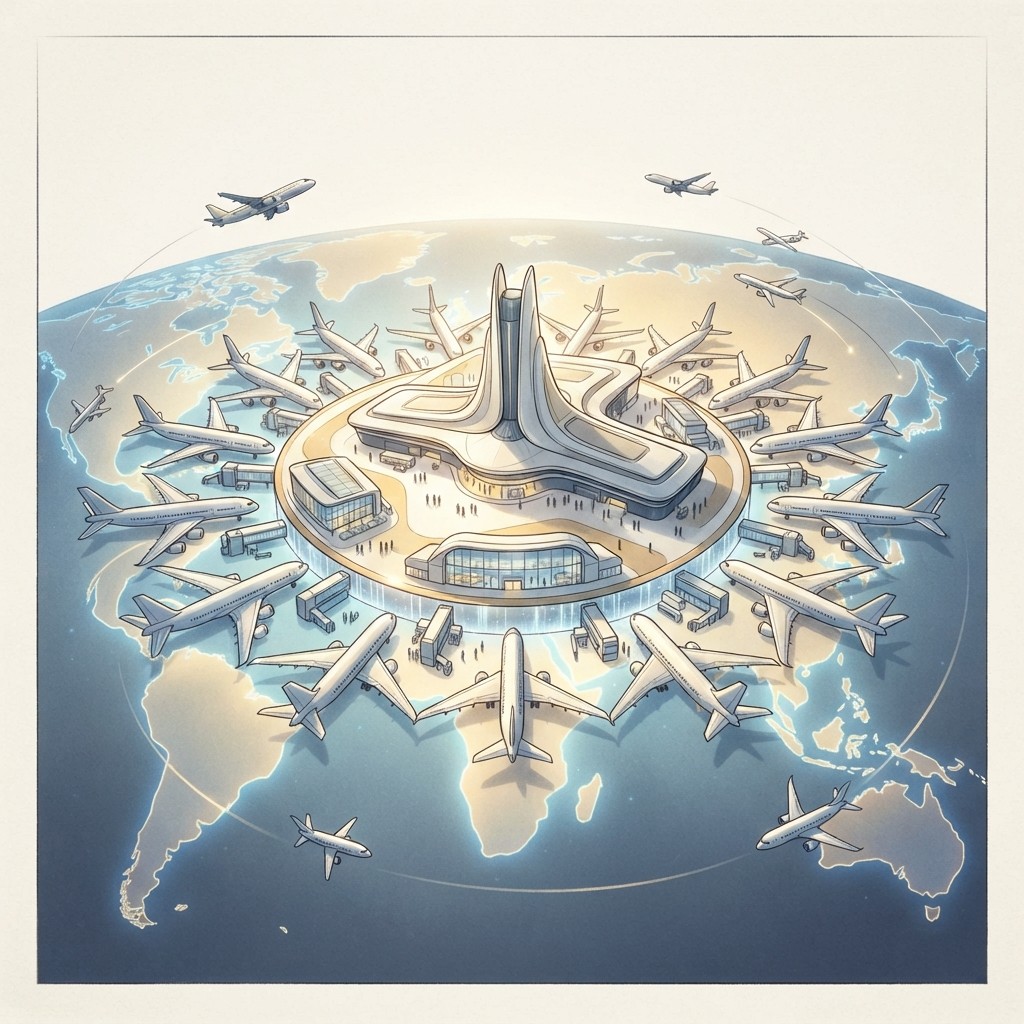
Here is the mechanism, worked down. Dubai sits at the seam of Europe, Africa, the Indian subcontinent and East Asia — a position from which most of the planet's population is within a single long-haul leg. Emirates did not just notice this; it built an airline that exists to harvest it. The model is the sixth freedom: carrying passengers who neither begin nor end their trip in the UAE, simply connecting them through Dubai on the way from one continent to another. London to Bangkok, Manchester to Sydney, Lagos to Mumbai — the passenger never sets foot in the country except to change planes. DXB is the funnel, and the funnel is enormous. In 2024 it handled 92.3 million passengers — its highest ever, the world's busiest airport for international travellers for the eleventh year running — and Emirates carried 51% of them.4 More than 3,600 Emirates flights a week pour out of a single terminal, on a fleet of over 250 aircraft that are all widebody — no regional jets, no narrowbody filler.3 That is not how a normal flag carrier is shaped. It is how a transfer machine is shaped.
| A legacy flag carrier's hub | Emirates at DXB | |
|---|---|---|
| Core traffic | Origin-and-destination domestic + international | Sixth-freedom transfer between continents |
| Domestic feed | Large | Zero |
| Fleet shape | Mixed narrowbody + widebody | All-widebody, 250+ aircraft |
| What protects it | Home-market loyalty and slots | A geographic position no rival can relocate to |
Plenty of cities sit on good map coordinates and do nothing with them. Dubai's geography is a lottery ticket; Emirates is the apparatus that converts it into revenue. The hub geometry, the all-widebody fleet, the single mega-terminal, the schedule banks structured so connecting passengers can flow between long-haul banks — each piece is useless alone and unreplicable together. A competitor cannot move its country to the seam of four continents, and even if it could, it would still have to build forty years of the machine that sits on top. That is the difference between an advantage you were born with and a moat you constructed around it.
And note the correction the critics' favourite stat hides. DXB is the busiest international airport, not the busiest airport — Atlanta moves more total passengers once you count domestic traffic — 108.1 million in 2024 against DXB's 92.3 million.11 That distinction is the whole point. Emirates has zero domestic routes. Its entire advantage is the international transfer play, which means its moat is built precisely on the segment that bilateral air-service treaties make hardest for rivals to expand into. The thing that looks like a footnote — no home market — is the source of the strength.
The $5 billion wall, and the plane nobody else can buy
Geography gets passengers to the funnel. Product keeps them choosing it. Emirates is the world's largest A380 operator — 116 of the double-decker giants in service as of early 2026 — and the largest Boeing 777 operator besides.3 The A380 is usually written off as a legacy mistake, a four-engine dinosaur the rest of the industry abandoned. For Emirates it is the opposite: a scarcity asset. Airbus has stopped building the A380. Which means no rival can place an order to match Emirates on the same premium, high-density, long-haul format — the showers, the bars, the sheer seat count per slot. The plane that everyone else regrets has become a thing Emirates owns and no one can acquire new. On top of that, the airline is pouring $5 billion into retrofitting cabins across 219 aircraft, including those A380s.7 A bilateral-constrained competitor cannot simply out-spend its way past that at scale — it can't get the airframes, can't get the slots, and can't get the four decades of brand the retrofit is dressing up.
The honest objection: so what happens when the map gets crowded?
The fair counter is that none of this is permanent, and the perpetual-growth narrative is a myth Emirates' own history disproves. The airline did lose money — in its second year, during a regional downturn — so the 'never unprofitable' legend is simply false.10 And earnings can crater hard: in the late-2000s downturn, profit fell 72% in a single year.10 The geometry can also be copied by neighbours sitting on the same seam — Doha and Abu Dhabi are building the identical sixth-freedom machine a short flight away. And the zero-tax era that quietly padded the cost base has ended: FY2024-25 was the first year the new 9% UAE corporate tax applied, trimming Group profit after tax to US$5.6 billion.8 Add the European regulators — Germany once ordered Emirates to raise business-class fares by up to 20% — and the moat clearly has soft edges.6 All true. But the test of a moat is not whether it can be attacked; it is whether the attacker has to rebuild the whole machine to win. A Gulf rival can copy the geometry, yes — and then spend a decade and tens of billions building the fleet, the terminal, the network density and the brand to fill it, while Emirates keeps compounding. The corporate tax shaves the margin; it does not erase a 14.9% one.1 The moat is being tested at the edges. The centre is holding because the centre was never the subsidy.
The proof sits in the FY2024-25 results, the strongest the airline has ever posted: AED 22.7 billion in Group profit before tax, AED 145.4 billion in revenue, and AED 53.4 billion in cash — the most it has ever held.1 Those are not the numbers of a charity case kept aloft by royal patronage. They are the numbers of a system that turned a city's location into a flywheel and then walled it off with a fleet the market can no longer buy. Emirates' rivals keep auditing the chequebook. They are reading the wrong document. The thing protecting Emirates was never written down on a balance sheet. It was drawn on a map, and then built, plane by plane, into something nobody else is positioned to copy.
When the moat isn't where everyone's looking
Moat Anatomy Canvas
A one-page canvas that dissects a moat instead of asserting it: where the advantage comes from, how much of the market it covers, how long it would take to copy, and what keeps it from eroding. Blank to dissect your own claimed edge; filled as the worked example tracing the structure of the story's defensible advantage. Use it to tell a real moat from a head start.
Included, filled and blank, in the The Moat Anatomy Casebook. See the set → · Preview the blank →
Sources
Where this comes from — the filings, records, and reporting behind it.
- 1Emirates Group FY2024-25 (ended 31 March 2025): record Group profit before tax of AED 22.7 billion (US$6.2 billion, up 18%); Emirates airline alone earned record profit before tax of AED 21.2 billion (US$5.8 billion, up 20%); Group revenue AED 145.4 billion (US$39.6 billion, up 6%); highest-ever cash assets AED 53.4 billion (US$14.6 billion); Emirates profit margin 14.9%.
- 2Emirates was founded 15 March 1985 with $10 million start-up capital (plus approximately $80 million additional at inception) from the Dubai government; required by its founding mandate to operate independently of government subsidies; has received no new government capital injections since; Dubai government has received AED 14.6 billion in dividends since 1999.
- 3Emirates operates more than 3,600 flights per week from Terminal 3, Dubai International Airport; fleet of over 250 all-widebody aircraft; world's largest long-haul airline and largest airline in the Middle East; world's largest A380 operator (116 aircraft as of January 2026) and largest Boeing 777 operator (133 aircraft).
- 4Dubai International Airport (DXB) handled 92.3 million passengers in 2024 — its highest annual traffic ever, surpassing the 2018 record of 89.1 million — and retained the ACI ranking as world's busiest airport for international passengers for the 11th consecutive year. Emirates carried 51% of DXB's passengers in 2024.
- 5Emirates published a 388-page rebuttal (June 2015) to U.S. Big Three (Delta, United, American) allegations that it received over $6 billion in subsidies from the Dubai government in violation of the U.S.-UAE Open Skies Agreement. Emirates denied all allegations including fuel-hedging subsidies, related-party transaction benefits, and below-market airport charges, providing point-by-point factual responses.
- 6Air France, Delta, Qantas, and Lufthansa have at various times accused Emirates of hidden state subsidies, below-market airport charges, and cross-subsidisation via government shareholder sovereign borrowing status. Germany's Federal Office for Goods Transport ordered Emirates to raise business-class fares on non-EU routes by up to 20% — a dispute Emirates called 'anti-consumer.'
- 7Emirates' order book at 31 March 2025 stood at 314 aircraft pending delivery: 61 A350s, 205 Boeing 777X, 35 787s, and 13 777Fs. Total fleet count 260 units, average fleet age 10.7 years. The airline added 99 more aircraft to its retrofit programme, now covering 219 aircraft at a total investment of US$5.0 billion.
- 8This is the first financial year (FY2024-25) that the UAE 9% corporate income tax, enacted in 2023, applied to the Emirates Group. After the tax charge, Group profit after tax was US$5.6 billion. This structural change ends the era of Emirates operating in a zero-tax environment — a previously unacknowledged element of its cost advantage.
- 9Emirates' first aircraft — an Airbus A300 B4 and a Boeing 737 — arrived in Dubai on October 20th on wet lease from Pakistan International Airlines; the airline launched its first commercial service on 25 October 1985.
- 10The Emirates Group became profitable within its first nine months; in its second year the group posted a loss; the airline's profits were down 72% for the 2008/09 fiscal year (profit of 1.49bn dirhams vs 5.3bn dirhams the previous year).
- 11Hartsfield-Jackson Atlanta International Airport hosted 108.1 million total passengers in 2024, the most of any airport in the world by total passenger volume.
More like this — beyond Emirates
New Strategically analyses as they publish: the defining moves in business, checked against the record. No noise, and one click to leave.