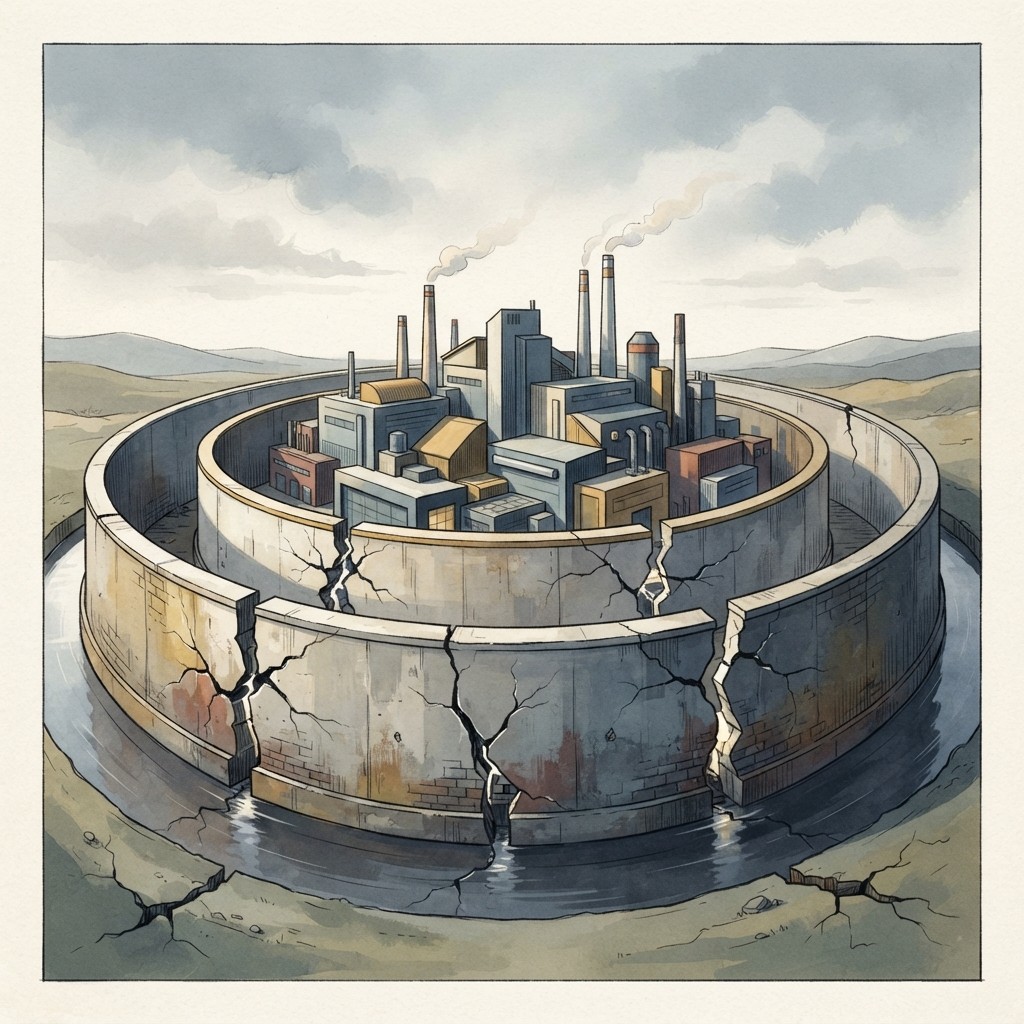
The system everyone calls Toyota's secret weapon has been a public document for over three decades. So why hasn't anyone drained the moat? Because the real defense was never the thing you could read.
Pairs with the Moat Anatomy Canvas — a ready-to-use strategy tool. Included in the The Moat Anatomy Casebook →
Ask an analyst what protects Toyota and you'll get one answer, fast: the Toyota Production System. The legendary lean factory, the andon cord, just-in-time, the kaizen everyone has heard of. It is a clean story, and it has a problem. That system has been an open book since 1984, when Toyota walked GM through it inside a shared California plant called NUMMI, and a fully public one since MIT printed the playbook in a 1990 bestseller.5 Thirty-five years later, every rival has read it. If the system were the moat, it would have been drained long ago.
The official story is that TPS is Toyota's unassailable secret weapon. The real story is that the secret leaked decades ago, and Toyota kept winning anyway — which means the protection was never the document. It was something the document could describe but never hand over.
Here is the thesis, in one line a smart friend could repeat: Toyota isn't defended by one wall. It's defended by three — a manufacturing doctrine baked into its supplier network, a multi-decade hybrid cost-curve lead, and a #1 global share position no rival can copy quickly — and each of the three has a specific crack that the bull case quietly ignores.
Wall one: the doctrine you can read but can't run: why a published playbook still can't be installed — the network behind it never fit in the book
Start with TPS, but ask the right question. Why hasn't full diffusion of a public system erased the advantage? Because the written principles are the smallest part of it. TPS wasn't a single invention by a single genius — Toyota's own history credits three people across three generations: Sakichi Toyoda's automatic loom gave it jidoka in the early 1900s, Kiichiro Toyoda conceptualized just-in-time in the 1930s, and Taiichi Ohno spent the late 1940s through 1975 turning both into a living factory floor.4 That is the tell. The system is the residue of seventy years of accumulated, mostly unwritten habit — distributed across thousands of suppliers who run to the same beat. A rival can copy the andon cord. It cannot copy the seventy years of supplier relationships that make the cord mean anything.
“TPS dissemination began in earnest with the NUMMI joint venture in 1984, and widespread recognition grew rapidly with the 1990 MIT publication 'The Machine That Changed the World.'”5
The crack: doctrine is copyable at the component level. Any competent plant can install a kanban board and a quality-stop. What doesn't transfer is the network — and a network can be poisoned by the very subsidiaries it's supposed to discipline, which is exactly what happened next.
Wall two: a cash engine that quietly argues against the future: the strongest wall is also the one whispering against the powertrain meant to replace it
The second wall is hybrids, and it is the strongest of the three precisely because it prints money. In 2024 Toyota sold 4.53 million electrified vehicles, a 23.1% jump from 3.68 million the year before, and hybrids made up roughly 40% of its global sales — climbing toward 48% in early 2025.67 Toyota has been building and refining this powertrain since the Prius launched in Japan in December 1997, and that head start shows up as a cost curve no one else has descended as far. The Toyota brand was the only automotive make on earth to hold over 10% global market share in 2024.7
But notice the second tell here. The Prius was not the unstoppable first-mover legend it became. It was sold only in Japan for three years, and Honda's Insight actually reached North American buyers before the Prius did.6 Toyota's hybrid dominance was built by scale and breadth over time — not by getting there first everywhere. That history matters now, because the same machine that makes hybrids so profitable is also the structural reason to under-invest in the battery-electric future that may eventually replace them. A cash engine this good doesn't just fund the next thing. It argues against it. The crack in the second wall is that Toyota's greatest strength and its greatest blind spot are the same asset.
Wall three: the #1 title with an asterisk: the crown is real, but read the number twice and a self-inflicted wound shows through
The third wall is sheer scale — the kind a challenger can't assemble in a decade. Toyota sold 10.8 million vehicles in 2024 and held the #1 global spot for the fifth year running, well ahead of Volkswagen's 9.03 million and Hyundai's 7.2 million.3 Scale buys purchasing power, fixed-cost absorption, dealer density, and brand ubiquity all at once. It is real, and it is hard to copy fast.
But read the number twice. The 10.8 million was a 3.7% decline, and the worst of the damage was self-inflicted: a 19.7% collapse in Japan driven by certification-test governance failures at subsidiary Daihatsu — a scandal, not a sales war.3 The headline crown is partly a group-accounting artifact. The crack in the third wall is that the title masks a real-volume decline that has nothing to do with manufacturing excellence, and everything to do with a subsidiary Toyota failed to govern. The wall is high. It also has a hole that Toyota's own house punched in it.
| What protects Toyota | The crack the bull case skips | |
|---|---|---|
| Doctrine (TPS) | 70 years of tacit supplier-network knowledge | The written system has been public since 1984 |
| Hybrid lead | ~48% of sales, a cost curve no rival matches | It's also the reason to under-invest in BEV |
| #1 scale | 10.8M units, 5 years running, ahead of VW & Hyundai | Down 3.7%, dragged by the Daihatsu scandal |
Isn't a moat with three cracks just a wall about to fall?: the layers that reinforce each other on the way up can reinforce each other on the way down
The fair objection is that a moat full of holes isn't a moat at all. If the doctrine is public, the cash engine is a trap, and the title has an asterisk, what's actually left? Here is the answer, and it is the whole point: the layers protect each other. The supplier network that makes TPS un-copyable is the same network that gives hybrids their cost advantage. The hybrid cash funds the scale, and the scale deepens the supplier network. No single rival can attack all three at once, because to neutralize one they'd have to replicate the other two first. A competitor can read the TPS book, but it can't also have 27 years of hybrid tooling and 10 million units of purchasing leverage on the same morning.
The honest counter to that is the income statement. FY2024 set a record operating income of 5.352 trillion yen.1 One year later, FY2025 operating income fell 14.7% to 3.940 trillion yen.2 A moat that compounds in your favor can also de-compound when the cash engine wobbles and the subsidiary scandals bite. The three walls are mutually reinforcing on the way up — and they can be mutually reinforcing on the way down, too.
The durable advantage is rarely the one thing everyone names — and the thing everyone names (here, TPS) is usually the most copyable, precisely because it's famous enough to be studied. Real protection comes from layers that defend each other: each is attackable alone, but knocking one down requires already owning the others. When you assess a moat, don't ask 'what's the secret?' Ask 'which advantages reinforce each other, and what single event could de-compound all three at once?' For Toyota, that event has a name — a cash engine that argues against its own successor, and a subsidiary it forgot to govern.
Toyota's protection was never the factory floor that everyone photographs. It was the quiet arithmetic of three advantages multiplying — a doctrine no rival can fully run, a powertrain no rival can fully match, a scale no rival can fully assemble — each leaning on the other two. That is also why the cracks matter. A moat made of compounding layers is the strongest kind there is, right up until the moment the layers start compounding the wrong direction. Toyota built the most over-engineered defense in the auto industry. Its real test isn't whether a rival can breach a wall. It's whether Toyota can stop the holes it dug itself from connecting.
How great companies are actually defended
Moat Anatomy Canvas
A one-page canvas that dissects a moat instead of asserting it: where the advantage comes from, how much of the market it covers, how long it would take to copy, and what keeps it from eroding. Blank to dissect your own claimed edge; filled as the worked example tracing the structure of the story's defensible advantage. Use it to tell a real moat from a head start.
Included, filled and blank, in the The Moat Anatomy Casebook. See the set → · Preview the blank →
Sources
Where this comes from — the filings, records, and reporting behind it.
- 1Toyota FY2024 (April 2023–March 2024): net revenues 45.095 trillion yen (~$311B), operating income 5.352 trillion yen (~$36.9B), net income 4.944 trillion yen (~$34.1B), consolidated vehicle sales ~9,443,000 units.
- 2Toyota FY2025 (April 2024–March 2025): operating income decreased 14.7% to 3.940 trillion yen vs. FY2024 record; total consolidated vehicle unit sales fell 0.9% to 9,362 thousand units.
- 3Toyota Motor Corporation sold 10.8 million vehicles globally in 2024, retaining #1 position for the fifth consecutive year despite a 3.7% group decline driven by a 19.7% Japan collapse at subsidiary Daihatsu due to certification-test governance failures. VW Group ranked #2 at 9.03M units, Hyundai #3 at 7.2M.
- 4Toyota's TPS was grounded in two pillars with three originators: Jidoka traces to Sakichi Toyoda's automatic loom (early 1900s); Just-in-Time was conceptualized by Kiichiro Toyoda in the 1930s; Taiichi Ohno (later Executive VP) realized both concepts in automobile manufacturing during the late 1940s–1975 at the Honsha Plant.
- 5Outside Japan, TPS dissemination began in earnest with the NUMMI Toyota–GM joint venture in California in 1984; widespread recognition of TPS as a model system grew rapidly with the 1990 MIT publication 'The Machine That Changed the World,' meaning the doctrine became widely public over 35 years ago.
- 6The Prius launched in Japan in December 1997, but was sold only in Japan for its first three years; Honda's Insight reached North America before the Prius did. Toyota's hybrid global sales exceeded 15 million by 2020 and 4.53 million units were sold in 2024 alone — a 23.1% increase from 2023.
- 7Hybrids accounted for ~40% of Toyota's global vehicle sales in 2024, rising to ~48.1% of total sales in Q1 2025; Toyota's hybrid/EV unit volume was 4.53 million in 2024, a 23.1% increase from 3.68 million in 2023. The Toyota brand was the only automotive make to hold over 10% global market share in 2024.
- 8Toyota FY2024 cash from operations: 6,970.0 billion yen; equity at end of FY2024: 20,440,081 million yen vs. 16,493,041 million yen at end of FY2023. Toyota adopted IFRS for consolidated financial statements beginning Q1 FY2021.
More like this — beyond Toyota
New Strategically analyses as they publish: the defining moves in business, checked against the record. No noise, and one click to leave.