Pairs with the Cannibalization Decision Tree — a ready-to-use strategy tool, filled for Snap. Included in the Cannibalization Choice Casebook →
“Should you launch the thing that takes revenue from your best business?”
In February 2018 a single tweet from Kylie Jenner — asking whether anyone still opened Snapchat — knocked about $1.3 billion off Snap's market value in a day.5 It is one of the great parlor stories of the social era: a celebrity sneezes, a public company catches a cold. But the tidy version hides the real one. Earlier that same week, a Citi analyst had already cut the stock to Sell, citing a spike in negative app reviews since Snap had rebuilt its own product.5 The tweet didn't start the fire. It poured petrol on one Snap had lit itself.
The official story is that Snap is the rare company brave enough to disrupt its own cash cow — to mess with the very thing that worked. The truer story is colder: Snap was pushed into cannibalizing itself by a competitor, and then fumbled the self-disruption twice. The cash cow it most needed to break — its near-total dependence on advertising — it left intact for years, until that dependence became the whole vulnerability.
Stories didn't eat the core. A rival did.
Start with the myth that Snap cannibalized itself by inventing Stories. Snapchat launched Stories — first called 'My Story' — in October 2013, letting users stitch snaps into a 24-hour reel.7 Stories didn't kill ephemeral messaging; it extended it, gave the product a public broadcast lane on top of its private one, and gave advertisers somewhere to live. That was addition, not cannibalization. The knife came from outside. In August 2016, Instagram — owned by Facebook — shipped a Stories feature so close to Snap's that it barely changed the name.7 A format Snap had pioneered for almost three years was suddenly available to Instagram's far larger base, and the copy worked. Snap's own IPO paperwork, filed months later, conceded that mid-2016 product launches had caused technical issues that 'resulted in a reduction in growth' of daily users.2 The disruption to the cash cow was real. It just wasn't a choice.
| The bold-disruptor version | The record | |
|---|---|---|
| Who cannibalized the core | Snap, on purpose | A rival copied the format |
| The 2013 Stories launch | Self-disruption | Extension of the core |
| The 2016 inflection | Snap reinventing itself | Instagram's clone, plus disclosed growth drag |
| The 2018 redesign | A bet on advertiser appeal | First-ever DAU decline; partly rolled back |
When you redesign the cash cow and it stops mooing
Cornered by the clone, Snap reached for the one lever it controlled: it rebuilt the app itself, hoping a cleaner separation of friends and creators would make the product easier for advertisers to monetize. The bet inverted. In Q2 2018, Snap posted its first-ever sequential decline in daily active users — the number a social company is structurally not supposed to be able to lose. Spiegel told analysts the drop was 'primarily driven by a slightly lower frequency of use among our user base due to the disruption caused by our redesign,' and later admitted in an internal memo that the company had 'moved too fast.'6 The changes were partly reversed. This is the heart of the cannibalization trap: the only honest way to know whether self-disruption works is to ship it to the people who already love what you're disrupting — and they are exactly the people you cannot afford to lose.
Notice what the redesign was actually trying to protect. Snap's entire revenue line was advertising, and advertising rewards predictable, legible, scalable attention — the thing Instagram was now better positioned to deliver at scale. Snap reshaped its product to look more like an ad inventory machine, and in doing so dented the very engagement that made the inventory worth buying. It was disrupting the wrong cash cow. The dangerous dependency was never the app's layout. It was the single revenue source underneath it.
The cow it should have disrupted was the revenue model
Here is the cannibalization Snap actually needed and avoided for years. At its 2017 IPO, the company reported $404 million in revenue and a $514 million net loss, with the business almost entirely advertising-funded.2 Eight years later, in FY2024, revenue had grown to $5,361 million — and the 10-K still describes advertising as 'substantially all' of it.1 A business that earns one kind of dollar and only that kind of dollar doesn't have a moat; it has a single point of failure. Every algorithm change at Apple, every macro ad pullback, every Instagram feature lands directly on the only pipe Snap has. The real self-disruption — building a revenue stream that doesn't depend on selling its users' attention — didn't arrive until June 2022, when Snapchat+ launched at $3.99 a month and crossed a million subscribers in roughly 60 days.8
And Snapchat+ has worked, on its own terms. By early 2026 the subscription community passed 25 million members and the direct-revenue business cleared a $1 billion annualized run rate.3 'Other Revenue,' which is mostly those subscriptions, grew 131% year over year in 2024.4 A revenue stream growing that fast off a non-advertising base is exactly the kind of cannibalization a healthy company welcomes: it competes for the user's wallet instead of someone else's ad budget. But scale tells the sober truth — even at $1 billion, direct revenue sits beside a $5.36 billion total that is still 'substantially all' advertising.1 Snap diversified at the edges. It did not transform the model. The cow is still mostly the same cow.
Isn't slow-but-survived the right call?
The fair objection is that Snap's caution was vindicated. It survived the Instagram onslaught, grew daily users to 453 million by the end of 2024 — up 9% year over year — and turned Adjusted EBITDA from $162 million in 2023 to $509 million in 2024.14 A company that recovers from a self-inflicted user decline and triples its profitability hasn't obviously failed at anything. There's force in that. But it confuses surviving the disruption with choosing it. The 2018 redesign was not a clever wager Snap won; it was an error its own CEO called moving 'too fast,' and the recovery came partly from undoing it.6 The deeper count is the clock. Snap saw the danger of single-source revenue at its IPO and didn't ship a serious alternative for nine years.28 Survival bought time. It did not buy the second pillar — and a company that can still be moved $1.3 billion by a tweet is telling you how thin the floor under that single pillar really is.5
There are two ways to attack your own success, and they are not the same. One is disrupting the PRODUCT — the layout, the feature, the experience your loyal users came for. That kind of self-disruption is brutally hard to validate, because the only honest test ships it to the people you can least afford to alienate, which is exactly what sank Snap's 2018 redesign. The other is disrupting the BUSINESS MODEL — building a new way to earn that doesn't cannibalize the user at all, only your dependence on a single revenue source. That second kind is the one worth being bold about, and it's the one Snap waited nearly a decade to attempt. When you feel the urge to disrupt yourself, ask first whether the cow that needs killing is the thing customers love, or the thing investors should fear. Mistaking one for the other costs years.
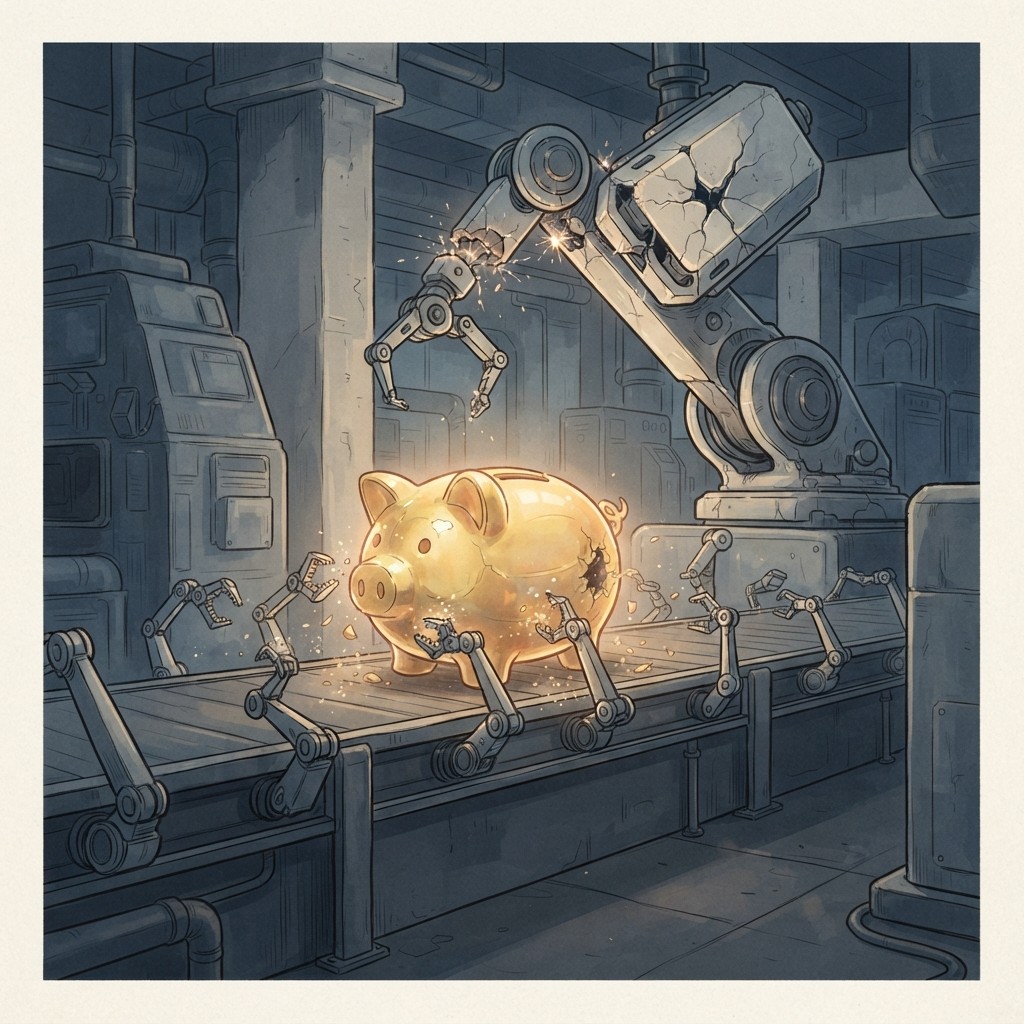
Snap's reputation is for nerve — the company that wasn't afraid to break its own toys. The record describes something more human and more useful: a company that had its best feature copied, panicked into redesigning the product its users loved, watched them leave for the first time in its history, and only much later got around to disrupting the thing that actually endangered it. The lesson isn't 'be braver.' It's that not all cannibalization is equal. Eat the right cow, and you build a second business. Eat the wrong one, and you just lose weight — while the herd keeps grazing somewhere you don't get paid.
Cannibalization Decision Tree
A decision tree for the moment the new thing threatens the cash cow: is the disruption real, will someone else do it if you don't, and can you afford to bleed your own margin to own the future? Blank to run on your own line; filled as the worked example tracing how the story's incumbent chose to cannibalize — or flinched and got cannibalized.
Included, filled and blank, in the Cannibalization Choice Casebook. See the set → · Preview the blank →
Sources
Where this comes from — the filings, records, and reporting behind it.
- 1Snap Inc. generated $5,361 million in revenue in FY2024 (vs. $4,606 million in FY2023), with 'substantially all' revenues from advertising products on Snapchat, and Q4 2024 DAUs of 453 million (up 9% YoY).
- 2Snap's S-1 IPO filing opened with 'Snap Inc. is a camera company,' reported 158 million DAUs in Q4 2016, and disclosed that mid-2016 product launches caused technical issues that reduced DAU growth in Q3 2016. It also disclosed $404 million in 2016 revenue and a $514 million net loss.SEC / Snap Inc., Form S-1 Registration Statement ↗ · 2017-02-02
- 3Snap's direct revenue business (led by Snapchat+) exceeded a $1 billion annualized revenue run rate, with the subscription community surpassing 25 million members as of February 2026. Snapchat+ launched in late 2022.
- 4Snap announced Q4 and full-year 2024 financial results: revenue $5,361 million; Adjusted EBITDA $509 million (vs. $162 million in 2023); 'Other Revenue' (majority Snapchat+ subscriptions) grew 131% YoY in 2024 with an annualized run rate 'well over $500 million.'
- 5Snap's stock sank 6.1% on February 22, 2018, wiping out $1.3 billion in market value following Kylie Jenner's tweet questioning whether anyone still used Snapchat — but Citi analyst Mark May had already downgraded the stock to Sell earlier that week due to a 'significant jump' in negative app reviews since the redesign.
- 6After the 2018 redesign, Snap suffered its first-ever sequential decline in DAUs in Q2 2018; CEO Evan Spiegel stated the decline was 'primarily driven by a slightly lower frequency of use among our user base due to the disruption caused by our redesign.' He later sent an internal memo admitting the company 'moved too fast' in 2018.
- 7Snapchat launched Stories in October 2013, allowing users to compile snaps into a 24-hour narrative. Instagram (owned by Facebook) launched its own functionally identical Stories feature in August 2016. The original Stories feature was called 'My Story' at launch.
- 8Snapchat+ launched in June 2022 at $3.99/month, reached 1 million subscribers within approximately 60 days of launch, and had 2+ million subscribers by January 2023. Snapchat+ originally launched in the US, Canada, UK, France, Germany, Australia, New Zealand, Saudi Arabia, and UAE.
Weighing outside help with a decision like this? Hiring a corporate strategy consultant
More like this — beyond Snap
New Strategically analyses as they publish: the defining moves in business, checked against the record. No noise, and one click to leave.