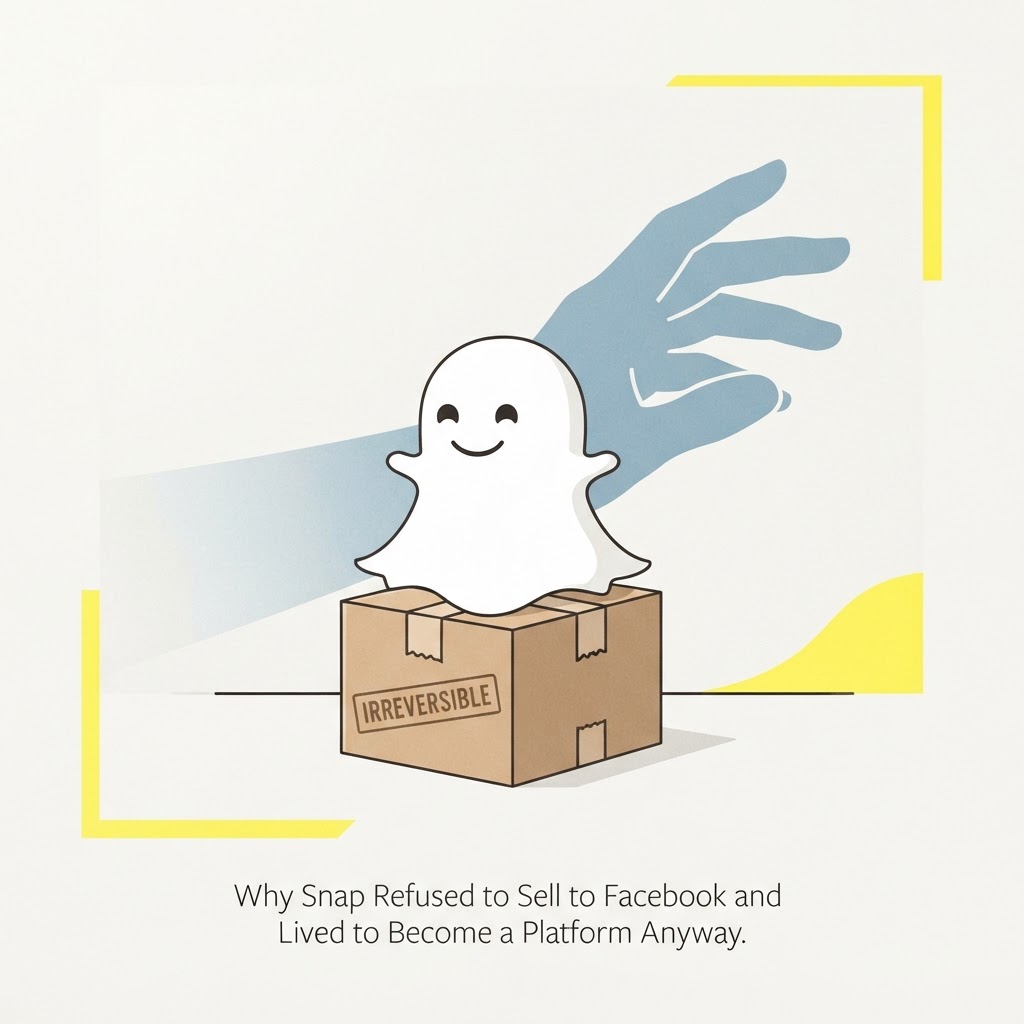
Pairs with the Counterfactual Timeline Builder — a ready-to-use strategy tool, filled for Snap. Included in the Counterfactual Casebook →
“What did the decision you did not take actually cost?”
In the fall of 2013, a 23-year-old who had left Stanford's product-design program before finishing was offered, by the largest social network on earth, somewhere north of three billion dollars in cash for an app that disappeared photos and earned zero revenue.13 He said no. The story practically tells itself: the visionary kid who saw what the suits couldn't, who held his nerve, who turned a fortune into a bigger one. It's a clean myth, and like most clean myths about founders, it has been sanded down until almost nothing true is left.
The version everyone remembers is that Evan Spiegel categorically rejected Facebook on principle, then turned down a $4 billion counter from Google, because he knew Snapchat was worth far more. Almost every load-bearing piece of that is shakier than the retelling admits. The original break by the Wall Street Journal in November 2013 reported that Spiegel was hoping Snapchat's numbers would grow enough by early 2014 to justify a larger valuation before he'd consider an acquisition or investment — a negotiating posture, not a moral stand.110 The Google number traces to a single tech writer, Om Malik, one day after the WSJ story, and has never been corroborated by Google or Snap.2 What Spiegel actually rejected, and why, looks much more like ordinary deal-making than destiny.
He wasn't rejecting three billion. He was waiting for more.
Start with the number, because the number is where the legend gets its weight. The figure was never '$3 billion.' The WSJ's language, relayed across every contemporaneous outlet, was '$3 billion or more' — an open ceiling.1 A leaked Sony email surfaced in December 2014 had Snapchat board member Michael Lynton, asked by Malcolm Gladwell whether the company was insane to spurn $3 billion, replying that if Gladwell knew the 'real number' he'd book them all a suite — implying the true figure was higher still.9 So the canonical headline understates the terms it's built on. When you hold out against an offer whose top end nobody has nailed down, you are not refusing money on principle. You are negotiating. The visionary-spurns-riches frame requires a firm 'no' to a firm number; the record gives us a soft maybe against a fuzzy one.
| The myth | The record | |
|---|---|---|
| The offer | A firm $3 billion | '$3 billion or more' — ceiling unspecified1 |
| The decision | Principled, categorical 'no' | Holding out for a better price in early 20141 |
| The Google counter | Confirmed $4 billion rejection | One writer's claim, never corroborated2 |
| The motive | Visionary foresight | 'We just loved what we were doing'4 |
Now the part the heroic version can't accommodate, because Spiegel himself supplies it. Asked years later why he held, he didn't reach for strategy. 'I wish I could say it was wisdom,' he said, 'but I think Bobby and I just loved what we were doing.'4 That is not a man describing a calculated bet on intrinsic value. It is a man describing the absence of a reason to leave — which is a very different thing, and a much rarer luxury than vision.
“I wish I could say it was wisdom but I think Bobby and I just loved what we were doing… Ultimately we were able to convince our investors too that our opportunity was much bigger over time.”4
The cash that let him say no had already cleared
Here is the mechanism the founder-genius myth skips entirely, and it's the only part that actually explains the decision. The reason most 23-year-olds take three billion dollars is not that they lack vision — it's that they are broke, and three billion dollars solves every problem a broke person has ever had. Spiegel was not broke. In an earlier funding round, he and Bobby Murphy had each cashed out roughly $10 million in secondary liquidity.4 That detail does all the work. Twenty million dollars between two founders is generational, never-work-again money. It converts a financial decision into a preference. You don't have to be wise to turn down a buyout when your downside is already a beachfront house; you just have to want to keep playing more than you want a bigger house.
This is why the secondary sale is the hidden hinge of the whole story. Vision is cheap and evenly distributed; founders are full of it. What's scarce is the financial position that lets vision survive contact with a nine-figure check. The $3-billion 'or more' offer was several times the $800 million valuation set at Snapchat's last priced round just months earlier, against zero revenue — though by late 2013 investors were already informally valuing the company well above that figure.3 A founder with a mortgage and a dwindling runway takes that and is right to. Spiegel could decline because the only thing on the table for him personally was upside — the catastrophe scenario had already been bought off. He wasn't braver than other founders. He was richer, earlier, with less to lose.
But it worked, didn't it?
The honest objection is the obvious one: who cares about the motive if the outcome was a triumph? Snap went public on March 2, 2017 at $17 a share, opened at $24, raised $3.4 billion, and at its $24 opening price was valued at about $33 billion — many times the offer he 'turned down.'813 On those numbers, the hold looks like one of the great calls in startup history, and the psychology behind it is a footnote. Except the numbers don't stop in 2017. By early 2024, Snap's market cap had fallen back to roughly $18 billion, below its IPO-day level — and at points its stock had traded below the $17 IPO price the company went out at, first closing under it in July 2017.1214 Hold that against a $3-billion-plus all-cash exit in 2013, compounded for a decade in literally anything else, and the supposedly obvious win turns murky. A cash exit is realized; a paper peak is a number on a screen you can't fully sell into. The triumphalist verdict quietly counts the IPO-day high and ignores the years on either side of it.
And there's a final irony the myth needs to bury. The thing that made Snap's refusal truly permanent wasn't Spiegel's nerve in 2013 — it was paperwork in 2017. Snap's IPO used a three-class share structure in which the public bought Class A stock with no votes at all, while Spiegel and Murphy held Class C shares carrying ten votes each.6 By the end of 2017, the two founders controlled about 94.6% of the company's voting power.7 After that, no unsolicited acquirer could buy Snap no matter how attractive the price, because the people who'd sell didn't have a vote and the people who had the votes wouldn't sell. The real 'no' to being acquired wasn't a brave phone call. It was a clause.
When a founder turns down a life-changing offer and the press calls it vision, check whether the founder was already financially safe. Secondary liquidity — cashing out a few million in an early round — quietly changes everything, because it converts a survival decision into a preference. The brave 'no' you admire is often a comfortable one, and the comfort came first. This cuts two ways. If you're a founder, the lesson isn't 'have nerve' — it's 'take some chips off the table early, so you can afford to hold.' If you're reading the legend, the lesson is that the most decisive variable in a founder's boldest moment is usually the least romantic one: how much money was already in the bank before the choice was offered.
Snap's refusal vindicates neither the heroic reading nor the foolish one. Spiegel wasn't a sage who saw a hundred-billion-dollar future the suits missed; the company that briefly approached that height also fell below the price it went public at. He was a young founder who loved his work, had already been made rich enough to keep doing it, and was holding out for a bigger number against an offer whose ceiling no one had set. The myth wants a moment of vision. The record offers something less flattering and more useful: a man who could afford to wait, dressed up afterward as a man who knew how to.
When the legend and the ledger disagree
Counterfactual Timeline Builder
A one-page canvas that runs two histories side by side: what actually happened, and the alternative that died at the fork. You pin the divergence point, trace each branch forward, and name the assumption that decided which one came true. Blank, it disciplines hindsight into a testable counterfactual instead of a what-if; filled, it shows the story's road-not-taken with enough rigor to argue about.
Included, filled and blank, in the Counterfactual Casebook. See the set → · Preview the blank →
Sources
Where this comes from — the filings, records, and reporting behind it.
- 1On November 13–14, 2013, the Wall Street Journal first reported that Facebook offered to acquire Snapchat for '$3 billion or more' in an all-cash deal, citing unnamed sources familiar with the offer, and that Spiegel declined.
- 2Tech writer Om Malik claimed on November 15, 2013 — one day after the WSJ report — that Google had separately offered $4 billion and Spiegel again declined. This claim originated with Malik alone and has not been independently corroborated.
- 3At the time of Snapchat's last funding round before the offer (June 2013), Snapchat was valued at only $800 million — meaning the $3B offer represented roughly a 3.75x premium to its then-current valuation, and the company had zero revenue.
- 4Spiegel's own primary-source explanation for the refusal: 'I wish I could say it was wisdom but I think Bobby and I just loved what we were doing… Ultimately we were able to convince our investors too that our opportunity was much bigger over time.' He also credited early secondary liquidity ($10M each) as enabling the founders to 'swing for the fences' without financial desperation.
- 5Spiegel's additional Forbes-attributed quote on the refusal: 'There are very few people in the world who get to build a business like this. I think trading that for some short-term gain isn't very interesting.'
- 6Snap's 2017 S-1 filing with the SEC confirms the three-class share structure: Class A (no votes, sold publicly), Class B (1 vote/share), and Class C (10 votes/share, held exclusively by Spiegel and Murphy), giving the co-founders control over all material corporate decisions regardless of public shareholder sentiment — structural insulation that made an unsolicited acquisition essentially impossible post-IPO.SEC / Snap Inc., Snap Inc. Form S-1 ↗ · 2017-02-02
- 7Snap's 10-K for fiscal year 2017 confirms that as of December 31, 2017, Spiegel and Murphy held Class C shares representing approximately 94.6% of total voting power, and that Spiegel alone received an additional RSU for 37,447,817 Class C shares upon IPO closing.
- 8Snap's IPO on March 2, 2017 priced at $17/share, opened at $24, raised $3.4 billion, and initially valued the company at approximately $24 billion — but by early 2024 the market cap had fallen to ~$18 billion, below the IPO-day valuation, undermining triumphalist 'the refusal paid off' narratives.
- 9In leaked Sony emails (December 2014), Malcolm Gladwell asked Snapchat board member and Sony Entertainment CEO Michael Lynton whether Snapchat was insane to turn down $3 billion, and Lynton replied that if Gladwell knew the 'real number' he would book everyone a suite — implying Facebook's offer was higher than the reported $3 billion.
- 10Sources told the Wall Street Journal at the time that Spiegel was holding out for much more, hoping Snapchat's numbers would grow enough by early 2014 to justify an even larger valuation before considering an acquisition or investment.
- 11Snap stock fell below its $17 IPO price for the first time in July 2017, hitting an all-time-then low of $16.99 at market close, meaning IPO buyers had lost money.
- 12Snap's market capitalization as of early March 2024 was about $18 billion, below its 2017 IPO-day level.Macrotrends, Snap Net Worth / Market Cap 2016-2024 ↗ · 2025-01-08
- 13At its $24 opening price on March 2, 2017, Snap's market capitalization was about $33 billion.
- 14Snap stock closed at $16.99 on July 10, 2017, falling below its $17 IPO price for the first time, meaning IPO buyers had lost money.
Weighing outside help with a decision like this? Hiring a commercial due diligence provider
More like this — beyond Snap
New Strategically analyses as they publish: the defining moves in business, checked against the record. No noise, and one click to leave.