Pairs with the Cannibalization Decision Tree — a ready-to-use strategy tool. Included in the The Cannibalization Choice Casebook →
In the summer of 2023, Lyft put feelers out to sell its entire micromobility business, and buyers came knocking.7 Fourteen months later it did the opposite: it kept the bikes, killed the scooters in a few cities, renamed the whole thing Lyft Urban Solutions, and its CEO said publicly that it would be 'insane' not to go all in on bikeshare.7 On the surface this reads like a confused company lurching between exit and commitment. It is the opposite. Lyft was deciding, line by line, which parts of its sprawl actually make money — and only keeping those.
The official narrative is that Lyft retreated. It dumped self-driving in a fire sale, fled the scooter wars it never should have entered, and crawled back to its core ride-hailing app, beaten. Almost none of that survives contact with the filings. Lyft did not flee. It pruned — and got paid for the pieces it cut.
Selling self-driving wasn't surrender. It was a capital raise.
The standard read of the Level 5 sale is that Lyft couldn't win the autonomy race, so it bailed. But look at what it actually got. In April 2021, Toyota's Woven Planet agreed to acquire Lyft's self-driving division for total proceeds of roughly $515 million — about $165 million upfront and $350 million over five years.1 Lyft booked a pre-tax gain of $119.3 million on the transaction.1 A company in retreat does not book a nine-figure gain on the way out the door. It takes a write-down. Lyft took a profit, plus multi-year commercial agreements that let it keep feeding fleet data into Woven Planet's automated-driving work without paying to build the cars itself.2 The over-300 engineers went to Toyota — a buyer with the balance sheet to fund a decade of capital burn that Lyft never had.3
That is the whole logic. Autonomy is a money pit that only pays off at a scale and time horizon a perpetually thin-margined ride-hailer cannot finance. Rather than light cash on fire defending a position it couldn't win, Lyft sold the position, kept the data access, and converted a cost center into half a billion dollars of capital and a partnership. Calling that a defeat is like calling a homeowner who sells a fixer-upper to a developer 'forced out of real estate.'
“It would be insane not to go all in on bikeshare.”7
The bikes that pay rent versus the bikes that beg for it
Here is the distinction the 'retreat' story collapses. There are two completely different micromobility businesses hiding under one word. Dockless scooters and free-floating bikes are a consumer land grab: you flood a city with hardware, hope riders show up, and absorb the theft, the vandalism, the regulatory whiplash, and the brutal unit economics in between. Docked bikeshare is something else entirely — it's a B2B infrastructure business. Cities sign multi-year contracts, the docks fix where the assets live, and the revenue is contractual rather than hopeful. When Lyft acquired Motivate in 2018, it didn't just buy bikes; it bought the largest U.S. bike-sharing operation and the city relationships that come with it.4 When it acquired PBSC Urban Solutions in 2022, it bought the equipment and technology supply chain underneath those systems.8
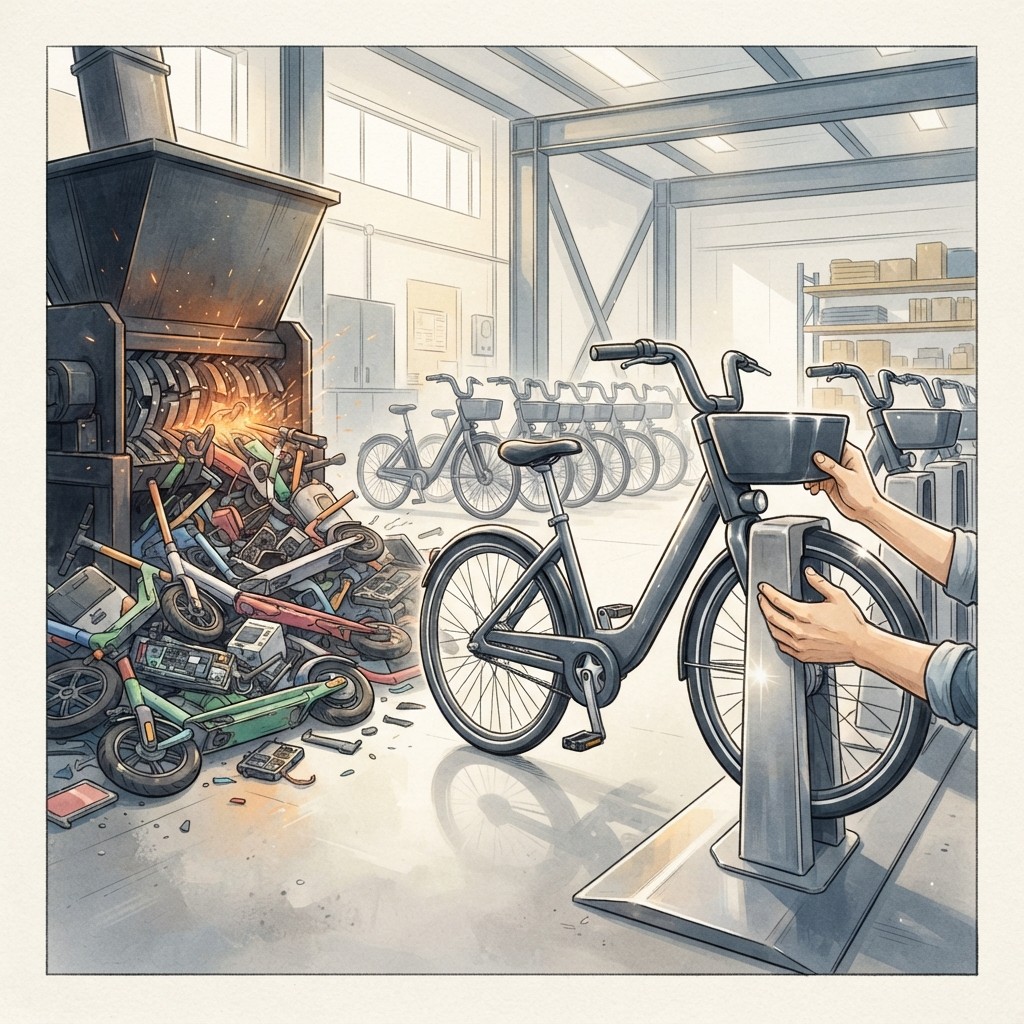
So in September 2024, Lyft did not exit micromobility. It filed with the SEC to stop standalone dockless bikes and scooters, rebranded the unit Lyft Urban Solutions, and laid off about 1% of its roughly 3,000 employees.6 It cut the speculative consumer mode and kept the contracted infrastructure one. Same division. Opposite economics.
| Dockless scooters & bikes | Docked bikeshare | |
|---|---|---|
| Customer | Walk-up consumer, no commitment | City, on a multi-year contract |
| Revenue | Hopeful, per-ride | Contractual, recurring |
| Asset risk | Theft, vandalism, regulation | Fixed docks, defined service area |
| Lyft's 2024 call | Stopped | Doubled down |
The restructuring carried $34M–$46M in charges, mostly the cost of disposing of the dockless assets, and was projected to lift adjusted operating income by roughly $20 million a year by the end of 2025.6 Read that as the price tag on the pruning: a one-time charge to amputate the loss-making mode, in exchange for a permanent annual profit improvement. That is not what failure looks like on a 10-K. It's what discipline looks like.
The lazy version of strategy treats 'micromobility' or 'autonomy' as a single yes-or-no bet — in or out, win or lose. The disciplined version asks the unit-economics question one mode at a time: which version of this business has a customer who signs a contract, an asset that doesn't walk away, and revenue that recurs? Lyft kept docked bikeshare because cities pay for it, and dropped dockless because riders only sometimes do. The trap is letting press narrative do your portfolio review for you. 'They retreated from bikes' and 'they cut the bikes that lost money and kept the ones that earn it' describe the same filing — but only one of them is a strategy. Sell the loser to someone who can afford it; keep the toll that the city pays every year.
But isn't this just a struggling company dressing up its losses?
The fair objection is that this is too generous — that 'portfolio pruning toward profitability' is the polite phrase every cash-strapped company reaches for when it's forced to retrench, and that Lyft only sold Level 5 and cut scooters because it couldn't afford them, not because it cleverly chose to. There's real truth there. The decisions were almost certainly pressured by Lyft's thin margins; a company swimming in cash might have funded the moonshots longer. And the fact that Lyft was shopping the entire micromobility unit in 2023 before reversing course suggests the strategy crystallized partly in hindsight.7 But pressure and discipline are not opposites — constraint is precisely what forces the honest unit-economics question that flush companies dodge for years. The test isn't whether the moves were comfortable. It's where the cash and the assets ended up. A retreating company burns capital defending dying positions. Lyft sold one for $515 million and a gain, and kept the one with city contracts behind it.1 You don't have to admire the constraint to read the result correctly.
The word 'retreat' carries a verdict inside it — it assumes the goal was breadth, and that narrowing is loss. But Lyft was never going to win autonomy against companies with infinite balance sheets, and dockless scooters were a race to lose money fastest. What it could own was the unglamorous middle: the bike docks a city pays for, year after year, on a contract. So it sold the dream that cost money and kept the infrastructure that earns it. The retreat was never a retreat. It was a company finally deciding which of its bets it actually wanted to be holding when the music stopped — and quietly handing the rest to people who could afford them.
Cannibalization Decision Tree
A decision tree for the moment the new thing threatens the cash cow: is the disruption real, will someone else do it if you don't, and can you afford to bleed your own margin to own the future? Blank to run on your own line; filled as the worked example tracing how the story's incumbent chose to cannibalize — or flinched and got cannibalized.
Included, filled and blank, in the The Cannibalization Choice Casebook. See the set → · Preview the blank →
Sources
Where this comes from — the filings, records, and reporting behind it.
- 1Lyft signed an agreement on April 26, 2021 for Woven Planet (Toyota subsidiary) to acquire its self-driving vehicle division, Level 5, for total proceeds of approximately $515 million ($165 million upfront, $350 million over five years); Lyft recognized a pre-tax gain of $119.3 million in Q3 2021.
- 2Lyft officially announced the Level 5 sale to Woven Planet on April 26, 2021; the deal included multi-year non-exclusive commercial agreements between Lyft and Woven Planet for fleet data to accelerate automated-driving safety.
- 3Toyota's Woven Planet confirmed closing the Level 5 acquisition on July 20, 2021, absorbing over 300 engineers and specialists and taking over Level 5's offices in Silicon Valley and London.
- 4Lyft completed its acquisition of Motivate's bike-sharing business in November 2018, becoming the largest bike-sharing company in the U.S.; the deal was reported by multiple outlets at $250 million, though Lyft never officially confirmed the price.
- 5Sources told Axios the Motivate deal was for $250 million, though Lyft declined to comment on the price.
- 6On September 4, 2024, Lyft filed with the SEC to restructure its micromobility division: stopping standalone dockless bikes and scooters, renaming the unit Lyft Urban Solutions, laying off ~1% of its ~3,000 employees, expecting $34M–$46M in charges (mostly asset disposal), and projecting ~$20 million annual adjusted operating income improvement by end of 2025.
- 7In summer 2023, Lyft was contemplating the sale of its micromobility business after receiving strong inbound interest from prospective buyers; by September 2024 it reversed course, doubling down on docked bikeshare. CEO David Risher stated cost savings from the restructuring would be ~$20 million per year.
- 8Lyft acquired PBSC Urban Solutions (global bike-share equipment and technology supplier) in 2022; terms were not disclosed at announcement, and Lyft said it would release financial details in a future SEC filing.
More like this — beyond Lyft
New Strategically analyses as they publish: the defining moves in business, checked against the record. No noise, and one click to leave.