Pairs with the Cannibalization Decision Tree — a ready-to-use strategy tool, filled for Fox. Included in the The Cannibalization Choice Casebook →
In March 2019, Disney handed over $71.3 billion for the bulk of 21st Century Fox — the movie studio, the international networks, the Hulu stake, the back catalog.1 What it could not buy, no matter how much it offered, was the part with Fox's name on the building: the broadcast network, Fox News, and Fox Sports. Those were carved out the day before the sale closed and lit up as a separate company, Fox Corporation. The press wrote it up as a clever survivor's gambit — Rupert Murdoch keeping the live, can't-skip-it assets and cashing out of everything Netflix could undercut. It is a tidy story. It is also mostly wrong about who did the choosing.
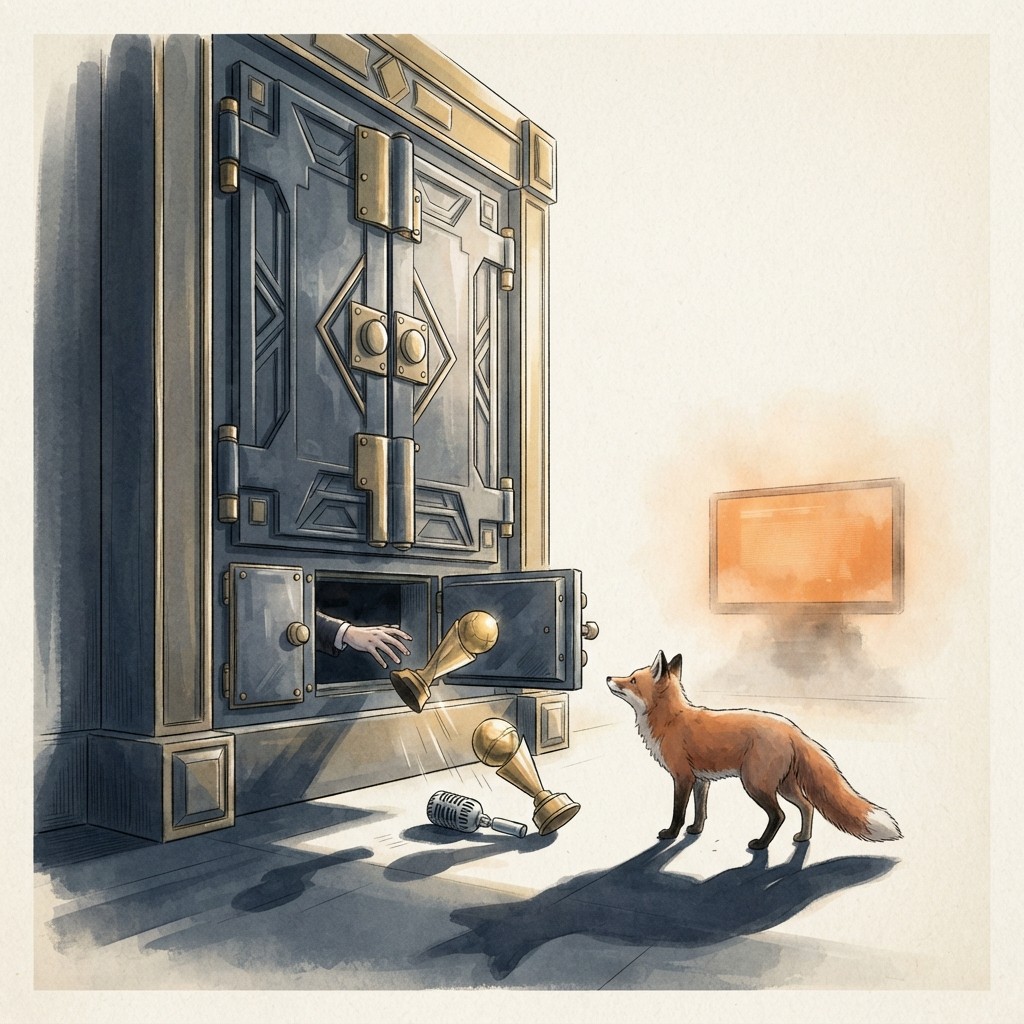
The official story: Fox boldly elected to focus on live news and sports while selling its entertainment assets to Disney. The real story: the FCC would not let Disney, which already owned ABC, also own a second over-the-air broadcast network — so the broadcast assets had to be left on the table, and Fox was what remained.29 The pivot wasn't a plan. It was a leftover.
“The spin-off separated 21st Century Fox's television broadcasting, news, and sports businesses into Fox Corporation; the broadcast networks could not be transferred to Disney under applicable regulations.”2
The constraint that turned out to be a moat
Here is the part that makes this more than a footnote about regulators. Fox was handed a portfolio it didn't fully design — and the portfolio happened to be the one thing streaming couldn't strip-mine. Scripted dramas, kids' shows, and movie libraries all became commodities the moment a thousand titles sat one click away for $15 a month. But you cannot binge a Sunday game on a Wednesday. You cannot pause an election night and watch it next year. Live content is perishable, and perishable content carries pricing power, because the value collapses to zero the instant it's over. Fox's accidental inheritance was the slice of television that has to be watched now — and 'now' is the only thing on-demand can't replicate. The constraint that defined the company also fenced off its competitive ground.
The numbers tell you the strategy held. In 2024, sixteen of Fox's NFL games landed among the hundred most-watched broadcasts in the country, and the NFC Championship between the Lions and 49ers pulled 56.3 million viewers — Fox's single biggest draw of the year.6 No drama, no franchise, no streaming exclusive came close. The Cable Network Programming segment alone brought in $5.96 billion in fiscal 2024, with advertising buoyed by the Euros and Copa América even as general-entertainment ratings on the FOX network sagged.5 The pattern is unmistakable: the live stuff carries the company, and the scripted stuff bleeds. Fox didn't pick its hand. It just played the only winning cards it was dealt.
| Went to Disney | Stayed with Fox | |
|---|---|---|
| Type of content | Scripted film & TV, libraries | Live news & sports |
| Shelf life | Watchable any time, forever | Worthless the moment it ends |
| Exposure to streaming | Direct — substitutable | Insulated — can't be binged |
| Why it landed there | Disney wanted it | Regulators wouldn't let Disney have it |
The $2.25 billion-a-year cost of owning the can't-skip moat
A moat made of live rights has a catch: you don't own the rights. You rent them, and the landlord is the NFL. In March 2021 Fox locked in an 11-year deal through the 2033 season for its NFC Sunday package, plus Super Bowls and Christmas Day games — paying roughly $2.2 to $2.25 billion a year.34 Across all its partners the league collected about $105 billion.4 That is the price of standing on perishable ground: the asset that can't be commoditized also can't be owned outright, and the seller knows exactly how badly you need it. Fox has already said out loud that it may have to 'rebalance' its sports portfolio when the NFL's opt-out clauses come due after 2029.8 Translation: the rent is going up, and Fox is bracing.
Live content people will pay for — on a screen Fox doesn't own
Which brings us to the bet that reveals what Fox actually fears. On June 15, 2026, Fox agreed to buy Roku at roughly $22 billion enterprise value — $160 a share, in cash and Fox stock, backed by $12 billion in committed bridge financing from Morgan Stanley.7 Read that against the NFL math and the logic snaps into focus. Fox has the content people refuse to skip. What it has never had is the screen they watch it on. As cable bundles thin out, a network with the best live programming and no direct path to the viewer is a toll collector with no road of its own. Roku is the road — the streaming gateway, the home screen, the ad platform that puts Fox between its content and the living room without paying a cable operator to stand in the middle. Live content is the product. Distribution is the problem live content can't solve by itself. Fox is spending its balance sheet to buy the missing half.
The trap in this story is mistaking the origin of an advantage for its quality. Fox didn't choose live news and sports — the FCC left them on the table when Disney bought everything else. But where the moat came from matters less than whether you defend it. Fox took a regulatory leftover and turned it into the one corner of television streaming can't flatten, then spent eleven years and $2.25 billion a year securing the rights that prove it. The lesson for any operator handed a constrained portfolio: don't argue with how you got here. Find the part of what's left that the market can't substitute, and build on exactly that. Constraint and strategy are not opposites — sometimes the regulator picks better than the strategist would have.
Isn't this just a survivor dressing up its limits?
The fair objection is that this reads too neatly — that calling a forced spin-off a 'moat' is just flattering a company that got left with the leftovers. There's truth in it. Fox didn't end up with the regional sports networks that once carried its name — those had gone to Disney as part of the broader 21CF acquisition and were then sold to a Sinclair-led group under a DOJ-mandated divestiture consent decree.10 A company genuinely confident in live sports doesn't pass on regional sports inventory. So part of the 'deliberate focus' is making a virtue of necessity. But the steelman cuts the other way too: necessity and strategy aren't mutually exclusive, and the results are real. The live assets out-earn and out-rate everything Fox kept, and the Roku bet is the move of a company that understands its actual weakness — distribution, not content. You don't spend $22 billion plugging a hole you don't believe is there. The honest read is the one in the middle: Fox didn't choose this hand, but it has played it like a company that knows which cards win.
The popular story gives Fox too much credit for foresight and not enough for adaptation. It never set out to become the live-only network; the FCC made it one. What it did next was the real strategy — recognizing that the assets it couldn't sell were the assets streaming couldn't kill, paying through the nose to keep them, and now betting its balance sheet on the distribution layer that turns can't-skip content into a business that reaches the screen directly. The regulator picked the ground. Fox is still deciding whether it can afford to hold it.
When the constraint becomes the strategy
Cannibalization Decision Tree
A decision tree for the moment the new thing threatens the cash cow: is the disruption real, will someone else do it if you don't, and can you afford to bleed your own margin to own the future? Blank to run on your own line; filled as the worked example tracing how the story's incumbent chose to cannibalize — or flinched and got cannibalized.
Included, filled and blank, in the The Cannibalization Choice Casebook. See the set → · Preview the blank →
Sources
Where this comes from — the filings, records, and reporting behind it.
- 1Fox Corporation was formed as a spin-off of 21st Century Fox's television broadcasting, news, and sports assets on March 19, 2019; 21CF's remaining assets were acquired the next day by Disney for $71.3 billion.
- 2FCC regulations required that the Disney-Fox deal exclude Fox's broadcast TV networks, which were spun off into Fox Corporation; the spin-off was not a purely voluntary strategic choice but a regulatory necessity.
- 3Fox Corporation announced an 11-year NFL media rights agreement through the 2033 season on March 18, 2021, covering NFC Sunday games, four Super Bowls, Christmas Day games, and expanded digital rights via Tubi; Fox dropped Thursday Night Football after 2022.
- 4The NFL's total media rights renewals across all partners (CBS, Fox, NBC, ESPN, Amazon) from 2023–2033 amount to approximately $105 billion; Fox currently pays approximately $2.2–$2.25 billion per year for its NFC package.
- 5Fox Corporation's Cable Network Programming segment reported full-year fiscal 2024 revenues of $5.96 billion; advertising revenues in Q4 FY2024 were supported by UEFA European Championship and Copa América broadcasts at Fox Sports and growth at Tubi, offset by lower FOX Network ratings.
- 616 of Fox's NFL games were among the top 100 most-watched U.S. broadcasts of 2024; the NFC Championship (Lions vs. 49ers) drew 56.3 million viewers, Fox's biggest draw of the year.
- 7On June 15, 2026, Fox Corporation announced a definitive agreement to acquire Roku for $160 per share in a combination of cash and Fox Class A common stock, valuing Roku at approximately $22 billion enterprise value; Fox obtained $12 billion in committed bridge financing from Morgan Stanley; the deal is expected to close in the first half of 2027 with $400 million in projected annual cost synergies.
- 8Fox currently pays $2.25 billion per year for NFL rights and has said publicly it may need to 'rebalance' its sports rights portfolio to absorb potential cost increases when the NFL exercises opt-out clauses after 2029.
- 9FCC rules effectively prohibit a merger between any two of the big four broadcast television networks — ABC, CBS, Fox, and NBC — which is why Disney, already owning ABC, could not acquire Fox Broadcasting.
- 10The Fox regional sports networks were acquired by Disney as part of the 21st Century Fox deal, then sold to Sinclair for $9.6 billion under a DOJ-required divestiture consent decree; Fox Corporation was not a party to that sale.
More like this — beyond Fox
New Strategically analyses as they publish: the defining moves in business, checked against the record. No noise, and one click to leave.