Pairs with the Cannibalization Decision Tree — a ready-to-use strategy tool, filled for Fox. Included in the The Cannibalization Choice Casebook →
In December 2017, Rupert Murdoch agreed to sell the heart of his empire — the studio that made Avatar, the FX cable network, a third of Hulu, the whole on-demand library — to Disney for about $52.4 billion in stock.1 What he kept was the leftovers: a broadcast network, a cable news channel, a couple of sports feeds. The press release called the survivor 'a growth company centered on live news and sports brands.'1 Within two years that line would be retold as one of the great strategic calls in modern media — the man who saw the streaming wars coming and refused to fight them. It is a wonderful story. It is also, mostly, written backwards.
The official version is that Murdoch surveyed the future, concluded that on-demand content was about to become a money pit, and deliberately chose to cannibalize his own entertainment business to stand on the high ground of live programming. The real version is that Fox kept what it kept because that is what Disney declined to buy — and the price it sold for had almost nothing to do with strategy and everything to do with a bidding war.
The $71 billion number that nobody planned
Start with the figure everyone quotes. 'Murdoch sold Fox to Disney for $71.3 billion' is the line in a thousand summaries, and it is wrong about the most basic fact in the story. The deal Murdoch and Bob Iger actually shook hands on was an all-stock transaction worth roughly $52.4 billion.12 The price jumped only because Comcast crashed the party in June 2018 with an all-cash counter-bid of about $65 billion, forcing Disney to come back with $38 a share — a number that pushed the total to $71.3 billion.2 That is a 36% premium produced not by any insight about content libraries, but by a rival who wanted the same assets and had cash to throw. Murdoch did not engineer that outcome. He benefited from it.
This matters because the bidding war is the tell. A company executing a clean, foresighted pivot does not need a competitor to validate its price. The Comcast fight reveals what Disney and Comcast both understood and what the 'foresight' narrative quietly forgets: the valuable, fought-over assets were the on-demand ones. The studio, FX, the Hulu stake — those were the prize. Live news and sports were not the crown Murdoch chose to keep. They were the part nobody was bidding for.
Fox kept exactly what Disney didn't want
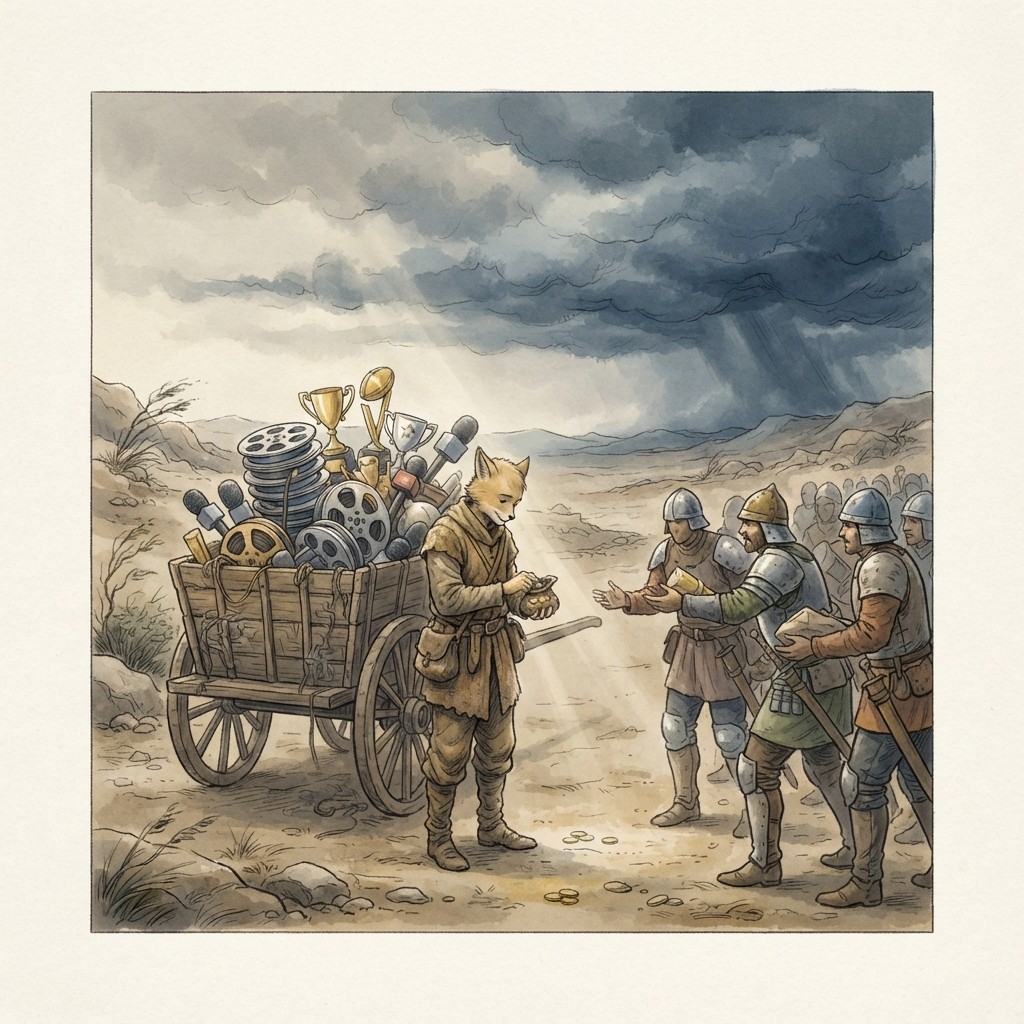
Look at how the pile was actually split. Into the new Fox Corporation went the Fox broadcast network, the Fox television stations, Fox News, Fox Business, FS1, FS2, Fox Deportes, and the Big Ten Network. Over to Disney went the 20th Century Fox film and television studios, the FX networks, the National Geographic stake, Star India, and 21st Century Fox's 30% slice of Hulu.5 Notice the logic of the cut. Disney took everything that could feed a streaming library — finished films, scripted series, a Hulu seat at the table. Fox was left holding the things you cannot put in a vault and watch later: a wrestling match, a presidential debate, a Sunday football game. The division wasn't a thesis Fox imposed. It was the residue of Disney's shopping list.
| To Disney (the prize) | To New Fox (the residue) | |
|---|---|---|
| What it is | On-demand libraries & studios | Live linear programming |
| Examples | 20th Century studios, FX, Hulu stake, Star India | Fox network, Fox News, FS1, Big Ten Network |
| Streaming value | The fuel for a future SVOD service | Hard to replay, hard to stockpile |
| Who wanted it | Disney and Comcast, in a bidding war | Whoever was left holding it |
Even the sports story gets simplified into fiction. The popular line is that Fox shrewdly held onto its regional sports networks as part of its live-sports bet. It did no such thing. The regional Fox Sports Networks went to Disney with the rest of the entertainment assets and were later sold off to Sinclair.5 What Fox actually kept was a narrow band of national sports rights, not the deep regional empire the legend implies. The 'live sports focus' was real in shape but thin in substance — and even thinner as a piece of advance planning.
The mechanics of a strategy that announced itself a year late
The transaction itself shows how mechanical the survivor was. On March 19, 2019, 21st Century Fox spun Fox Corporation off to its own shareholders — 0.263183 of each old share converting into a third of a new Fox Corp share — and the Disney acquisition of everything else closed the very next day, March 20.43 Fox Corporation was, quite literally, the leftover entity created the day before the sale completed. Its first annual report then dutifully listed 'Maintain leading positions in live news, live sports and quality entertainment' as goal number one.6 A spun-off shell describing the assets it had been handed is not a cannibalization thesis. It is a company reading its own inventory back to investors.
The genuine foresight claim arrived years afterward, and from the people with the most to gain from making the past look deliberate. In 2022, Lachlan Murdoch told an investor conference that Fox had been 'very happily on the sidelines' of the streaming wars, that it had refused to spend 'billions of dollars propping up an SVOD service' or to 'artificially put sports into an SVOD service to keep subscription levels up.'7 By 2025, Fox Sports CEO Eric Shanks was crediting Rupert and Lachlan with having 'connected the dots' on streaming and linear TV, noting that because Fox had 'sold off pretty much all of the on-demand assets,' it was perfectly positioned as a live destination.8 Both statements are true descriptions of where Fox ended up. Neither is evidence that Fox aimed there. This is the correction device in its purest form: a consequence, retold as an intention.
“We've been very happily on the sidelines... We haven't spent billions of dollars propping up an SVOD service.”7
Doesn't being right by accident still count as being right?
Here is the honest counter, and it is strong: who cares whether the strategy was planned, if it worked? Disney, Comcast, Warner, and the rest poured billions into subscription streaming and bled for years; Fox stayed out of that fire and kept producing the one kind of content that streaming cannot stockpile or skip — the live event you have to watch now or miss. By that measure, the accidental position has aged into a deliberate-looking advantage, and a CEO who lands on high ground by luck is still standing on high ground.
Fair. But two things keep the foresight myth from being harmless. First, it gets the lesson exactly backwards. The takeaway 'have the vision to avoid the streaming wars' is useless, because Fox didn't have it; the real takeaway is subtler and far more useful — when a forced sale strips you down, the assets nobody bids for can turn out to be the ones with the most durable economics. Second, the 'sidelines' framing erases what Fox actually did do. It didn't abstain from streaming at all. It launched Fox Nation as an OTT service in that same first fiscal year.6 What Fox avoided was the specific trap of expensive subscription video-on-demand — not streaming itself. The myth flattens a precise, interesting distinction into a heroic abstraction. And heroic abstractions are exactly the kind of strategy advice that gets the next company killed.
When a company's clearest articulation of its 'plan' arrives years after the outcome — from the executives who benefit most from looking prescient — treat it as a hypothesis, not a record. Trace the decision back to the contemporaneous documents: the press release, the deal terms, who was bidding against whom. Outcomes get narrated into intentions because a deliberate win is worth more reputationally than a lucky one. The useful question is never 'did it work?' It's 'what did they actually control, and what did the bidding war, the buyer's appetite, or the calendar decide for them?' Strip the retrofit away, and you can usually see which part was judgment and which part was just the residue left on the table.
Fox didn't win the streaming wars by sitting them out. It got handed the assets a richer buyer didn't want, at a price a hungrier rival inflated, and then watched the rest of the industry set fire to the very content it had just sold. The high ground was real. The map that supposedly led there was drawn afterward. And that is the part worth keeping: sometimes the smartest-looking move in a portfolio is just the piece the auction left behind — and the only genius required was to be standing in the right doorway when everyone else rushed past it toward the prize.
When the strategy is written after the fact
Cannibalization Decision Tree
A decision tree for the moment the new thing threatens the cash cow: is the disruption real, will someone else do it if you don't, and can you afford to bleed your own margin to own the future? Blank to run on your own line; filled as the worked example tracing how the story's incumbent chose to cannibalize — or flinched and got cannibalized.
Included, filled and blank, in the The Cannibalization Choice Casebook. See the set → · Preview the blank →
Sources
Where this comes from — the filings, records, and reporting behind it.
- 1On December 14, 2017, 21st Century Fox announced it would spin off its news, sports, and broadcast businesses into a new 'Fox' and combine its film, cable entertainment, and international TV assets with Disney for approximately $52.4 billion in stock. The announcement explicitly described the new Fox as 'a growth company centered on live news and sports brands.'
- 2The original December 2017 Disney-Fox deal was an all-stock transaction worth approximately $52.4 billion (0.2745 Disney shares per 21CF share). After Comcast mounted an all-cash bid of $65 billion in June 2018, Disney raised its offer to $71.3 billion ($38/share in cash or stock). Fox shareholders and Disney shareholders approved the amended deal on July 27, 2018.
- 3The Disney acquisition of 21CF became effective March 20, 2019. Each 21CF share was exchangeable for $51.572626 in cash or 0.4517 Disney shares. Disney also acquired approximately $19.8 billion of 21CF cash and assumed approximately $19.2 billion of 21CF debt, implying a total transaction value of approximately $71 billion.
- 4On March 19, 2019 — one day before the Disney deal closed — 21st Century Fox distributed to its shareholders all issued and outstanding common stock of Fox Corporation on a pro-rata basis (0.263183 of each 21CF share was exchanged for 1/3 of one Fox Corp share). Fox Corporation became a standalone publicly traded company at that moment.
- 5Assets spun into Fox Corporation included: Fox Broadcasting Company, Fox Television Stations, Fox News Channel, Fox Business Network, FS1, FS2, Fox Deportes, and the Big Ten Network. Assets sold to Disney included: 20th Century Fox film and TV studios, FX Networks, National Geographic Partners (73% stake), Star India, and 21CF's 30% stake in Hulu. The Fox Sports Networks (regional sports channels) were NOT retained by Fox Corp — they were acquired by Disney and later sold to Sinclair.
- 6Fox Corporation's first annual 10-K (FY2019) stated its first strategic goal as 'Maintain leading positions in live news, live sports and quality entertainment,' and noted investment in news, sports, and original entertainment programming as areas of distinct competitive advantage. Fox Nation, an OTT streaming service, launched in fiscal 2019.
- 7Lachlan Murdoch publicly stated Fox had been 'very happily on the sidelines' of the SVOD streaming wars, had not spent 'billions of dollars propping up an SVOD service,' and had not felt the need to 'artificially put sports into an SVOD service to keep subscription levels up.' This was attributed-to-source at the MoffettNathanson Media and Communications Summit, May 2022.
- 8Fox Sports CEO Eric Shanks stated that Rupert and Lachlan Murdoch 'connected the dots' between on-demand streaming and the future of linear television, and that because Fox 'sold off pretty much all of the on-demand assets — the TV studio, the movie studio, a lot of the entertainment cable channels — to Disney,' Fox was positioned as a live-events destination. This is a retrospective attribution of foresight, not a contemporaneous strategic document.
More like this — beyond Fox
New Strategically analyses as they publish: the defining moves in business, checked against the record. No noise, and one click to leave.