Pairs with the Profit-Engine Map — a ready-to-use strategy tool. Included in the Money Machine Casebook →
“Where does the money actually come from, and who sets the rate it comes in at?”
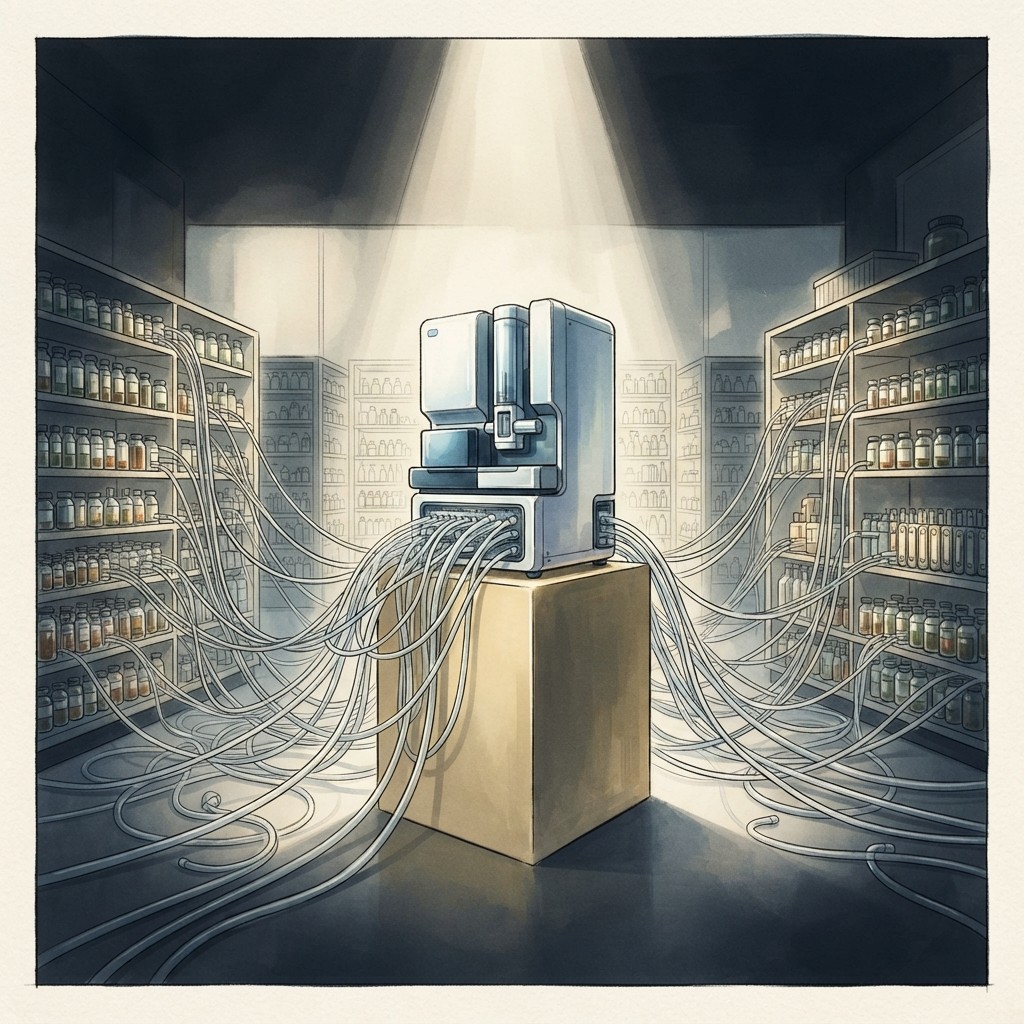
A scientist buys a mass spectrometer once, maybe once a decade. The same scientist buys the reagents, the pipette tips, the antibodies, the cell-culture media that machine consumes every single week, for the entire life of the lab. Thermo Fisher sells both. And the popular story - that it's a giant in scientific instruments - keeps its eye on the wrong purchase. Instruments were only about 17% of the company's $42.9 billion in FY2024 revenue.3 The machine is the doorway. The money is in everything that gets poured into it afterward.
The official story is that Thermo Fisher is a scientific instruments company. That framing is not just incomplete - it inverts the business. Instruments are the smallest of the three things it actually sells, and the sprawling distribution arm is its largest segment by revenue. The profit lives somewhere the instruments label never points: in the consumables and the biologics, the things a lab can't stop buying once it's hooked in.
Follow the revenue, and the instruments shrink
Break FY2024 revenue down by what was actually sold and the picture rearranges itself. Consumables came to about $17.6 billion - roughly 41% of revenue. Services were about $17.8 billion, another 42%. Instruments were $7.45 billion: 17%.3 So roughly 83% of the company's revenue has nothing to do with selling a box of hardware. By segment, the largest single business is Laboratory Products & Biopharma Services, at 52% of revenue - a sprawling distribution-and-services operation. The segment everyone thinks defines the company, Analytical Instruments, is 17%.2 The brand says 'instruments.' The cash register says 'everything else.'
| Instruments | Consumables | Services | |
|---|---|---|---|
| Share of revenue | ~17% | ~41% | ~42% |
| Purchase frequency | Once a decade | Weekly, forever | Ongoing contract |
| Role in the model | The doorway | The recurring bite | The lock-in |
| What the brand name implies | The whole company | Overlooked | Overlooked |
The biggest segment isn't where the profit is
Here is the move that makes the whole thing work. The biggest segment by revenue is not the most profitable - and it isn't supposed to be. Laboratory Products & Biopharma Services is more than half of revenue precisely because it is the distribution layer: the catalog, the supply chain, the contract-manufacturing relationships that put Thermo Fisher inside the daily operations of pharma and biotech customers. Its margins are structurally constrained by the nature of distribution and contract services. Its job isn't to make the profit. Its job is to own the customer. Because once a lab routes its purchasing, its workflow, and its outsourced manufacturing through one supplier, switching becomes a project nobody wants to run. The low-margin arm buys proximity, and proximity is what gets the high-margin reagents onto the order form.
The high-margin reagents live in a different segment. Life Sciences Solutions - reagents, antibodies, biologics, the consumable chemistry of modern research - ran a full-year adjusted operating margin of about 36.4% in 2024, up 210 basis points on the prior year.4 Set that against the company-wide adjusted operating margin of 22.6%1 and the asymmetry is the entire thesis: a segment that is roughly 21% of revenue2 carries margins that look nothing like the rest of the business. That is the flywheel. The distribution arm gets you in the door and keeps you there; the consumables segment is where the door pays off.
A 52%-of-revenue distribution arm2 does the work of locking the customer in; a ~36% Life Sciences margin4 does the work of monetizing them. The catch is in that last term: because the model was assembled by acquisition, the company carries roughly $49 billion of goodwill8, and the resulting amortization of acquisition-related intangibles is the largest single driver of why FY2024 GAAP operating margin was 17.1% while the adjusted figure was 22.6%.19 Those are not the same number, and the gap is structural, not a one-off.
A company assembled, not grown
None of this happened organically - it was bought. The company's own name records its largest deal: in 2006, Thermo Electron and Fisher Scientific combined. The popular telling has Fisher acquiring Thermo, but the filed prospectus is the reverse - Thermo Electron was the surviving legal parent, Fisher was merged into a Thermo subsidiary, and the combined entity was renamed Thermo Fisher Scientific, with Fisher holders receiving 2.0 Thermo shares each, not cash.5 Then in February 2014 came the consumables engine itself: Life Technologies, for about $13.6 billion in equity plus roughly $1.5 billion of assumed net debt.6 That deal is what built the reagents-and-biologics business now throwing off 36% margins. The strategy was explicit in the checkbook: acquire the recurring-revenue chemistry, then push it through the distribution you already own.
“Thermo Fisher Scientific Completes Acquisition of Life Technologies Corporation... for approximately $13.6 billion in cash equity consideration, plus assumption of approximately $1.5 billion in net debt.”6
Isn't a flat-growth, debt-heavy roll-up the weak version of this story?
The fair objection is that this looks less like a flywheel and more like financial engineering: a company that grew by buying, now sitting on roughly $49 billion of goodwill and around $39 billion of debt8, with overall organic revenue growth of 0% in FY202410 - and that zero masked an uneven picture across segments, with Life Sciences Solutions — the prized high-margin unit — pressured by post-pandemic normalisation in research funding and biologics demand. A skeptic can read all that as a buy-growth-because-you-can't-make-it machine running out of runway. The honest answer is that the objection has teeth on the balance sheet and loses them on the economics. The 0% was a single soft year in a post-pandemic comedown, and it reversed: FY2025 revenue grew 4% to $44.56 billion, with 2% organic growth and adjusted operating margin back at 22.7%.7 More to the point, the goodwill and the debt are the cost of acquiring the lock-in - and the lock-in is real. Once a lab's consumables, contracts, and outsourced manufacturing all run through one supplier, a flat year doesn't send the customer shopping. The roll-up critique explains the GAAP margin; it doesn't explain why the customer stays.
The most durable businesses often hide their profit one layer behind the product everyone associates with the brand. The hardware, the storefront, the big-ticket box - those are how you get inside the customer's operations. The recurring consumable is how you get paid for the next decade. So when you study a company, don't stop at what it's famous for selling; find the thing the customer can't stop buying, and check whether the famous product mainly exists to make that repeat purchase inevitable. One caution: this model runs on switching costs, and switching costs erode if a cheaper, compatible blade ever shows up. The lock-in has to be earned with genuine integration - workflow, supply chain, trust - not just incumbency, or the razor becomes a giveaway with no return.
Thermo Fisher makes its money the way a printer company does, except the printer is a $200,000 spectrometer and the ink is the reagent a scientist will reorder until the grant runs out. The instruments are the most visible thing it sells and among the least of how it earns. Call it a scientific instruments giant and you've described the doorway and missed the room. The genius was never the machine. It was buying the chemistry that machine consumes, owning the distribution that keeps the chemistry flowing, and letting a low-margin arm do the quiet work of making sure nobody ever leaves.
Companies that profit where you'd never look
Profit-Engine Map
A one-page map that pulls a business apart into the hook that gets the customer in the door and the engine that quietly earns the margin. Use it to see where the real profit lives, how the two halves are wired together, and what breaks if the link is cut. Blank to dissect your own P&L; filled as the worked example of a business whose advertised product is not where it makes its money.
Included, filled and blank, in the Money Machine Casebook. See the set → · Preview the blank →
Sources
Where this comes from — the filings, records, and reporting behind it.
- 1Thermo Fisher FY2024 total revenues were $42,879 million ($25,034M product + $17,845M service); GAAP operating income was $7,337M (17.1% margin); adjusted operating income was $9,707M (22.6% margin); GAAP diluted EPS was $16.53; adjusted EPS was $21.86.
- 2Thermo Fisher operates four segments: Life Sciences Solutions (21% of revenue), Analytical Instruments (17%), Specialty Diagnostics (10%), and Laboratory Products & Biopharma Services (52%) — per the 2024 Annual Report segment breakdown.
- 3FY2024 revenue by product type: consumables $17.59B (41%), instruments $7.45B (17%), services $17.85B (42%) — sourced from the 10-K disaggregated revenue note.
- 4Life Sciences Solutions segment Q4 2024 adjusted operating margin was 36.6%; full-year adjusted operating margin was 36.4%, an increase of 210 basis points versus 2023 — confirming it is the highest-margin segment.
- 5The 2006 merger structure: Thermo Electron Corporation was the surviving legal parent; a Thermo subsidiary ('Trumpet Merger Corporation') was merged into Fisher Scientific, with Fisher surviving as a wholly-owned Thermo subsidiary; the combined company was then renamed Thermo Fisher Scientific Inc. Fisher stockholders received 2.0 Thermo shares per Fisher share.
- 6Thermo Fisher completed the acquisition of Life Technologies Corporation on February 3, 2014, for approximately $13.6 billion in cash equity consideration ($76.1311786 per fully diluted share) plus assumption of approximately $1.5 billion in net debt.
- 7FY2025 full-year revenue grew 4% to $44.56 billion; organic revenue growth was 2%; GAAP diluted EPS was $17.74; adjusted EPS was $22.87; adjusted operating income was $10.11 billion; adjusted operating margin was 22.7%.
- 8As of FY2025, Thermo Fisher carries goodwill of approximately $49.36 billion and roughly $39.38 billion of debt, reflecting the cumulative weight of its acquisitions-driven growth model.
- 9FY2024 GAAP-to-adjusted operating income reconciliation: amortization of acquisition-related intangible assets was the largest single adjustment item, at approximately $2.1–2.2 billion, explaining the bulk of the gap between 17.1% GAAP and 22.6% adjusted operating margin.
- 10Thermo Fisher FY2024 full-year organic revenue growth and Core organic revenue growth were both flat (0%), per the Q4 2024 earnings press release.
Weighing outside help with a decision like this? Hiring a pricing strategy consultant
More from Stratrix
Strategy Decision Cases
879 strategic decisions with dated outcomes, ranked by how often each kind holds.
24 decision typesSee which decisions hold →The Strategist’s Craft
The methods behind the job: the planning cycle, initiative charters, decision rights, the memo that gets a yes.
Methods and templatesStart with the craft →Weekly email
Stratonomics, every Tuesday
One data story every Tuesday: what happened, what it means, and the figures you can quote. Free.
More like this — beyond Thermo Fisher
New Strategically analyses as they publish: the defining moves in business, checked against the record. No noise, and one click to leave.