Pairs with the Adjacency / Synergy Map — a ready-to-use strategy tool, filled for Thermo Fisher. Included in the Adjacency Expansion Casebook →
“When does the business next door belong to you?”
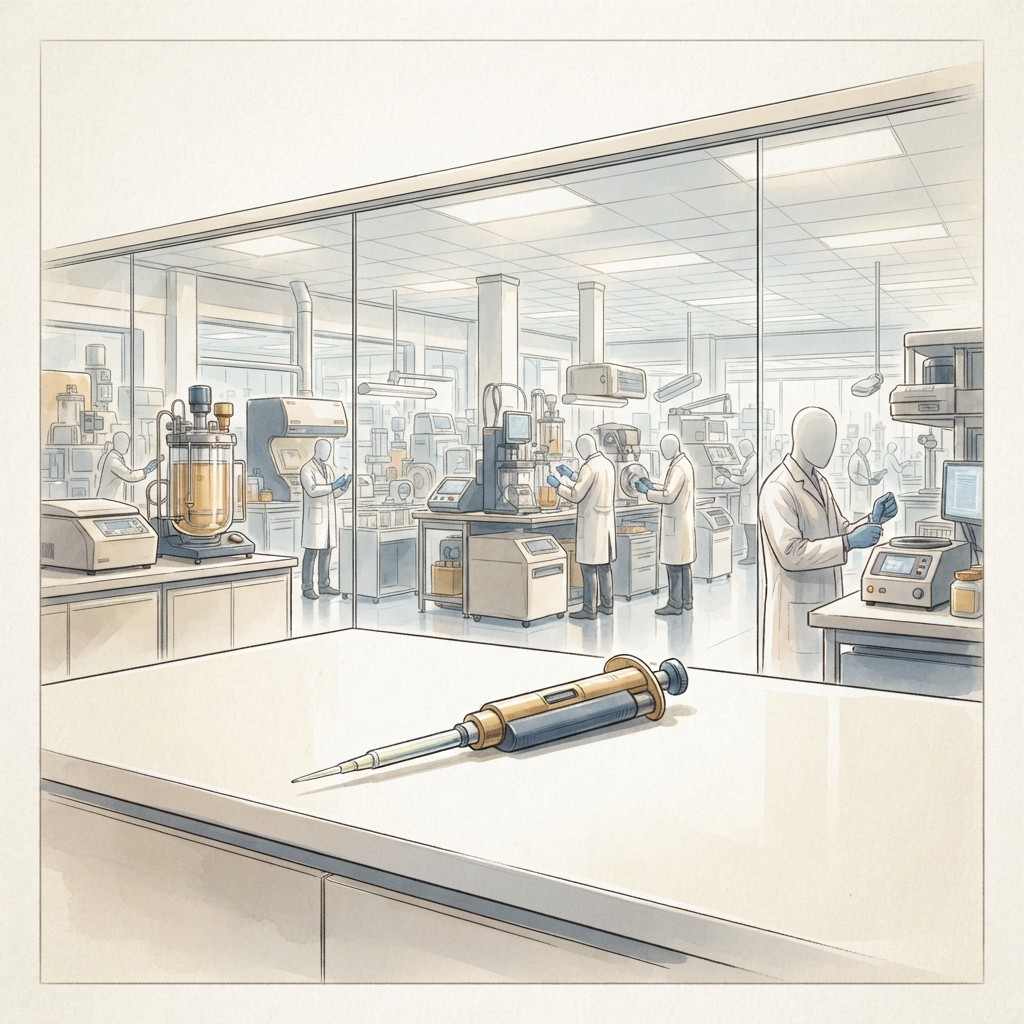
Picture a biotech with a promising molecule and almost nothing else. It needs the reagents to test it, the instruments to read it, the contract scientists to run its trials, and a factory to actually make the drug if it works. Twenty years ago that was four or five vendors. Today it can be one, and that one is Thermo Fisher - which started out selling the pipettes and ended up running the lab. The remarkable thing is how it got there: not by inventing its way down the value chain, but by buying its way down it, one large check at a time.
The official story is that Thermo Fisher is the world's great scientific-tools empire - a rollup of instruments and lab consumables, the company whose catalog every researcher orders from. That story is half a decade out of date. The instruments are still there, but the deals that built the modern company didn't deepen the tools business. They walked the company out of it - toward developing, testing, and manufacturing drugs on behalf of the pharma industry itself.
Here is the thesis a smart friend could repeat at dinner: Thermo Fisher isn't a tools company that does services on the side. It's a biopharma outsourcing platform that still happens to sell tools. Every major acquisition after 2013 moved it further from the catalog and deeper into the client's own R&D and factory floor - and by 2024 the services it picked up that way were nearly half its revenue.
The deals trace a line out of the instrument business
Start with the founding fact that almost everyone gets wrong. There was no "Thermo Fisher" before 2006. The company was born that year when Thermo Electron and Fisher Scientific combined in a tax-free, stock-for-stock exchange - 2.0 Thermo shares for each Fisher share - worth $10.6 billion in equity plus $2.2 billion of assumed net debt.12 That deal was the classic tools play: bolt a catalog (Fisher) onto an instrument maker (Thermo) and own the researcher's whole order. If the story stopped there, "scientific tools empire" would be exactly right.
It didn't stop there. In 2013 Thermo Fisher agreed to buy Life Technologies - the genetic-analysis and reagents business with $3.9 billion in revenue - closing in February 2014 for roughly $13.6 billion in equity plus $1.5 billion of assumed net debt.34 On its face this still looks like tools: reagents, sequencing, the new Life Sciences Solutions segment.4 But Life Technologies sold the inputs to drug discovery - the consumables a pharma client burns through, over and over, not a one-time instrument purchase. That's the first quiet pivot: from selling the machine once to selling what the machine eats forever.
Then the line bends sharply. In 2017 Thermo Fisher paid about $7.2 billion for Patheon, a leading CDMO - a contract development and manufacturing organization that actually makes drugs for pharma clients.5 This is no longer the supply room. This is the factory. And in 2021 it spent a total cash price of $17.4 billion - plus roughly $3.5 billion of assumed net debt - on PPD, a clinical-research organization that runs the human trials.6 With PPD, Thermo Fisher now stood at every station of a drug's life: the reagents to discover it, the trials to prove it, and the plant to manufacture it.
Why a tools company would rather rent out the lab
The mechanism is about the kind of revenue, not the size of it. An instrument is a magnificent one-time sale: a client buys a mass spectrometer, and then doesn't buy another for years. Services are different. When you run a client's trials and make their drugs, you are embedded in their operations for the life of the molecule - revenue that recurs, deepens, and is brutally hard to switch away from once your processes are validated by regulators. Thermo Fisher figured out that the most valuable seat in the lab isn't the one selling the equipment. It's the one doing the work the equipment was bought to do.
And the work is sticky in a way a catalog order never is. A pharma client can swap reagent suppliers between purchase orders. It cannot easily move a drug mid-trial to a different research organization, or re-validate a new factory line with the FDA on a whim. Each services acquisition didn't just add revenue - it added lock-in. The deeper into the client's process Thermo Fisher reached, the harder it became to remove. The tools were a way in. The services were the way to stay.
| The tools catalog | The services platform | |
|---|---|---|
| What's sold | Instruments, reagents, consumables | Trials run, drugs developed and made |
| Revenue shape | One-time sale, then consumables | Recurring, embedded in client operations |
| Switching cost | Low - swap between orders | High - regulator-validated, mid-program |
| Built by | The 2006 founding merger | Patheon (2017), PPD (2021) |
The 2024 numbers settle the argument. Total revenue was $42.9 billion - and of that, $17.8 billion was services, against $25.0 billion in products.7 Services are no longer a footnote to the catalog; they are a co-equal half of the business, the half built almost entirely by acquisition. The most recent move keeps the pattern going: in early 2026 Thermo Fisher closed its $8.875 billion purchase of Clario, a clinical-trial technology business, folding it straight into the Laboratory Products and Biopharma Services segment.8 The name of the segment tells you where the company thinks it lives now.
Isn't this just a rollup with a fancier name?
The fair objection is that this is dressing up an ordinary acquisition machine. Plenty of companies buy growth because they can't build it, and a string of big deals can paper over thin organic performance. Thermo Fisher's own 2024 revenue was flat year over year7 - hardly the picture of a company compounding from within. If the engine only runs on the next check, the "platform" is just leverage with a story attached.
That objection lands a real hit, and it's worth conceding: the "scientific tools empire" frame doesn't just understate the services pivot - it also overstates Thermo Fisher's organic instrument leadership, much of which was bought rather than grown. But notice what the rollup critique can't explain. A pure financial rollup buys more of the same thing to wring out cost. Thermo Fisher did the opposite - it bought into different things, each one further from instruments than the last, deliberately changing what the company is rather than scaling what it already was. Patheon and PPD don't make the catalog bigger. They make the catalog beside the point. That's not consolidation. That's a company using M&A to walk through an open door into an adjacent, stickier business - and pulling the door shut behind it.
The richest use of M&A isn't buying more of what you already sell to lower unit costs - it's buying the next station down your customer's value chain, where the revenue recurs and the switching costs are higher. Thermo Fisher started by selling instruments, then bought the reagents those instruments consume, then the factory that uses them, then the trials that justify them. Each deal sat one step closer to the customer's actual work, and the closer you get to the work, the harder you are to remove. The caution: this only compounds if the adjacencies genuinely lock the customer in - a string of acquisitions in unrelated, switchable businesses is just leverage wearing a strategy's clothes. Buy your way toward the embedded, regulated, recurring seat - not just a wider catalog.
Thermo Fisher is still filed in everyone's mind under "scientific tools," and the label isn't wrong so much as it's a snapshot of a company that has since moved house. The pipettes and spectrometers were never the destination. They were the way in - the relationship that let it sell the client something far more valuable than equipment: the running of the client's own work. It out-grew the catalog the way a landlord out-grows a hardware store. The empire was never really the tools. It was the standing invitation to do the work the tools were bought to perform - and a decade of acquisitions spent turning that invitation into a place at every bench.
Companies that moved house without changing the sign
Adjacency / Synergy Map
A one-page canvas for an adjacency play: the new business next door, the shared assets that justify entering it, the synergies that actually transfer versus the ones that evaporate on contact, and the dis-synergies nobody put on the deck. Blank to test your own expansion; filled as the worked example showing where the story's 'natural adjacency' was real and where it was wishful.
Included, filled and blank, in the Adjacency Expansion Casebook. See the set → · Preview the blank →
Sources
Where this comes from — the filings, records, and reporting behind it.
- 1The 2006 Thermo Electron / Fisher Scientific combination was a tax-free stock-for-stock exchange at a fixed ratio of 2.0 Thermo shares per Fisher share, representing an equity value of $10.6 billion plus assumed net debt of $2.2 billion at announcement.
- 2The merger agreement between Thermo Electron and Fisher Scientific was dated May 7, 2006, with Fisher stockholders receiving 2.0 shares of Thermo common stock for each Fisher share at a fixed, unadjusted exchange ratio.
- 3Thermo Fisher completed its acquisition of Life Technologies Corporation on February 3, 2014, for approximately $13.6 billion in cash ($76.13 per fully diluted share) plus the assumption of $1.5 billion in net debt.
- 4The Life Technologies acquisition agreement was entered into on April 14, 2013; Life Technologies revenues totaled $3.9 billion in 2013; the business was reported in a new Life Sciences Solutions segment.
- 5Thermo Fisher completed its acquisition of Patheon N.V. on August 29, 2017, for approximately $7.2 billion at $35.00 per share in cash, adding a leading CDMO to its pharma services platform.
- 6Thermo Fisher agreed on April 15, 2021, to acquire PPD, Inc. for $47.50 per share for a total cash purchase price of $17.4 billion plus the assumption of approximately $3.5 billion of net debt; the deal closed December 8, 2021.
- 7Thermo Fisher's full-year 2024 revenues were $42,879 million (product revenues $25,034M; service revenues $17,845M), flat versus prior year, with GAAP operating income of $7,337 million and a 17.1% GAAP operating margin.
- 8Thermo Fisher completed its acquisition of Clario Holdings, Inc. on approximately March 24, 2026, for $8.875 billion in cash plus potential earnout payments of up to $400 million, with Clario becoming part of the Laboratory Products and Biopharma Services segment.
Weighing outside help with a decision like this? Hiring a commercial due diligence provider
More like this — beyond Thermo Fisher
New Strategically analyses as they publish: the defining moves in business, checked against the record. No noise, and one click to leave.