Pairs with the Profit-Engine Map — a ready-to-use strategy tool, filled for Block (Square). Included in the The Money Machine Casebook →
In 2009, a glass artist named Jim McKelvey lost a sale worth a few thousand dollars — a glass faucet — because he couldn't accept an American Express card.8 His co-founder told the story years later in a federal filing, with the flat formality such documents demand: 'We started Square because our co-founder, Jim McKelvey, couldn't accept a credit card for his art.'1 That is the founding myth, and it is a good one: a tiny seller, locked out of the payment system, builds the key. But the more instructive story isn't the lost sale. It's the famous win that everyone celebrates — and that quietly cost Square more than $71 million.
The official story is that Starbucks validated Square — that when a 7,000-store giant signed on as a customer, the world finally believed the little white reader was real. The financial story, buried in Square's own S-1, is almost the opposite: Square lost money on every Starbucks swipe, the deal was being unwound before the IPO, and the company that 'won' the marquee logo nearly let it define the worst part of its prospectus.
The trophy customer that bled cash on every cup
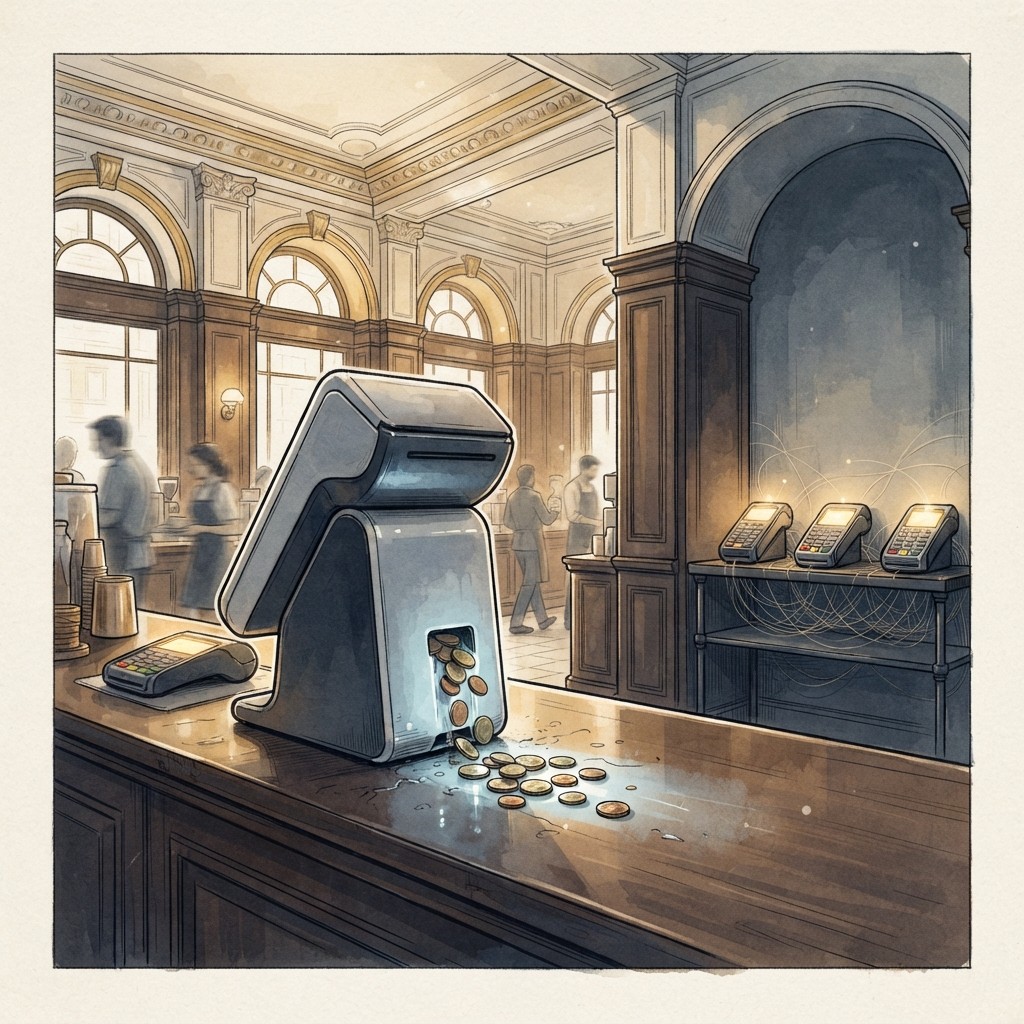
In August 2012, Starbucks invested $25 million in Square's Series D, made Square the exclusive processor for all 7,000-plus U.S. stores, and put CEO Howard Schultz on Square's board.5 On paper, the dream endorsement. In practice, a structural trap: Square's contracted share of interchange came in below its cost to process each transaction, so the bigger Starbucks grew, the more Square lost.4 By the time the S-1 was filed on October 14, 2015, cumulative losses on the deal exceeded $71 million, and Square had already begun unwinding it.42 The lesson hides in plain sight: a megabrand has the leverage to negotiate terms that turn a 'customer' into a subsidy. The logo that was supposed to prove the business model was busy contradicting it.
“We started Square because our co-founder, Jim McKelvey, couldn't accept a credit card for his art.”1
Read against that origin, the contrast sharpens. Square was built to serve the seller too small to matter to the banks — the McKelveys of the world. The Starbucks deal pulled it toward the opposite pole: a single account so large it could dictate price. The real Square machine was never going to be powered by giants. It was going to be powered by the millions of small sellers no giant would ever bother to underprice.
| The validation story | What the filings show | |
|---|---|---|
| Starbucks deal | Proof Square had arrived | Loss leader topping $71M by mid-2015[[cite:s4]] |
| Per-transaction economics | Scale at last | Interchange share below processing cost[[cite:s4]] |
| The IPO | Stock opened above offer price | $9 priced below the $11–$13 range, 42% under the last private round[[cite:s3]] |
| The real asset | A famous logo | Millions of small sellers nobody else wanted[[cite:s7]] |
The IPO that 'popped' and fell at the same time
When Square went public in November 2015, it priced at $9.00 and the stock opened at $11.20 — above the offer price, the kind of detail that gets reported as a win.39 But $9.00 was set below the preliminary $11–$13 range in the S-1/A, and a full 42% below the $15.50 that private investors had paid in the last round.23 The 'pop' was real and the down round was real, and they describe the same event. Public-market buyers got a discount; the last private backers took a haircut. The market wasn't disputing that Square had volume. It was pricing the unresolved question underneath the volume: how do you make a thin payment fee turn a profit when your most famous customer proves the fee can go negative?
The real machine: own the swipe, then sell everything around it
Here is the thesis, plainly. Square isn't a payments company that wandered into software. It's a software-and-lending company that uses the payment as the doorway — and the doorway, taken alone, barely pays. The little reader gets a seller in the door at near-cost. The margin comes from what attaches once they're inside: payroll, point-of-sale software, marketing tools, and above all credit, because a processor that watches every dollar a seller takes in knows exactly how much that seller can safely borrow. Payments are the sensor. Financial services are the business.
In 2024 more than 4 million sellers ran 5.2 billion transactions worth $228 billion in Square gross payment volume.7 On the swipe alone, the take is thin and contestable — the Starbucks deal showed it can even go negative. The leverage is the second term: every seller already inside the ecosystem who also takes a loan, runs payroll, or banks through Square. Get the attach rate up and Block's gross profit climbed to $8,889 million in 2024 from $7,505 million the year before, lifting the company to its first full-year GAAP operating profit — $892 million, against a $279 million operating loss in 2023.6
Square's mistake with Starbucks wasn't pricing a swipe at a loss — it was pricing a swipe at a loss for a customer it could never up-sell. A megabrand buys processing and nothing else; there's no payroll to add, no loan to extend, no software to attach. The whole model only works when the thin-margin swipe is the front door to a high-margin relationship. Sell the razor at cost, yes — but only to someone who will buy the blades. Starbucks bought the razor and walked out.
The honest objection: the flywheel still isn't finished
The fair counter is that this is too tidy. Block now runs two ecosystems — Square for sellers and Cash App for consumers (it launched as 'Square Cash' for peer-to-peer transfers in October 2013 and was later rebranded Cash App)1011 — and the bull case is that they fuse into a single closed loop where a buyer pays a seller and both stay inside Block's rails. That loop is the prize. It is also not yet built. The two halves still operate largely apart, and the company's long-term edge rests on financial-services attach rates it has not proven at scale. The 2024 operating profit is genuine and hard-won, but it arrives a decade after the IPO and is thin against $24.1 billion of revenue.6 So the position isn't a finished flywheel; it's a half-built one, spinning on the strength of four million sellers it actually can up-sell — and waiting on the attach math to close the loop. The honest read is that Square survived its way to a strategy, layering product on product, and the elegant version was written backward from the result.
McKelvey lost a single glass-faucet sale over a card he couldn't accept, and out of it came a company that, in a single year, carried $228 billion across its rails.7 But the path there ran through a $71 million 'validation' that taught the most expensive lesson in Square's history: the swipe is never the prize. The prize is what you can sell to the person standing at the register — and the one customer Square couldn't sell anything to was the one it put on the cover. The machine works only as long as the door it opens leads somewhere worth more than the door.
Companies whose real business hides behind the obvious one
Profit-Engine Map
A one-page map that pulls a business apart into the hook that gets the customer in the door and the engine that quietly earns the margin. Use it to see where the real profit lives, how the two halves are wired together, and what breaks if the link is cut. Blank to dissect your own P&L; filled as the worked example of a business whose advertised product is not where it makes its money.
Included, filled and blank, in the The Money Machine Casebook. See the set → · Preview the blank →
Sources
Where this comes from — the filings, records, and reporting behind it.
- 1Jack Dorsey stated in an SEC filing: 'We started Square because our co-founder, Jim McKelvey, couldn't accept a credit card for his art.' This is Dorsey's own on-record origin statement.
- 2Square's S-1 IPO registration statement was filed October 14, 2015; the S-1/A set a preliminary offering price range of $11–$13 per share for Class A common stock.
- 3Square's IPO closed November 24, 2015 at $9.00 per share — below the $11–$13 preliminary range and roughly 42% below the $15.46 last private-round price — selling a total of 31,050,000 Class A shares.[[cite:s12]][[cite:s13]]
- 4Square's S-1 disclosed cumulative losses exceeding $71 million from the Starbucks processing deal through mid-2015; Square lost money on every transaction because its contracted share of interchange was less than its cost of processing. The deal was being unwound as of August 2015.
- 5The Starbucks deal originated in August 2012: Starbucks invested $25 million in Square's Series D and Square became exclusive processor for all 7,000+ U.S. Starbucks locations; Starbucks CEO Howard Schultz joined Square's board (departed late 2013).
- 6Block's FY2024 10-K (filed with the SEC) reports total net revenue of $24,121 million (+10% YoY), gross profit of $8,889 million (up from $7,505 million in 2023), and operating income of $892 million (vs. an operating loss of $279 million in 2023), representing the company's first full-year GAAP operating profit.
- 7In 2024, more than 4 million sellers used the Square ecosystem to make 5.2 billion individual sales transactions, totaling $228 billion in Square Gross Payment Volume (GPV), per Block's 10-K filing.
- 8Jim McKelvey is identified as co-founder of Square (with Jack Dorsey) in 2009; Wikipedia specifies the lost sale involved glass faucets and fittings, not generic art. McKelvey is also noted as a glass artist and director of the St. Louis Federal Reserve.Wikipedia, Jim McKelvey ↗ · 2024
- 9Square's stock opened at $11.20 on its first day of trading on the NYSE, above its $9 IPO price — a roughly 24% pop that climbed higher through the day.
- 10Cash App launched in October 2013 under the name Square Cash as a peer-to-peer money transfer service, developed internally at Square.Wikipedia, Cash App ↗ · 2024
- 11Block describes its business as two ecosystems — the Square seller ecosystem and the Cash App consumer ecosystem; in renaming Square, Inc. to Block, the company noted the Square name had become synonymous with its Seller business.
- 12Square's IPO closed November 24, 2015 at $9.00 per share; a total of 31,050,000 shares of Class A common stock were sold.
- 13Square's $9 IPO price was 42% below the $15.46-per-share price of its last private round (Series E, in which it raised $180 million).
More like this — beyond Block (Square)
New Strategically analyses as they publish: the defining moves in business, checked against the record. No noise, and one click to leave.