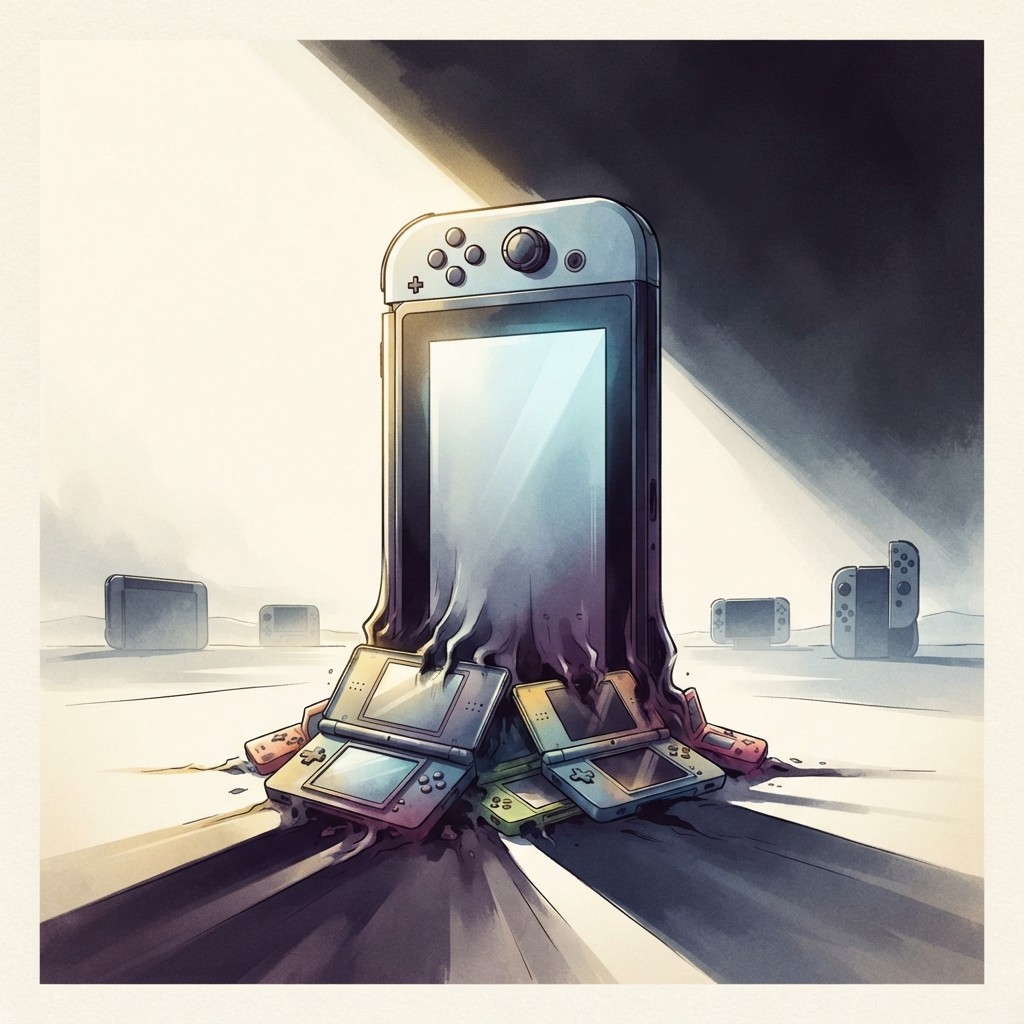
Pairs with the Cannibalization Decision Tree — a ready-to-use strategy tool, filled for Nintendo. Included in the The Cannibalization Choice Casebook →
On November 19, 2006, Nintendo put a $249.99 white box on American shelves with a controller you waved like a tennis racket and a graphics chip a generation behind everyone else's.2 Sony and Microsoft were racing to render every pore on a soldier's face in high definition. Nintendo shipped a console that looked, on a spec sheet, like a toy. It sold 101.63 million of them.1 The story that grew up around this is one of the most repeated case studies in business school: Nintendo found a 'blue ocean,' swam away from the bloody competition, and won by refusing to fight. It is a clean, satisfying lesson. It is also wrong in the way that matters most.
The legend says Nintendo escaped competition. It found uncontested market space and left its rivals behind. What actually happened is that Nintendo picked a fight it could win by deciding, in advance, which customers it was willing to lose. The blue ocean wasn't found. It was paid for — and the bill came due twice.
What the spec sheet was hiding
Strip away the romance and the Wii's move was an act of subtraction. Nintendo eliminated the things the industry treated as non-negotiable — high-definition output, the expensive chips needed to drive it, the dense controller with two sticks and a dozen buttons that intimidated anyone who hadn't grown up holding one.8 Cheaper silicon meant a lower bill of materials, which meant Nintendo could sell at $249.99 and actually profit on the hardware while Sony and Microsoft sold their consoles at a hardware loss — one early iSuppli teardown estimated Sony lost roughly $307 on each launch 20GB PS3 (the entry-level $499 model) — and $241 on the $599 60GB version — not counting controllers, cables, or packaging.13 The subtraction funded the addition: a motion sensor that let your grandmother bowl a strike in her living room. The audience that move unlocked wasn't the hardcore gamer at all. It was everyone the hardcore market had quietly written off.
| PS3 / Xbox 360 (2006) | Wii | |
|---|---|---|
| Graphics | High-definition, cutting-edge | Last-generation, standard-def |
| Controller | Twin sticks, ~12 buttons | Motion wand, point and wave |
| Hardware economics | Sold at a loss | Profitable per unit |
| Target customer | The existing gamer | The person who never bought a console |
| Customer disappointed on purpose | — | The spec-obsessed enthusiast |
The early numbers were staggering. Nintendo met its target of 4 million units shipped by the end of 2006, group net profit jumped 43% to ¥132 billion for the April–December period, and sales soared 73% to ¥713 billion.4 By the first half of 2007 the Wii was outselling the PS3 and Xbox 360 combined in the U.S., and by September the Financial Times had it leading worldwide home-console sales — the first Nintendo console to lead its generation since the SNES.143 This is the moment the blue-ocean story freezes the frame. It is also where it starts to mislead.
The ocean turned red, and fast
Here is the part the case study skips. A blue ocean, by definition, is uncontested — and motion control stopped being uncontested almost immediately. In September 2010 Sony shipped PlayStation Move; in November 2010 Microsoft shipped Kinect, which needed no controller at all.1011 Both were aimed squarely at the casual, motion-friendly buyer the Wii had discovered. The differentiator that defined the Wii was, within four years of launch, a feature on every console — and Wii sales began to slide that same year, falling 21% in 2010 in a decline observers tied partly to the arrival of Move and Kinect.12 The water Nintendo had to itself filled with sharks the instant the sharks understood the new game. And then a bigger predator arrived that nobody could fence out: the smartphone, which put casual, intuitive play into hundreds of millions of pockets — much of it free — eroding the exact audience the Wii had built its business on. The blue ocean wasn't a destination. It was a head start, and head starts expire.
Value innovation creates uncontested space, but the space is only uncontested until rivals see the receipts. The Wii proved the casual market existed and printed money doing it — which is exactly what told Sony, Microsoft, and eventually every smartphone maker that the market was worth taking. The reward for proving an ocean is blue is that everyone now rows toward it. So the strategic question is never 'how do I avoid competition?' It's 'what am I building during the head start that survives the moment competition shows up?' Differentiation buys you time. What you do with the time is the actual strategy.
The Switch survived by eating Nintendo alive
When Nintendo launched the Switch on March 3, 2017 at $299.99, the surface story was another blue-ocean play: a hybrid you could dock to a TV or carry on a train, with 80 games from over 50 companies in development at announcement.5 But the real strategic move wasn't aimed at Sony or Microsoft. It was aimed inward. For years Nintendo had run two distinct hardware lines — home consoles like the Wii, and handhelds like the DS and 3DS. The Switch, a hybrid that worked both docked and on the go, effectively collapsed both into a single device — making its own handheld line and its own home-console line redundant in one stroke. This is the cannibalization choice in its purest form: rather than let a smartphone or a rival kill its handheld business, Nintendo killed it itself, on its own schedule, and folded the survivors into one product it controlled.
The bet worked spectacularly. By March 31, 2024 the Switch had reached 141.32 million lifetime units and powered FY2024 net sales of ¥1,671.87 billion, up 4.4% year over year.6 It eventually crossed 150.8 million — surpassing the Wii itself.7 Nintendo had not escaped the red ocean. It had chosen, twice, exactly which of its own customers and which of its own businesses to disappoint, and timed the disappointment to suit itself.
“The Switch had topped 150.8 million lifetime sales, but the aging platform was performing 'below expectations,' with hardware sales down 30.6% year over year.”7
Isn't this just blue ocean strategy working exactly as advertised?
The honest objection is that the framework, in its own terms, called both shots correctly. The Blue Ocean Strategy Institute classifies the Wii and Switch as textbook value innovations — Nintendo eliminated high-cost hardware and complex controllers while creating intuitive, social play — and the consoles sold roughly a quarter of a billion units between them — 101.63 million Wiis and 141.32 million Switches.816 That is not nothing. The framework correctly identifies the move: differentiate by subtraction, open a new demographic, profit on hardware others sell at a loss. Where it misleads is in the promise the name makes. 'Blue ocean' implies the water stays calm. It never does. Within four years Move and Kinect had turned the Wii's ocean red, and the Switch's success required not a fresh discovery but a willingness to destroy two of Nintendo's own profit centers before someone else did.8 The framework names the tactic and oversells the outcome. It teaches you to look for uncontested space; it forgets to teach you that finding it is what guarantees the contest.
Every value-innovation move is really a disappointment, aimed precisely. The Wii disappointed the spec-obsessed enthusiast to win the grandmother. The Switch disappointed Nintendo's own handheld and home-console buyers to win the hybrid future before a rival took it. The discipline isn't 'avoid competition' — that's a fantasy with an expiration date. It's choosing, on purpose and in advance, which customers and which of your own businesses you will let down, so you control the timing instead of the market controlling it. The companies that get cannibalized are the ones who wouldn't choose. The ones who endure pick the knife up themselves.
Nintendo never swam to a calmer sea. It learned, twice over, that the only thing you truly control is which fight you start and which customers you walk away from to start it. The Wii didn't escape the competition — it invited it, and got a four-year lead as the prize. The Switch didn't outflank Sony — it outflanked Nintendo's own past, eating its handheld and home businesses before anyone else could. The blue ocean was never a place. It was a choice about who to disappoint, made early enough to still be a choice. The companies that wait until the ocean turns red don't get to decide. They just get eaten.
When a company turns the knife on itself
Cannibalization Decision Tree
A decision tree for the moment the new thing threatens the cash cow: is the disruption real, will someone else do it if you don't, and can you afford to bleed your own margin to own the future? Blank to run on your own line; filled as the worked example tracing how the story's incumbent chose to cannibalize — or flinched and got cannibalized.
Included, filled and blank, in the The Cannibalization Choice Casebook. See the set → · Preview the blank →
Sources
Where this comes from — the filings, records, and reporting behind it.
- 1The Wii had total lifetime sales of 101.63 million consoles worldwide as of March 31, 2016 — the last reported data for the console by Nintendo. At least 48 million were sold in North America, 12 million in Japan, and 40 million in all other regions.[[cite:s15]]
- 2The Wii launched in the United States on November 19, 2006, priced at US$249.99. Nintendo anticipated shipping over 4 million consoles by year's end and aimed to have ~30 Wii games available by end of 2006.
- 3According to NPD Group data, the Wii sold more units in the United States than the Xbox 360 and PlayStation 3 combined in the first half of 2007. By September 2007 the Financial Times reported the Wii had become the market leader in worldwide home-console sales, based on Enterbrain, NPD Group and GfK data — the first time a Nintendo console led its generation since the SNES.
- 4Nintendo reported group net profit of ¥132 billion ($1.1 billion) for April–December 2006 (up 43% YoY) and sales soaring 73% to ¥713 billion ($5.9 billion) over the same nine-month period, boosted by Wii launch sales. Nintendo confirmed it met its target of 4 million units shipped by end of 2006.
- 5Nintendo Switch launched globally on March 3, 2017, priced at $299.99 in North America and 29,980 yen in Japan. At announcement, 80 games from over 50 companies were in development for the platform.
- 6Nintendo Switch lifetime hardware sales reached 141.32 million units as of March 31, 2024, with 54.52 million in the Americas, 36.49 million in Europe, 34.01 million in Japan, and 16.30 million in the rest of the world. Nintendo's FY2024 net sales were ¥1,671.87 billion (~$10.83 billion), up 4.4% YoY.
- 7Switch hardware sales as of December 31, 2024 declined 30.6% YoY to 9.54 million units for the nine-month period; the Switch had topped 150.8 million lifetime sales but Nintendo acknowledged the aging platform was performing 'below expectations.'
- 8The Blue Ocean Strategy Institute (INSEAD professors Kim & Mauborgne) retroactively classifies the Wii and Switch as blue ocean examples, arguing Nintendo targeted non-gamers by eliminating high-definition hardware, complex controllers, and high-cost chips, while creating motion-based intuitive controls and social/family gameplay. The 'blue ocean' label is a post-hoc academic/consulting framework, not Nintendo's own strategic vocabulary at the time.
- 9PS3 lifetime sales reached roughly 87.4 million and Xbox 360 roughly 85.7 million, together about 173 million — exceeding the Wii's lifetime total.
- 10Sony announced PlayStation Move for the PS3 would release on September 15, 2010 in Europe/PAL and Asia and September 19, 2010 in North America.
- 11Microsoft's Kinect for Xbox 360, which required no physical controller, was released in North America on November 4, 2010.
- 12In 2010 Wii sales began to decline, falling 21% from the previous year, attributed partly to the introduction of PlayStation Move and Kinect and the waning of the Wii fad.Wikipedia, Wii — Wikipedia ↗ · 2026
- 13Sony and Microsoft sold their seventh-generation consoles at a hardware loss (iSuppli estimated Sony lost about $307 per early 20GB PS3), while Nintendo optimized production so the Wii turned a profit on each console sold.
- 14According to NPD Group data, the Wii sold more units in the United States than the Xbox 360 and PlayStation 3 combined in the first half of 2007.
- 15The Wii had total lifetime sales of 101.63 million consoles worldwide as of March 31, 2016 — the last reported data for the console by Nintendo.Wikipedia, Wii — Wikipedia ↗ · 2026
- 16Sony announced PlayStation Move would release September 15, 2010 in Europe/PAL territories and Asian countries/regions, and September 19, 2010 in North America.
- 17Sony Computer Entertainment announced PlayStation Move for PS3 would release September 15, 2010 in Europe/PAL territories and Asian countries/regions, and September 19, 2010 in North America
More like this — beyond Nintendo
New Strategically analyses as they publish: the defining moves in business, checked against the record. No noise, and one click to leave.