Pairs with the Profit-Engine Map — a ready-to-use strategy tool, filled for Vice Media. Included in the Money Machine Casebook →
“Where does the money actually come from, and who sets the rate it comes in at?”
In 2017, a media company that made its name on gonzo documentaries and an irreverent magazine was valued at nearly $6 billion, after TPG put in $450 million.4 The story sold to investors was intoxicating: Vice had cracked the code on reaching young people who had abandoned cable, and it would monetize them the way every media giant before it had — by selling their attention to advertisers. Six years later the same company filed for bankruptcy, and the buyers who showed up did not want the audience at all. They wanted the agency.
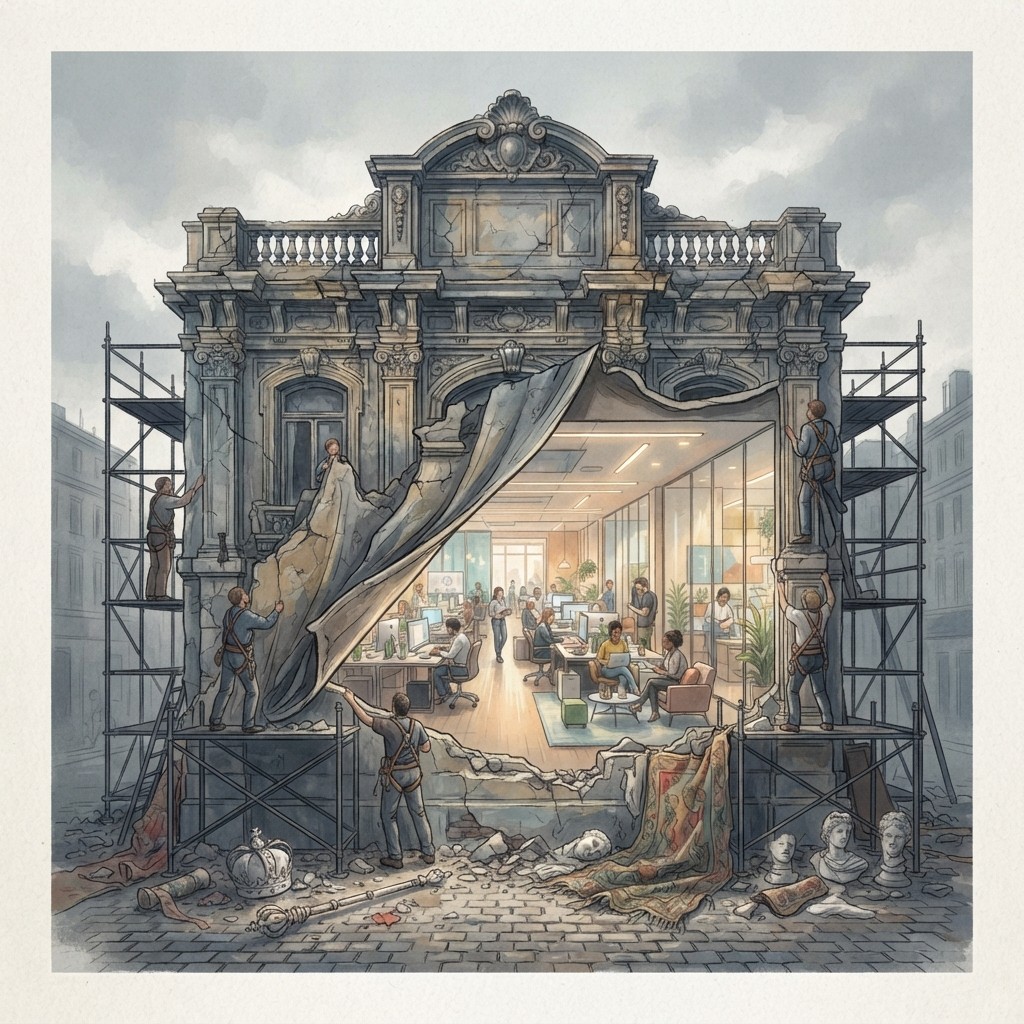
The official story was that Vice was a digital-media empire — a publisher that built huge owned audiences and sold ads against them. The real business was something far less glamorous and far more durable: it was a creative-services shop and a studio-for-hire that happened to wear a counterculture costume. The valuation was a bet on the costume. The P&L underneath was wearing a suit.
What the buyers wanted tells you what the business was
When a company goes up for sale, the bid sheet is the most honest document it will ever produce. Buyers do not pay for narrative; they pay for the parts they can run profitably. So it is worth reading what CNBC reported as Vice restarted its sale process in early 2023: the most attractive assets to potential buyers were the content studio and Virtue, its creative advertising agency — not the owned digital-media properties everyone associated with the Vice name.7 Strip away the brand glow and that sentence is the whole thesis. The websites, the channels, the audience that justified the multibillion-dollar valuation were the part nobody especially wanted. The valuable thing was Vice doing for other brands what it had always implicitly done for itself: making cool things on contract.
“Its most attractive assets to potential buyers were its content studio and Virtue creative advertising agency — not its owned digital-media properties.”7
The agency was there from the very beginning
This was not a late pivot born of desperation. The B2B engine was original equipment. Virtue Worldwide, a full-service creative agency, was already a Vice business line in 2011 — the year WPP, one of the largest advertising holding companies on earth, took a minority stake in Vice Holdings.8 Sit with that for a moment. An advertising conglomerate's first instinct, more than a decade before the bankruptcy, was to buy into the part of Vice that was an ad agency. The smartest money in advertising looked at Vice and saw a peer, not a publisher. The structure made the same point years later: by 2024 the company's segments were Vice Studios, a Vice TV joint venture with A&E Networks, Virtue, and Vice Digital — three of the four built on selling production and creative work, with the pure-publishing piece sitting last on the list.6
| The 'digital-media empire' narrative | The actual machine | |
|---|---|---|
| Who pays | Advertisers buying audience reach | Brands buying creative and production services |
| Core asset | Owned websites and channels | Virtue agency and the content studio |
| Revenue shape | Ads against owned traffic | Project work, contracts, B2B services |
| What buyers wanted in 2023 | Almost none of it | The studio and Virtue |
Why the costume cost billions
Here is the mechanism that turned a sound services business into a financial catastrophe. A creative agency and a studio-for-hire are good businesses — but they are services businesses, which means they scale linearly. More revenue requires more people doing more work; margins are decent, not magical; and you cannot 10x by adding servers. Investors did not write a near-$6-billion check for a services business. They wrote it for a software-shaped fantasy: an owned audience so vast that ad revenue would compound while costs stayed flat. To justify that fantasy, Vice had to keep buying scale. In 2019 it acquired Refinery29 at a reported $400 million valuation — and, contrary to the legend of a cash splurge, the deal was structured mostly as stock with a smaller cash component, against a target generating roughly $100 million in annual revenue.5 Even with that bolt-on, the combined entity was valued at $4 billion4 — already a roughly 30% markdown from the peak two years earlier. The narrative was deflating in real time while the company kept feeding it.
The bill came due in the most literal way. By the time it filed for Chapter 11 on May 15, 2023, Vice Media and 31 associated entities owed Fortress $474.6 million — debt taken on to fund a growth story the cash flows could not service.3 The filing listed assets and liabilities between $500 million and $1 billion,1 a fraction of the valuation it had carried at its peak. And the ending was the clearest verdict of all.
The fair objection: didn't the brand earn its premium?
The honest counter is that the brand was real and the audience was real, and a creative agency owned by a publisher with genuine cultural reach is worth more than a faceless one. That is true — Virtue could sell brands a kind of authenticity precisely because the Vice name carried weight, and that halo had value. But notice what the bankruptcy proved: the halo was a multiplier on the services, not a standalone asset. When the company was finally sold, the consideration was approximately $350 million, and it came as a credit bid from Fortress, Soros Fund Management, and Monroe Capital — the existing lenders swapping debt they were already owed for the assets, rather than a fresh buyer paying cash for the audience.2 The market's verdict was unambiguous. The cool was worth keeping only because it made the agency more sellable. Nobody, in the end, paid real money for the empire. They settled the debt and kept the workshop.
When a company carries a valuation built on one story but earns its money from another, the gap is a debt that eventually comes due — usually in a fire sale, where the only honest appraisal happens. The tell is to ask which assets a buyer actually wants to operate. If the answer is the unglamorous services arm and not the headline brand, you are looking at a services business wearing media's multiple. Services scale with headcount; the narrative scaled with belief. Vice borrowed against the belief and had to repay in headcount it couldn't grow fast enough — and the lenders, not a starry-eyed acquirer, ended up holding the workshop.
Vice always told the world it was selling rebellion to a generation. It was. But the people actually paying for it weren't the kids watching the documentaries — they were the brands hiring Virtue and the networks commissioning the studio. The audience was the showroom; the agency was the business. The tragedy wasn't that Vice failed to make money. It made money the whole time, in a perfectly respectable way. It just spent a decade insisting it was a different, richer kind of company — and then borrowed nearly half a billion dollars against the difference.
When the real business isn't the one on the marquee
Profit-Engine Map
A one-page map that pulls a business apart into the hook that gets the customer in the door and the engine that quietly earns the margin. Use it to see where the real profit lives, how the two halves are wired together, and what breaks if the link is cut. Blank to dissect your own P&L; filled as the worked example of a business whose advertised product is not where it makes its money.
Included, filled and blank, in the Money Machine Casebook. See the set → · Preview the blank →
Sources
Where this comes from — the filings, records, and reporting behind it.
- 1Vice Group Holding filed for Chapter 11 bankruptcy on May 15, 2023, in the U.S. Bankruptcy Court for the Southern District of New York, listing assets and liabilities between $500 million and $1 billion.
- 2The U.S. Bankruptcy Court for the Southern District of New York approved Vice's asset purchase agreement on June 23, 2023; the final purchase consideration was approximately $350 million in the form of a credit bid by Fortress Investment Group, Soros Fund Management, and Monroe Capital.
- 3At the time of Chapter 11 filing, Vice Media LLC and 31 associated LLCs owed Fortress $474.6 million, per Chapter 11 filing documents.
- 4Vice reached its peak valuation of nearly $6 billion in 2017 with a $450 million investment from TPG. By 2019, the Refinery29 acquisition valued the combined entity at $4 billion.
- 5Vice's acquisition of Refinery29 was structured as mostly stock with a smaller cash component, reported at a $400 million valuation; Refinery29 had generated roughly $100 million in annual revenue at the time of acquisition.
- 6Vice Media's four main business segments as of April 2024 are Vice Studios Group (film and TV production), Vice TV (a joint venture with A&E Networks), Virtue (a creative-services agency), and Vice Digital (digital content).
- 7CNBC reported in January 2023 that Vice's most attractive assets to potential buyers were its content studio and Virtue creative advertising agency — not its owned digital-media properties.
- 8Virtue Worldwide (full-service creative agency) was an original Vice Media business line as early as 2011, when WPP acquired a minority stake in Vice Holdings. Vice's unaudited gross assets for year-end 2010 were $34.3 million.
Weighing outside help with a decision like this? Hiring a pricing strategy consultant
More like this — beyond Vice Media
New Strategically analyses as they publish: the defining moves in business, checked against the record. No noise, and one click to leave.