Pairs with the Counterfactual Timeline Builder — a ready-to-use strategy tool, filled for Vice Media. Included in the Counterfactual Casebook →
“What did the decision you did not take actually cost?”
In June 2017, a single phone call between Vice Media and the private-equity firm TPG produced a number that would define the company for the rest of its life: $5.7 billion. TPG put in $450 million, the valuation was announced, and the press dutifully crowned Vice the most valuable digital-media company on earth.3 Six years later, the same company filed for Chapter 11 and was sold to a group of lenders for $350 million.2 The headline math is brutal — a 94% haircut. But the number that actually killed Vice wasn't the one that fell. It was the one that never meant anything in the first place.
The official obituary says Vice was a content company that lost its edge — that the punk magazine grew up, sold out, and got dull. That's the comfortable story, and it's mostly wrong. Vice didn't die because the journalism got worse. It died because the capital structure got worse, and by the end the people deciding its fate weren't founders or advertisers. They were lenders.
The valuation was a negotiation, not a verdict
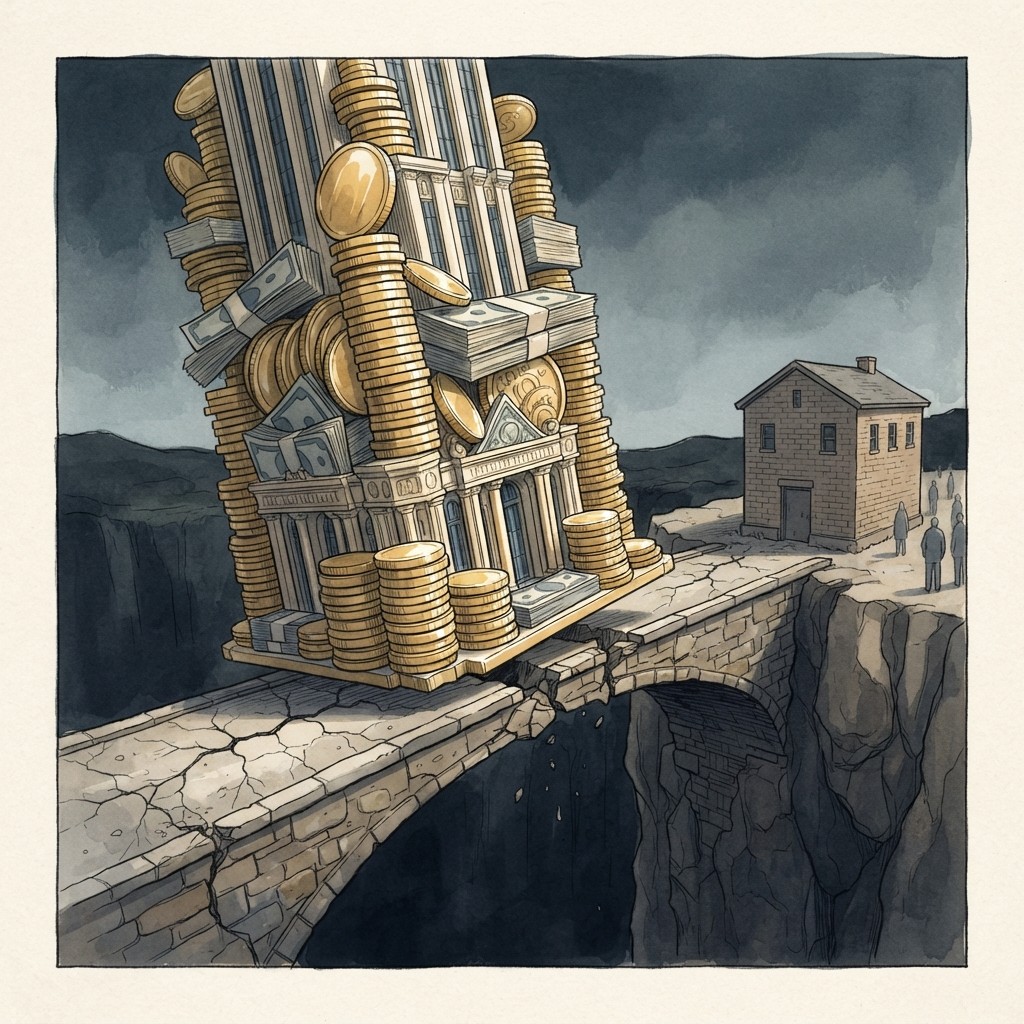
Start with the $5.7 billion, because everything downstream depends on what you believe that number was. A public market sets a valuation the way a thermometer sets a temperature — continuously, by thousands of independent trades, every second the market is open. Vice's valuation was set exactly once, by one buyer, in one private round, and then it was never tested again.3 After 2017, Vice raised only debt — at materially lower implied valuations — which is the financial equivalent of a house that keeps getting refinanced but never resold. The $5.7 billion didn't reflect what Vice was worth. It reflected what one firm agreed to pay for a slice, on a day when paying a lot for digital media was fashionable. It was a frozen artifact of a single conversation, and Vice spent six years carrying it around like a price tag the market would never honor.
Here is the detail that exposes the whole illusion. Between 2018 and 2022, Vice's revenue went from roughly $600–650 million to about $600 million — essentially flat across four years.8 In that same window, the company kept raising money, eventually pulling in over $1.6 billion from investors in total.8 A growth company that takes in more than a billion dollars and produces no growth is no longer raising equity against a future. It is borrowing against a story. And stories, unlike equity, come due.
Why flat revenue plus a debt load is a death sentence
This is the mechanism, and it's the part the content-decline narrative misses entirely. Equity is patient — a shareholder can wait a decade for a return and has no power to force anything in the meantime. Debt is impatient. It has covenants, interest payments, and a maturity date, and behind that date stands a creditor with the legal right to seize the business if the payments stop. When Vice stopped being able to raise equity at a credible price and switched to borrowing, it quietly handed the steering wheel to its lenders. By the time it filed for Chapter 11 on May 15, 2023, it owed Fortress $474.6 million alone.1 At flat revenue, there was no growth to grow into that debt — only a bill that arrived faster than the business could service it.
| Equity (what Vice's story implied) | Debt (what Vice actually leaned on) | |
|---|---|---|
| Who gets paid back | Maybe, eventually, if it grows | On a fixed date, or else |
| What it needs from the company | A future | A payment |
| Who decides the company's fate in a crisis | Founders and the board | The lenders |
| What it does to a flat-revenue business | Sits patiently | Forecloses |
Watch how the endgame plays out, because it confirms exactly whose company it had become. Vice filed for bankruptcy with a $225 million stalking-horse bid already in hand — from Fortress, Soros Fund Management, and Monroe Capital, the same consortium that held the debt.1 The creditors, in other words, were bidding to buy the very company they were owed money by. A rival, GoDigital, came in at $300 million, but it wasn't accepted; Fortress had concerns about GoDigital's funding, and Fortress was running the table.6 In the end Fortress simply raised its own bid to $350 million and took the asset.2 The lenders didn't lose to a buyer — they outbid one, with money the company already owed them, to convert their debt into ownership. That is not a sale. It is a foreclosure dressed as an auction.
“VICE Media Group Completes Sale to Lenders.”2
Even Disney, the smartest buyer in the room, couldn't escape the math
If you want proof that the bubble fooled the experts and not just the founders, look at Disney. It put $400 million of direct equity into Vice in 2015, at roughly a $4 billion valuation — a year before the TPG round pushed the number higher.4 Then it watched the value evaporate in two installments: a $157 million write-down disclosed in late 2018, and a further $353 million impairment in May 2019.45 Disney's total reported loss reached $510 million — more than the cash it put in directly — because its exposure ran wider than the headline check, through its stakes in A+E and the position it inherited from Fox.5 The most disciplined strategic investor in entertainment looked at Vice's growth story, paid up, and lost everything it put in and then some. The valuation didn't just fool the founders. It fooled the house.
When a single round sets a sky-high number that the market never gets to retest, treat that number as a marketing claim, not a market verdict — it tells you what one buyer paid on one day, nothing more. The real signal arrives later, in the quiet shift from raising equity to raising debt. Equity is a bet on your future; debt is a claim on your present. The moment a flat-growth company starts borrowing instead of selling shares, control has begun to move from the people who built it to the people who financed it — and by the time that becomes visible in a bankruptcy filing, the decision has already been made elsewhere. Watch the capital structure, not the press release.
Wasn't this just the whole digital-media bubble popping?
The fair objection is that Vice's fall was systemic, not specific — that the entire digital-media class got overvalued in the mid-2010s, that platform algorithms ate the audience, that ad dollars fled to Google and Meta, and that no clever capital structure could have saved a business model the platforms had quietly hollowed out. All of that is true, and it's why the bubble is the right frame. But it sharpens the point rather than softening it. The macro tide explains why Vice's revenue stopped growing; it does not explain why Vice ended up owned by its creditors instead of merged, sold whole, or shrunk into profitability. Plenty of media companies survived the same tide by staying small, staying private, or never taking on debt they couldn't service. Vice's distinctive error wasn't believing in digital media. It was financializing that belief — borrowing against a $5.7 billion story until the story's authors no longer owned the company the story was about. The bubble set the trap. The balance sheet sprang it.
There is one last irony worth sitting with. The company that became a debt-fueled valuation fantasy began life as the opposite of one. Its precursor, Voice of Montreal, was a Canadian government welfare-to-work program publication, founded in 1994 by Alix Laurent, with the people who became Vice's famous founders running it before they bought it out and rebranded it in 1996.7 It started as something almost no one wanted to fund, and it ended as something everyone wanted to fund and no one could afford to keep. Vice didn't lose its edge. It lost the only number that ever mattered — the one it owed, not the one it claimed — and once that number outran the revenue, the lenders did what lenders always do. They counted up what they were owed, bid it back, and turned the most valuable digital-media company in the world into a line item on someone else's balance sheet.
When the money decides, not the market
Counterfactual Timeline Builder
A one-page canvas that runs two histories side by side: what actually happened, and the alternative that died at the fork. You pin the divergence point, trace each branch forward, and name the assumption that decided which one came true. Blank, it disciplines hindsight into a testable counterfactual instead of a what-if; filled, it shows the story's road-not-taken with enough rigor to argue about.
Included, filled and blank, in the Counterfactual Casebook. See the set → · Preview the blank →
Sources
Where this comes from — the filings, records, and reporting behind it.
- 1Vice Media LLC and 31 associated LLCs filed for Chapter 11 bankruptcy on May 15, 2023, in the Southern District of New York, owing Fortress $474.6 million, with a stalking-horse bid of $225 million from the Fortress consortium (Fortress, Soros Fund Management, Monroe Capital).
- 2The post-bankruptcy sale of Vice Media to a consortium led by Fortress Investment Group, Soros Fund Management, and Monroe Capital closed on July 31, 2023, for $350 million — up from the initial $225 million stalking-horse bid after Fortress raised its offer during the auction.
- 3Vice's $5.7 billion peak valuation was set in June 2017 when private-equity firm TPG invested $450 million; that was the last time the company's valuation was publicly disclosed. In the years following, Vice raised only debt at lower implied valuations.
- 4Disney took a first write-down of $157 million on its Vice investment in its Q4 FY2018 earnings (reported November 2018), against a direct cash investment of $400 million made in 2015 at a valuation of approximately $4 billion.
- 5Disney's total reported loss on its Vice investment was $510 million — exceeding its $400 million direct investment — because its stake also encompassed A+E Networks' 20% position in Vice (Disney owns 50% of A+E) and the 21CF stake inherited via the Fox acquisition. Disney booked a further $353 million impairment in Q2 FY2019 earnings.
- 6Fortress raised its acquisition bid from $225 million to $350 million during the bankruptcy auction; a competing bid from GoDigital was submitted at $300 million but was not accepted due to Fortress's concerns about GoDigital's funding.
- 7Voice of Montreal — the precursor to Vice — was founded in October 1994 by Alix Laurent of Interimages Communications, with Suroosh Alvi as editor and Gavin McInnes as assistant editor; Shane Smith joined later. The trio bought out Laurent and renamed the publication Vice in 1996. The magazine was initially funded as a Canadian government welfare-to-work program.
- 8Vice's 2018 revenues were reportedly $600–$650 million; 2022 revenues were also reported at $600 million (per WSJ), indicating essentially flat top-line growth over four years despite the $5.7 billion valuation and massive capital raises. Vice raised over $1.6 billion in total from investors.Axios, Vice Media files for Chapter 11 bankruptcy ↗ · 2023-05-15
Weighing outside help with a decision like this? Hiring a commercial due diligence provider
More like this — beyond Vice Media
New Strategically analyses as they publish: the defining moves in business, checked against the record. No noise, and one click to leave.