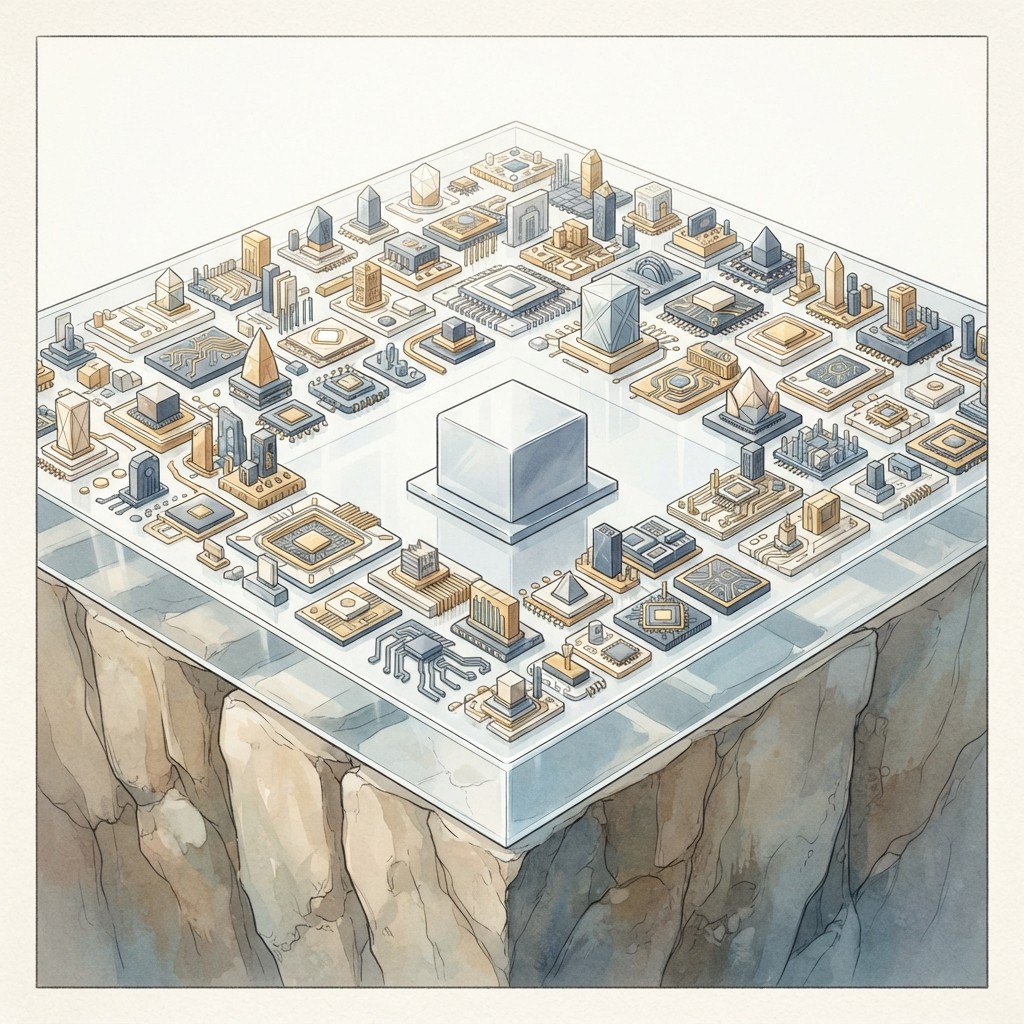
An entire industry believed power meant owning the factory. One company in Hsinchu built the world's most expensive factories — then vowed never to design a single thing of its own. That refusal became the moat.
Pairs with the Profit-Engine Map — a ready-to-use strategy tool. Included in the Money Machine Casebook →
“Where does the money actually come from, and who sets the rate it comes in at?”
In the late 1980s, the smart money in chips lived by a single swaggering rule: build your own fabrication plant or you weren't a real semiconductor company. The line — 'real men have fabs' — belonged to Jerry Sanders, the CEO of AMD, and it captured the gospel of an entire industry.7 Owning the factory was the whole point of being powerful. Into that conviction walked a company in Hsinchu, Taiwan, that proposed the opposite: it would build the most expensive factories in the world and then promise, in writing and forever, to never design a single chip of its own. That company was TSMC. The swagger aged badly. AMD itself eventually went fabless.7
The official story of TSMC's dominance is that it simply out-engineered everyone — better yields, smaller transistors, the tightest process technology on earth. That's true, and it's also the wrong explanation. The engineering is the visible result; the cause sits underneath it, in a structural choice made on the day of incorporation. TSMC didn't win because it built the best fab. It won because of the one thing it promised never to build.
The promise that turned a factory into a moat: where a self-imposed limitation reveals itself as the actual product
TSMC was incorporated on February 21, 1987, in Hsinchu, with the Taiwanese government's National Development Fund holding 48.3% and Philips 27.5%, on a single founding idea: it would be a pure-play foundry that pledged never to compete with its customers.1 Morris Chang, recruited to Taiwan in 1985 to run the government's ITRI research institute, had conceived it there as a 'common fab' — a shared factory that would take any customer, do no design work of its own, and stay out of every product market its clients were in.6 Read coldly, that pledge looks like a limitation. It was actually the entire business model. A chip design is a company's crown jewel; handing it to a manufacturer that also designs chips means handing it to a future competitor. By promising to be only a manufacturer — never a rival — TSMC removed the single biggest reason a designer would refuse to outsource. The promise wasn't a constraint on the business. It was the product.
“Real men have fabs.”7
Why every customer's R&D becomes TSMC's switching cost: how the trust that opens the door becomes the chain that locks it
Here is the mechanism, worked down to where it actually bites. When a fabless company designs a chip, it does not design in the abstract — it designs against a specific foundry's process, its design rules, its libraries, its packaging. The customer pours its own R&D into making a product that works inside TSMC's particular factory. That investment is the trap, and it's self-laid. Switching to another foundry doesn't mean signing a new contract; it means re-engineering the chip, re-validating it, and re-tooling around a different process — at the customer's own expense, with the customer's own time, against a deadline a competitor isn't waiting on. So the more deeply a designer commits to TSMC, the more expensive it becomes to leave. The trust that the pure-play pledge created is what got the customer in the door; the co-engineering is what nails it to the floor. TSMC doesn't have to lock anyone in. The customer does it to themselves, one design cycle at a time.
Now watch that loop compound across decades. TSMC's early international customers — Intel, Motorola, Texas Instruments — outsourced older, trailing-edge work, not their crown jewels.5 The real prize was a generation of fabless startups that had no fabs at all. Broadcom, Marvell, Nvidia, Qualcomm: in Chang's own telling, they 'started with us when they were small.'5 They grew up designing against TSMC's process, so as they got large, their entire product architecture was already entangled with one manufacturer. Volume flowed in; that volume funded the next, more expensive process node; the better node attracted the next wave of designers. The flywheel runs on a promise — keep it, and the trust never has to be re-earned.
| An integrated chipmaker (designs + manufactures) | TSMC (pure-play foundry) | |
|---|---|---|
| Relationship to customer | Potential competitor | Never a competitor — by pledge |
| What the customer risks sharing | Its design with a rival | Nothing it can be copied on |
| Who funds the chip's R&D | The chipmaker (for its own products) | The customer — against TSMC's process |
| Where the switching cost lives | Weak | In the customer's own engineering |
| Result over time | Limited external trust | Compounding lock-in |
The numbers a near-monopoly looks like: reading the signature a business leaves when its customers have nowhere else to go
By 2025 the loop had produced something close to a structural monopoly on the world's most advanced manufacturing. TSMC's revenue reached about US$122.54 billion for the year, up 36.1%, giving it 69.9% of the global foundry market — up from 64.4% the year before — while Samsung, the distant second, held 7.2%.4 In 2023 TSMC produced 28% of the entire world's non-memory semiconductor output value.2 Concentration shows up inside the customer book too: in its 2025 SEC filing, the top ten customers accounted for 78% of net revenue, with the single largest at 19%.3 That's the signature of a business whose customers are deeply, expensively committed. And the leading edge is where the lock is tightest: advanced nodes of 7nm and below made up 74% of TSMC's wafer revenue in late 2025.8
The clearest proof of pricing power is the boldest move of all: in early 2026 TSMC notified customers of 5–10% price hikes across its most advanced sub-5nm nodes.8 A supplier raises prices on its most demanding products only when it knows the customer has nowhere else to go.
Isn't this just the best fab winning — and isn't it fragile?: where the obvious objection turns out to reinforce the thesis it was meant to puncture
The fair objection is that none of this requires a clever business model — TSMC simply makes better chips, and customers stay because the alternatives are worse. There's truth in that. Samsung's 3nm yields reportedly sat in the 30–40% range in 2025, too low to win large external orders, which means a designer who wanted to leave TSMC for the leading edge often had no credible place to go.8 But that argument actually strengthens the thesis rather than undercutting it. Technology leadership and the switching cost are the same flywheel seen from two angles: the volume that the pure-play trust attracts is what funds the next node, and the next node is what keeps the volume captive. Strip the model away and a rival could in principle out-engineer one factory. Leave it in place and the rival must out-engineer the factory and overcome years of a customer's own joint R&D and earn trust that TSMC never has to re-earn. A better fab is necessary. It was never sufficient.
The honest counter is that the position is not eternal, and it's not purely Chang's genius either. The lone-visionary story is too tidy: Chang was recruited by Taiwanese officials — Sun Yun-suan, Li Kuo-ting — into a state-backed semiconductor push, and the government held 48.3% of the company at founding.61 The pure-play structure was his strategic move; the runway under it was national policy. And concentration cuts both ways: a customer book where the top ten are 78% of revenue is also a book where the loss of a few relationships would hurt badly.3 Geography is the real fragility — the most indispensable factories on earth sit on one contested island. But none of that is a flaw in the model. It's the price of the model working too well.
The most durable moat is sometimes a door you nail shut on yourself. When your customers must hand you their most valuable asset to do business — a design, a dataset, a roadmap — the single most powerful thing you can offer is a credible, permanent promise never to use it against them. That promise lowers the cost of trusting you, which pulls in the early committers, whose own investment then becomes the switching cost that holds everyone else. Two cautions: the pledge only works if it's structural, not a slogan — TSMC built a whole company around having nothing of its own to compete with. And success at this scale concentrates risk in your customer book and your geography. The moat that makes you indispensable is the same one that makes the world nervous about where you sit.
TSMC's founders made the most counterintuitive promise in the industry's history: we will build the hardest, most expensive thing to build, and we will never use it to build a single thing of our own. The competitors who laughed — real men have fabs — were measuring power by who owned the factory. TSMC measured it by who could be trusted with it. Four decades later it manufactures the brains of the modern world and answers to almost no one for the price.84 The genius was never the smallest transistor. It was choosing, on day one, to want nothing from its customers except their work — and to give them, in return, the one thing no rival with a design of its own could ever credibly offer: a manufacturer that would never become a competitor.
Companies that win by what they refuse to do
Profit-Engine Map
A one-page map that pulls a business apart into the hook that gets the customer in the door and the engine that quietly earns the margin. Use it to see where the real profit lives, how the two halves are wired together, and what breaks if the link is cut. Blank to dissect your own P&L; filled as the worked example of a business whose advertised product is not where it makes its money.
Included, filled and blank, in the Money Machine Casebook. See the set → · Preview the blank →
Sources
Where this comes from — the filings, records, and reporting behind it.
- 1TSMC was incorporated on February 21, 1987, in Hsinchu, Taiwan, with the National Development Fund (Executive Yuan) holding 48.3% equity and Philips holding 27.5%, on a pure-play foundry model pledging never to compete with customers.
- 2TSMC's 2023 consolidated revenue was NT$2,161.74 billion (approx. US$70.6 billion), a 4.5% decrease from 2022; the company produced 28% of world semiconductor (ex-memory) output value in 2023.
- 3TSMC's 2025 20-F (primary SEC filing) shows 2025 net revenue of NT$3,809,054 million, with HPC generating 58% of revenue; top-10 customers accounted for 78% of net revenue; largest single customer 19%; 2026 capex planned at US$52–56 billion.TSMC / SEC EDGAR, TSMC Form 20-F for Year 2025 ↗ · 2026-04-16
- 4In Q4 2024, TSMC held 67% global foundry market share by revenue; for full-year 2025, TSMC revenue reached US$122.54 billion (up 36.1% YoY), representing 69.9% of the global foundry market, up from 64.4% in 2024. Samsung was a distant second at 7.2%.
- 5Chang is credited with pioneering the foundry concept in 1987; TSMC opened with $220 million in capital and its first major international customers included Intel, Motorola, and TI — who outsourced older-technology products, not leading-edge work. Fabless startups like Broadcom, Marvell, Nvidia, and Qualcomm 'started with us when they were small,' per Chang directly.
- 6Morris Chang was recruited to Taiwan in 1985 by government officials including Premier Sun Yun-suan and Li Kuo-ting to head ITRI; he proposed the pure-play foundry model from within ITRI before spinning TSMC out. The foundry was conceived as a 'common fab' for multiple companies that would take any customer — no design work, no competition with customers.
- 7The 'Real men have fabs' quip is attributable to AMD's Jerry Sanders (CEO of AMD), not Intel's Andy Grove. TSMC's rise inverted this dictum: AMD itself eventually went fabless, and AMD's later CEO Lisa Su reportedly riposted 'Real women don't need fabs.'
- 8Advanced process technologies (7nm and below) accounted for 74% of TSMC's wafer revenue in Q4 2025, with 3nm at 24% and 5nm at 36%. Samsung's 3nm yields sat in the 30–40% range in 2025, insufficient to attract large external orders. TSMC notified customers of 5–10% price hikes across sub-5nm nodes for January 2026.
Weighing outside help with a decision like this? Hiring a pricing strategy consultant
More like this — beyond TSMC
New Strategically analyses as they publish: the defining moves in business, checked against the record. No noise, and one click to leave.