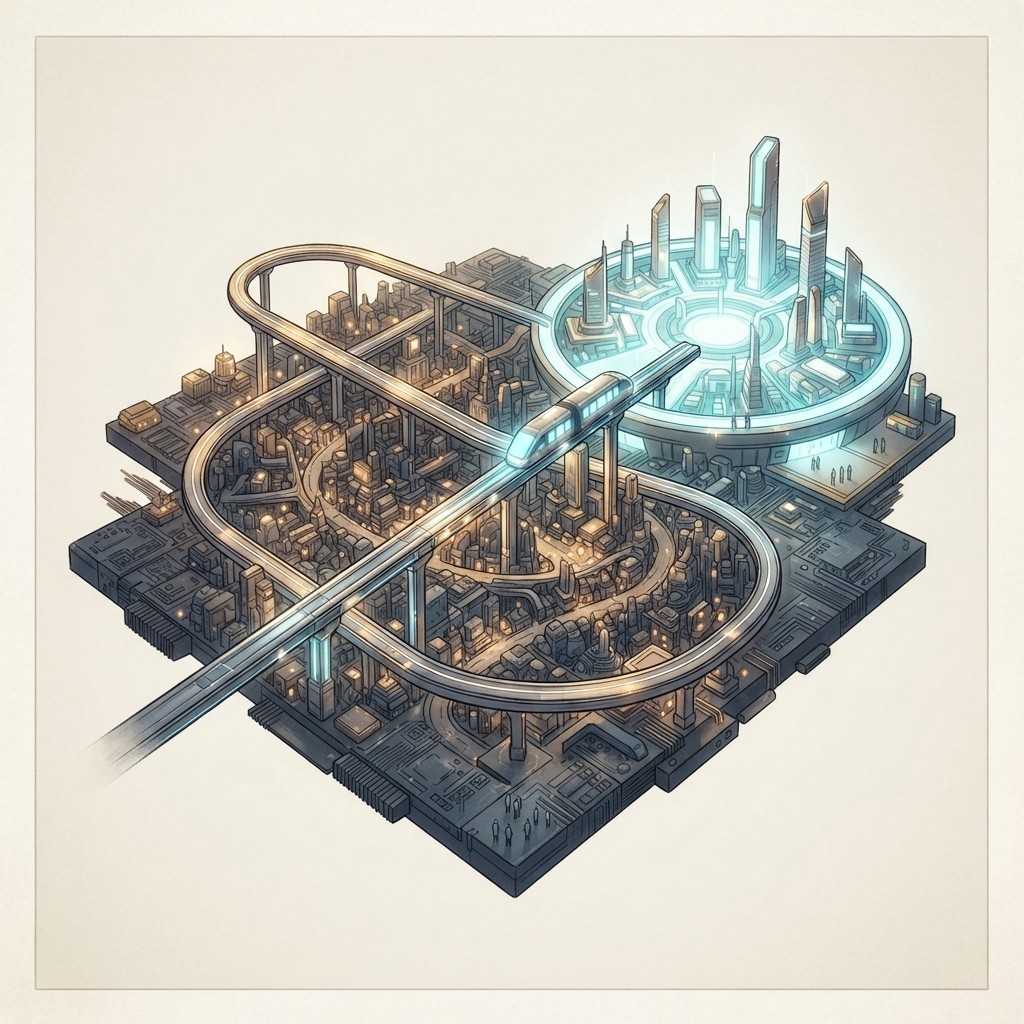
Pairs with the Market-Entry Gambit Canvas — a ready-to-use strategy tool. Included in the Market-Entry Gambit Casebook →
“How fast can this actually be done?”
In April 2024, on a stage in front of its biggest customers, TSMC unveiled a chip with a name that sounded like the future: A16.1 The 'A' is for angstroms. Ten of them make a nanometer, so A16 reads as 1.6 nanometers - a number smaller than anything anyone has shipped, a leap past the 2nm everyone else is racing toward. Except TSMC, when pressed, won't call it 1.6nm at all.6 And the transistor architecture inside it isn't new. It is the same first-generation nanosheet GAA architecture TSMC already built for its N2 node — with incremental improvements, but no new transistor generation. What changed most dramatically is where the power wires run. That's the leap.
The story the name tells is that TSMC sprinted to a new frontier of transistor physics. The truth is quieter and far more interesting. A16 is built on the same first-generation nanosheet GAA platform as N2P, with backside power delivery added — and TSMC's own senior leadership is candid about the lineage.
“A16 will include transistor improvements, plus the new Super Power Rail advantages over the N2 family.”5
The feature that got demoted, then promoted
Here is the move almost everyone missed. Backside power delivery - routing the power wires underneath the transistors instead of crowding them on top - was never supposed to be its own node. It was originally planned for N2P, the second-generation 2nm process, targeted for the back half of 2025. Then it was pulled. TSMC removed it from N2P and gave it a new name: A16.4 The reason is the part the marketing skips. TSMC's version of backside power, called Super Power Rail, connects directly to each transistor's source and drain - one of the most complex backside designs in the industry, more involved than Intel's. That complexity is expensive, and expensive features don't belong on a high-volume mainstream node feeding millions of phones.7 So TSMC didn't cancel it. It quarantined it - peeled it off the cheap, ubiquitous node and stood it up as a premium one. A demoted feature became a promoted product.
Strip away the angstrom branding and the thesis is plain. TSMC isn't selling a new transistor generation. It is selling segmentation. By building A16 as a separate, higher-priced lane aimed squarely at high-performance computing and AI chips - the buyers whose power-hungry designs actually benefit from source-and-drain backside power - TSMC gets to charge a premium for an expensive feature without forcing it, or its cost, onto the mobile customers who don't need it.2 The mobile roadmap stays on N2P, cheaper and undisrupted. The AI customers pay up for A16. Same fab, same transistor family, two price points. It's a price-discrimination play wearing a technology-leap costume.
| What the '1.6nm' name implies | What A16 actually is | |
|---|---|---|
| The transistor | A new, smaller generation | Same first-gen nanosheet GAA as N2 |
| The real change | A full geometric shrink | Power wiring moved to the wafer's back |
| Origin | Built fresh for A16 | A feature pulled out of N2P |
| Who it's for | Everyone, eventually | HPC and AI buyers willing to pay a premium |
The rival who handed TSMC the playbook
The richest twist is who made this possible. TSMC did not invent backside power. Intel demonstrated and shipped it first, on its 18A process, with a version called PowerVia — Panther Lake, the first 18A product, shipped in late 2025, well ahead of A16's volume ramp.9 But Intel built the simpler kind, connecting at the cell contact level, and reached market first with that implementation.77 That left TSMC a lane. Rather than match Intel's timing on a cheap node, TSMC went the other direction: a harder, costlier source-and-drain implementation, deliberately reserved for the customers who'd pay for it. Intel proved the technology worked and normalized it as table stakes. TSMC then declined to compete on Intel's terms and instead carved a premium tier above them. The follower turned the leader's head start into a market it could segment.
When a feature is too expensive to put on everything, the instinct is to cut it or wait. The sharper move is to wall it off and sell it to the buyers who value it most. TSMC took a capability it had to pull from a high-volume node on cost grounds and, instead of shelving it, gave it a new name, a new price, and a new audience. The technology barely changed; the market structure did. Before you call something a product breakthrough, ask the quieter question: did the engineering leap forward, or did the segmentation? A premium tier built on an existing platform earns margin without the R&D risk of a true new generation - which is exactly why it's so often mistaken for one.
Isn't this just clever foundry marketing, then?
The fair objection is that calling A16 a 'mere' repricing undersells it. The gains are real - up to 10% faster or 20% lower power, with denser logic - and TSMC's source-and-drain backside contact is genuinely harder engineering than its rivals' versions, not a cosmetic tweak.17 All true. But difficulty isn't the same as a new node, and the strategy holds precisely because the engineering is real: a premium lane only commands a premium if the thing inside it actually delivers. The honest counter cuts the other way, too. This was not a frictionless masterstroke. A16 was first pitched for 2026 production, and TSMC has since pushed real volume to 2027, with its SVP conceding the ramp depends on customers showing up with products.3 And the no-High-NA-EUV restraint that keeps A16 affordable is explicitly temporary - TSMC's own annual report says it is exploring next-generation lithography for the nodes that follow.8 So the segmentation is deliberate and well-executed, but it is also a holding pattern. The genuine geometric shrink everyone thinks they're buying today is still a node or two away. A16 is the bridge built to charge a toll while the real bridge gets engineered.
TSMC didn't crack the angstrom era with a new transistor. It cracked it with a rename. It took a feature it couldn't afford to put everywhere, gave it a number that sounds like the frontier, and sold it to the only customers who'd pay frontier prices - while its mainstream business kept humming along on cheaper silicon, untouched. That's not a smaller win than inventing a new node. It's a different game entirely: the one where you don't have to out-engineer the future to get paid for it - you only have to out-segment the present.
When the real product isn't the one on the label
Market-Entry Gambit Canvas
A one-page canvas for staging an entry into a market you don't own yet: the beachhead you take first, the wedge that gets you in cheaply, the sequence that turns a foothold into a position, and the incumbent's likely counter-move. Blank to plan your own entry; filled as the worked example showing how the story's challenger picked its landing spot and walked the rest in.
Included, filled and blank, in the Market-Entry Gambit Casebook. See the set → · Preview the blank →
Sources
Where this comes from — the filings, records, and reporting behind it.
- 1TSMC debuted A16 at its 30th North America Technology Symposium on April 24, 2024, describing it as combining Super Power Rail (SPR) backside power delivery with nanosheet transistors, targeting production in 2026, and offering 8-10% speed improvement or 15-20% power reduction vs. N2P, plus up to 1.10x chip density.
- 2TSMC's official product page states: 'TSMC A16™ technology integrates leading nanosheet transistors with innovative Super Power Rail (SPR) solutions, bringing greatly improved logic density and performance. SPR improves logic density and performance by dedicating front-side routing resources to signals. It also significantly reduces IR drop, improving power delivery efficiency.'
- 3TSMC SVP Kevin Zhang stated at the April 2026 North America Technology Symposium: 'A16 will be ready for production in 2026. However, actual product ramp depends on customers, and we expect volume production to begin in 2027.' TSMC formally reclassified A16 as a 2027 node on its roadmap.
- 4Backside power delivery was originally planned for TSMC's N2P node (then targeted for H2 2025), but was removed and relocated to the new A16 node. SemiEngineering reported this directly from the 2024 Tech Symposium, citing the timing as 'lined up better with the development of that process.'
- 5TSMC SVP Kevin Zhang confirmed at the 2024 Symposium that A16 includes genuine transistor improvements over N2 beyond just adding backside power: 'A16 will include transistor improvements, plus the new Super Power Rail advantages over the N2 family.' However, it uses the same first-generation nanosheet GAA architecture as N2.
- 6The Register confirmed directly with TSMC that 'A' stands for angstroms (10 angstroms = 1nm), making A16 a 1.6nm-class node in common parlance, but 'TSMC does not refer to it as such' — the company only uses the A16 designation. Node naming in this era is a marketing convention, not a physical measurement.
- 7TSMC's SPR backside power delivery connects directly to each transistor's source and drain — described by Tom's Hardware and TrendForce as 'one of the most complex BSPDN designs, surpassing Intel's PowerVia,' which connects at the cell/transistor contact level. This complexity is cited as a key reason BSPDN was removed from the less expensive N2P node.
- 8TSMC's 2023 Annual Report (filed with the SEC on Form 20-F) states A14 development 'made good progress' and that 'TSMC R&D will continue to explore next generation EUV lithography scanners' for A14 and beyond — confirming that the no-High-NA-EUV stance applies to A16 specifically, not permanently to all future nodes.
- 9Intel shipped the first commercial product on 18A (with PowerVia backside power delivery) in late 2025: Panther Lake (Core Ultra Series 3) began high-volume production at Fab 52 in Arizona, with the first SKU shipping before end of 2025 and broad market availability in January 2026.
Weighing outside help with a decision like this? Hiring a commercial due diligence provider
More like this — beyond TSMC
New Strategically analyses as they publish: the defining moves in business, checked against the record. No noise, and one click to leave.