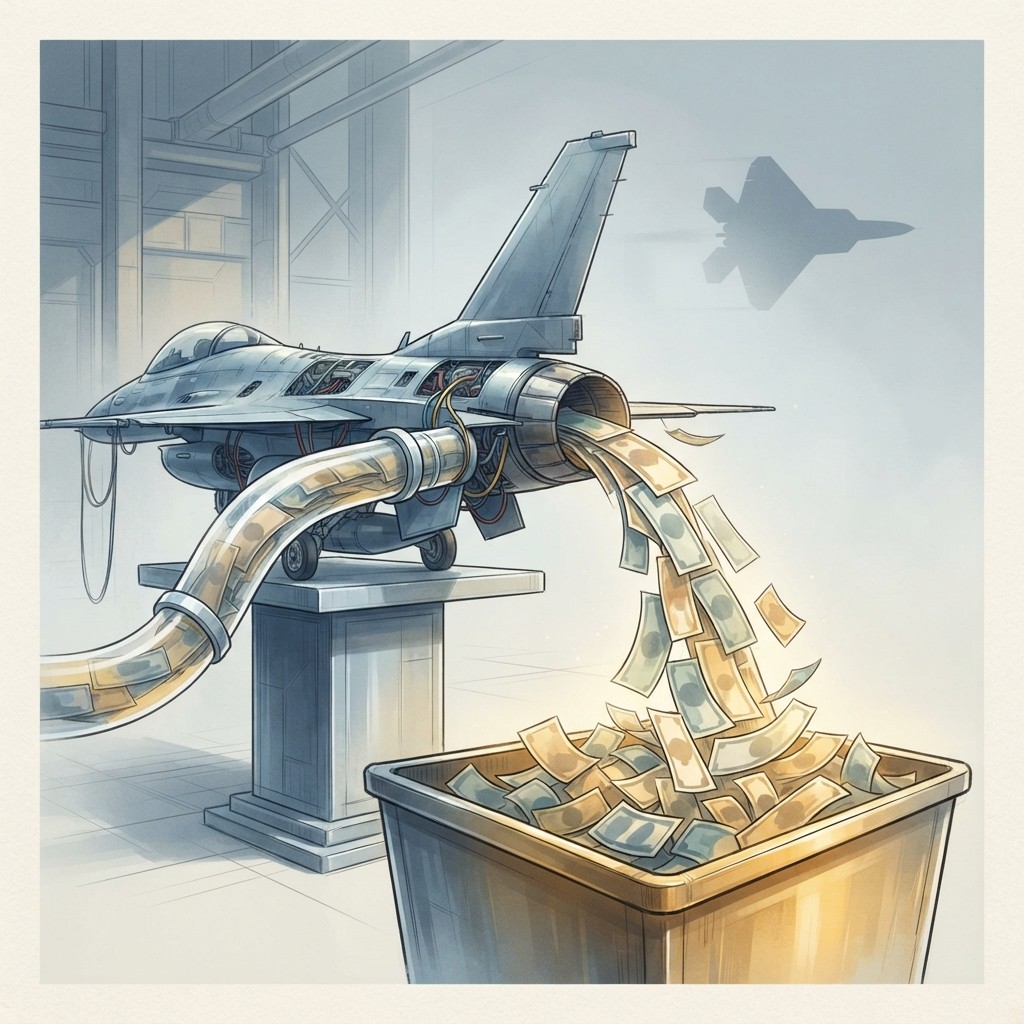
Pairs with the Profit-Engine Map — a ready-to-use strategy tool. Included in the Money Machine Casebook →
“Where does the money actually come from, and who sets the rate it comes in at?”
Picture a fleet of the most advanced fighter jets ever built, and then picture that on any given day in 2025, fewer than half of them could fly a mission at all.5 That is not a hypothetical. The F-35's fleet-wide mission capable rate fell to 44% in FY2025, and the share able to perform all their missions dropped to 25%.5 (GAO-26-108113 was published June 11, 2026, covering FY2025 performance data gathered during an audit conducted January 2025 through June 2026.) You would expect a supplier paid to keep those jets ready to be in trouble. Instead, that supplier has built one of the most durable revenue machines in the defense industry - precisely because the jets keep breaking.
The official story is that the F-35 anchors Lockheed Martin because it is a great airplane that everyone wants to buy. The real story is quieter and stranger: the airplane is roughly a quarter of Lockheed's revenue and flat,1 while the thing that actually locks the customer in is the part nobody markets - the spare parts, the data, and the software that keep a chronically unreliable fleet limping forward.
The anchor isn't the jet. It's everything the jet can't do without.
Here is the thesis a smart friend could repeat at dinner: Lockheed isn't anchored by selling F-35s - it's anchored by owning the F-35's bloodstream. The aircraft is built around proprietary logistics, parts pipelines, and maintenance data that the government does not fully control. So once a country buys the jet, it has also bought a decades-long dependency on Lockheed to keep it alive. The buy is the front door. The sustainment is the trap.
Look at the numbers and the shape of the business comes into focus. The DoD's 2023 estimate puts the F-35's total cost at $2.1 trillion across a 94-year lifecycle running to 2088.3 Most people read that as Lockheed's payday. It isn't - the figure includes fuel, personnel, depot repair, and inflation, and the Joint Program Office itself notes roughly $1 trillion of it is just inflation adjustment.3 But buried inside the total is the part that does matter: sustainment alone is now estimated at nearly $1.58 trillion, a 44% jump from the 2018 estimate of $1.1 trillion, driven by the Pentagon extending the jet's service life to 2088 and by relentless reliability failures.4 The less reliable the fleet, the bigger the sustainment tail. The bigger the tail, the deeper the dependency.
| The official story | The captive-sustainment read | |
|---|---|---|
| What anchors Lockheed | Selling great jets people want | Owning the parts, data, and logistics |
| Revenue trajectory | Growing program | 26% of sales and flat-to-declining |
| Reliability problems | A bug to be fixed | A feature that grows the sustainment tail |
| Customer's exit option | Buy someone else's jet | None - the dependency is built in |
Paid to keep them flying, even as they fall out of the sky
The cleanest evidence that this is a trap and not a partnership is what happens when the product fails. The mission capable rate didn't drift - it collapsed, from 67% in FY2021 to 44% in FY2025, while the full mission capable rate fell from 38% to 25%.5 Those numbers sit nowhere near the 80% targets the services set; the Air Force's F-35A managed 51.9% in 2023 against an 80% minimum.6 And yet, from 2020 through 2023, Lockheed was paid more than $114 million in incentive fees even as readiness stagnated or got worse.5 A normal supplier loses the contract when the product underperforms. Lockheed got bonuses.
Why doesn't the Pentagon just route around it? Because it can't easily. Take it apart and the mechanism is plain: the government bought a weapon system whose logistics nervous system Lockheed designed and operates. The parts network, the maintenance software, the data on what's broken and why - the dependency is structural, not contractual. The Pentagon knows this, which is why it has been trying to claw back control, even formally pausing performance-based logistics negotiations in late 2023 after the Office of the Secretary of Defense determined the proposed PBL contract did not meet Congressional certification requirements.9 The frustration is the proof. You don't fight that hard to escape a vendor you could simply replace.
Lockheed anticipates more than 3,500 F-35s at the program's height.8 Multiply a fleet that size by a service life now stretched to 2088 and a sustainment estimate near $1.58 trillion4, and the program's value isn't the sale price of any jet - it's the recurring, near-inescapable demand to keep all of them running for two generations. The reliability problems don't shrink that demand. They inflate it.
The bill for harvesting one account: the next two fighters
Here is where the anchor metaphor turns dark. An anchor holds you in place - which is exactly the danger when the fleet starts to move. In March 2025, the Air Force awarded its sixth-generation NGAD fighter, the F-47, to Boeing. Then Lockheed was dropped from the Navy's F/A-XX competition too, leaving it shut out of both next-generation manned fighter programs at once.7 Wall Street read the signal instantly: Bank of America, Melius, and RBC Capital all downgraded the stock to neutral.7 Two decades of harvesting the F-35 account, and the company that built the last dominant fighter was not chosen to build the next one.
“We want to take the F-35 chassis and turn it into a Ferrari - 80% of sixth-gen capability at 50% of the cost.”8
The 'Ferrari F-35' pitch - upgrade the existing chassis toward sixth-generation capability rather than build a new jet - is exactly the move you'd expect from a company whose strategy has become defending the installed base.8 It may even work. But notice what it concedes. Lockheed isn't proposing to win the future; it's proposing to make its anchor good enough that the future doesn't fully leave it behind. And tellingly, it won't even protest the F-47 award.8 When the incumbent stops fighting for the next contract and starts optimizing the last one, you are watching a money machine, not a frontier.
But isn't a 60-year captive customer the best business in the world?
The fair objection is that this read is too cynical. A recurring revenue stream attached to thousands of jets flying through 2088 is, by any normal standard, an extraordinary business - the kind every company wishes it had.4 And there's truth there: a customer who can't leave is the dream, and Lockheed engineered one. The honest counter, though, is that captivity cuts both ways. The F-35 revenue isn't growing - it was 27% of sales in 2022 and 26% in both 2023 and 2024, with 2023 F-35 sales actually falling $400 million on lower production volume.21 A flat, defended account is not a growth engine; it's a plateau you defend. And the deeper risk is that optimizing one account is a different muscle than winning the next one. Lockheed got very good at the first and, in 2025, discovered it had let the second atrophy. The anchor held the ship perfectly still while the fleet sailed on without it.
A captive customer is the most seductive position in business - recurring revenue, no real competitor, a switching cost so high the buyer can't leave even when they're furious. But there's a tax that comes due late and all at once: the discipline of winning new business decays while you optimize the old. Lockheed's F-35 sustainment tail is genuinely formidable, locking in demand for a fleet through 2088. Yet the same focus that perfected the harvest left it shut out of both sixth-generation fighters in a single year. The lesson isn't to avoid captive accounts - it's to never let one become your only muscle. The moment your strategy is 'defend the installed base,' check whether you've stopped being able to build the next one.
Lockheed makes its money the way a landlord does with a building no one else can manage - serenely indifferent to whether the tenants are happy, because the tenants cannot leave. It needs only one thing from the world: that thousands of F-35s keep needing parts, data, and patches for the next sixty years, and they will. The genius was never the airplane. It was standing in the one place the customer can't route around - the bloodstream of a fleet that breaks. And the cost of that genius arrived in 2025, in two contracts Lockheed didn't win, with a message a money machine is the last to hear: the place you can't be replaced is also the place you stop being asked to lead.
Companies that profit from the part you can't leave
Profit-Engine Map
A one-page map that pulls a business apart into the hook that gets the customer in the door and the engine that quietly earns the margin. Use it to see where the real profit lives, how the two halves are wired together, and what breaks if the link is cut. Blank to dissect your own P&L; filled as the worked example of a business whose advertised product is not where it makes its money.
Included, filled and blank, in the Money Machine Casebook. See the set → · Preview the blank →
Sources
Where this comes from — the filings, records, and reporting behind it.
- 1The F-35 program generated 26% of Lockheed Martin's total consolidated net sales in both 2023 and 2024, and 65% of Aeronautics net sales in 2024.
- 2The F-35 program generated 27% of Lockheed Martin's total consolidated net sales in 2022 and 66% of Aeronautics net sales. Full-year 2023 F-35 net sales fell $400 million versus 2022 due to lower production volume.
- 3DoD's 2023 Modernized Selected Acquisition Report (MSAR) estimates the F-35 program's total cost at $2.1 trillion over its 94-year lifecycle (1994–2088), including procurement, sustainment, personnel, fuel, and inflation; approximately $1 trillion of the total reflects inflationary effects.
- 4The GAO reported in April 2024 that the F-35's total lifetime cost tops $2 trillion, up from the prior $1.7 trillion estimate; sustainment costs alone rose 44% to nearly $1.58 trillion, driven by the Pentagon extending service life to 2088 (from 2077) and ongoing readiness failures.
- 5The F-35 fleet's mission capable rate declined from 67% in FY2021 to 44% in FY2025; the full mission capable rate (all missions) fell from 38% to 25% over the same period—well below service targets. From 2020–2023, Lockheed was paid more than $114 million in incentive fees even as readiness stagnated or worsened.
- 6The F-35 fleet mission capable rate was about 55% in March 2023, far below program goals; the Air Force F-35A rate was 51.9% in 2023 against an 80% minimum target. DOD declared full-rate production in March 2024.
- 7Boeing was awarded the NGAD (F-47) contract on March 21, 2025; Lockheed was subsequently dropped from the Navy's F/A-XX competition as well, leaving it shut out of both sixth-generation manned fighter programs. Wall Street analysts at Bank of America, Melius, and RBC Capital all downgraded Lockheed to neutral.
- 8After losing NGAD, Lockheed CEO Jim Taiclet announced a 'Ferrari' F-35 upgrade strategy on the Q1 2025 earnings call, aiming to deliver '80% of sixth-gen capability at 50% of the cost.' Lockheed anticipates more than 3,500 F-35s to be operational at the program's height. Lockheed will not protest the F-47 award.
- 9The Pentagon formally paused F-35 PBL negotiations with Lockheed Martin in late 2023, with the Office of the Secretary of Defense issuing a statement that the current proposed PBL 'does not meet' Congressional certification requirements.
- 10Jim Taiclet said on the Q1 2025 earnings call: 'We're basically going to take the chassis and turn it into a Ferrari,' aiming to deliver 80% of sixth-gen capability at half the cost.
Weighing outside help with a decision like this? Hiring a pricing strategy consultant
More like this — beyond Lockheed Martin
New Strategically analyses as they publish: the defining moves in business, checked against the record. No noise, and one click to leave.