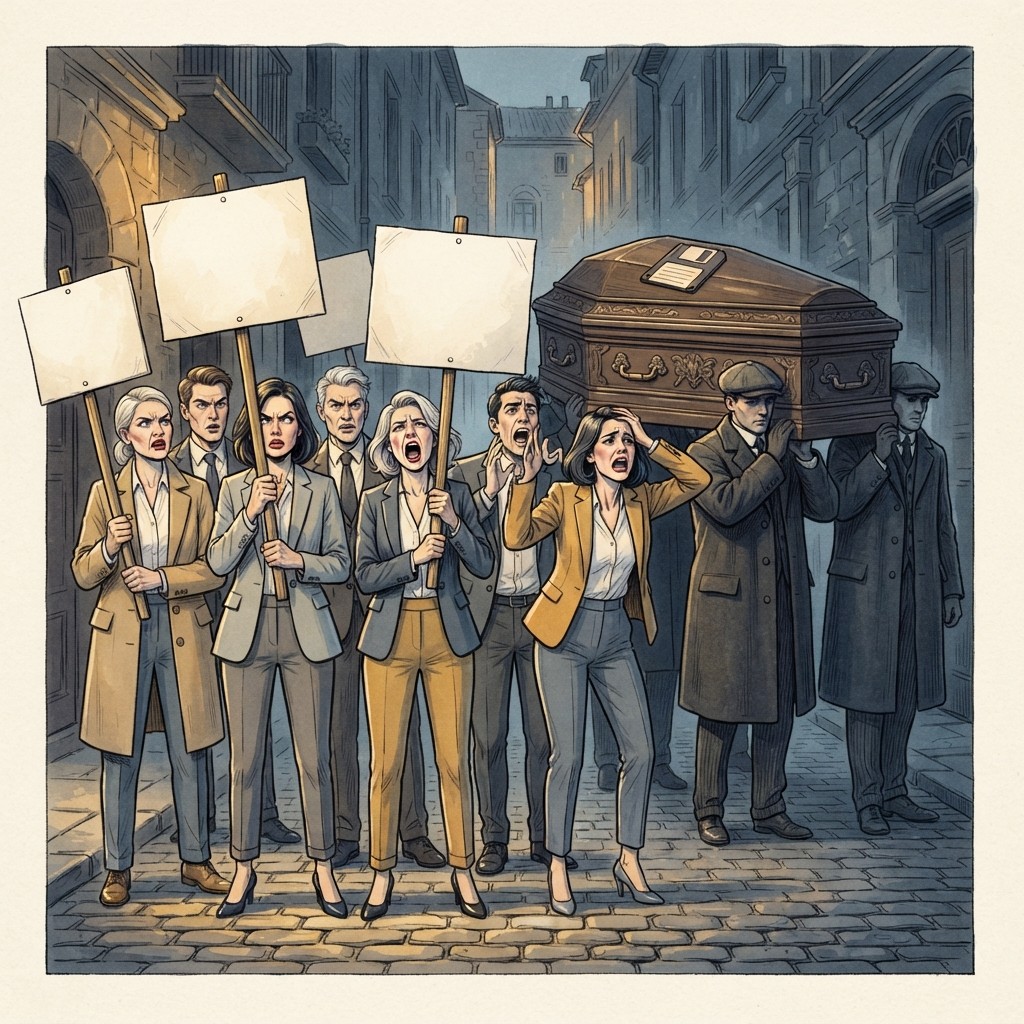
A 35-person startup hired actors to picket a rival's conference. They weren't protesting wages - they were protesting the idea of software you install. The marketing was the product.
Pairs with the Profit-Engine Map — a ready-to-use strategy tool, filled for Salesforce. Included in the The Money Machine Casebook →
In March 2000, executives arriving at a Siebel Systems conference walked into a picket line. Protestors with signs and chants. Except the protestors were actors, hired by a 35-person startup operating out of a rented one-bedroom apartment on Telegraph Hill, and the thing they were protesting wasn't a labor dispute - it was the very idea of software you install.5 The startup was Salesforce. It would later stage a launch event depicting a literal hell for traditional enterprise software, complete with a fighter jet shooting down a biplane.5 None of this was about code. It was theater. And the theater is the whole story.
The official version is that Salesforce invented software-as-a-service. It didn't. Hosted software existed before it, the term came after it, and at least one rival was shipping web-delivered subscription CRM at the same time. What Salesforce actually invented was the argument.
Here is the thesis a smart friend can repeat at dinner: Salesforce didn't pioneer the technology of SaaS so much as it pioneered the belief in it. The real moat was evangelism. The company took a delivery method that buyers found abstract and confusing and turned it into a movement with a villain, a slogan, and a fighter jet.
What Salesforce actually built - and what it didn't: the architecture was real, the origin myth was not, and the gap between them is the whole point
Strip away the marketing and there is a genuine technical bet underneath, and it matters. The hosted-software companies of the late 1990s - Application Service Providers - ran a copy of the software on dedicated infrastructure for each customer. One tenant, one stack. That meant every customer was a small, expensive island to maintain. Salesforce instead built a multi-tenant architecture: one set of shared code and infrastructure serving every customer at once, with their data logically separated.8 Crucially, the company never transitioned from a prior model. There was no CD-ROM era to abandon, no on-premise legacy to migrate off. It was built as pure web-delivered subscription software from day one.8
That single architectural choice is what made the economics work. When the next customer costs almost nothing to onboard because they share the same machines and the same upgrade, your gross margin starts to look like software and your operating leverage compounds. But here is the correction that the founding legend skips: Salesforce was not the first to deliver software over the internet. NetSuite was founded in 1998, and other hosted-CRM rivals were live around the same time. The defensible claim is narrower and truer - Salesforce was the first pure-play, multi-tenant SaaS company built from scratch at scale.8
| On-premise software | ASP (hosted, single-tenant) | Salesforce (multi-tenant) | |
|---|---|---|---|
| Where it ran | On your servers | On dedicated servers per customer | On shared infrastructure for all |
| Cost of the next customer | A full new install | A full new stack | Near zero |
| Upgrades | Manual, per site | Per customer | Once, for everyone |
| What Salesforce called it | Hell | Yesterday's idea | 'No Software' |
Why the marketing was the product: when buyers have no category for what you sell, the highest-leverage move is to pick a fight
Multi-tenant architecture is invisible. No buyer ever fell in love with logical data separation. The problem Salesforce faced in 1999 was not that its technology was weak - it was that enterprise buyers had no mental category for what it was selling. 'Software as a service' was not yet a phrase a CIO had heard; it consolidated in analyst white papers and industry usage in the years that followed, not at Salesforce's founding. So Salesforce did something more clever than coining a term. It picked a fight.
The 'No Software' campaign gave the abstract a shape. A red circle with 'software' crossed out. A theatrical hell for the installed-software way of life. A fighter jet downing a biplane to dramatize new versus old.5 And the actors picketing outside Siebel's conference - reported in The Wall Street Journal in March 2000 - did the most important work of all.5 They named a villain. Once buyers had a villain (slow, expensive, install-it-yourself enterprise software) and a banner (No Software), they suddenly had a category to belong to. The geography of the argument did the selling. Benioff understood enterprise software from the inside - he had spent 13 years at Oracle, where he was the youngest vice president in company history - and he knew exactly which incumbent fears to weaponize.6
“No Software.”5
There is a delicious irony here that proves the point. Salesforce is software. It is nothing but software. The slogan was technically false and strategically perfect, because it wasn't describing a product - it was describing a side. You weren't buying a CRM database. You were defecting from the old world.
When your product belongs to a category buyers don't yet recognize, the highest-leverage move isn't a better feature - it's a better fight. Name the old way, make it the villain, and give your buyers a banner to march under. Salesforce had a real architectural advantage in multi-tenancy, but multi-tenancy is invisible and arguments are not. The caution: this only works if the underlying substance is real. Theater on top of a hollow product is just noise that disappointment will eventually catch. 'No Software' worked because behind the slogan was an architecture that actually delivered the economics the slogan promised.
From a Telegraph Hill apartment to a public referendum: five years from a rented one-bedroom to the moment the public finally voted on the argument
The bet took five years to face a real verdict. Salesforce was incorporated on March 8, 1999, by four co-founders - Benioff, Parker Harris, Frank Dominguez, and Dave Moellenhoff - working from a rented one-bedroom unit at 1449 Montgomery Street.1 By late 2003 it was ready to go public, and the road was bumpy: it filed its S-1 in December 2003, the SEC balked over how it accounted for sales commissions, and Benioff broke the quiet period, pushing the debut back by roughly a month.3
On June 23, 2004, Salesforce listed on the NYSE under the ticker CRM, offering 10,000,000 shares at $11.00 to raise $110 million.2 Note what that price already tells you: the offering had been ranged at $7.50 to $8.50 and was pushed above range before pricing - the popular '$8 IPO' shorthand describes a range that never happened.4 The stock closed its first day at $17.20, a gain of more than 55%.4 The public had bought the argument.
But wasn't the real win the technology, not the theater?: both were required to win, but only one of them was actually rare
The honest objection is that this overrates the marketing. Picket lines and slogans get you attention; they don't get you to $1 billion in revenue in 2009 - which made Salesforce one of the first cloud companies to reach that milestone - or to a record $41.5 billion in its fiscal 2026.7 Surely the multi-tenant architecture, not the fighter jet, built that. And the architecture was genuinely load-bearing: it is what let each new customer cost almost nothing to serve, the engine of the whole economic story.8
True - but it confuses the necessary with the decisive. The architecture was necessary; plenty of competitors had hosted software, and at least one rival had multi-tenant ambitions of its own. What Salesforce had that they didn't was distribution for the idea. The theater is what got enterprise buyers to take a phone call about a category they'd never heard of, from a startup in an apartment, against incumbents they'd trusted for a decade. The architecture made the model profitable; the evangelism made the model believed. Take away the architecture and the economics collapse. Take away the marketing and a superior product dies in obscurity while a slower-moving incumbent keeps the account. Both were required. Only one was rare.
That is the lesson worth keeping. Salesforce's most-copied invention was never multi-tenancy - that became table stakes. It was the discovery that when you are selling something the market cannot yet picture, the product is the argument, and the moat is how many people you can get to repeat it. Salesforce hired actors to protest the old way, and then it spent twenty-five years making the protest come true. The slogan was a lie about the product and the truth about the company. It really did sell No Software. It sold a side.
Companies that won the argument before the product
Profit-Engine Map
A one-page map that pulls a business apart into the hook that gets the customer in the door and the engine that quietly earns the margin. Use it to see where the real profit lives, how the two halves are wired together, and what breaks if the link is cut. Blank to dissect your own P&L; filled as the worked example of a business whose advertised product is not where it makes its money.
Included, filled and blank, in the The Money Machine Casebook. See the set → · Preview the blank →
Sources
Where this comes from — the filings, records, and reporting behind it.
- 1Salesforce was incorporated on March 8, 1999, by Marc Benioff, Parker Harris, Frank Dominguez, and Dave Moellenhoff, operating from a rented one-bedroom apartment at 1449 Montgomery Street on San Francisco's Telegraph Hill.Salesforce, Inc., The History of Salesforce ↗ · 2025-12-16
- 2Salesforce's IPO on June 23, 2004 offered 10,000,000 shares at $11.00 per share on the NYSE under ticker symbol CRM, raising $110,000,000 in gross proceeds.
- 3Salesforce.com first filed its S-1 IPO registration statement on December 18, 2003; the SEC delayed acceptance due to objections over how the company accounted for sales commissions, and CEO Benioff's violation of the quiet period further postponed the debut by roughly one month.
- 4On its first day of trading (June 23, 2004), Salesforce.com stock closed at $17.20, a greater than 55% first-day gain from its $11 offering price; the offering had originally been ranged at $7.50–$8.50 before being priced above range.
- 5Salesforce's early-2000 product launch at the Regency Theater staged a theatrical 'hell' for traditional enterprise software; the 'No Software' branding campaign accompanied the event, featuring a fighter jet shooting down a biplane. Salesforce also hired actors to stage a mock protest outside a Siebel Systems conference, a stunt first reported in The Wall Street Journal in March 2000.Salesforce, Inc., The History of Salesforce ↗ · 2025-12-16
- 6Before launching Salesforce, Benioff spent 13 years at Oracle Corporation (1986–1999), where he was the youngest vice president in company history. Oracle co-founder Larry Ellison was an early investor in Salesforce, and Salesforce's Wikipedia entry (citing secondary coverage) places Ellison and CNET founder Halsey Minor among the earliest investors; Minor held 10.2% pre-IPO per the S-1 notes.
- 7Salesforce passed $1 billion in annual revenue in 2009, becoming one of the first cloud computing companies to reach that milestone; for fiscal year 2026 (ending January 31, 2026) the company reported record annual revenue of $41.5 billion.
- 8Salesforce's multi-tenant SaaS architecture was a key technical differentiator from the single-tenant ASP model that preceded it; ASPs from the late 1990s provided dedicated infrastructure per customer, whereas Salesforce shared common code and infrastructure across all customers with logical data separation. Salesforce never transitioned from CD-ROM or on-premise distribution — it was built as pure web-delivered subscription software from day one.
More like this — beyond Salesforce
New Strategically analyses as they publish: the defining moves in business, checked against the record. No noise, and one click to leave.