Pairs with the Switching-Cost Ledger — a ready-to-use strategy tool, filled for Salesforce. Included in the The Ecosystem Lock-In Casebook →
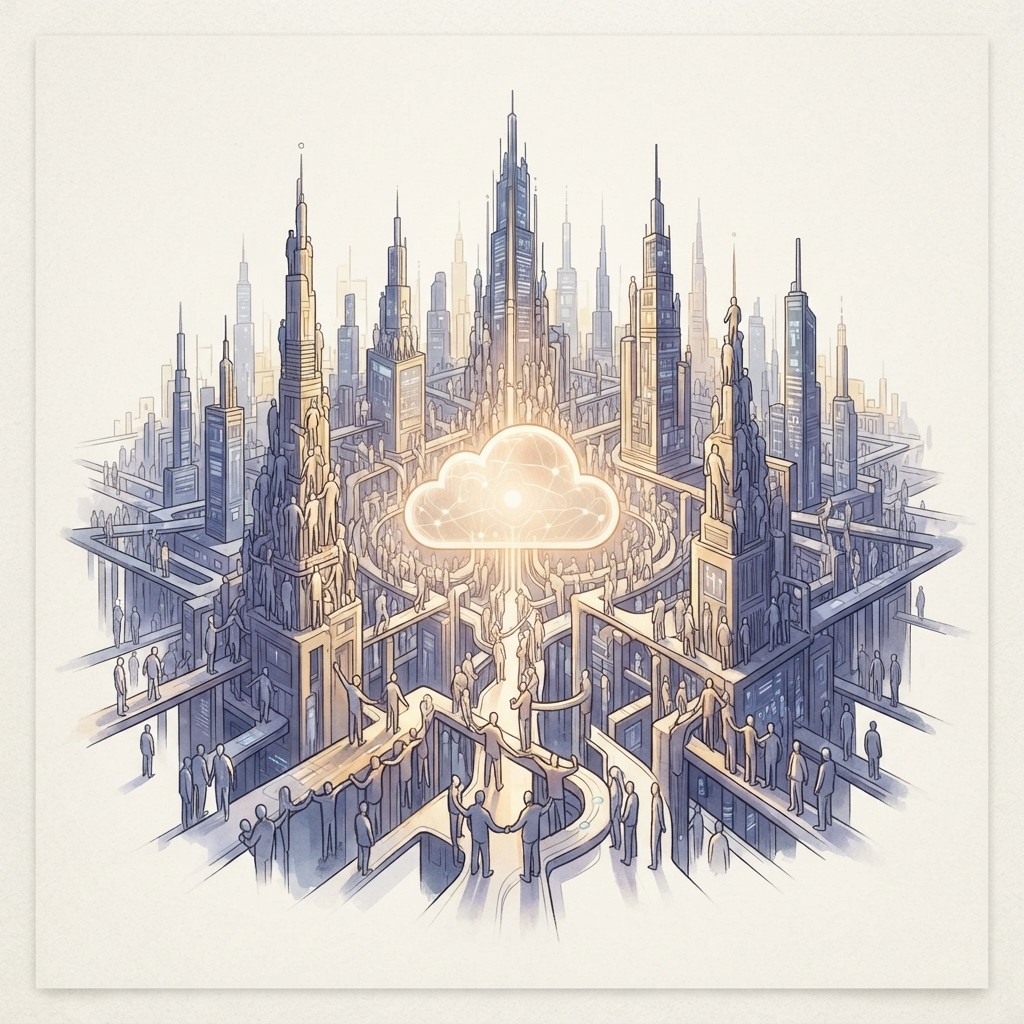
Picture the meeting where a company decides to leave Salesforce. The CFO has done the math on the contract. The data team has scoped the migration. And then someone speaks up — the admin who spent two years collecting Salesforce certifications, the ops lead whose entire LinkedIn headline is a Salesforce credential, the consultant on retainer whose firm does nothing else. They are not arguing for the software. They are arguing for themselves. That, and not the contract, is the wall Salesforce actually built.
The official story of Salesforce lock-in is the usual SaaS one: long contracts, painful data exports, deep integrations you'd have to unpick. All true, and all beside the point. The real lock-in isn't in the contract or the database. It's in the people — the ones whose livelihoods now run on the platform staying exactly where it is.
The contract is the moat everyone can see
Start with the obvious version, because it's real and it's enormous. Salesforce's remaining performance obligation — the contracted revenue it has booked but not yet recognized — ended its FY2024 fourth quarter at $56.9 billion, up 17% year over year.2 By FY2026 that figure had climbed to $72.4 billion.3 RPO is the cleanest single measure of how deeply customers are committed: it's money they've already promised to pay. On FY2024 total revenue of about $34.9 billion, the forward book was larger than a year and a half of sales.1 That is contractual lock-in, and it works.
But a contract expires. Data, eventually, migrates. If the only thing holding a customer were the paperwork, a determined buyer with a budget could leave — painfully, but leave. The reason almost nobody does is that the contract isn't the deepest layer. Underneath it sits something far harder to export: an entire workforce that has bet its résumé on the product.
Salesforce turned its product into a labor market
In 2014 Salesforce launched Trailhead, a free, gamified learning platform that today offers more than 60 certifications.8 On the surface it looks like generous customer enablement — teach people to use the thing, they'll use it more. Look again at what it actually manufactures: a credential. A Salesforce certification is not a skill you keep in your head. It's a badge you put on your LinkedIn profile, a line on a job posting, a salary band. Trailhead quietly converted product knowledge into career currency — and currency is something people defend.
Now multiply that by the population. Salesforce reports more than 200,000 credentialed experts and over 11,000 partner firms worldwide.6 Roughly 70% of its implementations are led not by Salesforce itself but by this army of outside specialists.5 A Salesforce-sponsored IDC projection — funding worth naming, because the sponsor has every reason to flatter the number — put the surrounding ecosystem at about six times the size of Salesforce's own business.6 Set that against FY2024 revenue near $34.9 billion1 and the implication is stark: for every dollar Salesforce makes, a constellation of consultants, admins, and app-builders make several more. Their income is the moat. They will not let you switch.
| The contractual moat | The human-capital moat | |
|---|---|---|
| What it traps | The buyer's budget | The workforce's careers |
| Lives in | The contract and the database | Résumés, certifications, partner firms |
| Expires when | The contract ends | Never — the skill is the asset |
| Who defends it | Procurement, reluctantly | Everyone whose income depends on it |
The network gets denser the longer you stay
The third layer braids the other two together. More than 91% of Salesforce customers have installed at least one AppExchange app, and every company in the Fortune 100 runs a Salesforce partner solution.5 AppExchange itself lists more than 6,900 apps5 and, as of 2024, around 3,000 consulting and services partners — a 20% jump in a single year, with nearly two-thirds of those firms employing fewer than 50 people.7 That fragmentation matters. It means the ecosystem isn't a handful of giant integrators Salesforce could lose in a bad quarter; it's thousands of small businesses whose survival is wired to the platform. Each app you install, each consultant you hire, each admin you certify, deepens a web that gets more expensive to cut with every passing year.
The strongest switching cost isn't the one the buyer pays — it's the one the buyer's employees and vendors pay. When you make individual careers depend on your product, you recruit an internal lobby in every account: people who will argue against leaving not out of loyalty to you, but out of self-interest. A certification economy turns customers into a labor market, and a labor market defends itself far more fiercely than any contract clause. The caution: this moat is built on trust and genuine career value. The moment a credential stops opening doors — because the platform stagnates or the job market shifts — the lobby evaporates, and you're left with only the contract you could always see.
Isn't this just every enterprise platform?
The fair objection is that lock-in like this isn't special — SAP, Oracle, and every large enterprise vendor have certified specialists and consulting ecosystems too. True. The difference is scale and design intent. Salesforce didn't inherit a credentialing economy; it engineered one, gamified the on-ramp so the cost of entry was zero, and let the certifications accumulate into a self-defending workforce of 200,000-plus.68 The honest counter is harder: some of the most impressive numbers here come from Salesforce's own materials or studies it paid for, and a sponsor-funded six-times-larger ecosystem projection should be read with one eyebrow raised.6 But the load-bearing facts don't depend on the rosiest figure. The 91% AppExchange adoption, the thousands of small partner firms growing 20% a year, the contracted revenue book north of $70 billion — those are independently corroborated or drawn straight from filings.2357 The mechanism holds even if you discount the marketing math. And it has held through real growth: operating cash flow hit $13 billion in FY2025, the highest in the company's history.4
Most companies build switching costs into their product. Salesforce built them into the people who use it. A contract you can buy your way out of. A database you can, with enough pain, export. But you cannot export the two years your admin spent earning badges, or the consulting firm that exists only because the platform does, or the quiet fact that for hundreds of thousands of professionals, 'rip out Salesforce' reads as 'make my skills worthless.' The genius was never the software being hard to leave. It was making the humans inside the building need it to stay.
More ways companies make leaving unthinkable
Switching-Cost Ledger
A worksheet that prices the exit. It itemizes every cost a customer eats to switch away — the contract penalties, the re-training, the data migration, the muscle memory — so you can see whether lock-in is real or just inertia waiting to break. Blank to audit your own stickiness; filled as the worked example tallying the switching costs the story's customers face.
Included, filled and blank, in the The Ecosystem Lock-In Casebook. See the set → · Preview the blank →
Sources
Where this comes from — the filings, records, and reporting behind it.
- 1Salesforce FY2024 total revenues were $34.857 billion; subscription and support revenues were $32.54 billion (up 12% Y/Y); net income was $4.136 billion.
- 2Total remaining performance obligation (RPO) ended Q4 FY2024 at $56.9 billion, up 17% Y/Y — a direct proxy for contracted forward revenue and customer lock-in depth.
- 3FY2026 RPO reached $72.4 billion (up 14% Y/Y); FY2026 full-year revenue was $41.5 billion (up 10% Y/Y); current RPO of $35.1 billion, up 16% Y/Y.
- 4FY2025 RPO exceeded $63 billion (up 11% Y/Y); operating cash flow was $13 billion (up 28% Y/Y) — the highest in company history per CEO Marc Benioff.
- 5More than 91% of Salesforce customers have installed at least one AppExchange app; 100% of the Fortune 100 have installed a Salesforce partner solution; AppExchange features more than 6,900 apps; 70% of Salesforce implementations are led by the company's 132,000 credentialed experts.
- 6Salesforce has more than 11,000 partners globally and over 200,000 credentialed experts; the ecosystem is projected to grow to ~6x Salesforce's own size, creating 9.3 million jobs (IDC projection, Salesforce-sponsored).
- 7As of 2024, approximately 3,000 consulting and services partners are listed on AppExchange (a 20% increase year-over-year); almost two-thirds have fewer than 50 employees, showing high ecosystem fragmentation; North America accounts for nearly half of all worldwide services partners.
- 8Trailhead, launched in 2014, is Salesforce's free gamified learning platform offering 60+ certifications; it underpins a proprietary credentialing economy that deepens human-capital switching costs by tying individual career advancement to Salesforce-specific skills.
More like this — beyond Salesforce
New Strategically analyses as they publish: the defining moves in business, checked against the record. No noise, and one click to leave.