Pairs with the Profit-Engine Map — a ready-to-use strategy tool. Included in the The Money Machine Casebook →
Look at Kraft Heinz's 2024 income statement and you'll see a company in freefall: operating income down 63.2% to $1.68 billion, sales sliding 3.0%, billions in charges bleeding through the bottom of the page.1 Then look one statement over, at cash flow, and the company quietly hands its owners $3.2 billion in free cash for the year.1 Those are the same company, the same twelve months. The distance between them is the most important thing to understand about how Kraft Heinz makes money — and why almost everyone reads it wrong.
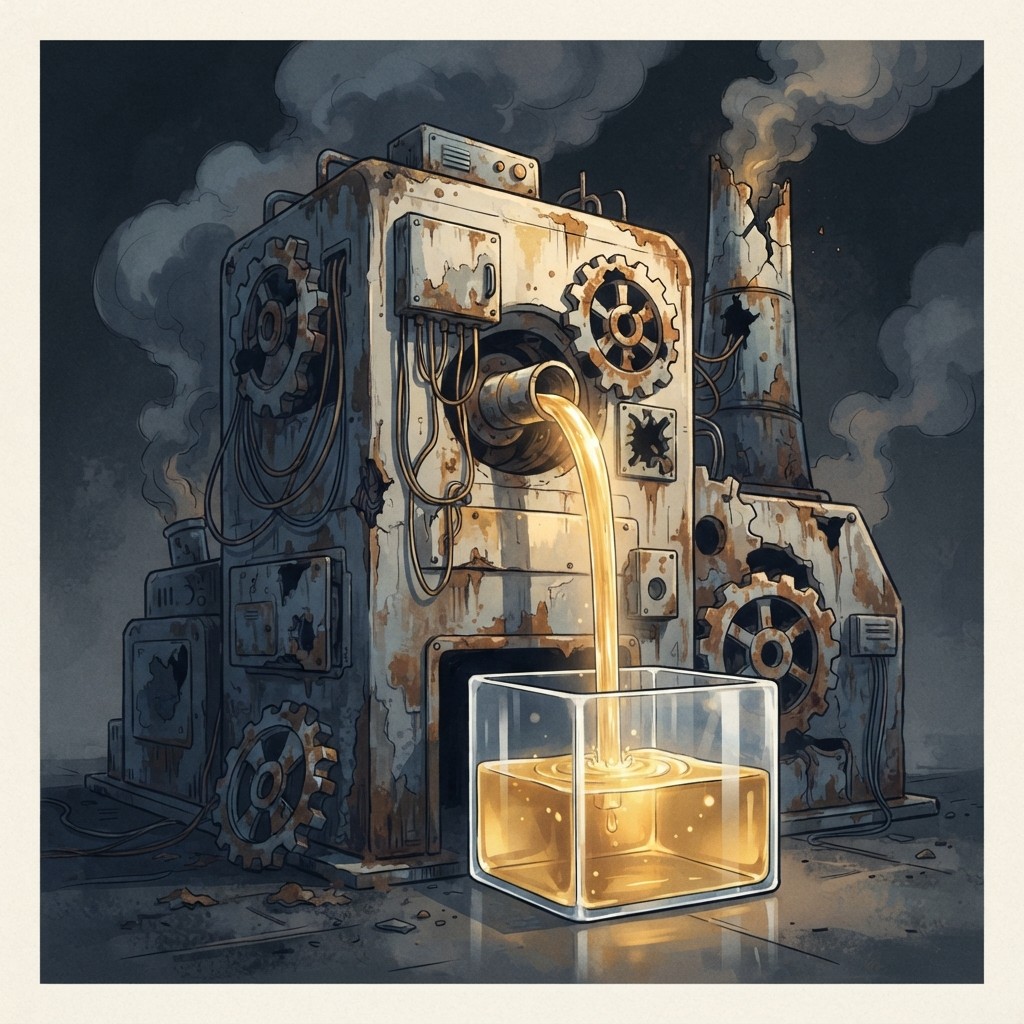
The official story is that Kraft Heinz is a struggling food giant lurching from one write-down to the next. That story is half true and entirely misleading. The cash engine is fine. What is broken is the price tag the company once put on itself — and every year, the accounting forces it to admit a little more of that out loud.
The ketchup pays the bills
Strip away the corporate machinery and Kraft Heinz is, at its core, a condiment company that happens to also sell cheese, coffee, snacks, and ready meals. The company organizes itself around eight product platforms, and the one it calls 'Taste Elevation' — sauces, ketchup, dressings, the squeeze bottle on every table — leads them all.3 By fiscal 2025 that single platform accounted for roughly 45% of net sales.9 This is not an accident of branding; it's the whole economic logic. A bottle of Heinz ketchup is a habit purchase bought on autopilot, priced well above private label, and made for pennies. That is why gross margin expanded 120 basis points to 34.7% in 2024 even as the top line shrank.1 The business doesn't grow much. It converts. Slow-moving, brand-defended staples turn into $3.2 billion of free cash, year after year.
But the cash engine has a single point of dependence that most CPG companies would lose sleep over. In 2024, Walmart alone represented about 21% of Kraft Heinz's total net sales, and the five largest North American customers together accounted for roughly 46% of segment sales.11 One retailer commands a fifth of the business. That concentration is the quiet cost of the model: the brands give Kraft Heinz pricing power against consumers, but the shelf gives Walmart pricing power against Kraft Heinz. The condiments are strong. The customer base is narrow.
Why the headline number lies
Here is the mechanism almost everyone misses. When 3G Capital engineered the merger of Kraft and Heinz, consummated on July 2, 2015, the deal stacked enormous value onto the balance sheet — goodwill and brand intangibles representing the premium paid for the combined company's future.5 Those assets don't wear out like a factory; under accounting rules, they sit on the books at full value until the company is forced to test them and admit they're worth less. That admission is an impairment — a non-cash charge. It doesn't cost a dollar of cash. It simply records, in public, that the price once paid was too high.
In 2024, operating income fell 63.2% to $1.68 billion — but $3.7 billion of that decline was non-cash impairment, a write-down of merger-era asset values rather than a loss of cash.1 That's why Adjusted EPS rose 2.7% to $3.06 and free cash flow stayed at $3.2 billion in the very same year the headline collapsed.1 The income statement is recording the unwinding of a 2015 price; the cash flow statement is recording the business that actually runs today.
This is not a one-time event. In early 2019, Kraft Heinz took a $15.4 billion impairment — and contrary to the shorthand everyone repeats, it was not all goodwill: $7.1 billion hit goodwill and $8.3 billion hit indefinite-lived brand intangibles, the value of the brands themselves.2 After that single charge, the carrying value of goodwill and intangibles fell from $97.3 billion to $80.5 billion.2 The market punished the stock, and a securities class action — covering purchasers of Kraft Heinz stock from November 6, 2015 through August 7, 2019 — later settled for $450 million.12 By the fiscal 2025 filing, the company still carried $59.7 billion of goodwill and intangibles — and took another $9.3 billion of impairment that year.9 The pattern is the spine of the story: a real business steadily writing down the imaginary one bolted on top of it in 2015.
| The cash business | The balance-sheet legacy | |
|---|---|---|
| What it is | Condiments, cheese, coffee bought on habit | Goodwill and brand intangibles from the 2015 merger |
| 2024 evidence | $3.2B free cash flow, 34.7% gross margin | $3.7B non-cash impairment dragging operating income down 63% |
| Direction | Slow, durable, cash-generative | Being written down year after year |
| What it tells you | How the company makes money | How much it overpaid to assemble itself |
Isn't a brand company that won't spend on brands just slowly dying?
The fair objection is brutal and well-documented: if the entire engine is brand-defended pricing power, and the company has spent a decade starving its brands, then the $3.2 billion of cash is being harvested from an asset that is quietly decaying. There's truth here. The popular version blames 3G Capital's zero-based budgeting for gutting marketing — but that's too tidy. The companies were already low advertisers before the deal closed, and the combined entity continued to spend well below the rates of branded-food peers — a habit both companies carried into the merger.7 The merger didn't create the underinvestment; it accelerated a habit both companies already had. So the honest read is that the brands have been ridden hard for a long time, and the repeated impairments are partly the market pricing in exactly this decay.
But notice what the impairments are not. They are write-downs of accounting value, not collapses of cash flow. Through every charge — 2019's $15.4 billion, 2025's $9.3 billion — the company has kept generating substantial free cash: $3.2 billion in 2024 and $3.7 billion in 2025.110 A brand can be worth far less than it was once carried at and still print money for years, because habit erodes slowly and ketchup sells itself. The risk isn't that the cash stops tomorrow. It's that the line between 'durable cash cow' and 'managed decline' is invisible until you've crossed it — and a company that won't advertise has chosen not to find out which one it is.
When a company carries a mountain of goodwill from a big acquisition, its income statement can lie to you for years — in both directions. On the way up, the price paid inflates reported assets; on the way down, impairment charges crater reported earnings without touching a dollar of cash. The discipline is simple: a non-cash impairment tells you what management overpaid in the past, not what the business earns today. To find the real engine, skip the operating-income headline and go straight to free cash flow. For Kraft Heinz, that's the difference between a company 'in collapse' and one quietly converting condiments into $3.2 billion a year. Both stories are printed in the same report — only one of them is the business.
Kraft Heinz makes money the way it always has: by owning a few unglamorous brands people buy without thinking and squeezing cash out of them at high margins. That part works. What doesn't work is the 2015 valuation — the bet that you could merge two underinvesting brand companies, cut your way to growth, and have the whole thing be worth $97 billion. The impairments aren't the business failing. They're the receipt, arriving in installments, for what it cost to assemble. The cash was always real. The price was always the fiction — and the accounting is just slowly telling the truth.
When the headline number isn't the real one
Profit-Engine Map
A one-page map that pulls a business apart into the hook that gets the customer in the door and the engine that quietly earns the margin. Use it to see where the real profit lives, how the two halves are wired together, and what breaks if the link is cut. Blank to dissect your own P&L; filled as the worked example of a business whose advertised product is not where it makes its money.
Included, filled and blank, in the The Money Machine Casebook. See the set → · Preview the blank →
Sources
Where this comes from — the filings, records, and reporting behind it.
- 1FY2024 net sales were $25,846 million (down 3.0%); gross profit margin expanded 120 bps to 34.7%; operating income fell 63.2% to $1,683 million driven by $3.7 billion non-cash impairment; Adjusted EPS rose 2.7% to $3.06; free cash flow was $3.2 billion.
- 2The $15.4 billion Q4 2018 impairment comprised $7.1 billion related to goodwill and $8.3 billion related to indefinite-lived intangible assets; following the charge, aggregate carrying amount of goodwill and intangibles fell from $97.3 billion to $80.5 billion.
- 3Kraft Heinz's FY2024 10-K discloses two reportable geographic segments (North America and International Developed Markets) plus Emerging Markets; it organizes its sales portfolio through eight consumer-driven product platforms: Taste Elevation, Easy Ready Meals, Substantial Snacking, Desserts, Hydration, Cheese, Coffee, and Meats.
- 4In 2024, Walmart Inc. represented approximately 21% of Kraft Heinz's total net sales; the five largest North America customers collectively accounted for approximately 46% of segment net sales.
- 5The 2015 Kraft–Heinz merger was consummated on July 2, 2015, through a series of transactions merging Kraft Foods Group into a wholly-owned subsidiary of H.J. Heinz Holding Corporation, orchestrated by 3G Capital.
- 6The securities class action lawsuit against Kraft Heinz arising from the 2019 impairment settled for $450 million; the suit alleged violations of the Securities Exchange Act during a class period from May 4, 2017, to February 21, 2019.
- 7Pre-merger, Heinz was spending approximately 2.2% of sales on advertising and Kraft approximately 2.5% — roughly half the rate of comparable branded food peers — meaning both companies entered the combination already underinvesting in brands.
- 8As of the FY2025 10-K, Kraft Heinz carries $59.7 billion of goodwill and intangibles and recorded $9.3 billion in related non-cash impairment in fiscal year 2025; Taste Elevation leads the platform portfolio at 45% of 2025 net sales.
- 9As of December 27, 2025, Kraft Heinz had goodwill and intangible assets with a total carrying amount of $59.7 billion; $9.3 billion in non-cash impairment losses were recorded in fiscal year 2025; and Taste Elevation led the platform portfolio at 45% of 2025 net sales.
- 10Kraft Heinz FY2025 full-year free cash flow was $3.7 billion, up 15.9%; operating income was a loss of $4.7 billion driven by $9.3 billion in non-cash impairment losses.
- 11In 2024, Walmart Inc. represented approximately 21% of Kraft Heinz's total net sales; the five largest customers in North America accounted for approximately 46% of segment net sales.
- 12The certified class period in the Kraft Heinz securities class action was November 6, 2015 through August 7, 2019, inclusive.
More like this — beyond Kraft Heinz
New Strategically analyses as they publish: the defining moves in business, checked against the record. No noise, and one click to leave.