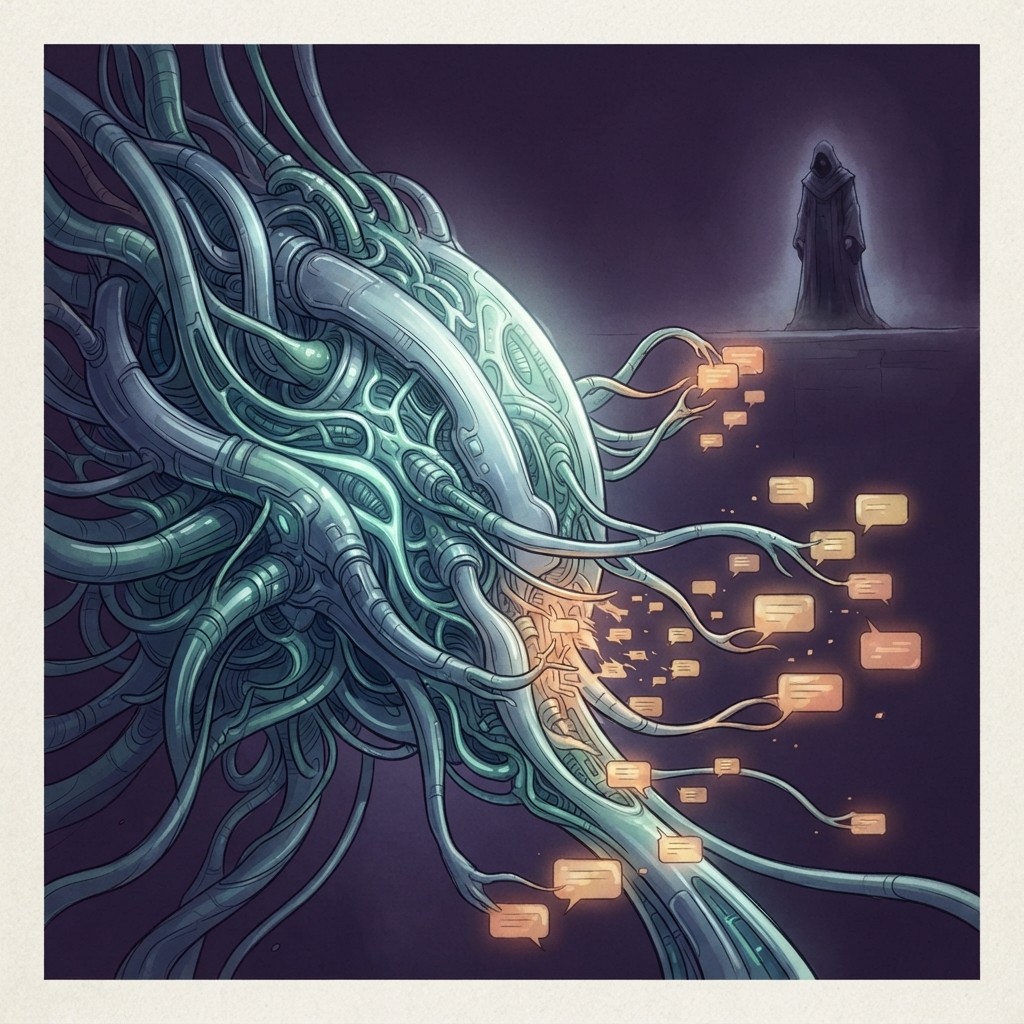
Everyone watched the chatbot, certain it would devour the search box. They were watching the wrong battlefield — and missing the one player who could actually open the door.
Pairs with the Profit-Engine Map — a ready-to-use strategy tool. Included in the The Money Machine Casebook →
Type a question into Google today and you no longer scroll to ten blue links. A paragraph of machine-written answer appears at the top, stitched together from the web, and tucked inside it — for the right query — is an ad. The thing everyone said would destroy Google's business is now sitting in the most valuable real estate Google owns, wearing Google's badge, carrying Google's ads. The chatbot didn't eat the search box. The search box ate the chatbot.
The official story of 2024 and 2025 is that ChatGPT and Perplexity are draining queries from Google, that AI answers are collapsing click-throughs, and that the most profitable franchise in the history of advertising is finally cracking. Almost none of that survives contact with the numbers. Google's search revenue did not shrink — it grew 13% to $198.1 billion.1 Its query share did not collapse — it slipped from above 90% to just below it.6 The disruption was real. The displacement was a story.
Here is the thesis a smart friend can repeat at dinner: Google is not losing the AI search war — it is winning it by absorbing AI into its own product and re-monetising the very shift that was supposed to kill it. The query data does not support displacement. The revenue line does not support erosion. The danger to Google Search is real, but it is not coming from a chat box. It is coming from a courtroom.
The query gap is not close — it is comical: where the displacement panic quietly falls apart on contact with scale
Start with scale, because scale is where the panic falls apart. Google processes roughly 14 billion queries a day — derived from its own stated figure of over 5 trillion annual searches.10 Perplexity — the most-hyped 'answer engine,' backed by Nvidia, SoftBank, and Jeff Bezos and valued at $20 billion — processed about 780 million queries a month as of May 2025.8 That is not a rounding error away from Google; it is roughly two-tenths of one percent of Google's volume. A clickstream study of 2024 found Google received about 373 times more searches than ChatGPT.6 AI-native tools combined still sit under 5% of global query volume.6 Perplexity is a genuinely good tool for deep research questions. It is not a volume challenger, and pretending otherwise confuses a sharp knife with a tectonic plate.
| The story | The numbers | |
|---|---|---|
| Google search share | Collapsing | Slipped below 90% for the first time in a decade[[cite:s6]] |
| AI-native query share | Surging past Google | Under 5% of global volume, combined[[cite:s6]] |
| Perplexity vs Google | Serious challenger | ~780M/month vs ~14B/day — roughly 0.2%[[cite:s8]] |
| Google search revenue | Eroding | Grew 13% to $198.1B in FY2024[[cite:s1]] |
How Google turned the threat into inventory: the trick wasn't surviving AI, it was billing advertisers for it
The clever part is not that Google survived AI — it is how. AI Overviews are not a new product Google bolted on in a panic. They are a rebrand of the Search Generative Experience, which had been quietly running in Search Labs since May 2023. The May 2024 announcement was the general-availability switch, not the genesis.2 By October 2024 the feature had reached more than 100 countries and over a billion monthly users — and crucially, Google began placing ads inside the AI Overview itself for relevant queries.3 That single move is the whole strategy. The AI answer doesn't bypass the ad slot. It becomes the ad slot.
Watch what this does to the click economics. After the AI Overviews launch, organic click-throughs reportedly fell about 30% — exactly the erosion the doomsayers pointed to.7 But the same period saw total search impressions rise roughly 49%, and paid click-through rates on AI Overview queries held in a steady 13–16% range throughout 2025.7 The organic clicks Google was giving away for free to publishers shrank; the paid clicks Google charges advertisers for held firm. And by early 2026 even organic CTR was rebounding — from about 1.3% back up to 2.4% in two months — which makes the 'permanent erosion' story look like a transition artifact, not a death spiral.9 The molecule changed. The monetisation didn't.
This is the part rivals cannot copy, and it has nothing to do with model quality. Google can place an answer in front of more than a billion people the day it ships, because those people already arrive at its box. ChatGPT has to win each user's intent; Google already owns the habit. When the incumbent controls distribution, a better answer is a feature it can add — not a moat a startup can cross. The threat became an upgrade Google shipped to its own demand.
The real threat wears a black robe: what a startup could never take, a regulator can simply switch off
So if AI isn't the danger, what is? The thing Google actually had to defend in court. In August 2024, Judge Amit Mehta ruled that Google had illegally maintained its search monopoly through exclusive default agreements — the deals that make Google the out-of-the-box search engine on Apple, Samsung, and other devices.4 These are not minor marketing spends. Court documents put Google's total distribution payments at $26 billion in 2021, with the Apple arrangement alone estimated at roughly $20 billion for 2022 by an expert witness — a sum representing something like a third of Safari's search revenue.5 That money buys the one asset the chatbots can't get: the default.
“Google violated the Sherman Antitrust Act by illegally maintaining its monopoly through exclusive default search agreements with Apple, Samsung, and others.”4
In September 2025, Mehta's remedies ruling did something interesting. It refused the DOJ's demand to force a breakup — no divestiture of Chrome, no spin-off of Android.4 Wall Street read that as Google winning. But the remedy it did impose strikes at the exact mechanism that AI never could: a six-year ban on exclusive default contracts and mandatory annual rebidding of those agreements.4 If Google can no longer lock the default with a check, the habit it has been buying for two decades goes up for auction every year. The chatbots were trying to win users one query at a time. The court is threatening to unlock the front door for everyone at once.
The flashy threat to an incumbent is almost never the real one. A better product gets attention; better distribution wins markets. Google could absorb the AI answer because it already owned where people arrive — and it owned that arrival point partly by paying billions to be the default everywhere. So the question that actually matters for a dominant platform isn't 'is there a smarter competitor?' It's 'what controls the moment of intent, and can someone take it away?' For Google, the smarter competitor was a feature it could ship. The default deal was the thing it fought tooth and nail to keep — because that's the asset, and a regulator can do what a startup never could: simply switch it off.
Isn't this just an incumbent's victory lap?: granting the cracks are real while insisting they aren't the same as collapse
The fair objection is that this reads too comfortably — that share dipping below 90% is the first crack in a dam, and clever ad placement only delays an inevitable shift to conversational interfaces. It's a real point, and parts of it are true. Google's share did slip below 90% for the first time in a decade.6 Organic clicks really did fall.7 Behaviour does change, slowly, and a generation raised on chat may simply ask differently. But the honest counter is that none of that is the same as displacement. A 373-to-1 query gap does not close in a press cycle.6 Revenue growing 13% is not the financial signature of a franchise being hollowed out.1 And the most-feared rival, Perplexity, is still operating at roughly 0.2% of Google's scale.8 The dam has a crack. The water threatening to break it is regulatory, not generative.
Google spent the AI panic doing the least glamorous thing imaginable: taking the disruptive technology, stapling it to the top of its own page, and selling ads against it. The displacement story was always about the wrong battlefield. Search was never really won on who had the best answer — it was won on who owned the place people go to ask. Google still owns that place. The only force that can pry it loose isn't a smarter model. It's a judge with the authority to put the default itself up for bid.
When the moat isn't where everyone is looking
Profit-Engine Map
A one-page map that pulls a business apart into the hook that gets the customer in the door and the engine that quietly earns the margin. Use it to see where the real profit lives, how the two halves are wired together, and what breaks if the link is cut. Blank to dissect your own P&L; filled as the worked example of a business whose advertised product is not where it makes its money.
Included, filled and blank, in the The Money Machine Casebook. See the set → · Preview the blank →
Sources
Where this comes from — the filings, records, and reporting behind it.
- 1Google Search & Other revenue was $198.1 billion in FY2024, up 13% YoY; Alphabet total revenue was $350.0 billion; Google generated more than 75% of total revenues from online advertising in 2024.
- 2AI Overviews began rolling out to all U.S. users on May 14, 2024 (announced at Google I/O); the feature was previously called Search Generative Experience (SGE) and had been in Search Labs since May 2023; Google projected over 1 billion global users by year-end 2024.
- 3By October 28, 2024, Google expanded AI Overviews to more than 100 countries and territories, reaching more than 1 billion global users monthly. Ads in AI Overviews became available for relevant queries for mobile users in the U.S.
- 4Judge Amit Mehta ruled in August 2024 that Google violated the Sherman Antitrust Act by illegally maintaining its monopoly via exclusive default search agreements with Apple, Samsung, and others. His September 2025 remedies ruling rejected Chrome divestiture but imposed a six-year ban on exclusive default contracts and mandated annual rebidding.
- 5Court documents revealed Google paid distribution partners (primarily Apple) $26 billion in TAC for search in FY2021. An expert witness at trial cited ~$20 billion paid to Apple for 2022 for its Safari/iOS default placement, representing ~36% of Safari search revenue.
- 6Google's search market share dropped below 90% for the first time in a decade as of 2024–2025, per StatCounter/Similarweb consensus; AI-native tools (ChatGPT, Perplexity combined) account for under 5% of global query volume; SparkToro/Datos found Google received ~373× more searches than ChatGPT in 2024.
- 7BrightEdge data show total search impressions rose ~49% since the May 2024 AI Overviews launch, but organic click-throughs fell ~30%; Google maintained over 90% search market share; Seer Interactive data show paid CTR on AI Overview queries held 13–16% throughout 2025, and organic CTR rebounded from ~1.3% to 2.4% in Dec 2025–Feb 2026.
- 8Perplexity processed ~780 million search queries/month as of May 2025, up from 230 million in mid-2024; Google processes ~14 billion queries/day. Perplexity's $20B valuation follows a September 2025 funding round; total funding exceeds $1.5 billion from Nvidia, SoftBank, and Jeff Bezos.
- 9Organic CTR on AI Overview queries rebounded from a floor of 1.3% in December 2025 to 2.4% in February 2026, based on analysis of 53 brands, 5.47 million queries, and 2.43 billion organic impressions from January 2025 to February 2026.
- 10Google processes roughly 13.7–14 billion searches per day globally, derived from Google's own stated figure of over 5 trillion annual searches.
More like this — beyond Alphabet (Google)
New Strategically analyses as they publish: the defining moves in business, checked against the record. No noise, and one click to leave.