Pairs with the Profit-Engine Map — a ready-to-use strategy tool, filled for CrowdStrike. Included in the The Money Machine Casebook →
At 04:09 UTC on July 19, 2024, a 40-kilobyte file went out from CrowdStrike to millions of Windows machines, and the modern world stopped. Airlines grounded fleets. Hospitals fell back to paper. Bank screens froze on the blue death-screen. It was not a cyberattack, not a Russian intrusion, not even a software bug in the usual sense - it was a single content configuration file, Channel File 291, that told the sensor to read 21 fields when only 20 existed.3 One field too many, read out of bounds, and the kernel did the only honest thing a kernel can do when handed garbage memory: it crashed.4 The largest IT outage in history was caused by an off-by-one error in a config file from a company most people had never heard of. Then something stranger happened. Almost nobody left.
The official story is that this should have been an extinction event. A security vendor whose entire pitch is trust and reliability had just personally blue-screened the Fortune 500. Every analyst expected the obvious: mass cancellations, a stampede to Microsoft Defender, the brand left for dead. None of it arrived. In the first full quarter after the outage, CrowdStrike's gross retention came in above 97% - down, in the CEO's words, less than half a percentage point.5 For the full year, ARR still grew 23%, to $4.24 billion.2 The company that broke the internet kept its customers anyway, and that fact is the whole point.
“Gross retention was over 97%, down less than half a percentage point.”5
The moat isn't the software. It's the depth of the hooks.
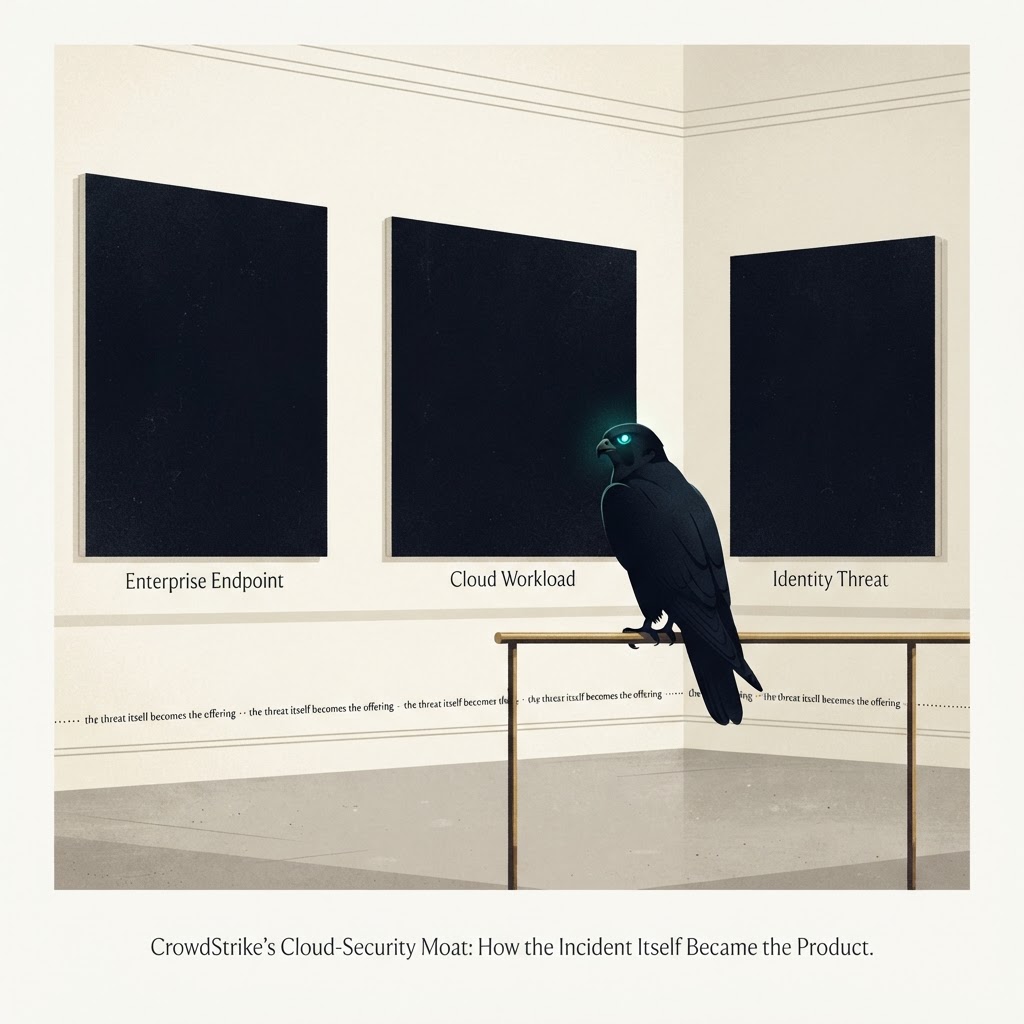
Here is the thesis a smart friend could repeat at dinner: CrowdStrike's outage didn't break the moat because the moat was never reliability - it was entanglement. Ripping out CrowdStrike is not like switching email providers. The Falcon sensor runs at kernel level, the most privileged layer of the operating system, on every endpoint in the enterprise - which is precisely why a bad file there can crash the OS instead of just a window. To remove it, a CISO has to re-tool every laptop, every server, every cloud workload, retrain the security operations team, re-pipe years of telemetry into a different threat model, and re-baseline what 'normal' looks like across the whole estate. The very property that made the outage catastrophic - that CrowdStrike sits at the deepest, most load-bearing point in the system - is the same property that makes leaving it agonizing. The depth that broke you is the depth that keeps you.
And the data compounds the lock-in. Every endpoint feeds behavioral telemetry back into a shared cloud model; the more an organization runs Falcon, the more the platform knows what its specific environment looks like, and the better it gets at flagging the one anomaly that matters. Switch vendors and you don't just swap a tool - you reset that learned baseline to zero and start blind. CrowdStrike has bundled this into a platform that now carries over $1.3 billion in combined ARR across Next-Gen SIEM, Cloud Security, and Identity Protection alone.2 Each module a customer adopts is another root the competitor would have to dig out. A point product is a purchase. A platform is a hostage situation everyone agreed to.
| A normal SaaS tool | CrowdStrike Falcon | |
|---|---|---|
| Where it lives | An app or browser tab | The OS kernel, on every endpoint |
| Cost to rip out | Cancel and export data | Re-tool every machine, retrain the SOC, reset the threat baseline |
| What the vendor knows about you | Your account settings | Years of learned behavioral telemetry |
| What a failure costs the customer to leave | A weekend migration | Months of re-architecture across the whole estate |
The contract that turned a $500 million claim into single-digit millions
There is a second, quieter mechanism, and it lives in the fine print. When you cause $5.4 billion in losses - Parametrix's estimate of the damage to Fortune 500 companies, of which only a fraction was even insured7 - the natural assumption is that you are about to be sued into oblivion. Delta Air Lines did exactly that, filing in Georgia for roughly $500 million.6 But Falcon's terms of service cap CrowdStrike's liability at 'fees paid' - the money the customer already handed over.7 So even with a court letting Delta's negligence and computer-trespass claims proceed, CrowdStrike's own outside counsel put the realistic worst-case exposure at 'single-digit millions.'6 Delta's own SEC filing pegged its non-fuel recovery cost near $170 million9 - and the gap between that headline and the company's actual exposure is the contract doing its job. The enterprise software business model doesn't just sell sticky products. It sells them with the downside legally pre-amputated.
On a base that grew from $3.44B in ARR in FY20241 to $4.24B in FY20252, a retention rate above 97%5 means the worst operational disaster in the company's history shaved off less than half a point of churn. Meanwhile the legal downside - which for a normal vendor might be existential - is capped at fees paid.7 The revenue is sticky going up and the liability is bounded going down. That asymmetry is the machine.
The fair objection: maybe they just got lucky with no alternative
The honest counter is that 97% retention might prove nothing about the moat and everything about the absence of a fast exit. Customers didn't stay because they loved CrowdStrike on July 20; they stayed because tearing out a kernel-level agent across thousands of machines in the middle of a crisis is itself a risk no CISO wants to run. That's a real point - but it concedes the thesis rather than refuting it. 'There was no practical alternative' is not the opposite of a moat; it is the definition of one. A moat that depends on the customer's misery to leave is still a moat. The deeper objection is structural: CrowdStrike holds roughly 14.7% of endpoint market share against Microsoft's ~40.2%, and Microsoft can bundle Defender into the operating system at marginal cost.8 If anyone can route around the entanglement, it's the company that owns the kernel CrowdStrike rents space in. The outage handed Microsoft the best sales pitch it could ask for - and even so, the customers stayed. The luck explanation has to account for that, and it can't.
The most durable revenue isn't the most reliable product - it's the most deeply embedded one. Look for the position in a customer's system where you become infrastructure rather than a tool: the layer where leaving means re-architecting, not just cancelling, and where your data about them gets more valuable every day they stay. That depth survives even a catastrophic failure, because the cost of leaving in a panic exceeds the cost of staying angry. But entanglement alone isn't enough - pair it with contractual liability caps so a single failure can't become an existential payout. The combination is what makes a business catastrophe-resistant: sticky enough that customers can't leave, and bounded enough that when you fail, the failure stays small. One caution: this same depth is what makes a platform owner like Microsoft your most dangerous rival, because they control the layer you depend on.
CrowdStrike spent one morning proving it could break the modern world, and the rest of the year proving the world couldn't quit it. The 8.5 million crashed machines were never the real story - Microsoft's own figure reflected only the devices that sent crash reports home, so the full impacted population was larger and never precisely counted.10 The real story was the quarter that followed: less than half a point of churn, ARR still climbing, a $500 million lawsuit shrinking to single-digit millions in the company's own lawyers' estimate. The moat in enterprise security was never that the product doesn't fail. It's that when it does, you're already too far inside the customer to be thrown out - and too far inside the contract to be made to pay. That's not a security company that got lucky. That's a money machine built to survive its own worst day.
Companies whose moat is the cost of leaving
Profit-Engine Map
A one-page map that pulls a business apart into the hook that gets the customer in the door and the engine that quietly earns the margin. Use it to see where the real profit lives, how the two halves are wired together, and what breaks if the link is cut. Blank to dissect your own P&L; filled as the worked example of a business whose advertised product is not where it makes its money.
Included, filled and blank, in the The Money Machine Casebook. See the set → · Preview the blank →
Sources
Where this comes from — the filings, records, and reporting behind it.
- 1CrowdStrike's FY2024 (ended January 31, 2024) total revenue was $3.055 billion; ending ARR was $3.44 billion, up 34% year-over-year.
- 2CrowdStrike's ARR grew 23% year-over-year to $4.24 billion as of January 31, 2025, with 97% gross retention and $1.3B+ in combined ARR across Next-Gen SIEM, Cloud Security, and Identity Protection.
- 3The outage was caused by a defect in a single content configuration update (Channel File 291) for Windows hosts; the IPC Template Type defined 21 input fields but the sensor code provided only 20, causing an out-of-bounds memory read and BSOD. This was NOT a cyberattack.
- 4CISA confirmed the CrowdStrike outage was due to a content update logic error, not malicious cyber activity; it affected Windows 10 and later systems; macOS and Linux were unaffected.
- 5In Q3 FY2025 (first full quarter post-outage), CrowdStrike gross retention was over 97%, down less than half a percentage point. ARR surpassed $4 billion and CEO Kurtz confirmed customers are staying with the platform.
- 6Delta Air Lines filed suit against CrowdStrike in Georgia Superior Court (docket 24CV013621) seeking ~$500M; as of May 2025, a Georgia judge allowed negligence and computer-trespass claims to proceed but struck fraud/misrepresentation claims. CrowdStrike's counsel stated worst-case exposure is 'single-digit millions.'
- 7Parametrix (specialist cloud outage insurer) estimated Fortune 500 companies (ex-Microsoft) suffered ~$5.4B in losses from the outage, of which only $540M–$1.08B was insured. CrowdStrike's Falcon software ToS limits liability to 'fees paid.'
- 8Gartner data cited in trade press places CrowdStrike second in endpoint protection market share at ~14.7%, behind Microsoft at ~40.2%, concentrated in large enterprises. CrowdStrike's own press releases cite IDC ranking it #1 for 'Modern Endpoint Security' revenue share.
- 9Delta Air Lines estimated non-fuel expense associated with the CrowdStrike outage and subsequent operational recovery at $170 million, primarily due to customer expense reimbursements and crew-related costs.Delta Air Lines, Inc. / SEC EDGAR, Form 8-K ↗ · 2024-08-08
- 10Microsoft estimated 8.5 million Windows devices were affected by the faulty CrowdStrike update, less than 1% of all Windows machines; Microsoft later indicated the 8.5 million figure came only from devices that shared crash reports, so the full impacted population was larger.
More like this — beyond CrowdStrike
New Strategically analyses as they publish: the defining moves in business, checked against the record. No noise, and one click to leave.