Pairs with the Adjacency / Synergy Map — a ready-to-use strategy tool. Included in the The Adjacency Expansion Casebook →
Two games hold up a company. One is a shooter that ships every autumn whether it's ready or not. The other is a tile-matching puzzle that turned ten years old and still grew its in-game bookings about 20% in every quarter of 2022.5 Strip those two away and the rest of Activision Blizzard - Warcraft, Diablo, Overwatch6 - is a respectable studio, not a $68.7 billion one. The popular charge against the company is that it milks its franchises until they're dry. That's the wrong worry. The franchises aren't dry. They're load-bearing.
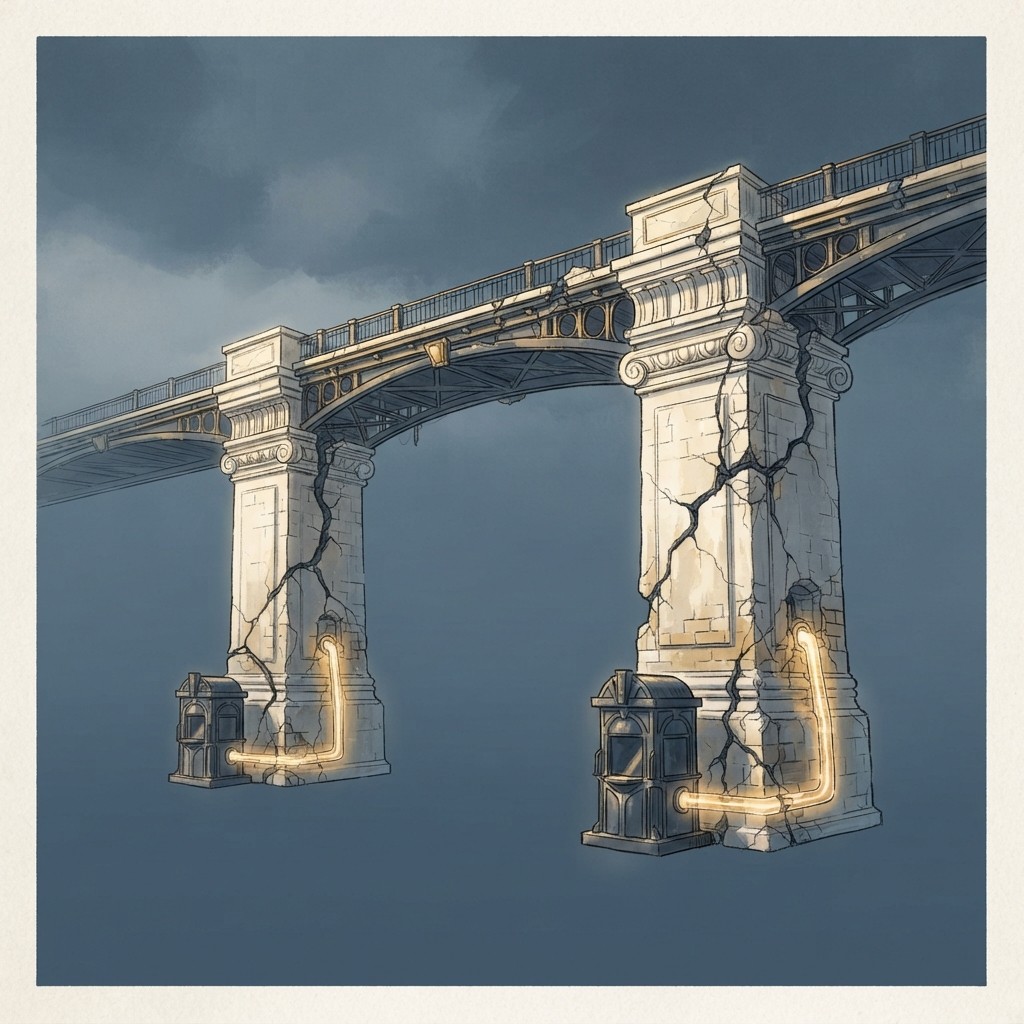
The official story is creative exhaustion: a tired publisher squeezing the same two cows for one more season of cream. Read the filings and a sharper, less moralistic problem appears. The risk isn't that Call of Duty gets boring or Candy Crush gets stale. It's that almost everything the company earns flows through a handful of titles - and a fee owed to two platform owners that Activision can't negotiate away.
The year the treadmill skipped a step
The milking model has one job: turn a beloved title into a predictable annuity. Ship Call of Duty every year, charge $60-70, layer in-game spending on top, and book the same revenue line each fall. It works until it doesn't - and the company told its own shareholders exactly when it didn't. In its proxy statement, Activision wrote, in the flat language of a filing, that 'Call of Duty: Vanguard did not meet our expectations.'4 That isn't a critic's take. It's the company conceding that the annual cadence had created a quality-versus-schedule squeeze, even as the same document pledged 'the most ambitious effort in franchise history.'4
The treadmill recovered fast. The very next entry, Modern Warfare II, 'delivered the highest opening-quarter sell-through in franchise history' and became 'the fastest premium Call of Duty release to cross $1 billion in sell-through.'3 One year a miss, the next a record. That whiplash is the tell. When a single title can swing a record into a disappointment, the franchise isn't an annuity - it's a high-stakes annual bet the company has to win again every September.
“Call of Duty: Vanguard did not meet our expectations.”4
The franchise isn't the risk. The toll collector is.
Here is the part the 'creative exhaustion' story never reaches, because it lives in a concentration table rather than a review score. In FY2022, the two largest revenue counterparties on Activision Blizzard's books were not games. They were storefronts. Apple accounted for 20% of consolidated net revenue; Google accounted for 18%.2 More than any single title, the company's top line runs through two app-store owners who set the platform fee and the rules - and who answer to no negotiation Activision can win. That is the buried cost of leaning on a mobile franchise. King's Candy Crush is the crown jewel, but every dollar it earns on a phone passes through a toll booth Activision doesn't own.
| The 'milking' narrative | What the 10-K shows | |
|---|---|---|
| The threat | Creative exhaustion, fan fatigue | Revenue concentration + platform fees |
| The evidence | Vibes, review scores | Apple 20%, Google 18% of revenue[[cite:s2]] |
| The fix | Make better games | Diversify the bench - which doesn't exist |
| Who has the leverage | Activision over its fans | Apple and Google over Activision |
Two franchises, no credible bench
Look at the segment math and the dependence is stark. In FY2021, King - effectively the Candy Crush business - posted $2.597 billion in net revenue, against Activision's $3.776 billion and Blizzard's $1.975 billion, and crossed $1 billion in annual operating income for the first time, driven overwhelmingly by Candy Crush.8 One franchise carried an entire segment past a billion dollars in profit. That is the strength and the fragility in a single number. The franchise entered its second decade with over 200 million monthly active users at record player-investment levels5 - genuinely impressive, and genuinely the problem. A decade-old puzzle game is doing the work three studios should be sharing.
And the whole edifice softened in 2022. Full-year net revenue fell to $7.53 billion from $8.80 billion the year before, and consolidated operating income dropped 49% to $1.7 billion.1 A company supposedly running an infinite cash machine watched half its operating income evaporate in a single year. The milking model didn't fail creatively. It revealed how little stands behind the two cows.
Isn't a franchise that prints money just a good business?
The fair objection is that concentration in a great asset isn't weakness - it's focus. Coca-Cola sells one brown liquid; nobody calls that a flaw. Candy Crush grew its in-game bookings roughly 20% in every quarter of 20225, and Modern Warfare II set franchise records.3 If two franchises can do that, why diversify into mediocrity? The steelman is real, and the answer is in who holds the leverage. Coca-Cola owns its distribution; Activision rents its biggest one. When 38% of revenue passes through Apple and Google2, the upside of any mobile franchise is capped by a fee you don't set and can't route around. And the proof the market believed in concentration arrived as a price tag: Microsoft offered $95.00 a share, $68.7 billion 'inclusive of Activision Blizzard's net cash,'6 for a portfolio whose value rested squarely on Call of Duty and Candy Crush. The premium wasn't paid for a deep catalog. It was paid for two franchises - and for moving the toll booth in-house under Microsoft's roof.
Regulators noticed exactly that. The FTC authorized an administrative complaint, arguing the deal would let Microsoft suppress rivals to Xbox and its Game Pass subscription, and the matter was withdrawn and returned to adjudication more than once, dragging into late September 2023.7 The fight wasn't really about a puzzle game. It was about who gets to own the rails two of the most valuable franchises in gaming run on.
A franchise that keeps growing is the easiest place to stop looking for danger. But the question isn't whether your hit is still a hit - it's how much of the company would survive without it, and who collects the toll between you and the customer. Activision's filings show the trap: revenue grew on Candy Crush while 38% of every dollar flowed through Apple and Google. When you can't negotiate with your largest counterparty and you have no second act behind your headliner, the strong number is the warning, not the comfort. Audit your dependence in the years the franchise is winning - because nobody audits it in the years it isn't, by then it's too late.
Activision Blizzard didn't milk two franchises into the ground. It did something riskier and quieter: it let two franchises become the company, and then leaned them against platforms it didn't own. The 49% drop in operating income in a single year wasn't fatigue with Call of Duty or Candy Crush.1 It was a reminder of how narrow the base is when the headliners stumble and there's no one behind them to step up. The milking model works beautifully right up until the moment you need a third cow - and discover the herd was always two.
Adjacency / Synergy Map
A one-page canvas for an adjacency play: the new business next door, the shared assets that justify entering it, the synergies that actually transfer versus the ones that evaporate on contact, and the dis-synergies nobody put on the deck. Blank to test your own expansion; filled as the worked example showing where the story's 'natural adjacency' was real and where it was wishful.
Included, filled and blank, in the The Adjacency Expansion Casebook. See the set → · Preview the blank →
Sources
Where this comes from — the filings, records, and reporting behind it.
- 1Activision Blizzard FY2022 full-year GAAP net revenues were $7.53 billion, down from $8.80 billion in FY2021; consolidated operating income fell 49% to $1.7 billion year-over-year.
- 2Apple Inc. accounted for 20% of Activision Blizzard's consolidated net revenues in 2022; Google accounted for 18% — the two largest revenue counterparties in the company's customer concentration table.
- 3Call of Duty: Modern Warfare II 'delivered the highest opening-quarter sell-through in franchise history' (Q4 2022), and the title 'set new records for our largest franchise, becoming the fastest premium Call of Duty release to cross $1 billion in sell-through.'
- 4Call of Duty: Vanguard 'did not meet our expectations,' per the company's own proxy statement; Activision acknowledged annual-cadence quality tension while simultaneously pledging 'the most ambitious effort in franchise history.'
- 5Candy Crush Saga in-game net bookings grew approximately 20% year-over-year for every quarter of 2022; the Candy Crush franchise entered its second decade with over 200 million monthly active users at record player investment levels.
- 6Microsoft announced its intention to acquire Activision Blizzard on January 18, 2022, for $95.00 per share in an all-cash transaction valued at $68.7 billion inclusive of Activision Blizzard's net cash; the acquisition included Call of Duty, Candy Crush, Warcraft, Diablo, and Overwatch franchises.
- 7The FTC authorized an administrative complaint against the Microsoft-Activision merger, alleging it would enable Microsoft to suppress competitors to its Xbox consoles and Game Pass subscription service; the matter was withdrawn and returned to adjudication multiple times through at least September 26, 2023.
- 8King's FY2021 segment net revenues were $2.597 billion (vs. Activision's $3.776 billion and Blizzard's $1.975 billion); King passed the $1 billion annual operating income milestone for the first time in 2021, driven overwhelmingly by the Candy Crush franchise.
More like this — beyond Activision Blizzard
New Strategically analyses as they publish: the defining moves in business, checked against the record. No noise, and one click to leave.