Pairs with the Vertical-Integration Assessment — a ready-to-use strategy tool, filled for Nucor. Get it — included with a subscription, or $1.99 →
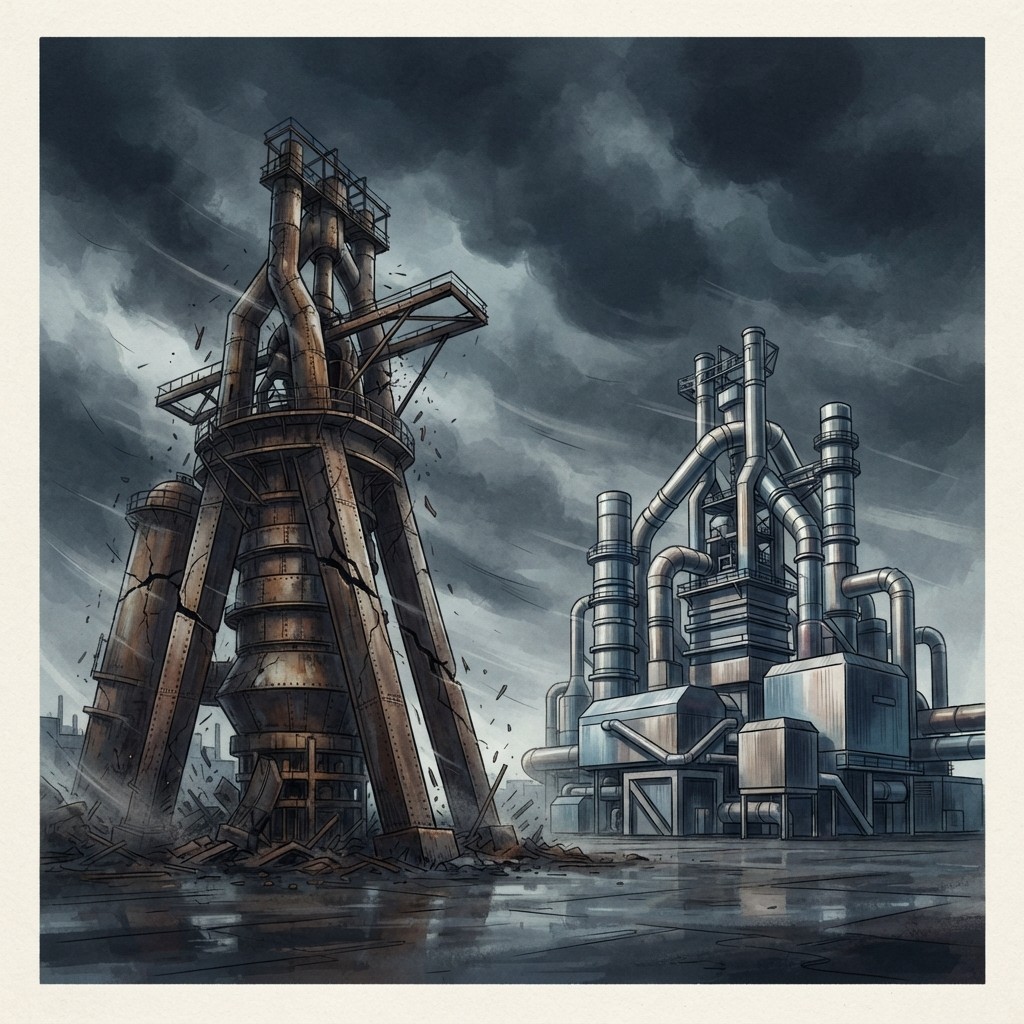
When steel demand collapses, the old integrated mills don't bend — they break. A blast furnace can't be turned down to a simmer; it runs hot or it goes cold, and going cold means idling thousands of workers whose paychecks were never going anywhere. So the cycle that periodically guts demand also guts the people who built the rivals. Nucor sits inside the very same cycle and almost never breaks. In a downturn its furnaces throttle back, its scrap bill shrinks, and — this is the part nobody expects — its payroll shrinks too, on its own, without a single firing decision. The crash that destroys an integrated mill merely deflates Nucor and waits to be re-inflated.
The popular story is that a visionary founder named Ken Iverson built a steel disruptor on a clever new furnace and a no-layoffs promise. Almost every beat of that is off. Iverson didn't found anything — he inherited a near-corpse and ran the turnaround. The furnace wasn't his invention. And the 'never lays off workers' line, repeated everywhere, quietly hides the mechanism that actually does the work.
The company was a bankrupt car-and-nuclear firm first
Nucor's lineage is a junk drawer of failed twentieth-century ideas. It began as the REO Motor Car Company in 1905, mutated into Nuclear Corporation of America in 1955, and was bleeding money when it acquired a steel-joist maker called Vulcraft in 1962 — bringing along a manager named Ken Iverson.1 In 1965 the firm filed for bankruptcy again, and Iverson, almost by default, became president of the wreckage. He renamed it Nucor in 1972.1 This matters because the standard founder-genius myth misreads the whole achievement. Iverson didn't sketch a company onto a blank page. He took an organization that had already tried and failed at two glamorous industries and pointed its remains at an unglamorous one: melting other people's garbage back into steel.
He didn't invent the tool, either. In 1969 Nucor's first electric-arc-furnace mini-mill fired up in Darlington, South Carolina — using EAF technology that was already more common in Europe than in the U.S.2 What Nucor pioneered wasn't the furnace; it was betting an entire American steel company on commercializing it at scale, feeding it post-consumer scrap instead of iron ore. The disruption was a sourcing decision dressed up as a technology decision.
The real product is a cost structure that flexes
Here is the thesis a smart friend can repeat at dinner: Nucor isn't a steel company that happens to be efficient — it's a cost structure that flexes with the cycle, wearing a steel company as a costume. Three pieces fit together, and the fit is the whole point. The electric-arc mini-mill carries a fraction of the fixed capital of a blast-furnace complex and can be powered down between heats. Scrap, sourced and recycled in-house — about 18 million gross tons of it in 2024, enough to make Nucor North America's largest recycler5 — is a variable input that falls when you melt less. And labor, the cost integrated mills treat as a fixed obligation, Nucor converts into a variable one through how it pays. Each piece lowers the others' breakeven. Lower fixed costs make variable pay tolerable; variable pay lets you keep crews through the trough; kept crews let you ramp the moment scrap and demand swing back.
| Integrated mill | Nucor mini-mill | |
|---|---|---|
| Furnace | Blast furnace — runs hot or goes cold | Electric arc — throttles between heats |
| Main input | Iron ore (long supply chain) | Scrap, sourced in-house |
| Fixed cost base | High — capital and committed payroll | Low — and labor is variable |
| What happens in a crash | Idle the plant, lay off workers | Cut hours and bonus pay, keep the crew |
| Cost when output falls | Stays high → losses | Falls with output → survival |
How a paycheck becomes a shock absorber
Roughly 80% of Nucor's employees are on a production-incentive plan: base pay is modest, and the real money comes from how much good steel the team makes.7 In a good year that produces eye-watering total pay. In a bad year it does something more interesting — it shrinks the wage bill automatically, because the bonus tied to output simply doesn't get earned. Nucor's own 10-K says this plainly: the incentive system reduces payroll costs in downturns, which lets the company keep its experienced workforce intact and keep running when competitors with greater fixed costs have to shut facilities.6 That is the engine behind the famous 'no layoffs' line — and the line is a half-truth worth correcting. The policy isn't a guarantee of full employment or full pay. It's a no-permanent-layoff policy delivered by cutting hours and pay, so the worker keeps the job and the company keeps the cost discipline. The pain is shared and distributed, not concentrated into a pink slip.
And the alignment runs upward, not just down — which the egalitarian retelling usually skips. Senior officers take lower base salaries, with the bulk of their pay tied to Nucor's net income as a percentage of stockholders' equity, and they do not receive the profit-sharing, pension, or scholarship programs that non-officer employees get.78 The executives carry more downside risk than the line workers, not less. The Tuck case study notes officers had no employment contracts at all, that everyone shared the same holidays and insurance, and that every annual report listed all employees alphabetically on its cover.8 The culture isn't decoration. It's the social contract that makes a variable wage feel fair instead of exploitative: in a bad year, the people at the top bleed first and worst.
“Our pay-for-performance system allows us to keep our experienced workforce intact and continue operating when competitors with greater fixed costs must shut facilities.”6
Crawfordsville, and the bet that wasn't a napkin
Mini-mills had a ceiling: they could make rebar and joists, but not the flat-rolled sheet that goes into cars and appliances — the high-margin steel the integrated giants owned. The popular version of how Nucor broke through is a charming oral tale of Iverson sketching the idea on a cocktail napkin in an airport lounge. The reality was a multi-year industrial gamble. In late 1986 Nucor ordered the first commercial CSP — Compact Strip Production — thin-slab caster from Germany's SMS Schloemann-Siemag, whose pilot plant had only begun testing the concept in 1985.34 Construction began in Crawfordsville, Indiana in the fall of 1987, and the plant started up in July 1989 as the world's first mini-mill to cast flat-rolled sheet.3 Nucor wasn't doodling. It was buying unproven equipment at commercial scale and betting the firm that it would work — extending the variable-cost model into the one product category that had been walled off from it.
Most companies in cyclical businesses fight their downturns with their balance sheet — they hold fixed costs steady and pray demand returns before the cash runs out. Nucor inverted the problem: it engineered its largest controllable costs, labor and inputs, to shrink automatically when revenue does. The lesson isn't 'cut pay.' It's that resilience comes from a cost base that breathes with demand, so a bad year is survivable by design rather than by heroics. The catch: a variable wage is only durable if the burden is genuinely shared — officers bearing more downside than workers is not a footnote, it's the thing that keeps the model from curdling into resentment the first time a paycheck shrinks.
Isn't this just a commodity producer in a good decade?
The honest objection is that steel is a brutal commodity and Nucor, at $30.73 billion in 2024 net sales,5 is still a price-taker selling an undifferentiated product — so maybe the 'system' is just a cost advantage dressed up as genius, and any rival could copy the EAF and the bonus plan. The cost edge is real and partly imitable: anyone can buy an electric-arc furnace. But two pieces resist copying. The scrap-and-recycling network that feeds 18 million tons of cheap input each year is built over decades and bound up with regional logistics, not a switch a competitor flips.5 And the variable-pay culture cannot be bolted onto a legacy mill with union contracts, a defined-benefit pension, and a workforce that was never told their pay would fall in a bad year. The integrated incumbents can't become Nucor without breaking the very promises that hold them together. The fair version of the steelman concedes the cost edge is partly portable — but a system isn't its cheapest part. It's the fit, and the fit took fifty years and a different founding myth to assemble.
So the durable thing about Nucor was never a furnace or a founder or a napkin. It was the decision to build a steel company whose every major cost — the heat, the scrap, the wages — falls when the market does. Integrated rivals stand rigid against the cycle and snap. Nucor leans into it, lets the downturn pass through its payroll instead of its people, and is still standing when the price of steel turns back up. The competitors are built to win the good years. Nucor is built to survive the bad ones — which, in a commodity, is the only edge that compounds.
Companies whose advantage hides in the cost structure
Vertical-Integration Assessment
A make-vs-buy assessment for a single stage of the value chain: rate the forces that argue for owning it and the forces that argue for renting it, then read the verdict off the gap. Blank to run on a stage you're deciding now; filled as the worked example showing why the story's company pulled a stage in-house — or pushed it out.
Included with any subscription, or unlock this tool for $1.99. Get it → · See plans →
Sources
Where this comes from — the filings, records, and reporting behind it.
- 1Nucor's corporate lineage runs from REO Motor Car Company (1905) to Nuclear Corporation of America (1955); Ken Iverson joined via the 1962 Vulcraft acquisition, rose to president in 1965 after the company again filed for bankruptcy, and the company was renamed Nucor Corporation in 1972.
- 2In 1969, Nucor's first electric arc furnace mini-mill began operating in Darlington, South Carolina, using EAF technology that was at the time more widely used in Europe than in the U.S., to melt post-consumer scrap metal into new steel.
- 3The first commercial CSP (Compact Strip Production) thin-slab casting plant was ordered by Nucor in late 1986 from SMS Schloemann-Siemag; construction began in Crawfordsville, Indiana in fall 1987, and the facility started operations in July 1989, making it the world's first mini-mill to produce flat-rolled sheet steel via thin-slab technology.
- 4Industrial thin-slab casting and direct rolling processing started in 1989 with the world's first CSP plant at Crawfordsville, USA; the CSP concept was developed by SMS Schloemann-Siemag in Germany with pilot plant testing beginning in 1985.
- 5Nucor's FY2024 10-K states the company manufactures steel principally from scrap steel and scrap substitutes using EAFs; in 2024 Nucor recycled approximately 18 million gross tons of scrap steel, making it North America's largest recycler. Consolidated net sales for full-year 2024 were $30.73 billion.
- 6Nucor's 10-K explicitly describes how its incentive-based pay system reduces payroll costs in downturns, and its pay-for-performance system allows it to keep its experienced workforce intact and continue operating when competitors with greater fixed costs must shut facilities.
- 7Approximately 80% of Nucor's employees are on a production-incentive plan; senior officers receive lower base salaries with the remainder tied to Nucor's annual net income as a percentage of stockholder's equity, paid in cash and stock; senior officers do not receive profit-sharing, pension plans, or the scholarship programs available to non-officer employees.
- 8The Dartmouth Tuck case study corroborates that Nucor senior officers had no employment contracts and did not participate in profit-sharing, pension, or similar programs; all employees shared the same holidays, vacation schedules, and insurance programs, and every Nucor annual report listed all employees alphabetically on the front cover.
More like this — beyond Nucor
New Strategically analyses as they publish: the defining moves in business, checked against the record. No noise, and one click to leave.