Pairs with the Vertical-Integration Assessment — a ready-to-use strategy tool. Included in the Integrator Casebook →
“What must you own, and what can you safely buy?”
In the late 1960s a small company that made steel building joists had a problem: it bought its raw steel from suppliers, and one of them kept raising prices. The conventional fix would have been to negotiate harder or find a second source. Instead, the company decided to build its own mill - and in 1969 a modest electric-furnace plant in Darlington, South Carolina started melting scrap into steel, first to feed the joist business, then for anyone who'd buy it.25 That defensive move by a firm called Nuclear Corporation of America became, over thirty years, the thing that rewrote the economics of American steel.1
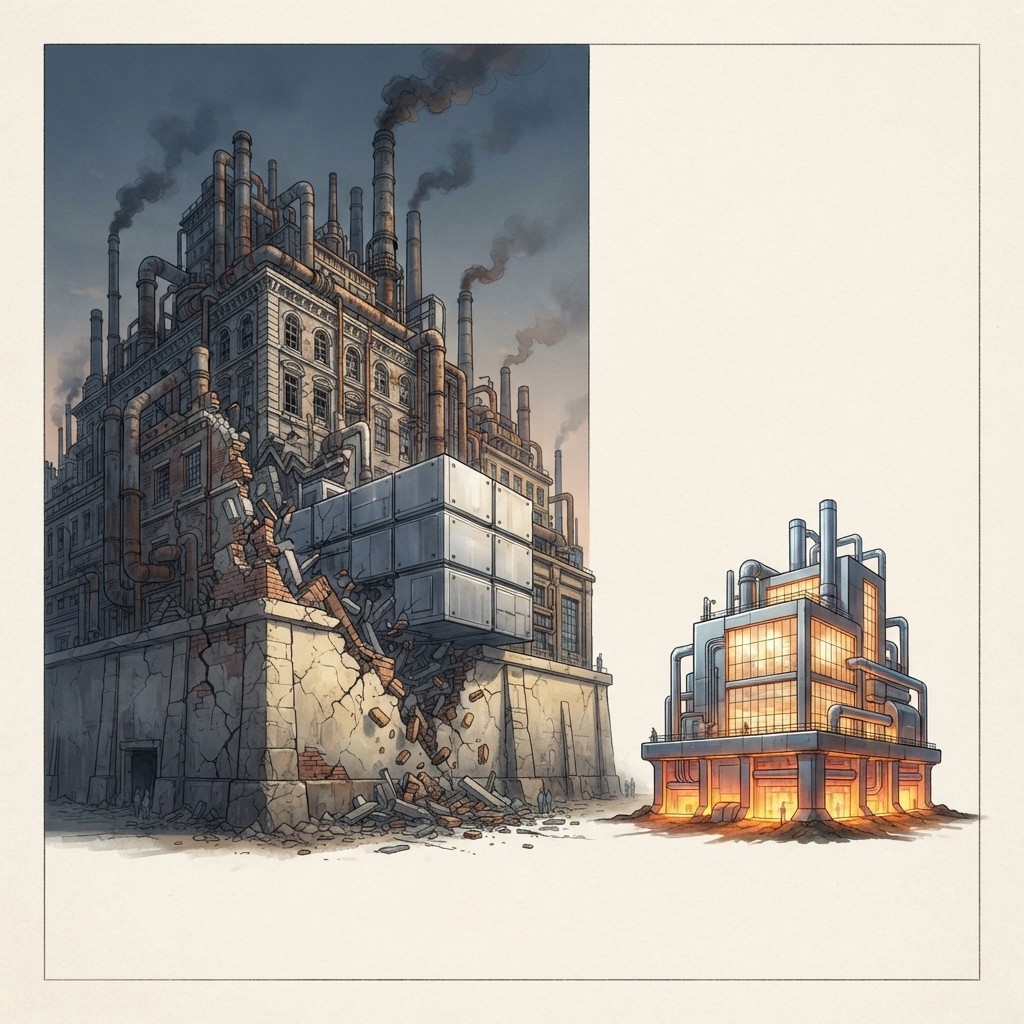
The official story is that Nucor's weapon was the electric arc furnace - the scrappy mini-mill that out-melted the giant blast furnaces. Nucor invented the mini-mill and beat Big Steel with better technology. It didn't. The furnace was the part anyone could buy. The thing nobody could buy was the system Nucor wrapped around it.
The furnace was never the secret
Electric arc furnaces were running in Europe during and after the Second World War, decades before Nucor touched one. By the company's own account, Nucor was an early American adopter of the concept, not its inventor - and by the 1980s, EAFs had become essential to U.S. steel as mini-mills spread fast.6 Other firms were melting scrap in arc furnaces at the same time Nucor was. A competitor with a checkbook could buy the same furnace from the same vendors. If the technology had been the moat, the moat would have leaked in a year.
So the interesting question isn't how did Nucor melt steel cheaply - everyone with an arc furnace could - it's why Nucor's cost advantage survived for decades while imitators struggled to hold one. The answer is that Nucor didn't run a technology. It ran a system in which the technology was only one moving part.
“EAF technology was used in Europe during and after World War II before Nucor adopted it; Nucor was an early adopter of the concept in the U.S., not its inventor.”6
Three things wired together, none copyable alone
Start with capital. The four bar mills Nucor built between 1969 and 1981 averaged less than $175 per ton of annual capacity - significantly lower than the capital cost of competing mills, including the far heavier investment required by integrated blast-furnace producers.3 Cheap to build means cheap to risk, and cheap to risk means you can build the next one before you're sure the last one paid off. That single number is the engine of the whole story: it let Nucor treat new mills as experiments rather than bet-the-company gambles.
Then the labor model, which is where Nucor stops looking like a steel company and starts looking like something stranger. Under Ken Iverson - who rose to president in 1965 and made the call to build the first mill - production workers earned a small base wage plus a weekly bonus that averaged about 82% of base pay.57 Read that twice: the bonus nearly equaled the salary. When the mill ran hot, paychecks swelled. When demand collapsed, the bonus shrank and labor cost fell with it - automatically, without a single layoff fight. The cost base flexed with the market because it was designed to.7
| Nucor's system | The integrated incumbent | |
|---|---|---|
| Capital per ton of capacity | Under $175 (bar mills, 1969–81) | A multiple of that |
| Production worker pay | Small base + ~82% weekly bonus | Fixed union wage |
| What happens in a downturn | Bonus shrinks, cost falls | Fixed cost, layoffs, or both |
| Officer perks | No pension, no profit-sharing | Full executive packages |
The third piece is the one that's easiest to dismiss and hardest to imitate: how thin the top was. Senior officers got a bonus tied to return on shareholders' equity, and - tellingly - the profit-sharing and pension plans available to workers were not available to officers.7 The pay risk ran upward, not downward. Decision rights ran the opposite way, pushed out to the mills. A near-empty headquarters and managers paid on the same volatile logic as the line is not a perk program; it's a cost structure that bends in the same direction every time the market moves.
The ladder that competitors couldn't follow up
Cheap mills and flexible cost would have made Nucor a strong commodity producer. What made it a giant was sequencing. Nucor started where mini-mills were allowed to play - low-end reinforcing bar, the steel nobody fought hard for - and used the cash and the cost discipline to climb. Each step upmarket put the EAF route into steel grades the incumbents had assumed were safe from it. The climb ended at the rung everyone said was impossible: flat-rolled sheet, the high-value product that fed cars and appliances and had always belonged to the blast-furnace giants.
In 1989, Nucor's Crawfordsville, Indiana plant became the first mini-mill in the world to make flat-rolled steel using thin-slab casting.4 Note the precise claim - first commercial deployment, not invention. The casting process came from outside; Nucor was first to make it work at scale in a mini-mill. That is the whole pattern in one sentence: take a technology anyone can license, and be the one with the cost structure and the nerve to commercialize it before the incumbents will. By 2024 the company was recycling approximately 18 million gross tons of scrap and had grown into the largest recycler in North America, built on scrap and arc furnaces nobody else turned into this.10
Wasn't this just luck and cheap electricity?
The honest objection is that arc furnaces are simply cheaper than blast furnaces - lower capital, scrap instead of ore - so any focused upstart could have done this, and several tried. That's fair, and it's why the technology can't be the answer. The advantage that lasted was the part competitors couldn't lift: the variable-pay system and the empty headquarters. An integrated steelmaker couldn't bolt those on, because to match the 82% production bonus it would have had to tear up fixed union contracts, and to match the thin overhead it would have had to gut layers of management that its own structure depended on.7 The technology was for sale. The willingness to rebuild your own company around it was not.
And it wasn't smooth. The Darlington mill's early years were rough enough that casting failures and delays sent the stock price to pennies; earnings finally rebounded - jumping roughly 140% in 1971 and another 70% in 1972 - and the now-famous record of profitability came after a hard, uncertain start, not from day one.9 The system was a build, not a gift.
When everyone can buy the same machine, the machine is not your advantage - it's table stakes. The durable edge is the system you wrap around it that competitors can't copy without dismantling themselves. Nucor's furnace was for sale to anyone; its variable-cost labor, its near-empty headquarters, and its ladder of cheap-mill bets were not, because matching them meant breaking union contracts and management layers that incumbents were built on. So when you scout a new technology, don't ask 'can we run it?' Ask 'what structure would let us run it cheaper than anyone who'd have to change to match us?' The moat is the structural commitment the leader can afford and the follower can't.
Nucor's story gets told as a triumph of the electric arc furnace, and that's the part that makes it forgettable - because furnaces don't have moats. What it actually built was a cost machine where every part pulled the same way: mills cheap enough to treat as experiments, pay that fell when demand fell, a head office too thin to slow anyone down, and a patient climb from rebar to the sheet steel the giants thought was theirs. The giants could have bought the same furnace. They could not have become a different company to use it. That, not the technology, is what changed steel.
When the real advantage isn't the obvious one
Vertical-Integration Assessment
A make-vs-buy assessment for a single stage of the value chain: rate the forces that argue for owning it and the forces that argue for renting it, then read the verdict off the gap. Blank to run on a stage you're deciding now; filled as the worked example showing why the story's company pulled a stage in-house — or pushed it out.
Included, filled and blank, in the Integrator Casebook. See the set → · Preview the blank →
Sources
Where this comes from — the filings, records, and reporting behind it.
- 1Nucor Corporation was originally incorporated in Delaware on March 28, 1958, under the name Nuclear Corporation of America.
- 2Nucor's first mini-mill, located in Darlington, South Carolina, went into production in 1969; it was initially intended to supply the company's Vulcraft divisions and soon expanded to outside customers.
- 3Nucor's first bar mill was constructed in 1969. The four bar mills constructed between 1969 and 1981 averaged less than $175 per ton of annual capacity — significantly lower capital cost than competing mills.
- 4In 1989, Nucor opened a facility in Crawfordsville, Indiana — the first mini-mill in the world to produce flat-rolled steel using thin-slab casting technology.
- 5Ken Iverson joined Nuclear Corporation in 1962 when it acquired Vulcraft, quickly rose to president in 1965, and in the late 1960s decided to build the company's own steel mill to escape dependence on a single steel supplier that kept raising prices.
- 6EAF technology was used in Europe during and after World War II before Nucor adopted it; Nucor was an early adopter of the concept in the U.S., not its inventor. By the 1980s, EAFs had become essential for steel production in the U.S., with mini-mills growing rapidly.
- 7Under Iverson, Nucor's compensation system had a small base pay plus a weekly production bonus averaging 82% of base salary for production workers; senior officers received a bonus tied to return on shareholders' equity; profit-sharing and pensions were not available to officers.
- 8Nucor is North America's largest recycler, using scrap steel as the primary raw material; it recycled approximately 20.3 million net tons of scrap steel in 2024 across 26 steel mills and produced/sold approximately 18.5 million tons of steel that year.
- 9During Darlington's early years, delays and casting machine failures caused stock prices to drop to pennies; depressed earnings rebounded 140% in 1971 and another 70% in 1972.
- 10In 2024, Nucor recycled approximately 18 million gross tons of scrap steel; Nucor is North America's largest recycler, using scrap steel as the primary raw material in producing steel and steel products.
- 11Nucor Corporation is North America's largest recycler, using approximately 20.3 million net tons of scrap steel in 2024 to create new products.
Weighing outside help with a decision like this? Hiring a post-merger integration consultant
More like this — beyond Nucor
New Strategically analyses as they publish: the defining moves in business, checked against the record. No noise, and one click to leave.