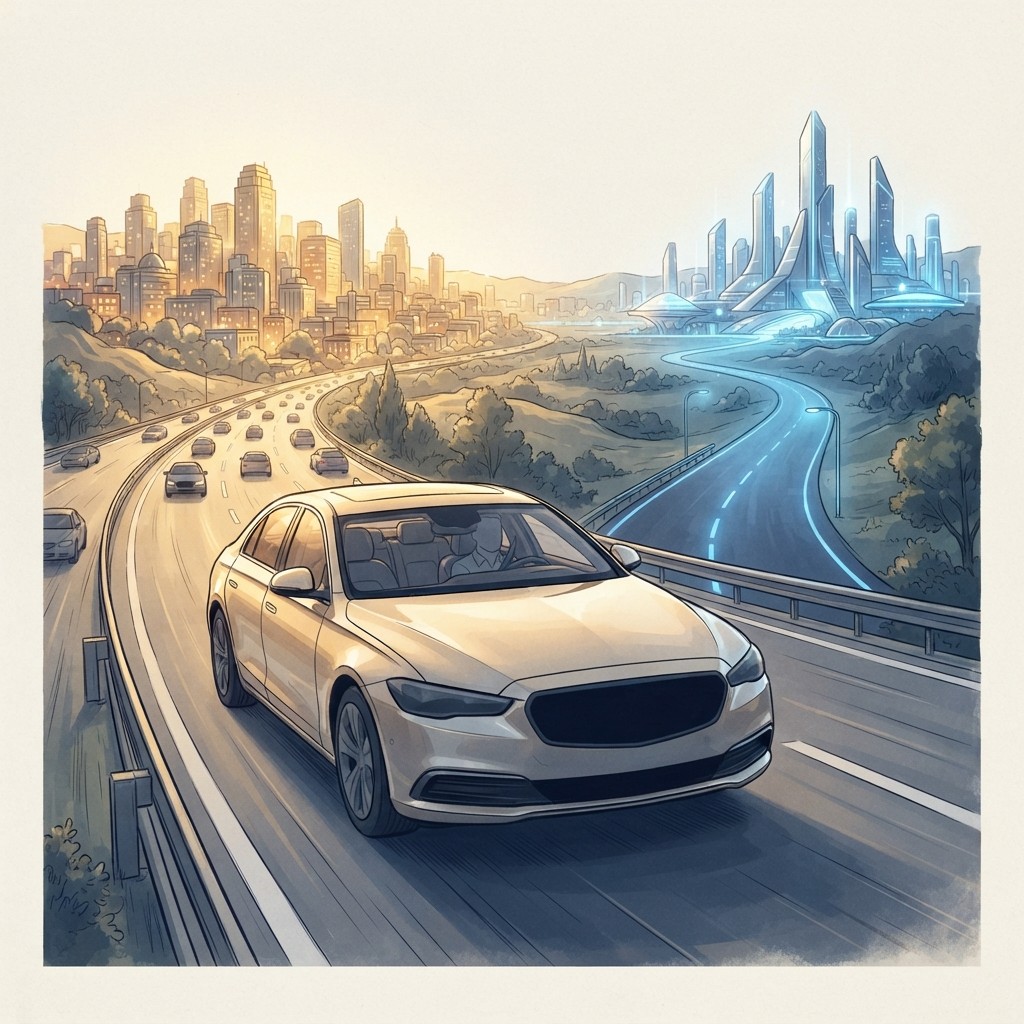
It lost roughly ten thousand dollars on every car it sold — and called it the smartest bet in the industry. Decades later, the same instinct cost the CEO his job.
Pairs with the Reversal Readiness Checklist — a ready-to-use strategy tool, filled for Toyota. Included in the The Reversal Casebook →
In December 1997, in Japan only, Toyota put a strange-looking sedan on sale and sold 323 of them.23 Each one reportedly cost the company about ¥1 million — roughly $10,000 — more to build than it sold for, the price of a battery nobody else had figured out how to make cheap.3 The launch was timed to land during the Kyoto climate conference, a message dressed as a product.3 First-generation production ran four years and stopped at 37,425 cars.2 By every quarterly metric, the Prius was a flop. By the only metric that mattered, it was the most patient bet in the industry.
The story everyone tells now is that Toyota saw the future — that while rivals chased horsepower, Toyota quietly understood electrification would arrive in stages, and was proven right when the world swung back toward hybrids. That version is half true and dangerously flattering. The conviction was real. The vindication was real. What the tidy story skips is the bill: the same belief that won the hybrid era curdled into a refusal to take pure EVs seriously, and that refusal cost the company its CEO.
A 1993 mandate that didn't even mention hybrids: the origin myth runs backward — there was no visionary blueprint, only an open-ended goal and a team that didn't believe in its own answer
The origin myth needs trimming first. The project that became the Prius — codenamed G21 — was launched in 1993 after honorary chairman Eiji Toyoda urged his engineers to build a 'vehicle for the 21st century,' with project manager Takeshi Uchiyamada running it.1 But the mandate was about efficiency, not electrification. The team didn't initially think a hybrid electric motor system was even feasible.4 The pivot to the two-motor planetary-gear architecture that defined the car came later — after Hiroshi Okuda became president in August 1995 and yanked the timeline forward.4 The official go-ahead for a production car came in June 1995.1 And Toyota didn't invent the hybrid at all; gasoline-electric cars have existed since at least 1898. Toyota was the first to mass-produce one — a distinction its own UK history page is careful to make.8 So the legend of a singular visionary mandate is a story told backward. What actually happened was messier and more impressive: an open-ended efficiency goal, an engineering team that didn't believe in the answer, and a new president willing to force it anyway.
“I am an old-fashioned person in regards to digitalization, electric vehicles, and connected cars — I cannot go beyond being a car guy.”6
The conviction that compounded — and the one that calcified: the patience that won one era and the stubbornness that lost the next are the same muscle, photographed from opposite sides
Here is the thesis, and it is uncomfortable on both ends: Toyota's hybrid bet was a genuine long-term conviction that paid off spectacularly — and that very success is what made the company too proud to move on pure EVs. The two are not separate failures and triumphs. They are the same trait, photographed from opposite sides. The patience to lose $10,000 a car for years until the technology matured is the same patience that, decades later, looked like stalling. The engineering pride that mass-produced a hybrid no one else could is the same pride that dismissed battery-only cars as one aisle in a store.
By September 2022, that posture had a name. CEO Akio Toyoda was calling Toyota 'a department store of all sorts of powertrains' — hybrids, plug-ins, hydrogen, and BEVs all on the shelf — and openly doubting that EV-only mandates like California's 2035 ban were achievable.5 Framed neutrally, this is portfolio diversification: don't bet the company on one chemistry. But the market did not read it as neutral. It read it as obstruction. Investors had watched the world's most capable manufacturer — the one that proved electrified mass production was possible — fall behind on the pure-electric version of exactly that.
| The hybrid bet (1990s) | The EV resistance (2020s) | |
|---|---|---|
| The instinct | Don't bet on one technology too early | Don't bet on one technology too late |
| What it looked like | Patient, visionary, contrarian | Stubborn, behind, defensive |
| The cost | ~$10,000 lost per early Prius | A forced CEO transition |
| The verdict | Vindicated | Penalized |
The reversal nobody calls a reversal: a company doesn't move its own scion out of the top seat over a difference of opinion that's working
In January 2023, Akio Toyoda stepped down as CEO, handing the job to Lexus chief Koji Sato. It was framed as generational renewal. It was widely reported as something blunter: a response to investor pressure over Toyota's slow EV transition.6 This is the part that makes the episode a true reversal rather than a strategy debate. A company does not move its own scion out of the top seat over a difference of opinion that's working. The leadership change was the institution conceding — quietly, without ever saying the word — that the multi-pathway stance had become a liability at the very top. The man who'd called Toyota a department store of powertrains admitted, in the same breath as his exit, that EVs were his 'limitation.'6
And then the data did something inconvenient for everyone. In 2024, Toyota's U.S. electrified sales — hybrids, plug-ins, BEVs, and hydrogen combined — hit an all-time record of 1,006,461 units, up 53.1% in a single year and accounting for 43.1% of everything Toyota sold in the country, across 30 electrified models.7 The bulk of that is hybrids: the exact technology Toyoda was defending when he was eased out. So the man got pushed for being too slow on EVs in the same window his core conviction was selling better than ever. Both things are true. That is the whole knot.
Wasn't Toyota just right all along?: being right that hybrids would matter is not the same as being right to drag on the platform someone else might own
The strongest defense of Toyota is also the most tempting, so name it plainly: the record 2024 numbers prove the multi-pathway skeptics were correct. EV demand cooled, hybrids are booming, and Toyota is selling more than a million electrified vehicles a year while purists who bet the farm on pure batteries are nursing losses.7 By that read, the 2023 CEO change was investors panicking at the top of a hype cycle. There is real weight here — Toyota's hybrid revenue is not a hypothesis, it is on the books. But the defense quietly swaps two different claims. Being right that hybrids would matter is not the same as being right to drag on building competitive pure EVs. Toyota can dominate the hybrid present and still be a laggard in the battery-electric technology that a meaningful slice of the market — and most of the regulatory map — is moving toward. The vindication is in the rear-view mirror. The unanswered question is whether the company that proved electrified mass production in 1997 can prove battery-electric mass production before someone else owns it. Selling a million hybrids buys time. It does not buy the next platform.
The trait that wins one era is rarely retired before it loses the next. Toyota's willingness to lose money for years on an unproven technology is precisely what let it dominate hybrids — and precisely what let it sit on pure EVs while telling itself patience was wisdom. When you find an organization defending a position with the same conviction that once made it great, ask the harder question: is this the original insight still paying off, or is it the original insight refusing to expire? The tell is usually who's nervous. When your own long-term holders start voting against the board, the muscle that made you has become the habit that's holding you.
Toyota spent four years and roughly $10,000 a car to be early, and the patience compounded into a million-vehicle lead in the very future it predicted. Then it spent the next era discovering that conviction has no expiry date stamped on it — that the same nerve which lets you wait out a skeptical market can quietly become the reason you wait out your own. The hybrid bet was real strategy, not luck and not hindsight. The lesson isn't that Toyota was visionary about EVs. It's that being right, held a few years too long, looks exactly like being wrong — and costs about the same.
Reversal Readiness Checklist
Reversing a public commitment is the hardest decision a leader makes — and the easiest to botch by doing it too late or too messily. This checklist gates the U-turn: is the evidence in, is the old logic genuinely dead, can you absorb the credibility hit, and is the new path actually ready. Blank, it keeps you from flip-flopping on a whim; filled, it scores the story's reversal against what a clean one demands.
Included, filled and blank, in the The Reversal Casebook. See the set → · Preview the blank →
Sources
Where this comes from — the filings, records, and reporting behind it.
- 1The G21 project — the direct precursor to the Prius — was launched in 1993 under Project General Manager Takeshi Uchiyamada after Honorary Chairman Eiji Toyoda urged development of a 'vehicle for the 21st century'; the official go-ahead for a production car came in June 1995.
- 2The first-generation Prius went on sale on 10 December 1997 in Japan only; it was the world's first mass-produced petrol-electric hybrid car. First-generation production ended in February 2000 after cumulative production of 37,425 vehicles.
- 3Toyota sold only 323 units in the Prius launch year (1997) and reportedly lost approximately ¥1 million (~$10,000) per vehicle in early years due to battery costs; the car's launch was timed to coincide with COP3 (the Kyoto Conference) in December 1997.
- 4The first-gen Prius team did not initially consider a hybrid electric motor system feasible; the pivot to the two-motor planetary-gear series-parallel architecture came after Hiroshi Okuda became president in August 1995 and accelerated the development timeline.
- 5In September 2022, CEO Akio Toyoda doubled down on a 'multi-pathway' strategy — hybrids, plug-ins, hydrogen, and BEVs — calling Toyota 'a department store of all sorts of powertrains' and expressing skepticism that EV-only mandates (e.g., California's 2035 ban) were achievable.
- 6Akio Toyoda stepped down as Toyota CEO in January 2023, replaced by then-Lexus chief Koji Sato; Toyoda himself told reporters he is 'an old-fashioned person in regards to digitalization, electric vehicles, and connected cars' and that this was his 'limitation.' The transition was widely reported as driven by investor pressure over slow EV adoption.
- 7In 2024, Toyota's U.S. electrified vehicle sales (hybrids, PHEVs, BEVs, FCEVs combined) hit 1,006,461 — an all-time record, up 53.1% year-on-year — representing 43.1% of total U.S. sales volume, with 30 electrified models on offer.
- 8Toyota's hybrid vehicle concept did not originate with Toyota; hybrid vehicles combining an ICE and electric motor have existed since at least 1898, and Toyota was the first to achieve mass production — not the inventor of the concept.Toyota UK Magazine, History of the Toyota Prius ↗ · 2024-08-12
More like this — beyond Toyota
New Strategically analyses as they publish: the defining moves in business, checked against the record. No noise, and one click to leave.