Pairs with the Pricing Power Diagnostic — a ready-to-use strategy tool. Included in the The Premium Trap Casebook →
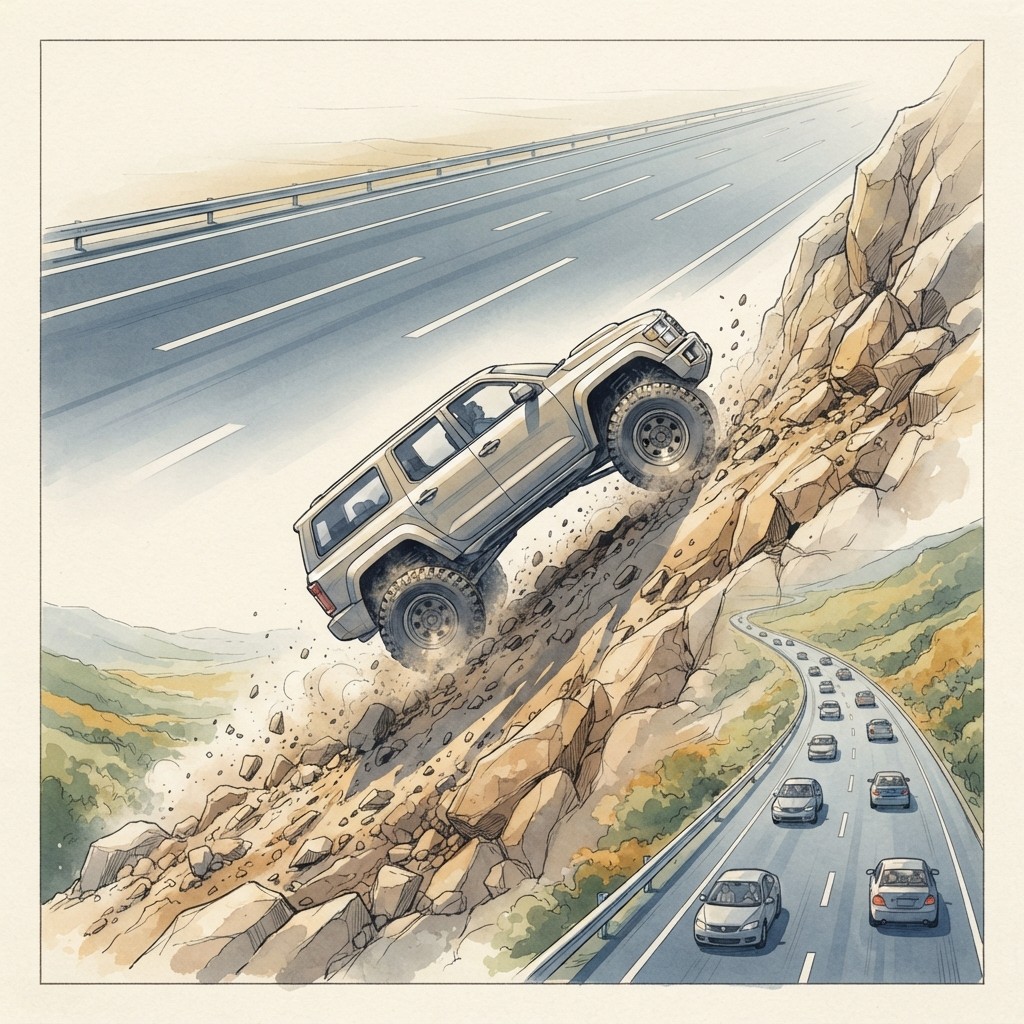
Walk onto a Ram lot in early 2022 and a Big Horn pickup wore a number that would have been unthinkable a few years earlier: an average transaction price of roughly $59,678.8 Jeep had pulled the same trick — its average price leapt 29% in a single year to over $50,000.8 The CEO of Ram said the quiet part out loud: 'We're able to command strong pricing right now.'8 It read like brand strength. It was the sound of a company spending an asset it didn't realize was finite.
The official story is that Stellantis got caught in the EV transition and a brutal macro environment. That's the comfortable version, and it is mostly wrong. The total U.S. market rose just over 2% in 2024 while Stellantis fell approximately 15%.1112 The company's own filing pinned roughly two-thirds of its margin collapse on corrective actions in North America — its own pricing and inventory decisions, not the weather.3 This was not a storm. It was a self-inflicted wound, priced one sticker at a time.
A 5% premium quietly became a 20% one
For years Jeep and Ram carried a small price premium over the industry average — about 5%, and most of it just reflected the mix of bigger, richer trucks and SUVs they sold.6 That is a healthy premium: it comes from what you build, not what you demand. Then, across 2022 and 2023, the math changed. The premium widened sharply past 20% above the market.6 That gap was not a richer product. It was the same product with a steeper price, on the bet that Jeep and Ram loyalty ran deep enough to absorb it.
Here is the thesis, plainly: Stellantis didn't price up because its trucks got better. It priced up because its margin targets needed it to, and it assumed the brand moat would pay the difference. The moat was real — but it was a few percent deep, not twenty. When the gap exceeded what loyalty would cover, buyers did the only rational thing. They walked to a comparable Chevy, Ford, or Toyota and kept the difference.
| The earned premium (pre-2022) | The extracted premium (2022–2023) | |
|---|---|---|
| Size of gap vs. market | ~5% | Over 20% |
| Where it came from | Richer product mix | Higher price on the same product |
| What it bought | Margin AND volume | Margin, briefly, then neither |
| What happened to share | Held | Fell from ~13% toward 10% |
The price kept climbing even when the demand signal flashed red. In Q4 2023, while most competitors held their transaction prices roughly flat, Stellantis pushed its ATP up another 6%, to $59,292.7 The result was not strength but stalled showrooms: Jeep's share fell to 3.92% from over 5% a few years earlier, Ram's slid to 3.44%, Wrangler hit its lowest volume in five years, and Ram's quarterly sales were the worst in five years.7 Then came the scramble — incentives jacked up 166% to $4,404 a vehicle,7 the discount you reach for when the price has already cost you the buyer.
They killed the cheap seats right before they needed them
A premium-pricing strategy can survive a downturn if you have an entry-level door for budget buyers to walk through. Stellantis bricked up that door. The Jeep Cherokee's production was halted in March 2023; the Renegade was discontinued for North America after the 2023 model year.9 Both were framed as platform and transition decisions, but the simpler truth is they had been quietly starved of refreshes and were no longer selling — the Cherokee had fallen under 10,000 units a year.9 Whatever the reason, the effect was the same: Jeep entered the critical 2024 sales period with no bargain-priced entry model in North America.9
So the trap closed from both sides. At the top, the price premium pushed loyal buyers out. At the bottom, there was no affordable Jeep to catch a downgrading customer before they left for another brand entirely. A buyer priced out of a $35,000 Cherokee in 2021 had nowhere to land in 2024 but somebody else's lot. The damage compounded: eight consecutive quarters of declining U.S. sales,10 inventory stacking up to over twice the industry-average days' supply, often past 150 days.6
“We're able to command strong pricing right now.”8
Wasn't this just the EV transition and a bad market?
The fair objection is that every legacy automaker took a beating in this window, and Stellantis discontinued aging models partly for genuine platform reasons. Both are true. But the numbers refuse to let the macro story stand. The U.S. market grew in 2024; Stellantis fell hard against it. And the company itself, in a filing it had every incentive to soften, attributed roughly two-thirds of its margin collapse to corrective actions in North America — its own pricing and inventory.3 When dealers wrote in, they didn't blame the EV transition; the dealer council chairman blamed too much emphasis on profit margins over competitive pricing.10 You cannot pin a self-described corrective action on the weather.
The honest counter that does land is that the high prices did, briefly, work. Margins were rich in 2022, and for a few quarters Jeep and Ram were the breadwinners. That is exactly what makes the trap dangerous: it pays out before it bills you. The full bill arrived in 2025 — full-year 2024 revenue down 17%, net profit down 70%, AOI margin halved to 5.5%, and industrial free cash flow swinging to negative €6 billion.2 The premium bought one good year and mortgaged the next three.
Brand loyalty is real, but it is not a blank check — it is a specific number of percentage points you can charge above the market before customers defect. Stellantis's moat was worth roughly 5%. Management priced as if it were worth 20%, and the gap between the two is precisely where the buyers went. The danger is that the bill arrives on a lag: the price increase books margin this quarter and erodes the customer base over the next eight. So when you raise price faster than you improve the product, you are not testing demand — you are spending equity, and equity drawn down on the same product never refills. Check whether your premium comes from what you build or what you demand. Only the first kind survives a downturn.
By the end of 2024 the experiment had run its full course. The ATP that once towered over the market had narrowed back toward it,6 share had drifted from around 13% toward 10%,6 and the CEO who engineered the premium was out the door, his resignation accepted with immediate effect on December 1.1 Jeep and Ram still build trucks people want. What they proved, expensively, is that wanting a truck and overpaying for it are two different decisions — and a brand can only confuse them for so long. The moat was always there. It was just never twenty percent deep.
Pricing Power Diagnostic
A scored diagnostic of pricing power: brand pull, switching costs, substitutes, and how critical the product is to the buyer. Each dimension rated 1-5 so you can see, at a glance, whether a price rise sticks or sends customers running. Blank to grade your own offer; filled as the worked example scoring a story's business on its real ability to charge more.
Included, filled and blank, in the The Premium Trap Casebook. See the set → · Preview the blank →
Sources
Where this comes from — the filings, records, and reporting behind it.
- 1Stellantis Board accepted Carlos Tavares's resignation on December 1, 2024, with immediate effect; a new CEO was to be appointed in H1 2025 and an interim executive committee chaired by John Elkann was established.
- 2Full-year 2024: Stellantis net revenues of €156.9 billion, down 17% vs. 2023; net profit down 70% to €5.5 billion; adjusted operating income of €8.6 billion, down 64%, with AOI margin of 5.5%; industrial free cash flows negative €6 billion; U.S. dealer stock fell 20% to 304,000 units.
- 3Stellantis's updated September 2024 guidance cut AOI margin to 5.5–7.0% (from prior 'double digit'); roughly two-thirds of the reduced margin was attributed to corrective actions in North America; industrial free cash flow guidance moved to -€5B to -€10B from 'Positive'.
- 4U.S. market share fell from 10.2% (H1 2023) to 8.4% (H1 2024), a decline of 180 basis points; North America shipments decreased in H1 2024 driven by discontinued products including Dodge Charger, Dodge Challenger, Jeep Renegade and Jeep Cherokee, as well as Ram 1500 mid-cycle action launch.
- 5Stellantis U.S. sales fell 21% in Q2 2024 year-over-year; Ram down 26%, Jeep down 19%, Chrysler down 19%, Dodge down 17%; the company sold 344,993 vehicles in the U.S. in Q2 2024 vs. 434,648 in Q2 2023; Wrangler and Grand Cherokee were down 17% and 26% respectively.
- 6Stellantis's ATP historically sat ~5% above the industry average due to model mix; during 2022–2023 that premium widened sharply to exceed 20%; by end of 2024 the ATP narrowed toward the market average; U.S. market share fell from around 13% to 10% by end of 2024; Stellantis brands had well over twice the industry-average days' supply throughout 2024, often exceeding 150 days.
- 7In Q4 2023, Stellantis's average transaction price jumped 6% to $59,292 when most competitors had ATPs flat or barely up; Jeep's Q4 2023 U.S. market share fell to 3.92% (from 5.17% in 2018–2019); Ram's share fell to 3.44% (from 4.60% in 2021); Wrangler sales hit their lowest volume in five years; Ram's Q4 2023 sales of 134,363 were the lowest in five years for the quarter; incentives were raised 166% to $4,404/vehicle.
- 8In Q1 2022, Ram's average transaction price reached $59,678; Jeep's average transaction price jumped 29% year-over-year to over $50,000; Ram CEO Mike Koval stated 'We're able to command strong pricing right now.'
- 9Jeep Cherokee production was halted March 1, 2023 at Belvidere Assembly; the Renegade was discontinued for North America after 2023 model year; both were eliminated during a period of persistently low sales (Cherokee under 10,000 units annually by end of 2023), leaving Jeep without a bargain-priced entry-level model in North America.
- 10Stellantis posted eight consecutive quarters of declining U.S. sales; retailers cited exorbitant sticker prices, insufficient incentives, lackluster vehicle lineups, and marketing cuts as primary culprits; the dealer council chairman Kevin Farrish wrote in August 2024 that Tavares put too much emphasis on profit margins and executive pay rather than competitive pricing.
- 11Stellantis (FCA US LLC) full-year 2024 U.S. sales totaled 1,303,570 vehicles, a decrease of approximately 15% year over year from 1,527,090 in 2023.
- 12U.S. new-vehicle sales in 2024 finished near 16.0 million, an increase of just over 2% from 2023 and the best year for volume since the pandemic; nearly every automaker posted higher sales year over year, with Stellantis and Tesla notable exceptions.
More like this — beyond Stellantis
New Strategically analyses as they publish: the defining moves in business, checked against the record. No noise, and one click to leave.