Pairs with the Pricing Power Diagnostic — a ready-to-use strategy tool. Included in the Pricing Power Play Casebook →
“What does changing how you charge cost before it starts paying?”
In April 2023, with China's carmakers slashing prices on each other in a war that would eventually drag more than 200 models into the discount bin8, NIO's CEO William Li stood apart. Margins were too thin, he said; NIO would not cut. It was a clean, premium message—the kind that protects an aura. Eight weeks later, on June 12, 2023, NIO cut RMB 30,000 off every model in the lineup and quietly killed the free battery-swap perk for new buyers in the same breath.3 The fortress held for about as long as a fiscal quarter's first half.
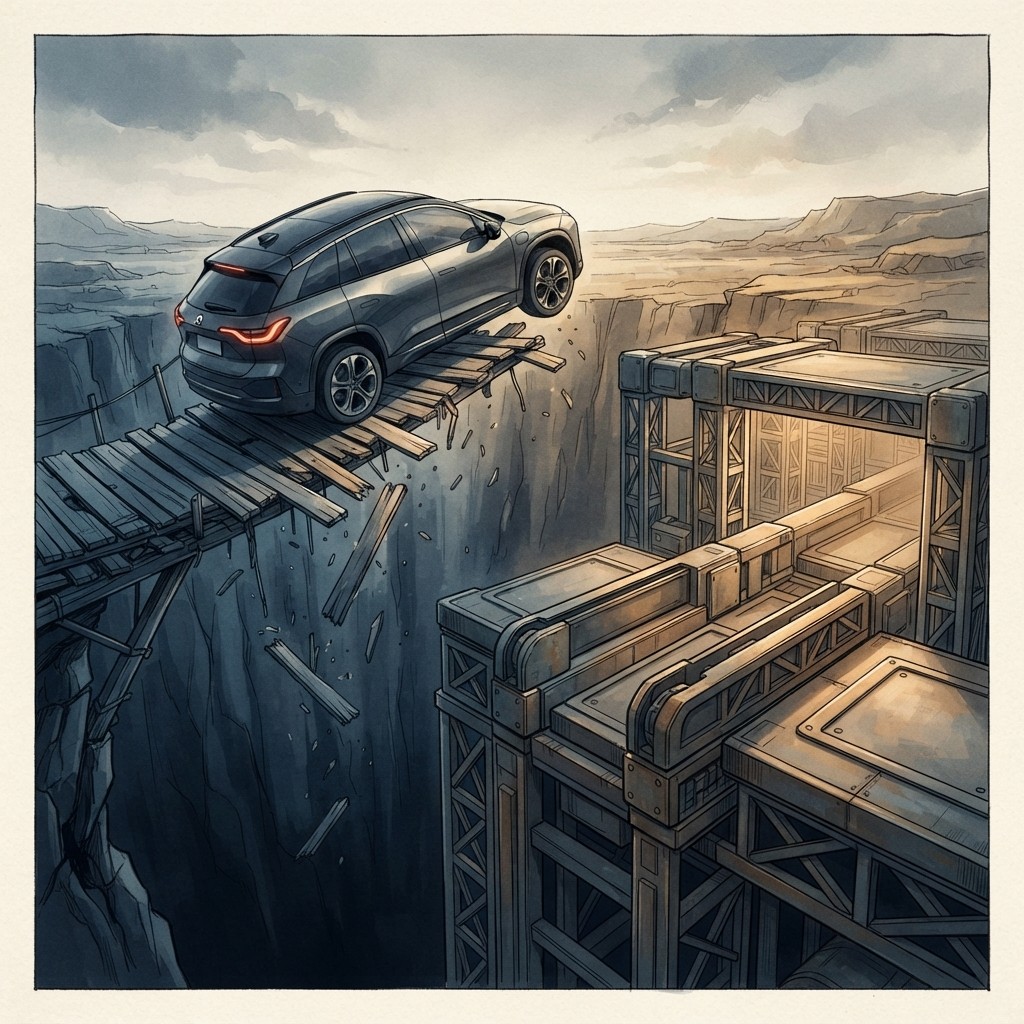
The story everyone tells is that NIO is the one Chinese EV maker that refused to fight on price—that it protected its premium positioning while rivals raced to the bottom. The record says otherwise. The pledge was made, then broken, then broken again. What survived was not the price. It was something far harder to copy, sitting in plain sight on the side of the highway.
“We will not participate in price wars. We will keep prices stable.”4
A pledge made twice, broken twice
Read the timeline and a pattern emerges that the 'premium holdout' narrative can't absorb. Li promised price discipline in April 2023, then cut RMB 30,000 across the board in June.3 In May 2024, launching the mass-market ONVO brand, he made the same promise again—'we will not participate in price wars'—even as ONVO's only sanctioned 'promotions' were free battery swaps, which are a discount wearing a service costume.4 Then in August 2025, NIO ran the play one more time, dropping its 100 kWh battery pack price by 16%, from RMB 128,000 to RMB 108,000, which pulled RMB 20,000 off the ET5 sedan and the same off the ES6 SUV.7 An indirect cut is still a cut. When a company has to discount its own battery to lower its sticker without admitting it lowered its sticker, the premium is no longer doing the work.
Record sales, record loss: the math the badge can't fix
Here is the number that breaks the fortress myth. In 2024, NIO delivered a record 221,970 vehicles, grew revenue 18.2% to RMB 65.7 billion, and even lifted its vehicle margin from 9.5% to 12.3%.1 By every operating measure the company was getting better at selling premium cars. And the full-year net loss still widened, to RMB 22.4 billion.5 More cars, fatter per-car margins, deeper hole. That combination only happens when the cost you carry doesn't scale down with each sale—when a large slab of your spending is fixed, structural, and paid for whether the car costs RMB 300,000 or RMB 280,000. A premium price helps the numerator. It does almost nothing to the denominator.
| 2023 | 2024 | |
|---|---|---|
| Vehicle deliveries | ~160,000 | 221,970 (record) |
| Vehicle margin | 9.5% | 12.3% |
| Total revenue | — | RMB 65.7B (+18.2%) |
| Net loss | RMB 20.7B | RMB 22.4B (wider) |
The moat was never the price. It's bolted to the ground.
So what is NIO actually defending? Not a price—prices fell, twice over. The thing that doesn't move is the Power Swap network: by March 2025, NIO had built 3,172 swap stations across China, and CATL agreed to invest up to RMB 2.5 billion to help expand what the two call the world's largest battery-swap network.6 This is the cruel symmetry at the heart of NIO. The same Battery-as-a-Service infrastructure that imposes the fixed cost dragging the loss wider is also the one asset a price-cutting rival cannot match by Tuesday. A competitor can knock RMB 30,000 off a sedan overnight. It cannot pour 3,000 swap stations into the ground overnight. The infrastructure is both the wound and the moat—and it explains why NIO keeps cutting prices while clinging to the network: the price was always the disposable lever, and the steel by the highway was the thing it was actually protecting.
That reframes the premium too. NIO's reported 40% share of China's BEV market above RMB 300,000 isn't proof of pricing power in the usual sense—it's a figure the company states about itself in its own earnings release.2 What buys loyalty in that segment isn't the sticker; it's the swap. Once your car and your driving life are wired into a network of stations only NIO operates, switching brands means switching infrastructure. That's lock-in. And lock-in, unlike price discipline, survives a price war.
But didn't the margins improve—and didn't NIO finally turn a profit?
The fair objection is that the trend lines are pointing the right way, and they are. Vehicle margin climbed nearly three points in a single year while the entire Chinese auto industry's profit margin sank to 4.4%.18 NIO reports it eventually posted its first net profit in the fourth quarter of fiscal 2025.5 A skeptic could say the swap-network drag is a front-loaded investment that finally inflected, and that the price 'cuts' were disciplined responses to a brutal market, not capitulation. Fair. But notice what that argument quietly concedes: it abandons the premise. It stops claiming NIO won by holding price and starts claiming NIO won by getting its costs and its network to scale. That's the right read—and it's a different read. The first quarterly profit, if it holds, vindicates the infrastructure thesis, not the fortress one. The badge got NIO into the premium segment. The stations are what kept the customers there long enough for the math to turn.
A premium sticker and the power to defend it are different things. Real pricing power means a rival can't take your customer by undercutting you—and that only holds when the customer is locked to something a price can't replace: a network, a standard, a switching cost paid in inconvenience. NIO's price fell twice; what didn't fall was the customer's tether to 3,000 swap stations only NIO runs. So when you're tempted to read a luxury price tag as a moat, ask the harder question: if a competitor matched the price tomorrow, would your customers leave? If yes, the price was never the moat—it was just the markup. Build the thing they can't walk away from, and let the price float.
NIO sold the market a story about discipline—a company too premium to fight in the mud. The story lasted eight weeks the first time and didn't survive contact with a price war that pulled 200 models down with it. What survived was the part NIO almost never markets: a few thousand tons of swap infrastructure that cost it a fortune to build and costs a rival even more to copy. The premium price was the thing everyone watched. The moat was the thing nobody could move.
When the real asset isn't the one on the price tag
Pricing Power Diagnostic
A scored diagnostic of pricing power: brand pull, switching costs, substitutes, and how critical the product is to the buyer. Each dimension rated 1-5 so you can see, at a glance, whether a price rise sticks or sends customers running. Blank to grade your own offer; filled as the worked example scoring a story's business on its real ability to charge more.
Included, filled and blank, in the Pricing Power Play Casebook. See the set → · Preview the blank →
Sources
Where this comes from — the filings, records, and reporting behind it.
- 1NIO full-year 2024 total revenues were RMB 65,731.6 million (US$9,005.2 million), up 18.2% YoY; vehicle deliveries were a record 221,970 units (+38.7% YoY); full-year net loss was RMB 22,401.7 million (US$3,069.0 million), up 8.1% YoY; full-year vehicle margin was 12.3% vs. 9.5% in 2023.
- 2NIO's Q4 2024 earnings press release (filed as Exhibit 99-1 on SEC EDGAR) states that 'NIO brand maintained its position as the leader in China's BEV market for vehicles priced over RMB300,000, capturing a 40% market share' in 2024.
- 3NIO cut prices by RMB 30,000 across all models on June 12, 2023, and simultaneously ended free battery-swap services for new buyers—reversing CEO William Li's April 2023 pledge that thin gross margins prevented NIO from joining the price war.
- 4NIO CEO William Li said in May 2024—at the launch of the ONVO mass-market brand—'We will not participate in price wars' and 'We will keep prices stable,' stating ONVO prices would not be adjusted frequently and that promotions would be limited to service incentives like free battery swaps.
- 5NIO net losses were RMB 20,719.8 million in 2023 and RMB 22,401.7 million in 2024, as reported in the FY2025 Form 20-F filed with the SEC; the company first recorded a net profit in Q4 of its fiscal year 2025.
- 6As of March 17, 2025, NIO had built 3,172 Power Swap Stations across China. On that date, NIO and CATL signed a strategic partnership in Ningde with CATL proposing an investment of up to RMB 2.5 billion in NIO Power to jointly build the world's largest battery swap network.
- 7In August 2025, NIO executed an indirect price cut by reducing the cost of its 100 kWh battery pack by 16%—from RMB 128,000 to RMB 108,000—lowering the ET5 sedan's starting price from RMB 356,000 to RMB 336,000 and the ES6 SUV from RMB 396,000 to RMB 376,000.
- 8More than 200 car models in China saw price cuts in 2024, up from 148 in 2023, according to China Passenger Car Association secretary general Cui Dongshu; China's auto industry sales profit margins fell to 4.4% in the first 11 months of 2024 vs. 5% in 2023 and 6.2% in 2020.
Weighing outside help with a decision like this? Hiring a pricing strategy consultant
More like this — beyond NIO
New Strategically analyses as they publish: the defining moves in business, checked against the record. No noise, and one click to leave.