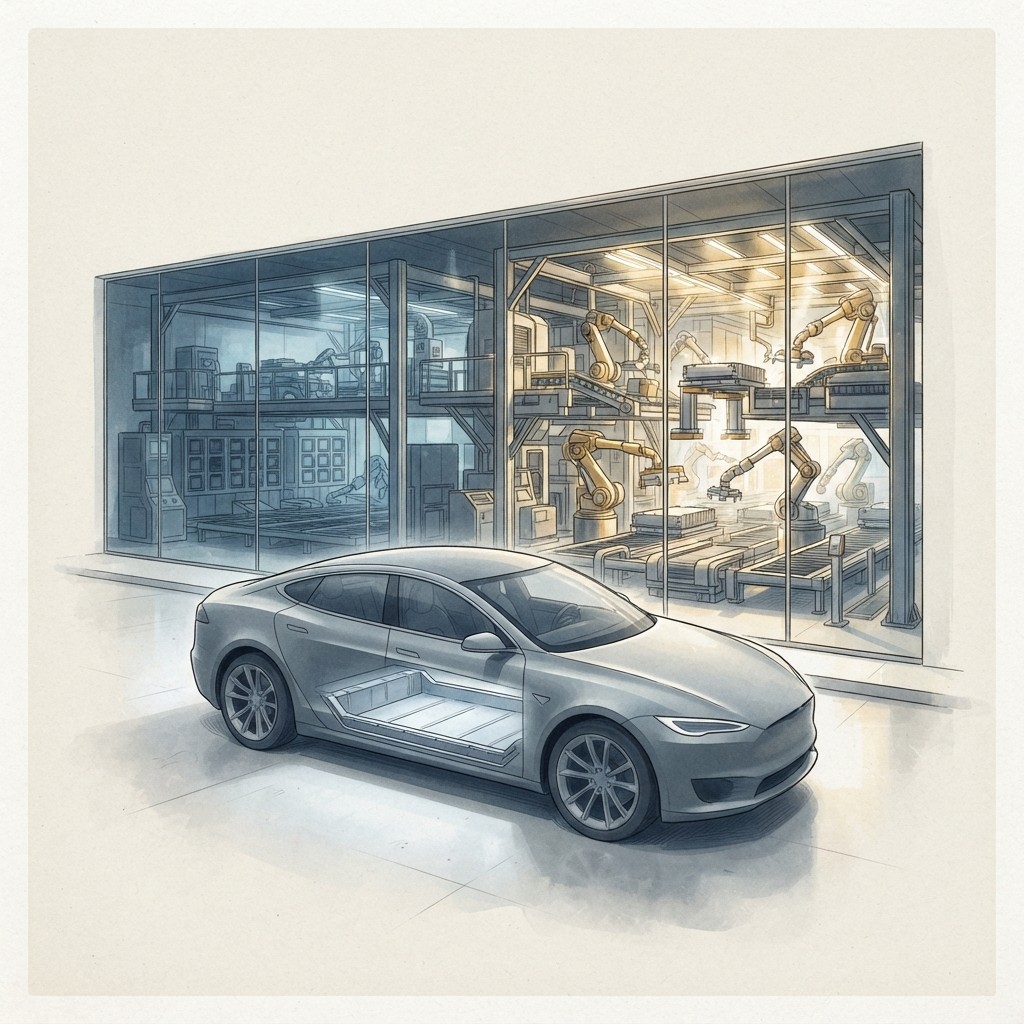
Pairs with the Pricing Power Diagnostic — a ready-to-use strategy tool, filled for NIO. Included in the Infrastructure Bet Casebook →
“What does changing how you charge cost before it starts paying?”
Pull into a NIO Power Swap Station, stay in your seat, and in about the time it takes to read this sentence twice a robot has slid your depleted battery out from under the floor and bolted a fully charged one in its place. No plug, no waiting, no charging curve. NIO has now done this 100 million times, reaching the milestone on February 6, 2026 — a figure that took 29 months just to climb past its first million.3 But the robot under the car is not the interesting machine. The interesting machine is the price tag it makes possible.
The official story is that NIO sells electric cars with a clever battery-swap service bolted on. The real story is the reverse: NIO sells you a car with the most expensive part removed, then rents that part back to you for the life of the vehicle — and the swap stations exist to make that rental feel like an upgrade instead of a catch.
Take the battery off the sticker, and the EV gets cheap
On August 20, 2020, NIO launched Battery as a Service, and the mechanism is almost embarrassingly simple. Buy an ES8, ES6, or EC6 under BaaS and you deduct RMB 70,000 from the purchase price — the cost of the battery — and instead pay a monthly fee to lease it, originally RMB 980 for a 70 kWh pack.12 The battery you're renting isn't even NIO's on paper: a separate vehicle, Wuhan Weineng Battery Asset Co., was capitalized at launch with RMB 200 million each from NIO, battery-maker CATL, and two state-linked investors, each holding 25%.1 The car and the battery were legally and financially divorced. What that does to a showroom is the whole point. The single biggest line item in an EV — the part that makes electric cars cost more than gas ones — vanishes from the sticker. The buyer's anxiety about range and battery degradation evaporates too, because a worn pack isn't theirs to worry about; they just swap it for a better one. Two of the three reasons people hesitate on EVs, gone, by accounting.
| The car (one-time) | The battery (forever) | |
|---|---|---|
| You pay | Sticker minus RMB 70,000 | A monthly lease fee |
| You own | The vehicle | Nothing — it's leased |
| Who carries degradation risk | Not you | The battery asset company |
| NIO's revenue type | One-time sale | Recurring subscription |
Here is the thesis a smart friend could repeat at dinner: NIO isn't a carmaker that offers battery swapping. It's a company trying to turn the most expensive component in a car into a subscription — and the swap network is the infrastructure that makes the subscription stick. Once your driving life runs on stations only NIO operates, switching brands means giving up the swaps too. The battery is the razor; the swap is the blade.
The trouble with renting out a robot-staffed gas station
Subscriptions are wonderful until you remember what they cost to deliver. Every BaaS customer needs somewhere to swap, and a swap station is not a charging cable on a pole — it's a building full of robots and a small warehouse of spare batteries that must be bought, charged, and maintained whether anyone shows up or not. That fixed cost sets a brutal break-even line. NIO's own CFO, Stanly Qu, said in November 2024 that a station needs 60 to 70 swaps a day to break even. The network was averaging 30 to 40.5 CEO William Li, at the August 2024 Power Up event, put the bar at 60 swaps a day and admitted only about 20% of the roughly 2,500 stations were even approaching it.6 The math caught up exactly as you'd expect: in 2024 the swap business lost an analyst-reported RMB 3.12 billion, with stations averaging just 32 sessions a day.7
The fixed cost barely moves whether a station does 5 swaps or 50. Below ~60 swaps a day, the building bleeds money; above it, every extra swap is nearly pure contribution.5 A 4th-gen station can theoretically run 480 services a day — so a busy station isn't a little profitable, it's enormously profitable. The whole business hinges on which side of that line the average station lands on, and in 2024 the network averaged just 32 sessions per station per day.7 NIO is, for now, running an expensive network mostly half-empty.
So why not blanket the country with stations and chase the density? Because density is the destination, not the lever. NIO actually pulled back: against a 2024 target of 1,000 new stations it built 679, and added just 681 in 2025 — partly a deliberate slowdown to retool for a fifth-generation station design before scaling again.4 You don't fix an under-utilized network by adding more under-utilized stations; you fix it by selling more cars into the geographies you already cover. The model's proof depends on a delivery volume NIO hasn't reached. In 2024 it delivered 221,970 vehicles, up nearly 39%, while still posting a RMB 22.4 billion net loss.7 Growing fast, and still feeding the network more than it returns.
One city already proves the model works
The reason to take this bet seriously sits in Shanghai. There, more than 150 stations were each handling over 100 swaps a day in late 2024 — comfortably past break-even, in the territory where every additional swap drops to the bottom line.5 That's the existence proof. The model is not theoretically impossible; it is empirically profitable wherever NIO cars are dense enough on the ground. The flywheel is real: more cars sold means busier stations, busier stations mean better swap coverage, better coverage makes the next car easier to sell. NIO has simply only spun it up to speed in a handful of cities. And it sharpened the offer to push harder — in March 2024 it cut the BaaS monthly fee from RMB 980 to RMB 728, as low as RMB 580 with discounts, and threw in free months and 60 free swap vouchers to drag the upfront cost of ownership down even further amid China's price war.8
“Most of NIO's swap stations in Shanghai deliver over 100 services per day.”5
Isn't this just Better Place with better PR?
The fair objection writes itself: a swap-station startup already tried this and went bankrupt. Better Place ran from 2007 to its 2013 collapse, and the comparison gets reached for every time NIO loses another few billion.9 But the comparison flatters Better Place and misreads NIO. Better Place built swap stations around the Renault Fluence ZE — a car it did not make and could not design — and offered a mileage-based subscription rather than a recurring battery-as-a-service product tied to a vehicle line it controlled; it was a pure infrastructure bet hoping carmakers would build to its standard.10 NIO inverted every piece of that. It manufactures the vehicles, engineered its entire product line around swappable packs from inception, and owns the recurring BaaS relationship outright. Better Place owned a network and rented demand from a partner who could walk. NIO owns both sides. That doesn't guarantee it survives — the RMB 3.12 billion swap loss and the missed station targets are real, and the path to break-even runs through delivery volumes NIO has yet to hit. But the honest read isn't 'Better Place again.' It's a structurally sounder version of the same bet, losing money in the build-out phase that Better Place never lived long enough to escape. The risk isn't that the idea is incoherent. The risk is that NIO runs out of cash before density catches up to ambition.
Separating an expensive component from the product and renting it back is a genuinely powerful move — it kills sticker shock, removes the customer's worst anxiety, and converts a one-time sale into recurring revenue and lock-in. But recurring revenue is not the same as recurring profit. The moment the subscription requires physical infrastructure to deliver, you inherit a fixed-cost network with a brutal utilization threshold, and you don't cross it by building more nodes — you cross it by selling more units into the nodes you already have. Density is the whole game. Before you admire the elegance of the pricing, find the break-even line on the infrastructure underneath it, and ask honestly how far the average node sits below it. NIO's line is 60 swaps a day. Its average is 32. The model isn't broken — it's just not finished, and 'not finished' burns cash until it is.
NIO took the heaviest, priciest, most dread-inducing part of an electric car and made it disappear from the price, the worry, and the resale — then quietly rented it back, forever, through stations only it runs. It is one of the cleverest pricing reframes in the auto industry, and it is losing billions a year, and both things are true at once. The genius is real and the bill is real. Whether the genius outlasts the bill comes down to a single unglamorous number that has nothing to do with robots or subscriptions: how many cars NIO can put on the roads it has already wired. Get the average station to 60 swaps a day, and the whole structure flips from cash furnace to compounding machine. Until then, NIO is paying — every single day, in every half-empty station — for the privilege of being early.
Other companies that sell the razor to keep the blade
Pricing Power Diagnostic
A scored diagnostic of pricing power: brand pull, switching costs, substitutes, and how critical the product is to the buyer. Each dimension rated 1-5 so you can see, at a glance, whether a price rise sticks or sends customers running. Blank to grade your own offer; filled as the worked example scoring a story's business on its real ability to charge more.
Included, filled and blank, in the Infrastructure Bet Casebook. See the set → · Preview the blank →
Sources
Where this comes from — the filings, records, and reporting behind it.
- 1NIO officially launched BaaS on August 20, 2020. Users purchasing an ES8, ES6, or EC6 received an RMB 70,000 deduction and paid RMB 980/month for a 70 kWh battery pack. NIO, CATL, Hubei Science Technology Investment Group, and a Guotai Junan subsidiary each invested RMB 200 million (25% equity) to establish Wuhan Weineng Battery Asset Co., Ltd. on August 18, 2020.
- 2NIO's BaaS launch was also filed with the SEC as a Form 6-K exhibit, confirming RMB 70,000 vehicle price deduction and RMB 980/month battery subscription for the 70 kWh pack at launch.
- 3NIO established its first battery swap station in Shenzhen on May 20, 2018—two full years before BaaS launched. It took 29 months to complete the first 1 million swaps. The 10-million milestone was reached July 4, 2022; 50 million on August 5, 2024; 80 million on July 19, 2025; 90 million on October 26, 2025; and 100 million on February 6, 2026.
- 4As of February 6, 2026, NIO operates 3,729 battery swap stations in China (1,020 on highways), having added only 679 in 2024 and 681 in 2025—both below NIO's own 1,000-station annual targets. CEO William Li committed to adding at least 1,000 in 2026.
- 5NIO's CFO Stanly Qu stated at a November 2024 industry forum that a battery swap station breaks even at 60–70 swaps per day. At that time, NIO's ~2,500 stations averaged only 30–40 services/day network-wide. In Shanghai specifically, over 150 stations were delivering more than 100 swaps/day—above breakeven. The 4th-gen station's theoretical maximum is 480 services/day.
- 6At NIO's August 2024 Power Up event, CEO William Li confirmed ~20% of the ~2,500 stations were approaching the 60-swap/day breakeven. NIO announced a new Wuhan battery swap station factory with annual capacity of 1,000+ units, and cost-sharing partnerships with six regional utility providers.
- 7In 2024, NIO's swap business lost RMB 3.12 billion, with an average of only 32 service sessions per station per day against a breakeven requirement of ~50 sessions. NIO's full-year 2024 net loss was RMB 22.4 billion (up 8.1% YoY). Full-year 2024 revenue was RMB 65.73 billion (+18.2% YoY) on 221,970 deliveries (+38.7% YoY).
- 8NIO revamped BaaS in March 2024, cutting the monthly battery lease fee from RMB 980 to RMB 728 (or as low as RMB 580 with discounts). The revamp also introduced a 'buy 4 months, get 1 free' incentive (capped at 12 free payments) for orders placed March 14–May 31, 2024, and included 60 free swap vouchers over 5 years post-delivery.
- 9Better Place was founded in 2007 by Shai Agassi and filed for bankruptcy in Israel in May 2013, having raised roughly $850 million. The only eligible vehicle was the Renault Fluence ZE, a car Better Place did not manufacture.
- 10Better Place's model required the customer to buy a vehicle — the only eligible vehicle was the 2012 Renault Fluence ZE — but lease the battery pack from the company. Customers paid a set fee for up to a certain number of miles covered per year. Better Place was a pure infrastructure and mileage-subscription play, not a recurring battery-as-a-service product tied to a vehicle line the company designed.
Weighing outside help with a decision like this? Hiring a pricing strategy consultant
More like this — beyond NIO
New Strategically analyses as they publish: the defining moves in business, checked against the record. No noise, and one click to leave.