Pairs with the Pricing Power Diagnostic — a ready-to-use strategy tool. Included in the The Repositioning Casebook →
In May 2022, on the Côte d'Azur, Mercedes-Benz gathered investors to make a promise about how it would get rich. The pitch had a name worthy of the setting — 'Economics of Desire' — and a thesis that sounded like an escape hatch: stop chasing volume, pour more than 75% of investment into the most profitable segments, grow the Maybachs and S-Classes and AMGs, and let mix do the work that quantity used to do.1 For one glorious year it looked like genius. Cars margin hit 14.6%, Maybach had its best year ever, group profit jumped 28% to €20.5 billion.4 Then 2024 arrived and presented the bill.
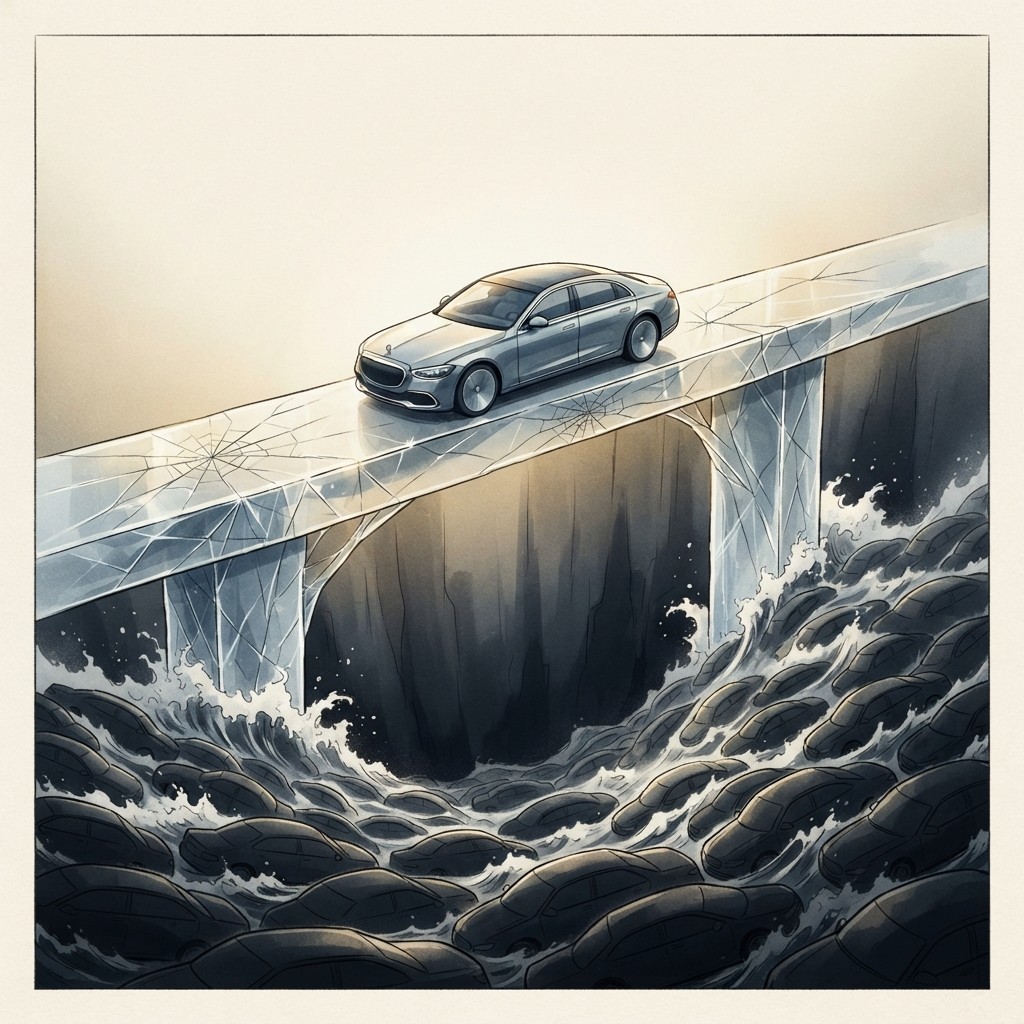
The official story is a premiumisation success: Mercedes went up-market, charged more for fewer richer cars, and unlocked structurally higher margins. The real story is narrower and more brutal. The repositioning didn't make Mercedes' profit independent of volume. It made profit more sensitive to it — and when Chinese demand turned, the same mechanism that amplified the boom amplified the bust.
“In October 2020, Mercedes-Benz provided new financial objectives as part of its new strategic course.”2
It was never a volume cut. It was a bet on the rich staying rich.
The popular version says Mercedes deliberately sold fewer cars to go up-market. The numbers say otherwise. Cars unit sales were 2,040,719 in 2022, up 5% year over year, and 2,044,100 in 2023 — essentially flat.45 Nobody pruned the lineup down to a boutique. What Mercedes actually did was tilt the mix: thin the bottom (Entry Luxury went from seven model variants to four3), fatten the top, and steer investment toward the segments where a customer's price sensitivity is lowest. The average car got pricier — average sales price rose 2% to €74,200 in 2023.5 The strategy's real wager wasn't 'sell fewer cars.' It was 'concentrate our profit in the part of the market that doesn't flinch at a recession.' That part of the market has a name, and increasingly it has a passport: China.
Why mix-shift makes margin a lever, not a floor
Here is the mechanism the pitch deck quietly skipped. A Top-End vehicle carries enormous gross margin per unit — that's the whole appeal. But concentrating profit in those units doesn't reduce your exposure to demand swings; it concentrates it. When you make most of your money on the most expensive, most discretionary, most China-dependent products, a downturn in exactly those products doesn't trim your margin — it guts it. In 2024 the trap sprang. Top-End vehicle sales fell 14%, Chinese sales dropped 7% to 683,600 units as buyers shunned the S-Class and Maybach for local brands, and net pricing turned negative as Mercedes discounted to move metal it had positioned not to discount.67 Cars adjusted EBIT fell from €14.3 billion to €8.7 billion. Return on Sales went from 12.6% to 8.1% in a single year.6 The high-margin mix didn't cushion the fall. It was the fall.
| 2022 | 2023 | 2024 | |
|---|---|---|---|
| Cars adjusted RoS | 14.6% | 12.6% | 8.1% |
| Cars unit sales | 2,040,719 | 2,044,100 | ~1.98M (−3%) |
| Top-End vehicles | — | 328,300 | −14% |
| Net pricing | Favourable | Holding | Negative |
| The story | Moat | Slipping | Cyclical |
Read the targets against the outcome and the gap is stark. The 'approximately 14% margin' was always conditioned on 'favourable market conditions by mid of the decade' — and the moment conditions turned unfavourable, the number didn't drift, it collapsed.16 The 60% Top-End growth target by 2026 looks unreachable after a 14% drop in 2024.7 And the company's own response gives the game away: it launched 'Next Level Performance,' a programme to cut production costs 10% by 2027.8 A pure luxury-margin story does not need an emergency cost cut. Cost discipline is what you reach for when pricing power, the thing the whole strategy was supposed to manufacture, turns out to be on loan from the cycle.
The fair objection: maybe the brand was just unlucky
The honest counter is that 2024 was an exogenous shock, not a design flaw. China's premium market cracked, local EV brands surged, and every Western luxury carmaker felt it — so blaming the repositioning is like blaming an umbrella for the storm. There's truth here. Mercedes didn't cause the Chinese slowdown, and 8.1% RoS in a brutal year still beats most volume automakers in a good one. But the objection actually proves the thesis rather than refuting it. A strategy sold as a structural moat — profit made durable and volume-independent — should be precisely the thing that holds when the weather turns. Instead it amplified the swing in both directions. If your competitive advantage only works in favourable conditions, it isn't a moat; it's a multiplier on the cycle, and a multiplier cuts both ways. Mercedes didn't escape the demand curve by going up-market. It bolted itself more tightly to the steepest part of it.
Premiumising your mix raises profit per unit — and quietly raises your exposure to the cycle, because the highest-margin units are also the most discretionary, the most discount-resistant on the way up, and the first to vanish on the way down. The same concentration that makes the boom look like a structural win makes the bust look like a structural failure. Before you call a mix-shift a moat, ask the only question that matters: does it hold when demand turns? If the margin needs 'favourable market conditions' written into its own target, you haven't built a floor. You've built a lever — and a lever moves in whichever direction the market pushes it.
Mercedes spent four years and a fortune in narrative convincing the market it had found a way to make money the way luxury houses do — on desire, not volume, immune to the showroom's swings. For one year the numbers agreed. Then the part of the world that buys the most Maybachs decided it preferred something else, and the most profitable mix in the industry turned into the most fragile. The repositioning wasn't wrong about where the profit lived. It was wrong about whether profit that lives in one rich, distant, discretionary market can ever be called structural. Desire is real. It's just never been volume-independent — and a brand that built its whole thesis on pretending otherwise spent 2024 discovering the difference.
When a repositioning meets the cycle it tried to outrun
Pricing Power Diagnostic
A scored diagnostic of pricing power: brand pull, switching costs, substitutes, and how critical the product is to the buyer. Each dimension rated 1-5 so you can see, at a glance, whether a price rise sticks or sends customers running. Blank to grade your own offer; filled as the worked example scoring a story's business on its real ability to charge more.
Included, filled and blank, in the The Repositioning Casebook. See the set → · Preview the blank →
Sources
Where this comes from — the filings, records, and reporting behind it.
- 1The 'Economics of Desire' strategy was formally presented on May 19, 2022 on the Côte d'Azur; it committed Mercedes to allocating more than 75% of investments to the most profitable segments and growing Top-End vehicle sales share by ~60% by 2026 vs. 2019, with a margin target of ~14% by mid-decade in favourable conditions.
- 2The luxury repositioning's roots are October 2020, not May 2022: Mercedes-Benz's own Economics of Desire materials state 'In October 2020, Mercedes-Benz provided new financial objectives as part of its new strategic course,' featuring fixed-cost reduction and 'substantial improvement in pricing discipline.'
- 3In the Entry Luxury segment, Mercedes-Benz committed to reducing model variants from seven to four, while significantly elevating technological substance.
- 4For FY2022, Mercedes-Benz Cars sold 2,040,719 vehicles (+5% YoY); adjusted Cars RoS rose to 14.6% (from 13.1%); Mercedes-Maybach achieved a new record year with sales up 41%; group EBIT rose 28% to €20.5 billion on a 12% revenue rise to €150.0 billion.
- 5For FY2023, Mercedes-Benz Cars adjusted RoS was 12.6% (down from 14.6%); average sales price rose 2% to €74,200; overall Cars unit sales reached 2,044,100 (essentially flat); Top-End vehicle sales reached 328,300 units; group revenue grew 2% to €153.2 billion.
- 6For FY2024, Mercedes-Benz Cars adjusted EBIT fell to €8.7 billion (from €14.3 billion in 2023) and adjusted Cars RoS collapsed to 8.1% (from 12.6%), driven by lower volumes particularly in China, negative net pricing and an unfavourable model mix; group revenue fell 4.5% to €145.6 billion and net profit fell 28.4% to €10.4 billion.
- 7In 2024, Mercedes-Benz Cars total unit sales fell 3% to 1.98 million vehicles; sales in China — its largest market — dropped 7% to 683,600 units, with consumers shunning models like the S-Class and Maybach in favour of local brands; Top-End vehicle sales fell 14% in 2024.
- 8In response to the 2024 profit decline, Mercedes-Benz launched 'Next Level Performance,' a comprehensive performance-enhancement programme targeting a 10% cut in production costs by 2027, and reconfirmed plans to expand and protect Top-End Vehicle share — including a new smaller G-Class and AMG.EA electric models.
More like this — beyond Mercedes-Benz
New Strategically analyses as they publish: the defining moves in business, checked against the record. No noise, and one click to leave.