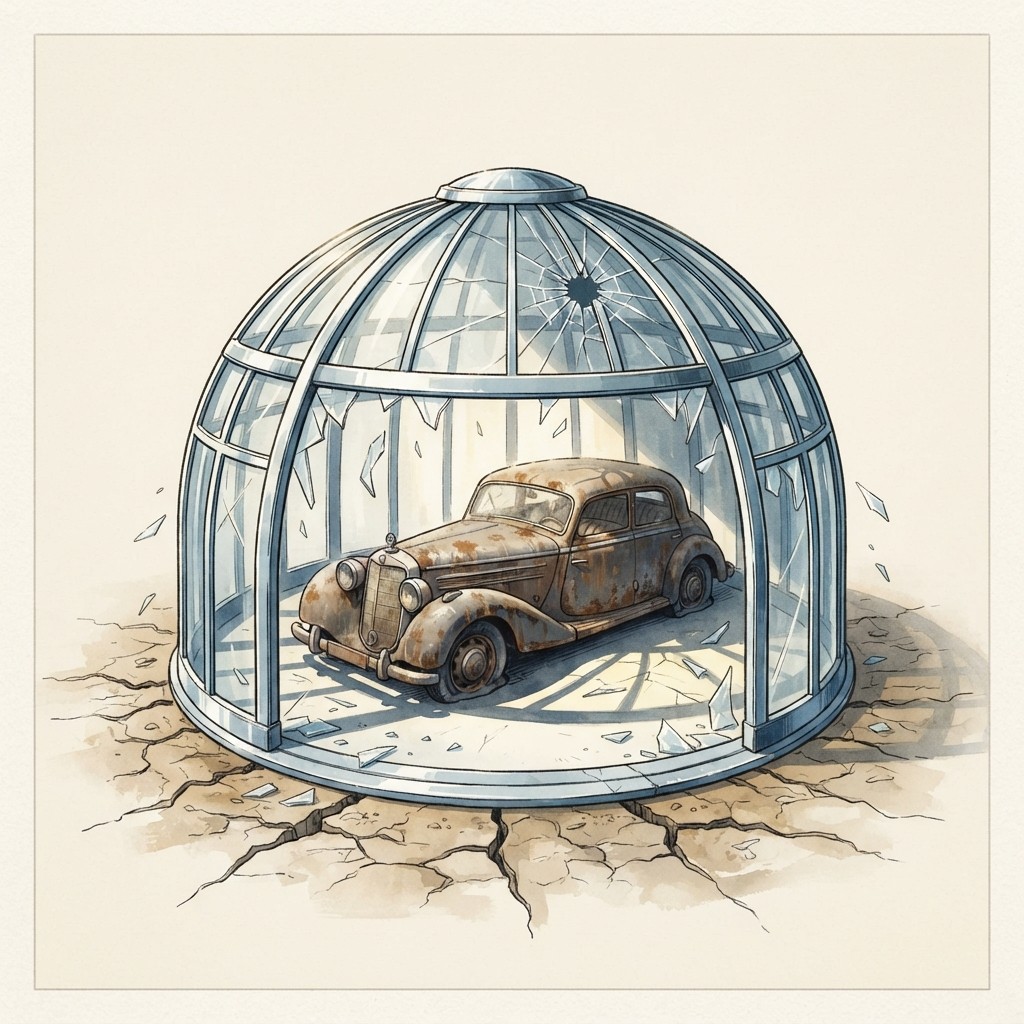
Pairs with the Cannibalization Decision Tree — a ready-to-use strategy tool. Included in the The Cannibalization Choice Casebook →
In the summer of 2021, Mercedes-Benz told the world it was getting ready to go all electric. The headlines wrote themselves: the inventor of the automobile was about to torch its own combustion empire and bet the company on batteries. It even had a phrase for the turn — from 'electric-first to electric-only,' with every new architecture from 2025 onward built for batteries alone.1 It sounded like a company willing to cannibalize its own cash cow before someone else did. Read the fine print, though, and a different sentence is doing all the work: 'where market conditions allow.'1 That clause was not a caveat. It was the entire strategy.
The official story is that Mercedes bravely disrupted itself. The real story is that it built an electric façade specifically so it would never have to. The EQ cars were never aimed at the heart of the gasoline business. They were a hedge wearing the costume of a revolution — and when the hedge stopped selling, there was no disruption dividend underneath to catch the company.
The strategy that quietly contradicted the press release
Ten months after the all-electric headlines, Mercedes held an investor event with a revealing name: 'Economics of Desire.' If the 2021 announcement was the public theater, this was the script. The company told investors it would steer more than three-quarters of its investment into its most profitable segments — the ones anchored by combustion S-Classes, AMGs, and Maybachs — and grow Top-End vehicle sales share by roughly 60% versus 2019.2 The whole point of electrification, in this framing, was not to replace the cash cow. It was to make the cash cow richer. EVs were the new badge on a luxury proposition, not the weapon against it.
That is why the EQS matters so much to the read. People assumed it was the electric S-Class — the moment the flagship went battery. It wasn't. Mercedes built it as a separate, bespoke model on its own platform, sitting beside the S-Class rather than inheriting its throne. CEO Ola Källenius later said the quiet part out loud: an uncompromised electric flagship would need its own dedicated platform, which is a polite way of confirming the EQS was never meant to supersede the gasoline car.10 The combustion S-Class kept its crown the entire time. The EQS was an addition to the lineup. Genuine cannibalization removes the old product; Mercedes carefully kept both alive.
“Getting ready to go all electric by the end of the decade, where market conditions allow.”1
| Genuine self-disruption | Mercedes's EQ play | |
|---|---|---|
| The new product's job | Kill the old one before a rival does | Add a luxury badge alongside the old one |
| The flagship | Replaced by the new technology | S-Class kept, EQS built separately |
| Where the money went | Into the disruptive line | >75% into the most profitable ICE-anchored segments |
| The commitment | Burn the boats | 'Where market conditions allow' |
A hedge only works if it sells
Here is the mechanism, and it is brutal in its simplicity. If you treat electrification as a defensive accessory rather than the future of the business, you accept a quiet bargain: the EVs don't have to win, they only have to be there in case the market turns. That bargain holds right up until the accessory fails to sell — at which point you've spent the capital of a revolution and bought neither the revolution nor the protection.
That is exactly what happened. The numbers a flagship electric program is supposed to post never arrived. Global EQS sedan sales never crossed 30,000 units in any single year — a figure that would embarrass any car positioned as a halo.5 Then it got worse. In the United States in 2024, the EQS sedan and SUV together sold just 6,963 units, down 52% in a single year; the EQE line fell 39%.5 The 'bold electric bet' wasn't disrupting anyone. It was a slow product line shrinking quietly while the company insisted everything was on plan.
So the company did what a defensive strategy does when the defense isn't needed yet: it retreated. By February 2024, Mercedes formally abandoned its interim target of 50% electrified sales by 2025, sliding it five years to 2030 and confirming it would keep building combustion engines well into the next decade.6 In 2023, fully battery-powered cars were still just 11% of sales.6 The all-electric promise of 2021 had become, in plain terms, a plan to mostly keep selling what it already sold.
The bill came due on the cash cow it was protecting
The cruelest part of a defensive strategy is what it does to the thing it was defending. Mercedes told investors to expect a Cars adjusted return on sales of around 14% by mid-decade.2 It never got there. The number peaked at 12.6% in 2023, fell to 8.1% in 2024, and then to 5.0% in 2025 — moving sharply in exactly the wrong direction.34 Group adjusted EBIT dropped from €13.7 billion in 2024 to €8.2 billion in 2025 on shrinking revenue.9 The whole logic of ring-fencing the EVs was to keep the profitable combustion business profitable. The combustion business got less profitable anyway.
A real self-disruption transfers volume from the old product to the new one, so a falling EV line at least means a rising legacy line. Mercedes broke that link: the EQ cars were additive, so their collapse transferred nothing back. It paid for an electric flagship program AND kept funding the combustion flagship, while the Cars margin it built the whole hedge to protect fell from 12.6% to 5.0% in two years.39
And so the face-saving begins. Mercedes is now phasing out the standalone EQ sub-brand — the electric G-Class launched not as the 'EQG' but as the 'G 580 with EQ Technology,' and the company concedes the EQE line 'has not met sales expectations.'7 Going forward, electric and gasoline models will share names and nearly identical styling.7 This is being presented as 'integration.' It is closer to a quiet admission that the distinct electric identity failed, and that the EQS will likely die without a successor.8 The blob-shaped future got folded back into the cars that were always paying the bills.
Wasn't the hedge actually the smart move?
The honest counter is strong, and worth stating at full strength: the EV market did soften, demand did not arrive on the 2021 schedule, and a company that had truly burned the boats — killed the S-Class, bet everything on batteries — might be in far deeper trouble today than one sitting at a 5.0% margin. Optionality has value. Keeping the combustion business running while EVs underdelivered looks, in hindsight, like prudence. Mercedes hedged, the market vindicated the hedge, and the headlines that called it timid were simply early.
There's truth in that — but it concedes the real point rather than rebutting it. Optionality is only valuable if you don't pay full price for the option you never exercise. Mercedes spent like a disruptor and positioned like one publicly, then declined to actually disrupt. It got the credibility cost of a bold pledge, the capital cost of a bespoke EV platform, the sales failure of an additive luxury accessory, and a legacy margin that eroded all the same. A genuine hedge protects the core. This one watched the core slide from 12.6% to 5.0% while the hedge itself went unsold.39 You can defend the decision to keep building engines. You cannot call the result a successful defense.
When you decide whether to cannibalize your own cash cow, the dangerous middle is the place that looks safest: announce the disruption loudly enough to claim the future, but build the new product as an addition rather than a replacement so the old margin stays untouched. The problem is that you then pay the full price of the revolution — the capital, the brand promise, the platform — while collecting none of its protection, because an additive product that fails transfers nothing back to the core. Either truly disrupt yourself (and shift volume from old to new), or honestly defend the core (and don't spend like a disruptor). The trap is doing both halfway: it's the only path that bills you twice and rewards you once.
Mercedes-Benz never disrupted its own cash cow. It built a second product line to stand guard over the first, told the world it was a revolution, and quietly steered three-quarters of its money toward the engines it had no intention of abandoning. The clever part was supposed to be that it never really had to choose. The expensive part is that the market made it choose anyway — and a company that had spent like a disruptor discovered it owned neither a disruption nor a moat, just a flagship that wouldn't sell and a cash cow that had quietly stopped paying like one.
When a company decides whether to eat its own lunch
Cannibalization Decision Tree
A decision tree for the moment the new thing threatens the cash cow: is the disruption real, will someone else do it if you don't, and can you afford to bleed your own margin to own the future? Blank to run on your own line; filled as the worked example tracing how the story's incumbent chose to cannibalize — or flinched and got cannibalized.
Included, filled and blank, in the The Cannibalization Choice Casebook. See the set → · Preview the blank →
Sources
Where this comes from — the filings, records, and reporting behind it.
- 1On July 22, 2021, Mercedes-Benz announced it was 'getting ready to go all electric by the end of the decade, where market conditions allow,' shifting from 'electric-first to electric-only'; from 2025 onwards all newly launched vehicle architectures would be electric-only.
- 2At the May 2022 'Economics of Desire' investor event, Mercedes-Benz announced it would allocate more than 75% of investments to the most profitable segments, target ~60% growth in Top-End Vehicle sales share by 2026 vs. 2019, and pursue an operating margin of approximately 14% by mid-decade.
- 3For full-year 2024, Mercedes-Benz Group reported revenue of €145.6 billion (down 4.5% YoY), EBIT of €13.6 billion (down 30.8% YoY); adjusted Cars RoS fell from 12.6% in 2023 to 8.1% in 2024. The company simultaneously unveiled a 'Next Level Performance' cost plan targeting a return to double-digit Cars margins.
- 4For full-year 2025, Mercedes-Benz Group reported adjusted EBIT of €8.2 billion (vs. €13.7 billion in 2024) and group revenues of €132.2 billion (vs. €145.6 billion); adjusted Cars RoS fell further to 5.0% (6.1% excluding tariffs). Top-End cars reached 15% of overall Cars sales in 2025.Mercedes-Benz Group AG, Full Year Results 2025 ↗ · 2026-02-12
- 5In the United States for full-year 2024, the combined EQS sedan and EQS SUV sold only 6,963 units, down 52% from 14,499 in 2023. The EQE sedan and SUV fell 39% to 11,660 units. Globally, EQS sedan annual sales never surpassed 30,000 units in any year.
- 6By February 2024, Mercedes-Benz formally abandoned its interim 50%-electrified-by-2025 target, pushing it back five years to 50% xEV by 2030. In 2023 fully battery-powered vehicles represented only 11% of company sales (19% including hybrids). CEO Källenius confirmed the brand remains committed to ICE engines well into the next decade.
- 7Mercedes-Benz is phasing out the standalone EQ sub-brand: the electric G-Class launched not as 'EQG' but as 'G 580 with EQ Technology.' The EQE line 'has not met sales expectations.' Going forward, electric and ICE models will share nearly identical styling under unified model names (e.g., electric E-Class, electric GLC).
- 8Autoblog reports that the EQS 'will likely be discontinued before decade's end' with no second generation planned. Mercedes CEO Källenius explained in late 2024 that an uncompromised electric flagship requires two separate platforms (one ICE/hybrid S-Class, one bespoke BEV), affirming the EQS was never a true S-Class replacement.
- 9For full-year 2025, Mercedes-Benz Group delivered adjusted EBIT of €8.2 billion (2024: €13.7 billion) and revenues of €132.2 billion (2024: €145.6 billion); adjusted Cars RoS 5.0% (6.1% excluding tariffs). Published February 12, 2026.
- 10CEO Ola Källenius confirmed to Autocar that the EQS will be phased out and replaced by two unified S-Class variants (ICE and electric), stating 'There will be two S-Classes in the future — ICE and electric,' confirming the EQS was never conceived as a true S-Class replacement.
More like this — beyond Mercedes-Benz
New Strategically analyses as they publish: the defining moves in business, checked against the record. No noise, and one click to leave.