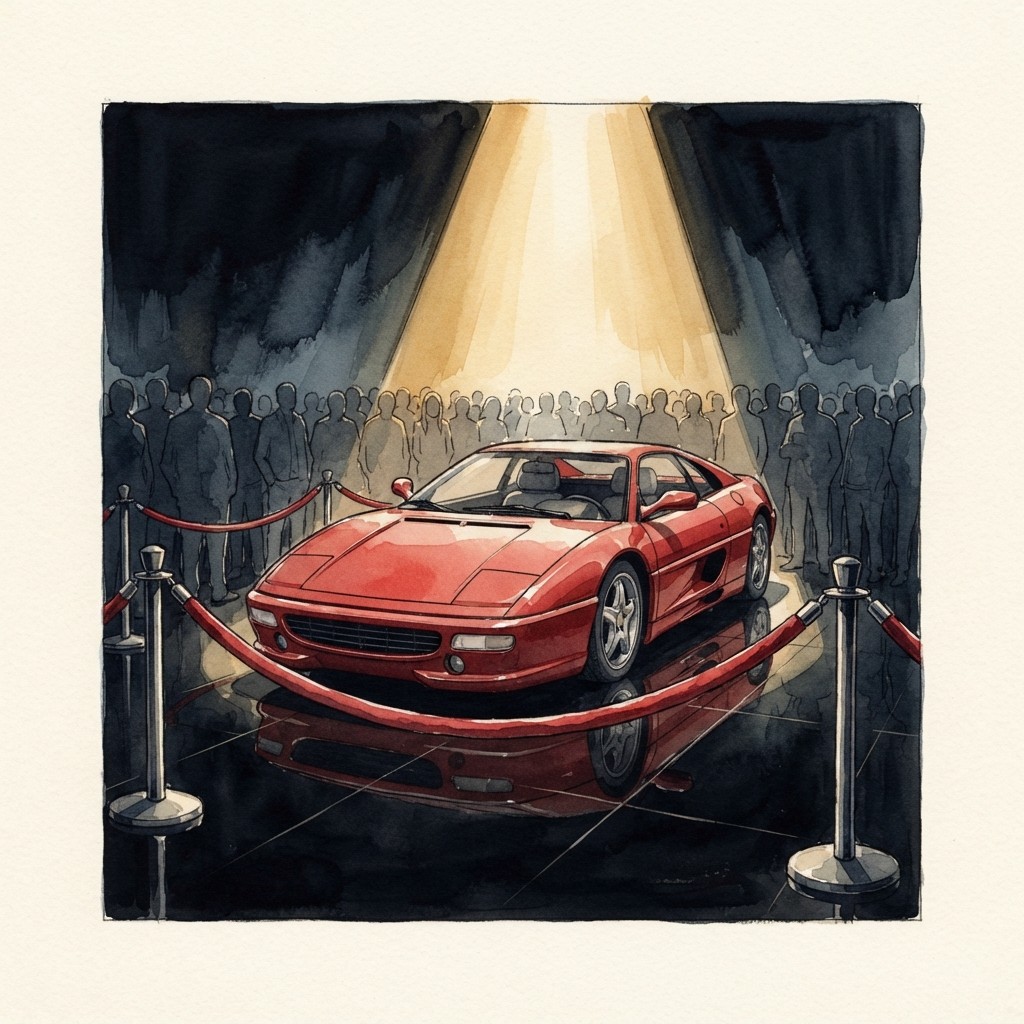
Pairs with the Pricing Power Diagnostic — a ready-to-use strategy tool, filled for Ferrari. Included in the The Deliberate Constraint Casebook →
Every retelling of the Ferrari myth lands on the same line: the company will always sell one less car than the market wants. It is the most quoted sentence in luxury strategy, the supposed iron law of Maranello, and it is usually delivered with a fixed number attached — Ferrari, the legend goes, will never build more than 7,000 cars a year. There is just one problem. In 2024 Ferrari shipped 13,752 of them.1 That is not a rounding error against a 7,000-unit cap. It is nearly double the approximately 6,573 it shipped in 2010.7 The ceiling everyone repeats does not exist.
The official story is that Ferrari grows by holding production artificially flat and letting unmet demand inflate the price. The real story is that Ferrari has been quietly doubling its output for fifteen years while making each car more expensive faster than it makes more of them. The scarcity is real — but it is not where you think it is.
“To cite Enzo Ferrari, we will always sell one less Ferrari than the market wants, that's a policy that will never change.”6
The cap is on access, not on output
Here is the thesis a smart friend can repeat at dinner: Ferrari is not a carmaker that refuses to grow. It is a carmaker that grows its volume slowly and grows its price per car faster — and then dresses the whole thing in a story about a fixed limit that the numbers flatly contradict. The 7,000 figure was roughly true around 2013, when Ferrari did hold output near that level.7 But it crossed 10,000 in 2019 — Ferrari's own filings record 10,131 shipments that year — and has stayed well above ever since.10 What the company actually rations is not the assembly line. It is the waiting list, the allocation, the right to buy. Scarcity, properly understood, is a tool pointed at customers, not at the factory.
Watch what happens to the math when you separate the two. In 2024 shipments rose just 0.7% — essentially flat. Net revenue rose 11.8%, to €6,677 million.1 Almost none of that growth came from selling more cars. It came from a mix-and-price variance of plus €386 million, the value of selling richer cars and more expensive options on the same number of chassis.1 That is the lever. Not a refusal to build, but a refusal to let the average transaction stand still.
How you charge 11% more for the same number of cars
The mechanism has two engines, and neither one requires building fewer cars. The first is the limited series — halo models like the Daytona SP3 and the 499P Modificata that sell at multiples of a standard car and pull the entire revenue average up the moment they enter the mix.9 They are scarce by design, allocated to existing collectors, and they do the price-anchoring work that the 'we won't grow' myth pretends the production cap does. The second engine is personalisation: the leather, the livery, the bespoke configuration that a Ferrari buyer is invited — and expected — to layer on. Each option is pure margin on a car already sold. CEO Benedetto Vigna named the whole doctrine in three words in the 2024 release: 'Quality of revenues over volumes.'5 That is not the language of a company defending a 7,000-unit ceiling. It is the language of a company that decided volume is the boring variable.
| The scarcity legend | The primary-source reality | |
|---|---|---|
| Production | Fixed near 7,000 cars/year | 13,752 shipped in 2024; ~110% growth since 2010 |
| The lever on price | Withholding supply | Mix enrichment + personalisation (+€386M) |
| What's actually rationed | The number of cars built | Allocation and access to the cars |
| The guiding line | An Enzo Ferrari original | Attributed via Marchionne; no primary Enzo text found |
And where Ferrari does cut supply, it says so out loud — in the place companies are least likely to spin. In 2024 it shipped 328 fewer cars to Mainland China, Hong Kong and Taiwan, and the FY2024 release describes the geographic split as reflecting 'the Company's allocation strategy to preserve the brand's exclusivity.'4 That is a remarkable admission in a regulated filing: not a demand shortfall, but a deliberate decision to withhold cars from a region to protect the brand. The scarcity is engineered. It is just engineered at the dealership and the border, not on the line.
But isn't doubling output exactly how a luxury brand dies?
The fair objection is that this reading proves too much. If Ferrari has really doubled production, shouldn't the magic be wearing off — shouldn't the price premium be eroding as the badge gets more common? The numbers say the opposite, and that is the most interesting part. EBIT margin in 2024 hit 28.3%; net profit rose 21.3%, far outpacing the trivial volume gain.1 Then Q1 2025 made the point even cleaner: revenue rose 13% to €1,791 million on just 3,593 cars — shipments up a mere 0.9% year on year.11 A brand losing its scarcity premium does not post numbers like that. So the steelman survives only halfway. Volume has grown, and the badge is more common — but Ferrari offsets the dilution by enriching the mix faster than it enlarges the fleet. The exclusivity that matters is preserved not by counting cars, but by controlling who gets which one, and at what configured price.
The lesson operators miss in the Ferrari story is that 'limited supply' and 'limited output' are different strategies wearing the same suit. You can grow units steadily and still charge a scarcity premium — as long as you ration the right thing: access, allocation, the top of the range, the bespoke configuration. The myth of the hard cap is itself an asset; it lets Ferrari double production while customers keep believing they're fighting over a fixed pie. The danger is believing your own legend. The moment scarcity becomes a literal production ceiling rather than a managed sense of access, you've capped your growth to protect a story you didn't need to tell that literally.
Strip the romance away and Ferrari's pricing genius is almost the inverse of its reputation. It is not a company heroically refusing to grow. It is a company that grew its output by 110% in fifteen years7 and convinced the world it never grew at all — because the only number anyone repeats is a 7,000-unit ceiling that the filings buried years ago.1 The waiting list does the work the assembly line is credited for. Ferrari sells one less car than the market wants, the saying goes. The truth is sharper: it builds all the cars it profitably can, and sells you the feeling that it didn't.
When the real business hides behind the famous story
Pricing Power Diagnostic
A scored diagnostic of pricing power: brand pull, switching costs, substitutes, and how critical the product is to the buyer. Each dimension rated 1-5 so you can see, at a glance, whether a price rise sticks or sends customers running. Blank to grade your own offer; filled as the worked example scoring a story's business on its real ability to charge more.
Included, filled and blank, in the The Deliberate Constraint Casebook. See the set → · Preview the blank →
Sources
Where this comes from — the filings, records, and reporting behind it.
- 1Ferrari shipped 13,752 units in 2024 (+0.7% YoY); net revenues were €6,677 million (+11.8%); EBIT was €1,888 million with a 28.3% margin; net profit was €1,526 million (+21.3%); mix/price variance was +€386 million.
- 2Ferrari N.V. filed its annual report on Form 20-F with the SEC for the fiscal year ended December 31, 2024; the United States represented 25% of shipments and 29% of cars/spare-parts revenues in 2024.
- 3Ferrari's official IR page confirmed publication of the 2024 Annual Report and Form 20-F filing with the SEC, including the first voluntary ESRS Sustainability Statement.
- 4Ferrari's geographic breakdown explicitly states it 'reflects the Company's allocation strategy to preserve the brand's exclusivity,' with Mainland China/HK/Taiwan down 328 units in 2024.
- 5CEO Benedetto Vigna stated 'Quality of revenues over volumes' as Ferrari's defining 2024 strategy in the official earnings release.
- 6Sergio Marchionne publicly attributed the 'one less Ferrari than the market wants' scarcity doctrine to Enzo Ferrari: 'To cite Enzo Ferrari, we will always sell one less Ferrari than the market wants, that's a policy that will never change.'
- 7Ferrari produced 6,573 units in 2010, capped around 7,000 in 2013, and crossed 10,000 for the first time in 2019 — demonstrating that production volume has grown roughly 110% since 2010, contradicting the popular '7,000-unit ceiling' myth.
- 8Ferrari Q1 2025 results showed that 'with very few incremental shipments year on year, all key metrics recorded double-digit growth,' with net revenues of €1,791M (+13%) on only 3,593 units — corroborating that revenue growth systematically decouples from volume growth.
- 9Ferrari FY2024 mix/price variance of +€386 million was driven specifically by deliveries of the Daytona SP3 and a few units of the 499P Modificata, along with increased personalizations and positive country mix from Americas.
- 10Ferrari shipped 10,131 units in full-year 2019, up 9.5% versus the prior year — the first time Ferrari crossed the 10,000-unit threshold.
- 11Ferrari Q1 2025 net revenues were €1,791 million, up 13.0%; shipments totalled 3,593 units, up 0.9% versus the prior year.
More like this — beyond Ferrari
New Strategically analyses as they publish: the defining moves in business, checked against the record. No noise, and one click to leave.