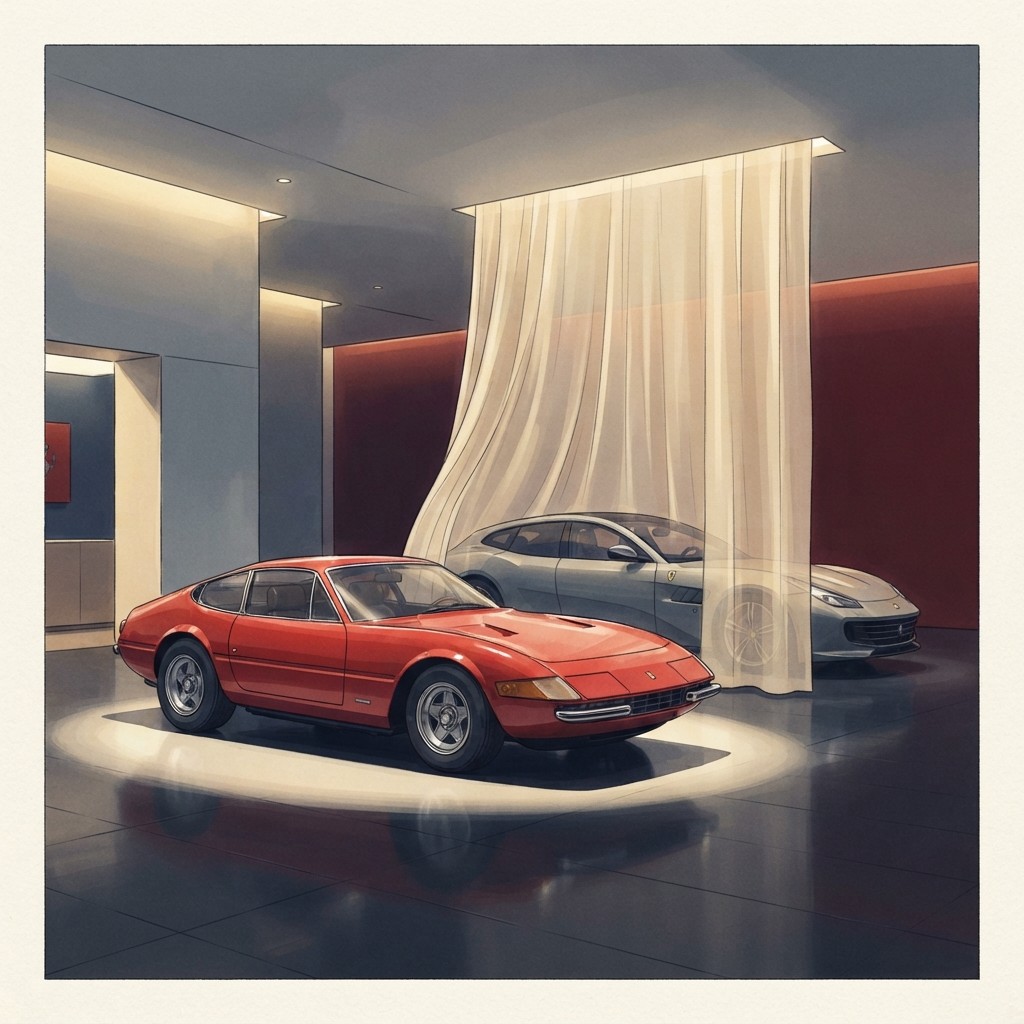
Pairs with the Adjacency / Synergy Map — a ready-to-use strategy tool, filled for Ferrari. Included in the The Adjacency Expansion Casebook →
On September 13, 2022, Ferrari unveiled a car with four doors, four seats, and a tailgate tall enough to swallow a dog or a set of skis.4 Every magazine on earth reached for the same three letters. Ferrari, in every line of its own press material, refused to type them.4 It called the Purosangue 'the first four-door, four-seater Ferrari' - never an SUV. Internally it coined a different acronym entirely. The world saw a Ferrari finally caving to the most profitable shape in the car business. What Ferrari actually built was a fence.
The official story is that Ferrari joined the SUV gold rush a few years late. The real story is that Ferrari did the opposite of a gold rush: it deliberately limited the most demanded thing it has ever made. The interesting decision wasn't building the car. It was the cap, the language, and the timing of a second, quieter expansion happening alongside it.
Most companies grow by selling more. Ferrari grew by selling barely more.
Here is the number that frames everything Ferrari does. In 2014, the year before it went public, it built 7,255 cars. A decade later, in 2024, it built 13,221.3 That is the entire volume story - across ten years of booming luxury demand and a stock-market debut, Ferrari roughly doubled output and then stopped pressing the accelerator, keeping production above 10,000 cars but holding the low-volume strategy as explicit policy.3 Now look at what happened to money over a far shorter window. FY 2024 net revenues hit €6,677 million, up 11.8% in a single year, with net profit of €1,526 million, up 21.3%, at a 28.3% operating margin.2 Revenue and profit are sprinting. Units are walking. That gap is not an accident. It is the whole business model.
Ferrari's premium over every other carmaker rests on a single, fragile belief: that a Ferrari is rare. The moment supply chases demand, the belief cracks, the resale values soften, and the brand begins to look like a fast Mercedes. So when Ferrari finally built the body style that could sell in enormous numbers, it had a problem of its own making. The answer was to neuter the volume before it could do any damage.
The 20% cap was the product - the car was just the wrapper
CEO Benedetto Vigna pledged at launch that the Purosangue would never exceed 20% of Ferrari's total annual output, specifically to preserve exclusivity.5 Read that carefully: the constraint was announced as deliberate policy from day one, not bolted on later when sales got hot. By Q1 2023 the model was already sold out into 2026, with first customer deliveries only just beginning in the second quarter of that year.56 A normal company looks at a model sold out three years deep and builds another factory. Ferrari looked at the same fact and held the line. The waitlist isn't a bottleneck to be fixed. It is the product working exactly as designed.
| The usual SUV move | What Ferrari did | |
|---|---|---|
| The label | Sell it loudly as an SUV | Refuse the word; call it a four-door sports car |
| The volume | Maximize - it's the cash cow | Cap it at 20% of total output |
| The demand | A backlog is a problem to solve | A backlog is the asset to protect |
| The goal | More units | More revenue per unit, same scarcity |
The refusal to say 'SUV' is the same move in a different register. Marketing chief Enrico Galliera insisted the Purosangue is a sports car, not an SUV with a sports-car engine.4 That sounds like vanity. It is balance-sheet protection. The instant Ferrari concedes it makes an SUV, it has admitted to making the one kind of car bought for utility rather than passion - and utility is a commodity that scales. The word, like the cap, exists to keep one door shut: the door to mass.
“We have to move from being a licensed brand to lifestyle brand.”7
The second expansion nobody noticed - off the cars entirely
While everyone argued about whether the Purosangue was an SUV, Ferrari ran a second adjacency move that touched no wheels at all. For years its brand outside the cars meant cheap licensing - the prancing horse stamped on stationery and budget cologne. Marchionne and Camilleri pulled that back. Then, in June 2021, Ferrari relaunched the effort with a stated goal: move from being a licensed brand to a lifestyle brand.7 The difference matters. A licensed brand rents its logo and takes a royalty; a lifestyle brand controls the product, the margin, and the meaning. Ferrari was trading a passive spigot for an owned business.
The 2024 results show it working. Sponsorship, commercial and brand revenues reached €670 million, up 17.1% - growing faster than the overall company - and Ferrari explicitly credited 'lifestyle activities' as a driver.2 This is the elegant part. Each capped, scarce car is a billboard that makes a jacket or a watch credible; the lifestyle business monetizes the brand heat that the volume cap deliberately keeps from leaking into the cars. Ferrari found a place to grow that doesn't dilute scarcity - because you can sell an unlimited number of jackets without anyone ever feeling there are too many Ferraris on the road.
Ferrari is engineering a permanent premium by proving it can grow revenue faster than it grows cars. In 2024, net revenue rose 11.8% to €6,677m and brand revenue rose 17.1% to €670m, while output stayed held under its low-volume strategy.23 The expansion isn't really about SUVs. It's about widening the gap between what Ferrari earns and how many cars it makes - the gap the market pays a luxury multiple for.
Isn't this just a clever cover story for selling out?
The fair objection is that all of this is rationalization. Ferrari built an SUV because SUVs print money, and the cap and the careful vocabulary are public-relations cladding on a commercial surrender. There is real force here - the Purosangue is genuinely an expansion into a body style the company spent decades disdaining, and 'we limited the thing everyone wants' is exactly what a company would say to make a cash grab look principled.
But the numbers cut against the cynical read. If this were a sellout, the Purosangue would be Ferrari's volume engine. It isn't: across 52 markets in early 2024 it ranked only third in sales, behind the 296 family and the Roma, while Ferrari set a first-half record of 7,044 units overall.8 A company chasing easy SUV money does not let its SUV finish third and then refuse to expand its capacity. The restraint is observable in the data, not just the press release. Ferrari didn't add a high-volume model. It added a high-price model and starved it of volume on purpose - which is the opposite of selling out.
When a luxury business moves into an adjacency, the danger is never the new product - it's the volume the new product invites, because volume quietly erodes the scarcity the premium is built on. Ferrari's discipline is worth stealing in two parts. First, if you must enter a high-volume category, cap it and say so up front, so the constraint is policy and not a reaction you can later be pressured to reverse. Second, grow hardest in the adjacencies that monetize brand heat without spending scarcity - lifestyle, experiences, services - where you can sell a thousand more without anyone feeling there's one too many of the thing you're actually famous for. The test for any expansion: does it raise revenue per customer, or just raise the customer count? Only one of those protects the premium.
Ferrari spent a decade learning the strangest lesson in luxury: that the most valuable thing it owns is the number it refuses to grow. A backlog stretching to 2026, a body style it won't name, an SUV that finishes third and stays there - none of these are problems to a company whose entire premium is the promise that there will never be enough. The careful expansion isn't a bet on SUVs at all. It's a bet that you can grow everything around the cars faster than you grow the cars - and that the discipline to keep one door shut is worth more than whatever lies behind it.
Adjacency / Synergy Map
A one-page canvas for an adjacency play: the new business next door, the shared assets that justify entering it, the synergies that actually transfer versus the ones that evaporate on contact, and the dis-synergies nobody put on the deck. Blank to test your own expansion; filled as the worked example showing where the story's 'natural adjacency' was real and where it was wishful.
Included, filled and blank, in the The Adjacency Expansion Casebook. See the set → · Preview the blank →
Sources
Where this comes from — the filings, records, and reporting behind it.
- 1Ferrari N.V. IPO occurred on October 21, 2015 at USD 52 per common share on the NYSE; Milan listing followed January 4, 2016 after FCA spin-off.
- 2Ferrari FY 2024 net revenues were Euro 6,677 million (+11.8%); sponsorship, commercial and brand revenues reached Euro 670 million (+17.1%), 'mainly attributable to new sponsorships and lifestyle activities'; EBIT margin 28.3%; net profit Euro 1,526 million (+21.3%).
- 3Ferrari 2024 Annual Report (Form 20-F) confirms global production exceeded 10,000 vehicles in 2022, 2023, and 2024; 13,221 cars in 2024 vs. 7,255 in 2014 (year before IPO); low-volume strategy explicitly maintained.
- 4The Purosangue (Type F175) was introduced September 13, 2022; it is Ferrari's first production four-door vehicle; Ferrari does not call it an SUV, labeling it instead 'the first four-door, four-seater Ferrari.' Ferrari officially refuses the SUV label in all press materials.
- 5CEO Benedetto Vigna publicly pledged to restrict Purosangue production to no more than 20% of Ferrari's total annual output, to preserve the brand's exclusivity; as of Q1 2023 the model was sold out until 2026.
- 6Ferrari's first Purosangue customer deliveries commenced in Q2 2023, per Ferrari's own SEC-filed interim report; the model began shipping during second quarter 2023.
- 7Ferrari's pivot from cheap licensing to a genuine lifestyle brand was explicit: CEOs Marchionne and Camilleri reined in licenses that put the logo on stationery and budget cologne; Ferrari's chief brand officer stated in June 2021: 'We have to move from being a licensed brand to lifestyle brand.'
- 8Per JATO Dynamics data across 52 markets (Jan–Aug 2024), the Purosangue ranked third in Ferrari sales with ~1,500 units, behind the 296 (3,100+ units) and Roma (nearly 1,900 units); Ferrari overall set a first-half 2024 sales record of 7,044 units.
More like this — beyond Ferrari
New Strategically analyses as they publish: the defining moves in business, checked against the record. No noise, and one click to leave.