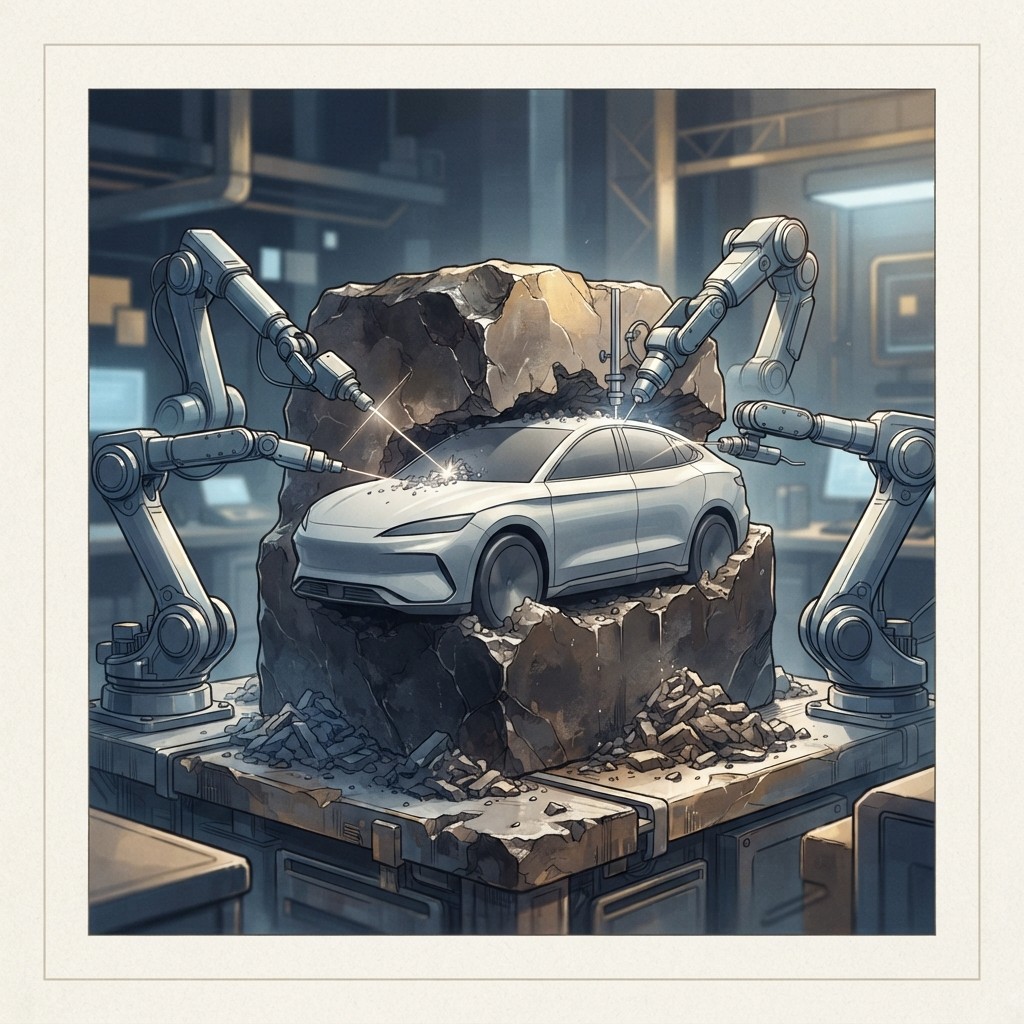
Pairs with the Pricing Power Diagnostic — a ready-to-use strategy tool. Included in the The Cost Engine Casebook →
In early 2024 BYD did the thing that is supposed to wreck a carmaker: it cut prices on its best-selling models by 10 to 20%, including the Yuan Plus that the West knows as the Atto 3.67 Rivals' shares wobbled on the news of a coming price war. Then BYD closed the year with net profit attributable to shareholders up 34%, to 40.25 billion yuan, on 4.27 million vehicles sold.12 Cut the price, grow the profit. That combination is supposed to be impossible — and the fact that BYD pulled it off tells you the price was never the strategy.
The official story is that BYD is winning a price war by dumping cheap cars. That reading misses the engine entirely. BYD is not sacrificing margin to move metal; its cost reductions are simply running faster than its price cuts, and the price is just the visible end of a much longer machine.
“An unparalleled cost structure and product innovation ability that stems from its high degree of vertical integration.”7
It started as a battery company, and never stopped being one
To understand the pricing, start before the cars. Wang Chuanfu founded BYD in February 1995 — not as a carmaker, but as a battery manufacturer, bootstrapped on a 250,000-yuan loan from his cousin Lu Xiangyang.23 The automotive arm only arrived in 2003.2 That sequence matters. Most automakers learned to buy batteries from suppliers and bolt them into cars. BYD learned to make the most expensive component in an electric vehicle first, and then built a car company around the thing it already controlled. By 2022 it was manufacturing over 70 GWh of batteries a year, a 167% jump.8 The carmaker grew out of the battery maker, which is why the cost of its single priciest part sits inside the house rather than on someone else's invoice.
The clearest expression of that came on 29 March 2020, when BYD launched the Blade Battery — first announced in January of that year and first sold inside the Han EV that June.5 It uses lithium-iron-phosphate chemistry in a cell-to-pack design that lifts space utilisation by more than 50% over conventional LFP packs.5 Peer-reviewed analysis puts the economic payoff bluntly: the LFP Blade chemistry offers up to 21% cost savings for small EVs versus high-nickel batteries, and BYD's battery-pack disassembly costs were the lowest in the industry.8 That is not a marketing edge. It is a structural one, baked into the cheapest viable chemistry, manufactured at scale, inside a company that answers to no battery supplier.
The pricing follows the cost, and the cost is engineered
Here is the mechanism most write-ups skip. A conventional automaker sets price by adding a margin to a bill of materials it does not control. When it wants to cut price, it gives up margin, because it cannot reach into a supplier's plant and lower the input. BYD can. It owns the battery, manufactures semiconductors in-house through its subsidiary BYD Semiconductor — the largest domestic automotive IGBT supplier in China — and produces roughly 75% of vehicle components within the group, and so when Wang Chuanfu justified the 2024 cuts, he framed them not as a discount but as applying technology to lower cost and raise quality.611 The price moves because the cost moved underneath it. Bernstein's phrase — an unparalleled cost structure born of vertical integration — is the whole thesis in seven words.7 BYD does not race to the bottom on price. It races to the bottom on cost, and lets the price ride down behind it while the margin stays intact.
| A typical automaker | BYD | |
|---|---|---|
| Owns the battery | No — buys it | Yes — makes it |
| Source of a price cut | Surrendered margin | Lowered internal cost |
| What happens to profit | Falls with the price | Net profit up 34% in 2024 |
| Can a rival copy it quickly | Yes, anyone can discount | No — requires three decades of integration |
And because the engine is cost rather than ideology, it runs in reverse when it has to. The tidy 'BYD always cuts prices' narrative is wrong. In 2022 BYD raised prices to absorb a spike in battery raw-material costs, then resumed cutting only as those costs fell from 2023.6 That is the signature of a company pricing off its inputs, not off a slogan. It is worth remembering that the slogan came late anyway: 'Build Your Dreams' is a backronym BYD only adopted at the 2008 Detroit auto show; the original name meant nothing in particular.4 The discipline was never about a dream. It was about the ledger.
Isn't this just subsidized dumping that's already cracking?
The honest objection has two parts, and both bite. First, the cost advantage isn't purely engineered — the academic review of the Blade Battery explicitly flags dependence on Chinese government NEV subsidies as a financial risk.8 Some of the room to cut comes from the state, not the supply chain, and that is a prop that can be pulled. Second, the integration thesis cannot make a market infinitely deep. That pressure has already arrived: BYD's 2025 net profit fell 19% to 32.62 billion yuan as gross margin narrowed from 19.44% to 17.74%, with management describing the domestic market as a brutal "knockout stage."10 The cut-and-grow trick of 2024 is not a law of nature, and there is a price floor below which even the lowest cost base bleeds. The fair version of the bear case is that BYD won 2024 and is already conceding margin in 2025–26 as the home price war runs faster than even its cost curve.10
But the part the bears underrate is durability. Subsidies and price wars are temporary; a vertically integrated cost base is not. To match BYD's price, a Western or Japanese rival would have to do more than discount — it would have to dismantle its supplier relationships and rebuild the battery, the semiconductor, and the assembly line inside its own walls, the work BYD has been compounding since 1995. You can copy a price cut in an afternoon. You cannot copy thirty years of owning your own bill of materials. That is why BYD's R&D spend hit 54.2 billion yuan in 2024, up roughly 36%, even as it cut prices12 — it is widening the cost moat faster than rivals can ford it.
A price cut is a decision anyone can make this morning; it surrenders margin and invites a war you may lose. A cost advantage is a position built over years, and it lets the price fall on its own without taking the profit with it. The trap is mistaking the two: discounting feels like the same move as BYD's, but it is the opposite — one gives away margin to move volume, the other engineers margin out of the supply chain and passes the surplus to the customer. Before you match a competitor's price, ask whether you can match the cost underneath it. If you can't, you're not in a price war. You're in a cost war you already lost, fought with the wrong weapon.
BYD's pricing power was never a clever number on a window sticker. It is the visible tip of a battery company that learned to make cars, an LFP chemistry that costs a fifth less, and a factory that owns the parts everyone else rents. The price moves because the cost moves, and the cost moves because BYD spent three decades putting the whole chain under one roof. Its rivals are watching the price and calling it a war. The price is just the smoke. The fire is the cost structure — and they don't have a hose long enough to reach it.
When the real product hides behind the obvious one
Pricing Power Diagnostic
A scored diagnostic of pricing power: brand pull, switching costs, substitutes, and how critical the product is to the buyer. Each dimension rated 1-5 so you can see, at a glance, whether a price rise sticks or sends customers running. Blank to grade your own offer; filled as the worked example scoring a story's business on its real ability to charge more.
Included, filled and blank, in the The Cost Engine Casebook. See the set → · Preview the blank →
Sources
Where this comes from — the filings, records, and reporting behind it.
- 1BYD's 2024 annual revenue was 777.1 billion yuan (up 29% YoY); net profit attributable to shareholders was 40.25 billion yuan (up 34% YoY); vehicle sales totalled 4.27 million units; R&D investment was 54.2 billion yuan (up ~36% YoY); cash reserves hit 154.9 billion yuan.
- 2BYD was formally founded by Wang Chuanfu in February 1995 as a battery manufacturing company; its automotive subsidiary BYD Auto was established in 2003; BYD Auto ended production of purely internal combustion engine cars in March 2022; since 2023 BYD Auto is the largest automobile manufacturer in China by annual sales.Wikipedia, BYD Company ↗ · 2026-06
- 3Wang Chuanfu founded BYD in 1995 with a CN¥250,000 loan from his cousin Lu Xiangyang; he has served as chairman, president, and CEO since inception; in 2008 Wang set a goal for BYD to become global number-one automaker by 2025; BYD entered the automotive market in 2003.Wikipedia, Wang Chuanfu ↗ · 2026-06
- 4The 'Build Your Dreams' slogan is a backronym BYD only adopted at the 2008 North American International Auto Show; the original company name 'BYD' had no particular meaning.Wikipedia, BYD Company ↗ · 2026-06
- 5BYD's Blade Battery was first publicly announced on 11 January 2020 at the China Electric Vehicle 100 Forum, with its launch event on 29 March 2020; the first production vehicle using it (BYD Han EV) went on sale in June 2020; the Blade Battery uses LFP chemistry and a cell-to-pack (CTP) design that increases space utilisation by over 50% vs. conventional LFP block batteries.Wikipedia, BYD Blade battery ↗ · 2026-05
- 6In early 2024 BYD launched multiple cheaper versions of its popular series with price cuts of 10–20%, justified by Wang Chuanfu as applying technology to reduce costs and improve quality; BYD raised prices in 2022 due to rising battery raw-material costs, then resumed cuts as raw-material prices fell from 2023.
- 7Bernstein analysts described BYD as having 'an unparalleled cost structure and product innovation ability that stems from its high degree of vertical integration'; BYD lowered prices on multiple EV models including the Yuan Plus (Atto 3) in early 2024.
- 8Academic peer-reviewed analysis finds BYD's LFP Blade Battery chemistry offers up to 21% cost savings for small EVs vs. high-nickel counterparts; BYD's battery pack disassembly costs were the lowest in the industry; BYD manufactured over 70 GWh of batteries in 2022 (up 167% YoY); the study flags dependence on Chinese government NEV subsidies as a financial risk.
- 9BYD's 2024 full-year revenue was 777.1 billion yuan, up 29% year-on-year; net profit attributable to shareholders was 40.25 billion yuan, up 34% year-on-year
- 10BYD's domestic margin compression intensified post-2024: full-year 2025 net profit fell 19% to 32.62 billion yuan and gross profit margin narrowed from 19.44% to 17.74%, with management citing a brutal domestic price war as the primary cause
- 11BYD manufactures semiconductors in-house through its subsidiary BYD Semiconductor, which produces chips for battery management systems, motor controllers, and smart cockpit functions, and is the largest domestic supplier of automotive IGBTs in ChinaNomad Semi, BYD Semiconductor Deep Dive ↗ · 2025-05-08
- 12BYD's 2024 full-year revenue was 777.102 billion yuan, a 29.02% increase year-on-year; net profit attributable to shareholders was 40.254 billion yuan, up 34% year-on-year; vehicle sales totalled 4,272,145 units (up 41.3% YoY); R&D investment was 54.2 billion yuan (up 35.7% YoY); cash reserves hit 154.9 billion yuan.
More like this — beyond BYD
New Strategically analyses as they publish: the defining moves in business, checked against the record. No noise, and one click to leave.