Pairs with the Market-Entry Gambit Canvas — a ready-to-use strategy tool. Included in the The Market-Entry Gambit Casebook →
In November 1994, in a town called Buji on the edge of Shenzhen, a 28-year-old metallurgist gathered twenty people and told them they were going to take on Japan.1 Japan owned rechargeable batteries the way Saudi Arabia owned oil — Sanyo, Sony, Panasonic, automated lines that cost tens of millions of dollars to stand up. Wang Chuanfu had borrowed money from his cousin and registered a company with CN¥2.5 million in capital, roughly the price of a small apartment block.21 He could not afford the robots. So he decided he didn't need them.
The official story is that BYD is an electric-car company that got lucky on subsidies and timing. That story is wrong by about a decade and one entire industry. BYD didn't start in cars. It started in batteries, and it didn't win on technology — it won on a manufacturing trick the incumbents never thought to defend against, then spent thirty years compounding that single advantage into everything else.
The arbitrage nobody in Tokyo was watching
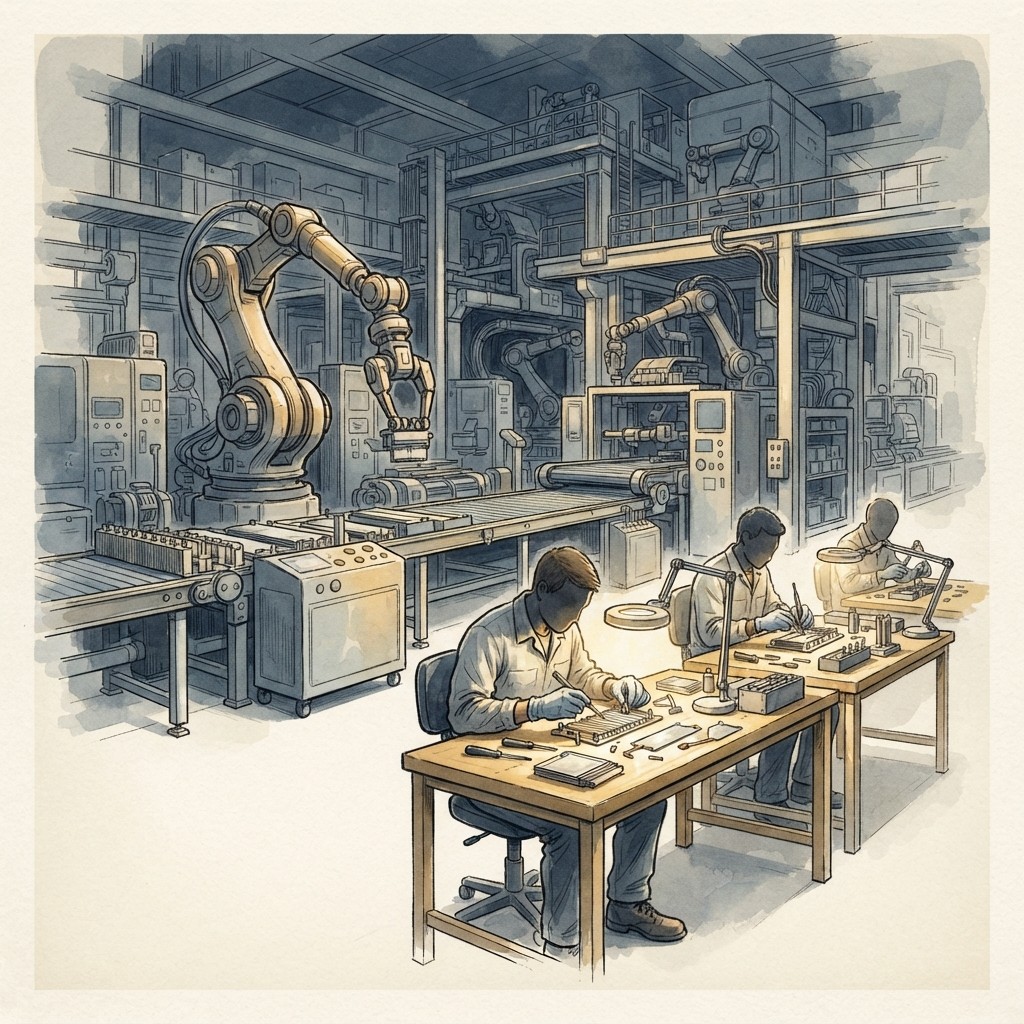
Here is the move that started it all. The Japanese had decided battery production was a capital problem — solve it with automation, amortize the machines over enormous volume, and price newcomers out before they could build a single line. Wang reframed it as a labor problem. He changed the production process to be more labor-intensive, breaking each automated step into manual tasks staffed with cheap, trainable workers and simple jigs.10 The capital cost of a BYD line was a fraction of a Japanese one. Same battery, radically lower fixed cost, and a cost structure that flexed with demand instead of demanding constant volume to stay profitable. The incumbents had spent a fortune building a moat that only worked against rivals who played by the capital-intensive rules. Wang refused to play.
That single decision is the whole company in miniature. It is not a battery insight; it is a vertical-integration instinct. If you can decompose a process and own each piece yourself, you control your own cost curve — and you stop paying someone else's margin. BYD applied that logic outward, relentlessly, for the next three decades: not just making the cells, but making the machines that make the cells, the chips, the motors, eventually the cars wrapped around them.
“We are extremely pleased and grateful that Berkshire Hathaway and MidAmerican will be our long-term investor and partner.”4
By 2008 the trick had become a thesis serious enough to attract the most famous patient investor on earth. Berkshire Hathaway's MidAmerican Energy agreed to buy roughly 9.9% of BYD for about $230 million.34 Read the press at the time and everyone called it a bet on 'green cars.' It was really a bet on a manufacturing company that owned its own supply chain in a world that had decided to outsource everything. Berkshire wasn't buying a car brand. It was buying the cost structure underneath one.
The car that ran on gasoline
And this is the part that detonates the popular narrative. BYD's entry into cars was not electric. Its first mass-market vehicle was a gasoline sedan, and BYD kept building pure internal-combustion cars until it finally halted them in March 2022 — nearly two decades after entering the auto business.9 The 'BYD was always an EV pioneer' framing is a story written backwards from the present. What BYD actually did was buy a car company, learn to manufacture vehicles cheaply using the same decompose-and-own playbook, and quietly keep the battery expertise loaded in the chamber until the world was ready to pay for it.
When the moment came, BYD didn't have to acquire a battery supplier, negotiate a chemistry licence, or queue behind every other automaker for cells. It already owned all of it. That is the difference between a company that pivots to electric and a company that was structurally electric a decade before it sold an electric car. The 2020 Blade Battery is the clearest demonstration: an LFP cell arranged in a cell-to-pack architecture that lifts pack space utilization by more than 50% over conventional LFP block batteries, and in BYD's own nail-penetration test holds a surface temperature of just 30–60°C where an NMC cell hits 500°C and ignites.5
| The Japanese incumbents (1990s batteries) | BYD's gambit | |
|---|---|---|
| The moat they built | Expensive automation, scale economics | — |
| The cost they treated as fixed | Capital (machines) | Labor (people and jigs) |
| What they owned | The factory | The factory, then the machines, then the chips, then the car |
| What it produced by 2024 | Mature, defended margins | 777.1 billion yuan in revenue, up 23% |
Why a competitor can't simply copy this now
Vertical integration sounds like something any well-funded rival could buy its way into. It isn't, and the reason is time. Each layer BYD owns was learned while building the layer beneath it — the cell knowledge funded the pack knowledge, which funded the motor and the chip and the vehicle, each one cheaper because the one before it was already in-house. You cannot acquire that sequence; you can only run it. And BYD has fed it continuously: R&D spending hit 54.2 billion yuan in 2024, up 36% and exceeding the year's net profit, and across 2011 to 2024 the company spent more on R&D than it earned in net profit in 13 of those 14 years.8 That is not a company maximizing this quarter. It is a company that decided, very early, to keep buying the next layer of the moat.
BYD turned 602.3 billion yuan of 2023 revenue into 777.1 billion in 2024, while plowing R&D back in above its own net profit nearly every year for over a decade.78 Each component it brought in-house lowered the cost of the next one it pursued. A rival who outsources can match BYD's price on one part. It cannot match the price on all of them at once, because it is paying margins to suppliers BYD long ago replaced with itself.
Isn't this just cheap Chinese labor and state subsidies?
The honest objection is the obvious one: BYD had access to cheap labor and a government eager to subsidize electric vehicles, and plenty of Chinese firms had both and went nowhere. That's the tell. Cheap labor and subsidies were available to every competitor in the country — they explain why China became a battery and EV theater, not why BYD specifically won it. The decomposition-of-automation insight was a choice, made in 1995, that turned cheap labor from a commodity input into a structural cost advantage no balance sheet could simply replicate. Subsidies accelerated the demand; they did not build the supply chain underneath it. The fairer worry is the marketing: BYD's claim that the Blade Battery 'erases' spontaneous combustion is an overstatement — LFP chemistry slows and raises the trigger for thermal runaway, it does not eliminate it, and cells can still fail under enough abuse.5 But that's a quibble with the press release, not the strategy. The 30–60°C test result is real and documented, and the company holds over 300 core patents on the design.6 The substance survives the spin.
Every fortified market has a moat that only defends against rivals playing by the incumbent's rules. The Japanese battery giants treated capital as the unavoidable cost and dared anyone to match their automation. BYD asked a different question — what if the expensive part isn't fixed at all? — and rebuilt the cost as labor it could control. The deeper lesson is patience: BYD didn't monetize that edge in batteries and stop. It reinvested every win into owning the next layer up, for thirty years, spending above its own profit to do it. A cost trick wins you one round. Compounding ownership of the supply chain wins you the market. The catch: this only works if you actually run the sequence — you cannot buy in year twenty what your competitor learned by building it from year one.
The world keeps trying to explain BYD with the present tense — the EVs, the subsidies, the Buffett halo, the 777 billion yuan. But the company that out-grew Tesla in volume — delivering 4.27 million vehicles in 2024 against Tesla's 1.79 million, and surpassing Tesla in pure-BEV annual sales by 202511 was already finished being assembled before most people noticed it had started. It was built in a town called Buji by twenty people who couldn't afford robots, and decided that was an advantage. BYD didn't crack the EV market. It cracked the battery market in 1995, kept the answer, and waited for the rest of the world to ask the question.
Companies that won the layer beneath the product
Market-Entry Gambit Canvas
A one-page canvas for staging an entry into a market you don't own yet: the beachhead you take first, the wedge that gets you in cheaply, the sequence that turns a foothold into a position, and the incumbent's likely counter-move. Blank to plan your own entry; filled as the worked example showing how the story's challenger picked its landing spot and walked the rest in.
Included, filled and blank, in the The Market-Entry Gambit Casebook. See the set → · Preview the blank →
Sources
Where this comes from — the filings, records, and reporting behind it.
- 1BYD was formally founded on 10 February 1995 as Shenzhen BYD Battery Company Limited with CN¥ 2.5 million registered capital and 20 employees, focused on NiCd batteries. Wang Chuanfu gathered the founding team on 18 November 1994 in Buji Town, Longgang District, Shenzhen.Wikipedia, BYD Company ↗ · 2026
- 2Wang Chuanfu (born 8 April 1966, Anhui) earned a master's degree from the Beijing General Research Institute of Nonferrous Metals, briefly managed a Shenzhen battery company, then founded BYD in 1995 borrowing from his cousin Lu Xiangyang. He has served as chairman, president, and CEO since inception.Wikipedia, Wang Chuanfu ↗ · 2026
- 3In September 2008, MidAmerican Energy Holdings (a Berkshire Hathaway subsidiary) agreed to purchase HK$1.8 billion (~$230 million) of BYD shares — 225 million new H-shares at HK$8 each, representing approximately 9.9% of BYD's enlarged share capital.FinanceAsia, Warren Buffett to purchase 10% of BYD ↗ · 2008-09-30
- 4CNBC contemporaneously reported (September 27, 2008) that Berkshire's MidAmerican Energy agreed to buy a 10% stake in BYD for $230 million. Wang Chuanfu is quoted: 'We are extremely pleased and grateful that Berkshire Hathaway and MidAmerican will be our long-term investor and partner.'
- 5BYD first disclosed the Blade Battery's imminent mass production on 11 January 2020 at the China Electric Vehicle 100 Forum; the formal public launch event was held on 29 March 2020. The battery is an LFP cell in a cell-to-pack architecture, increasing battery pack space utilization by over 50% vs. conventional LFP block batteries. In the nail penetration test, surface temperature reached only 30–60°C vs. 500°C+ for NMC cells.
- 6BYD's official press release on the Blade Battery states it passed the nail penetration test emitting 'neither smoke nor fire' with a surface temperature of 30–60°C. The company claims over 300 core patents on the technology.
- 7BYD reported FY2023 revenue of 602.3 billion yuan and net profit of 30.04 billion yuan (up 80.7% YoY), selling 3.02 million electric and hybrid vehicles. It missed consensus analyst estimates of 30.94 billion yuan net profit by a small margin.
- 8BYD's FY2024 revenue hit 777.1 billion yuan (up 23% YoY). R&D expenditure reached 54.2 billion yuan in 2024 (up 36% YoY), exceeding net profit. Over the past 14 years (2011–2024), BYD invested more in R&D than its net annual profit 13 times. Cash reserves reached 154.9 billion yuan at year-end 2024.
- 9BYD halted production of pure gasoline cars in March 2022, announcing the decision on April 4, 2022.
- 10Wang Chuanfu made battery production more labor-intensive rather than automated, using manual workers and jigs instead of the robots used in Japanese factories.
- 11BYD delivered 4.27 million vehicles in 2024, exceeding Tesla's 1.79 million deliveries that year; by 2025 BYD surpassed Tesla in pure BEV annual sales for the first time.
More like this — beyond BYD
New Strategically analyses as they publish: the defining moves in business, checked against the record. No noise, and one click to leave.