Pairs with the Moat Anatomy Canvas — a ready-to-use strategy tool. Included in the Moat Anatomy Casebook →
“What would it actually cost a challenger to take your customer?”
On September 12, 2018, Apple held up a fingernail-sized slab of silicon with 6.9 billion transistors etched into it and called the A12 Bionic 'the industry's first 7nm chip.'1 It was a thrilling claim, delivered with the usual confidence. It was also already false. Two weeks earlier, on August 31, Huawei had stood on a stage in Berlin and announced the Kirin 980 — also 7nm, also fabricated by TSMC, also 6.9 billion transistors.3 Same node, same fab, same transistor count, announced first by someone else. The honest version of Apple's claim is narrower: the A12 was the first 7nm chip to actually ship in a product you could buy.2 First to the shelf, not first to the future.
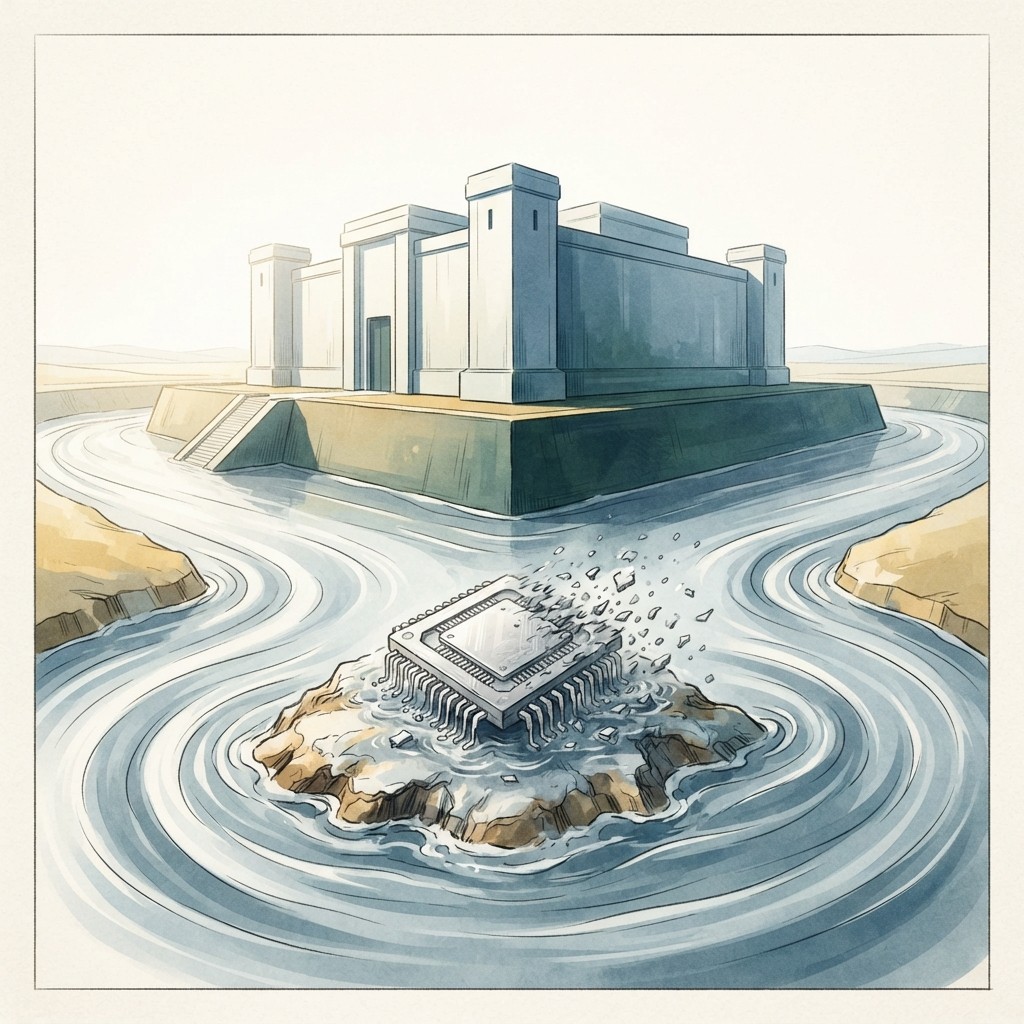
The official story is that Apple's silicon is its moat — the magic chip nobody can match. That story dissolves the moment you notice a rival matched the headline spec in roughly fourteen days. A lead measured in weeks is not a moat. It is a sprint. So if the chip isn't what protects Apple, what does?
The node was shared. The advantage wasn't.
Here is the part the spec sheet hides. The 7nm process — the thing both companies fought to claim first — came from TSMC, and TSMC sold it to both of them. A manufacturing node is rented, not owned. What separated the two chips wasn't the node; it was what Apple put on it. Apple designed its own CPU cores, named Vortex and Tempest, and its own GPU. Huawei reached for ARM's reference parts off the shelf: Cortex-A76 cores, a Mali-G76 GPU.4 The gap showed up where it counts. In Geekbench single-core, the A12-powered iPhone XS scored about 4,821; the Kirin 980-powered Mate 20 Pro managed about 3,333.4 Same factory, same nanometers — and a roughly 45% performance chasm, opened entirely by the architecture stacked on top.
| Apple A12 Bionic | Huawei Kirin 980 | |
|---|---|---|
| Fabricated by | TSMC, 7nm | TSMC, 7nm |
| Transistors | 6.9 billion | 6.9 billion |
| CPU cores | Custom (Vortex/Tempest) | ARM reference (Cortex-A76) |
| GPU | Custom Apple design | ARM Mali-G76 |
| Geekbench single-core | ~4,821 | ~3,333 |
Custom design is a more durable edge than a node — but it is still an edge in the hardware itself, and hardware edges erode. Huawei matched the spec in a fortnight; competitors close architecture gaps over a few cycles. Even the A12's most futuristic feature points past the chip rather than at it: the Neural Engine jumped from the A11's 2 cores at 600 billion operations per second to 8 cores at 5 trillion5 — an eightfold leap whose entire purpose is to run software faster. The silicon, in other words, exists to serve something else. That something else is where the real moat lives.
The flywheel that runs on every device it sells
The thesis is simple, and it has nothing to do with nanometers. Apple's durable moat is the Services flywheel: each device it sells deepens the customer's entanglement with iCloud, iMessage, the App Store, and a dozen other recurring streams, and that entanglement converts a one-time hardware sale into a high-margin annuity. In fiscal 2024, Services threw off $96.2 billion in revenue — up nearly 13% year over year, and roughly a quarter of Apple's ~$391 billion total — at margins materially higher than hardware.7 The phone is the toll booth you buy once. The Services are the road you keep paying to drive.
Why is this a moat and the chip wasn't? Because it compounds, and it compounds in a way a rival can't shortcut. The mechanism runs in a loop. Each new device added to a household raises the cost of leaving — your messages, your photos, your purchased apps, your subscriptions all live inside the same walls. That stickiness keeps the installed base growing, which Apple reported hit an all-time high across every product category and region, with management pointing to 'very high levels of customer satisfaction and loyalty.'8 A larger, stickier base means more Services revenue, which funds more silicon and software, which makes the next device better, which adds more devices. The chip is one spoke. The flywheel is the whole wheel — and it turns faster the more it spins.
“very high levels of customer satisfaction and loyalty”8
Isn't this just lock-in by another name — and isn't it fragile?
The fair objection is that 'flywheel' is a flattering word for being trapped, and that lock-in built on switching friction is exactly the kind of moat regulators love to drain — break open the App Store, mandate interoperable messaging, and the walls come down. That pressure is real, and Apple's own 10-K concedes its markets are 'highly competitive' with 'aggressive price competition and resulting downward pressure on gross margins.'6 But notice what the objection actually grants: it concedes the moat is the ecosystem, not the chip. And the reason the ecosystem is harder to pry open than it looks is that it isn't a single wall — it is silicon, OS, services, and 164,000 employees6 all tuned to each other. A competitor can rent TSMC's node, as Huawei did. It cannot rent the full silicon-to-software stack, because no one sells the integration. Regulation can lower the walls. It can't hand a rival the loop that took two decades to spin up.
A spec you can put on a stage is a spec a rival can match from a stage two weeks earlier — Apple's '7nm first' lasted about as long as it takes to announce one. The real moat is almost never the thing in the keynote; it's the boring, compounding system underneath that the keynote feature feeds. Ask of any 'moat': can a competitor buy this from the same supplier? If yes, it's a sprint. The durable barrier is the part no vendor sells — the integration across layers that only shows up as a higher-margin recurring line in the income statement years later. Find the flywheel, not the fingernail of silicon.
Apple won the 7nm race by a fortnight and lost the framing entirely, because the chip was never the thing protecting it. The transistor count was matched, the node was shared, the headline was wrong. What couldn't be matched was the quiet machine the chip was built to serve: a base of devices too entangled to leave, throwing off ninety-six billion dollars of high-margin Services a year and growing. The moat was never the slab of silicon held up on stage. It was the road every one of those devices keeps paying to drive — and Apple owns the road.
Where the real protection actually sits
Moat Anatomy Canvas
A one-page canvas that dissects a moat instead of asserting it: where the advantage comes from, how much of the market it covers, how long it would take to copy, and what keeps it from eroding. Blank to dissect your own claimed edge; filled as the worked example tracing the structure of the story's defensible advantage. Use it to tell a real moat from a head start.
Included, filled and blank, in the Moat Anatomy Casebook. See the set → · Preview the blank →
Sources
Where this comes from — the filings, records, and reporting behind it.
- 1The Apple A12 Bionic is a 64-bit ARM-based SoC designed by Apple, fabricated by TSMC on a 7nm FinFET process with 6.9 billion transistors, announced September 12, 2018; it is the first mass-market SoC to ship in a consumer product on the 7nm process.Wikipedia / Apple A12, Apple A12 - Wikipedia ↗ · 2018-09-12
- 2Apple claimed the A12 Bionic was the industry's first 7nm chip, but Huawei had also announced a 7nm chip (Kirin 980) before Apple's event; both chips were fabricated by TSMC. The A12 is correctly described as the first to ship commercially, not the first announced.
- 3Huawei unveiled the Kirin 980, also a 7nm TSMC chip with 6.9 billion transistors, at IFA 2018 on August 31, 2018 — before Apple's September 12 announcement — and both companies claimed to be first with a 7nm SoC.
- 4The A12's durable performance lead over Kirin 980 derived from Apple's fully custom CPU cores (Vortex/Tempest) and custom GPU — not the shared 7nm node. Kirin 980 used ARM reference Cortex-A76/A55 CPU cores and ARM's Mali-G76 GPU. In Geekbench single-core, A12-powered iPhone XS scored ~4,821 vs. Kirin 980-powered Mate 20 Pro's ~3,333.
- 5Apple's A12 Neural Engine has 8 cores capable of 5 trillion 8-bit operations per second, up from the A11's 2-core Neural Engine at 600 billion ops/sec — an 8x core-count increase and a large uplift in machine learning throughput.WikiChip, A12 Bionic - Apple - WikiChip ↗ · 2018-09-12
- 6Apple's FY2024 10-K (filed with the SEC) discloses that the company had approximately 164,000 full-time equivalent employees as of September 28, 2024, and that its markets are 'highly competitive' with 'aggressive price competition and resulting downward pressure on gross margins.'
- 7Apple's Services segment generated $96.2 billion in FY2024 revenue, a 12.9% year-over-year increase, representing approximately 24.6% of Apple's total FY2024 revenue of ~$391 billion, with significantly higher margins than the Products segment.
- 8Apple's installed base of active devices reached a new all-time high across all product categories and geographic segments at the end of FY2025, with Apple CFO Kevan Parekh citing 'very high levels of customer satisfaction and loyalty' in the company's official earnings disclosure.
Weighing outside help with a decision like this? Hiring a commercial due diligence provider
More like this — beyond Apple
New Strategically analyses as they publish: the defining moves in business, checked against the record. No noise, and one click to leave.