Pairs with the Market-Entry Gambit Canvas — a ready-to-use strategy tool, filled for Target. Included in the The Market-Entry Gambit Casebook →
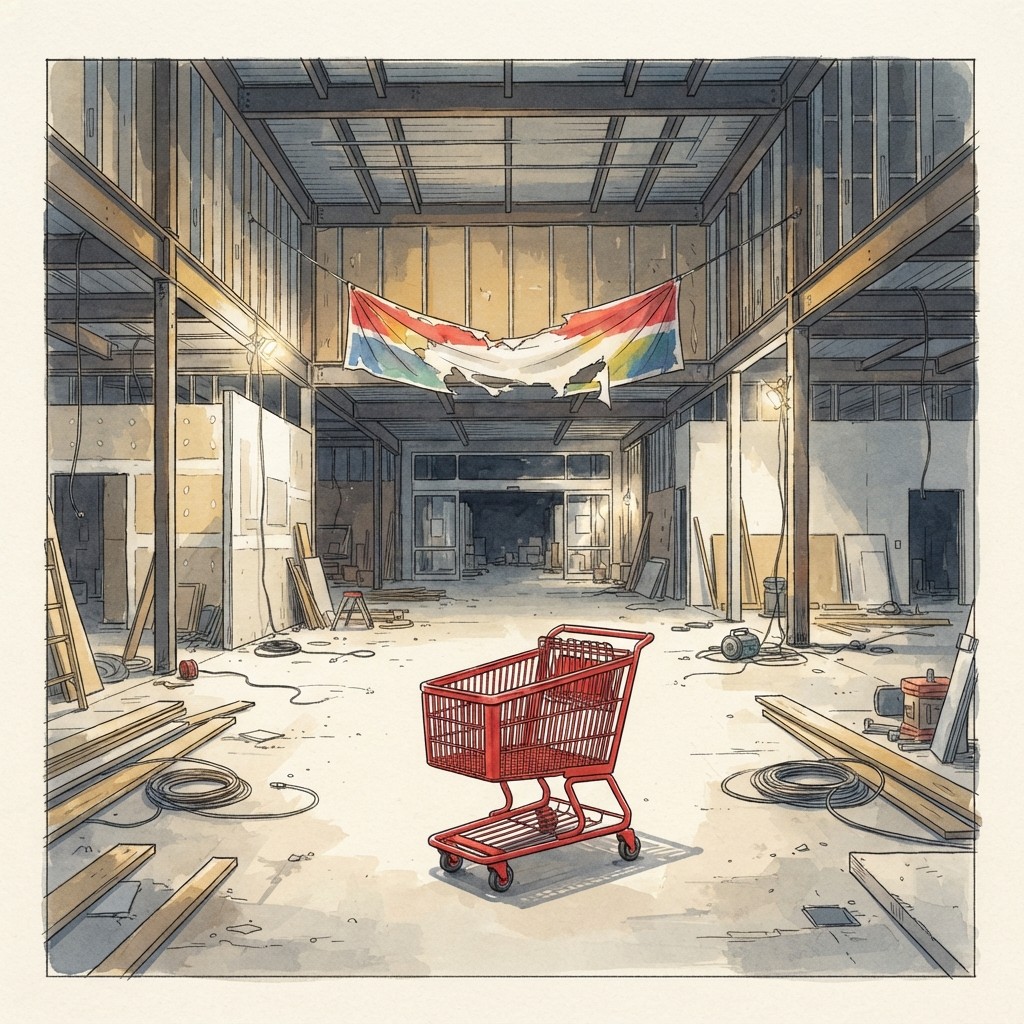
Walk into a Target Canada store in the spring of 2013 and you'd find a contradiction that no retailer is supposed to allow: empty shelves in the building, full pallets in the warehouse, and no working bridge between the two. The software that was meant to connect them had been switched on with corrupted product data — wrong dimensions, wrong weights, wrong quantities — so a system designed to move goods to shelves instead jammed them in distribution centers while customers stared at bare hooks.7 The doors were open. The store was, in every way that mattered to a shopper, closed.
The official story is that Target tried Canada, Canadians didn't take to it, and the company cut its losses. Almost none of that is the real story. Canadians showed up. What failed was upstream of them entirely — a self-inflicted collision between an opening schedule no one would slow down and a supply chain no one knew how to run.
Here is the thesis, plainly: Target Canada didn't lose to a market. It lost to a calendar. Management locked itself into a forced-march opening to stop bleeding rent on dozens of acquired leases, and to hit that calendar it launched a brand-new SAP supply chain it had never operated anywhere — without the people to configure it. The failure was baked in before a single Canadian walked through the door.7
The clock started ticking the day it bought the leases
In January 2011, Target agreed to pay C$1.825 billion — two installments of C$912.5 million — to take over leasehold interests in Zellers sites from Hudson's Bay Company, with plans to open well over a hundred Canadian stores.1 By its FY2011 filing, the shape had firmed up: leaseholds in 189 sites for $1.861 billion, 54 rights resold for $225 million, a net of $1.636 billion, and a plan to open most of the stores in 2013.2 That was the trap, and it was financial, not strategic. The moment Target held those leases, it was paying to keep empty buildings empty. Every month a store stayed dark was rent burned for nothing. So the schedule wasn't chosen to serve customers — it was chosen to stop the meter. Open the stores, the logic went, and at least the rent buys revenue. Supply chain problems were known before the March 2013 launch. The launch went ahead anyway.7
A new nervous system, switched on at full speed
A retailer's supply chain isn't plumbing in the back room — it's the nervous system. It decides what arrives where, when, and in what quantity, and a store that can't restock is just a warehouse customers can walk into. Target's U.S. operation ran on systems honed over decades. For Canada, it chose to stand up an SAP supply chain it had never used before — a brand-new system, with no qualified in-house SAP expertise to configure it.7 That is the part that should stop you. The single hardest thing in the whole expansion — keeping shelves full across a national footprint — was being attempted on unfamiliar software, by people learning it in real time, on a schedule that couldn't slip. The data that went into the system was corrupted and incomplete. The machine did what machines do with bad inputs: it executed the errors flawlessly, overflowing warehouses while shelves emptied.7
| What the calendar demanded | What the operation needed | |
|---|---|---|
| Opening date | March 2013, no delay | A delay until the supply chain worked |
| Supply chain | Untested SAP, run live | A system staff had actually operated |
| The product data | Loaded as-is, corrupted | Cleaned and verified before launch |
| The driver | Stop paying rent on dark stores | Don't open stores that can't restock |
“Target Corporation Announces Plans to Discontinue Canadian Operations”3
The number everyone quotes is far too small
Call it the '$2 billion Canada disaster' and you've understated it by more than half. That figure is roughly the accumulated operating losses, not the cost of the venture. When Target announced the shutdown on January 15, 2015, it told investors to expect approximately $5.4 billion of pre-tax losses on discontinued operations in the quarter — driven mostly by writing down its Canadian investment, exit and disposal costs, and the operating losses themselves.3 Its FY2015 10-K recorded $5.1 billion of pre-tax impairment and other charges tied to deconsolidating the business.5 And the Globe and Mail put Target's total Canadian investment — lease purchase, renovations, and losses — above $7 billion, with pre-tax operating losses through January 2015 running past $2.5 billion, more than triple what the company had initially projected for that stretch.6 The same reporting pegged the bleed at roughly $200 million a quarter, every quarter it existed.6
The end was as fast as the start was rushed. On January 15, 2015 — less than two years after the doors opened — Target Canada was granted creditor protection under Canada's CCAA by the Ontario Superior Court of Justice, with Alvarez & Marsal appointed as court-supervised Monitor.48 The court approved a C$70 million trust for 17,600 employees, and the parent backstopped the wind-down with a US$175 million debtor-in-possession facility.4 The same machine that couldn't fill shelves was now filling a court file.
Wasn't this just Canada being hard?
The honest counter is that international retail is genuinely brutal — different suppliers, different distances, a wary consumer who already had Walmart and Canadian Tire — and plenty of capable companies have stumbled across that border. Maybe Canada really was the harder market it looked. But that defense doesn't survive the timeline. The decisive failures weren't about Canadian tastes or Canadian competitors; they were about a supply chain that couldn't get product onto shelves, running on software the company had never operated, launched before it worked.7 A market can punish you for misreading demand. It cannot empty your warehouses into the wrong place — you do that to yourself. Canada didn't beat Target. Target's own calendar did, and the proof is that the worst damage was self-inflicted before the first customer ever rated the experience.
Sunk costs make terrible schedulers. Target held leases that bled rent whether stores opened or not, so the cost of waiting felt unbearable — and that pressure, not customer readiness, set the launch date. But the leases were already lost money; rushing didn't recover them, it multiplied them. The discipline is to keep two clocks separate: the financial clock that says 'this is costing us to delay' and the operating clock that says 'this isn't ready.' When you let the first override the second, you don't open early — you open broken, and a broken launch costs more than any rent ever would. Especially do not run an untested core system to hit a date you set for accounting reasons.
Target spent more than $7 billion to learn something it could have known for the price of a delayed opening: a store that can't restock is not a store, no matter how many you light up at once.6 The disaster wasn't the country. It was the decision to race a calendar with a system that wasn't ready and people who couldn't run it — and to call the empty shelves a market verdict when they were, all along, a self-portrait.
Market-Entry Gambit Canvas
A one-page canvas for staging an entry into a market you don't own yet: the beachhead you take first, the wedge that gets you in cheaply, the sequence that turns a foothold into a position, and the incumbent's likely counter-move. Blank to plan your own entry; filled as the worked example showing how the story's challenger picked its landing spot and walked the rest in.
Included, filled and blank, in the The Market-Entry Gambit Casebook. See the set → · Preview the blank →
Sources
Where this comes from — the filings, records, and reporting behind it.
- 1On January 13, 2011, Target Corporation agreed to pay C$1.825 billion (in two equal payments of C$912.5 million in May and September 2011) to acquire leasehold interests in up to 220 Zellers sites from Hudson's Bay Company, with plans to open 100–150 Canadian stores in 2013–2014.
- 2Target's FY2011 10-K confirmed it acquired leasehold interests in 189 Zellers sites for $1,861 million USD, sold 54 rights to third parties for $225 million, resulting in a net purchase price of $1,636 million USD. Target expected to open 125–135 stores, primarily in 2013.
- 3On January 15, 2015, Target Corporation announced plans to discontinue Canadian operations and expected to report approximately $5.4 billion of pre-tax losses on discontinued operations in Q4 2014, driven primarily by the write-down of its investment in Target Canada, exit/disposal costs, and operating losses.
- 4Target Canada Co. and subsidiaries were granted creditor protection under Canada's CCAA by the Ontario Superior Court of Justice on January 15, 2015. The court approved a C$70 million Employee Trust for 17,600 employees and appointed Alvarez & Marsal as court-appointed Monitor. Target Corporation provided a US$175 million debtor-in-possession credit facility.
- 5Target's FY2015 10-K (covering the period ending January 31, 2015) recorded a pretax impairment loss on deconsolidation and other charges totaling $5.1 billion. All Canadian results prior to the January 15, 2015 CCAA filing were classified as discontinued operations.
- 6Target Canada's total investment including the lease purchase, store renovations, and operating losses exceeded $7 billion. Pretax operating losses through January 2015 exceeded $2.5 billion—more than triple Target's initially projected losses for that period. The Canadian operation averaged $200 million in losses per quarter of its existence.
- 7Target Canada's SAP supply chain software was implemented simultaneously with the mass store opening—a brand-new system for Target with no qualified in-house SAP expertise. The system launched with corrupted and incomplete product data (wrong dimensions, weights, quantities), causing warehouses to overflow while store shelves ran empty. Supply chain problems were known before the March 2013 opening but the launch was not delayed to avoid paying rent on unopened stores.
- 8On January 15, 2015, Target Canada and its affiliates were granted CCAA protection by the Ontario Superior Court of Justice (OSB File No. 0000237-2015-ON). Court-appointed Monitor was Alvarez & Marsal Canada Inc.
More like this — beyond Target
New Strategically analyses as they publish: the defining moves in business, checked against the record. No noise, and one click to leave.