Pairs with the Crisis Response Playbook — a ready-to-use strategy tool. Included in the The Crisis Response Casebook →
In late November 2013, a piece of malware quietly installed itself on Target's systems, and a security tool called FireEye did exactly what Target paid it to do: it noticed, and it screamed. Urgent alert. Then another, as the malware updated.3 Somewhere in Minneapolis, the alarm reached a screen. And nothing happened. Over the following weeks, attackers siphoned 40 million payment-card records out the door2 — in plain text, via FTP, to a server that included at least one machine in Russia3 — while the system that caught them kept blinking, ignored. The breach is taught as a story about a clever hacker. It is really a story about an alarm nobody answered.
The official story is that Target got hacked and didn't know. Its own 10-K even says the breach 'went undetected for several weeks.'1 But that phrasing is doing a lot of quiet work. The malware was not undetected. The intrusion was caught, flagged, and escalated by software. What went undetected was the alert — by the humans and the management chain that were supposed to act on it.
“Target's security team neither reacted to the alarms nor allowed the FireEye software to automatically delete the malware.”3
The detection worked. The decisions didn't.
Here is the thesis a smart friend could repeat at dinner: Target's breach was not a technology failure. It was a governance failure wearing a technology costume. The detection tool functioned. The automatic-deletion feature that could have killed the malware on sight was switched off, leaving the call to a human team that did not make it. Each layer of the disaster was a choice — to disable the auto-response, to under-staff the escalation, to leave the alarm to be judged rather than obeyed.3 None of those choices was a hack. Every one of them was management.
The entry point tells the same story. Attackers did not breach Target's payment systems head-on. They used credentials stolen from Fazio Mechanical, an HVAC contractor, to log into an external vendor portal — Target's Ariba billing system.7 A refrigeration vendor's password should never have been within reach of cash registers. But Target's network was segmented so poorly that attackers could move laterally from a billing portal all the way to point-of-sale terminals across 1,797 stores.7 The popular line is that 'the HVAC vendor let hackers into the POS network.' The vendor let them into a billing system. Target's own architecture did the rest.
| The popular story | What the investigations found | |
|---|---|---|
| The detection | Target had no warning | FireEye fired urgent alerts on each malware install |
| The response | Nothing could be done | Auto-delete was disabled; the team didn't react |
| The entry path | HVAC vendor reached the POS network | Vendor reached a billing portal; lateral movement reached POS |
| The cause | A sophisticated outside hack | Compounding internal governance choices |
Why a controllable failure became an uncontrollable scandal
Brian Krebs broke the story publicly on December 18, 2013; the next day Target confirmed 40 million card accounts compromised between November 27 and December 15.2 Then, on January 10, the number metastasized: another 70 million records — names, phone numbers, addresses, emails.5 The press summed the two into a single horrifying headline: 110 million customers. But the two cohorts overlap, and Target itself admitted 'some overlap.'5 The real count of distinct people was lower. It didn't matter. By the time a company is correcting your math on how many of its customers it failed to protect, the trust is already gone.
That is the mechanism of a trust collapse: it doesn't track the technical severity, it tracks the sense of betrayal. A retailer's entire promise is that handing over your card at the register is safe. The breach didn't just leak data — it falsified the promise. And the deeper damage was the revelation underneath: the alarm had gone off, and the company had let it ring. A breach you couldn't stop reads as misfortune. A breach you were warned about and waved through reads as negligence. The financial wound followed fast — Q4 2013 profit fell 46%.8
Even the executive exit fit the pattern. The popular framing is that CEO Gregg Steinhafel was fired over the breach. The SEC filing reads more carefully: he stepped down effective May 5, 2014, with CFO John Mulligan named interim CEO, and Steinhafel was retained in a paid advisory role through at least that August.4 A negotiated departure, not a perp walk. Telling, too: Target's pre-breach risk disclosures had described prior security incidents as 'insignificant'8 — a word that aged into a confession the moment the alarms it had ignored cost the company a CEO and over $220 million.
Wasn't this just bad luck, the kind any retailer could have suffered?
The fair objection is that hindsight makes every breach look avoidable, and that any large retailer with thousands of stores and tens of thousands of vendors presents an attack surface impossible to defend perfectly. True — and Target was, on paper, a diligent buyer of security. It had FireEye. It had monitoring. That is precisely what makes the case damning rather than excusable. The honest counter to 'bad luck' is the Senate's own finding: the system caught it, and the failure was in not acting.3 Luck is when your defenses miss the threat. This was the opposite — the defenses worked and the organization overrode them. You can forgive a company for not seeing an attack. It is much harder to forgive one that saw it, was told, and chose to wait.
Buying the detection tool is the easy, visible, board-pleasing half of security. The hard half is the governance around the alert: who has authority to act, how fast, and whether the system is allowed to defend itself without waiting for a human verdict. Target had disabled FireEye's auto-delete and left the call to a team that didn't make it — and so the most expensive part of its defense was the part it switched off. The lesson generalizes well beyond cybersecurity: any warning that must first survive human judgment and a management chain will, on the worst possible day, be judged away. Design the response, not just the sensor — and ask the uncomfortable question about every alert you collect: when this one fires for real, who is empowered to act before someone asks permission?
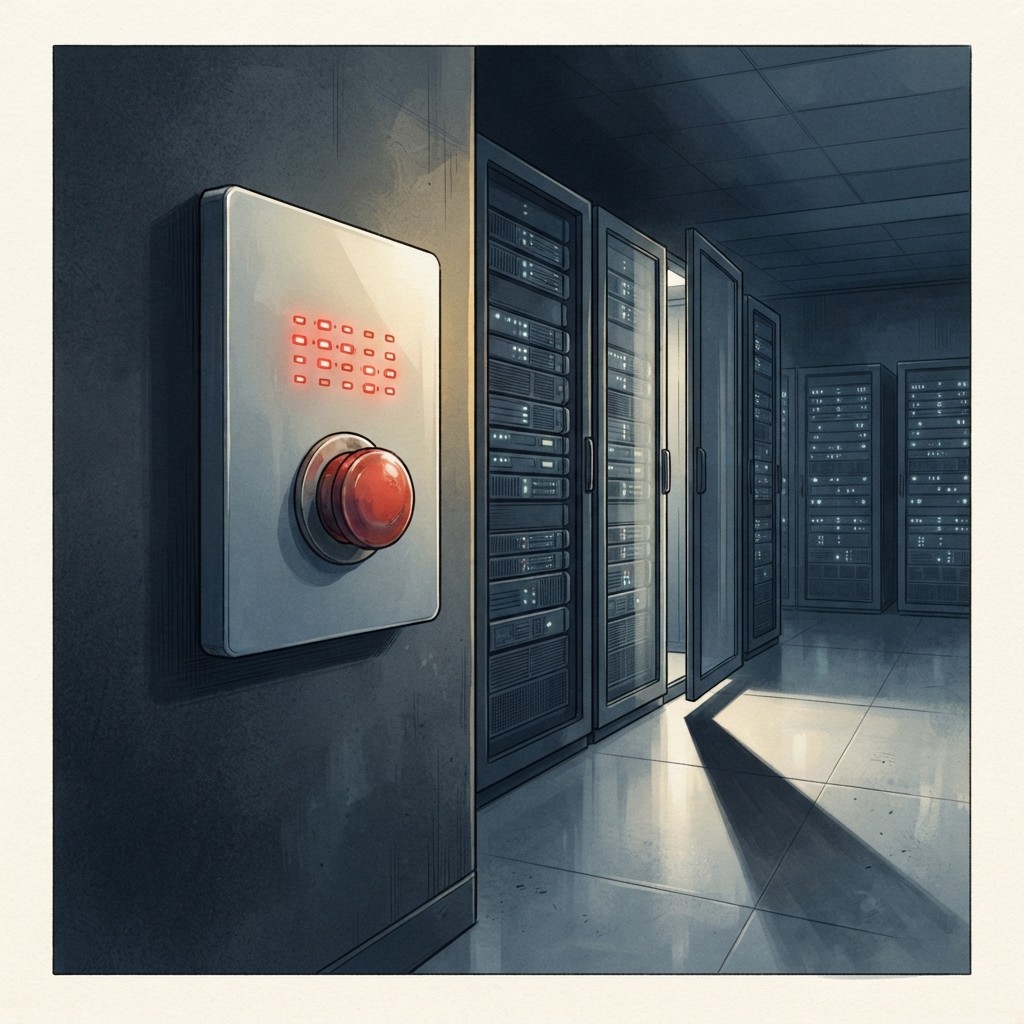
Target eventually settled with 47 states and Washington, D.C. for $18.5 million — the largest multistate data-breach settlement at the time — on top of $39 million to banks and $10 million to consumers, with cumulative gross costs reaching $292 million before insurance.6 But the dollar figure was never the real story. The real story is a single image: a fire alarm, ringing in an empty hallway, while the building filled with smoke. Target had bought the smoke detector and disconnected the sprinklers. The breach didn't prove that retail security is impossible. It proved that the most dangerous failure isn't blindness — it's seeing the threat clearly, being told twice, and deciding it could wait.
Crisis Response Playbook
A playbook for a crisis already in motion: who decides, which plays fire on which trigger, and what gets said to whom. It replaces panic and the all-hands meeting with a pre-agreed sequence each person can run alone. Blank to pre-load before a crisis hits; filled as the worked example reconstructing the plays the story's team ran — and the ones they should have.
Included, filled and blank, in the The Crisis Response Casebook. See the set → · Preview the blank →
Sources
Where this comes from — the filings, records, and reporting behind it.
- 1Target's own 2013 10-K (filed March 14, 2014) states the data breach 'went undetected for several weeks,' that Target faced more than 80 civil lawsuits, and that it recorded $61 million in pretax Data Breach-related expenses in Q4 2013 with expected insurance proceeds of $44 million, for net expenses of $17 million ($11 million after tax).
- 2Target confirmed on December 19, 2013 that 40 million credit and debit card accounts were affected between November 27 and December 15, 2013; Brian Krebs was the first journalist to report the breach publicly on December 18, 2013.
- 3The U.S. Senate Commerce Committee's March 2014 kill-chain analysis found that Target's FireEye intrusion-detection system triggered urgent alerts with each installation of the data-exfiltration malware, but Target's security team neither reacted nor allowed FireEye to auto-delete the malware; data was exfiltrated in plain text via FTP to servers including at least one in Russia.
- 4Gregg Steinhafel stepped down as Chairman, President, and CEO of Target effective May 5, 2014; CFO John Mulligan was named interim CEO; Steinhafel remained in a paid advisory role through at least August 23, 2014 per subsequent 8-K/A.
- 5On January 10, 2014, Target disclosed an additional 70 million customer records (names, phone numbers, addresses, email addresses) were also stolen; Target acknowledged there was 'some overlap' between the 40 million card-record cohort and the 70 million personal-data cohort, making the '110 million' figure a non-deduplicated sum.
- 6On May 23, 2017, Target settled with 47 states and the District of Columbia for $18.5 million — the largest multistate data breach settlement at the time. This followed a separate $39 million settlement with financial institutions (December 2015) and a $10 million consumer class-action settlement (also 2015). Through end of 2016, Target's 10-K reported $292 million gross breach costs, offset by $90 million insurance, for ~$202 million net; the AG settlement pushed total net cost above $220 million.
- 7Attackers used credentials stolen from Fazio Mechanical Services, an HVAC contractor, to access Target's network via an external vendor portal (Ariba billing system); they then moved laterally through a poorly segmented network to install malware on POS systems across 1,797 stores. The states' investigation confirmed the vendor-credential attack vector.
- 8Target's Q4 2013 profit dropped 46%; the company had already identified cyber risk in its pre-breach March 2013 10-K risk factors, stating that prior incidents 'have been insignificant' — language that became conspicuous after the breach.
More like this — beyond Target
New Strategically analyses as they publish: the defining moves in business, checked against the record. No noise, and one click to leave.