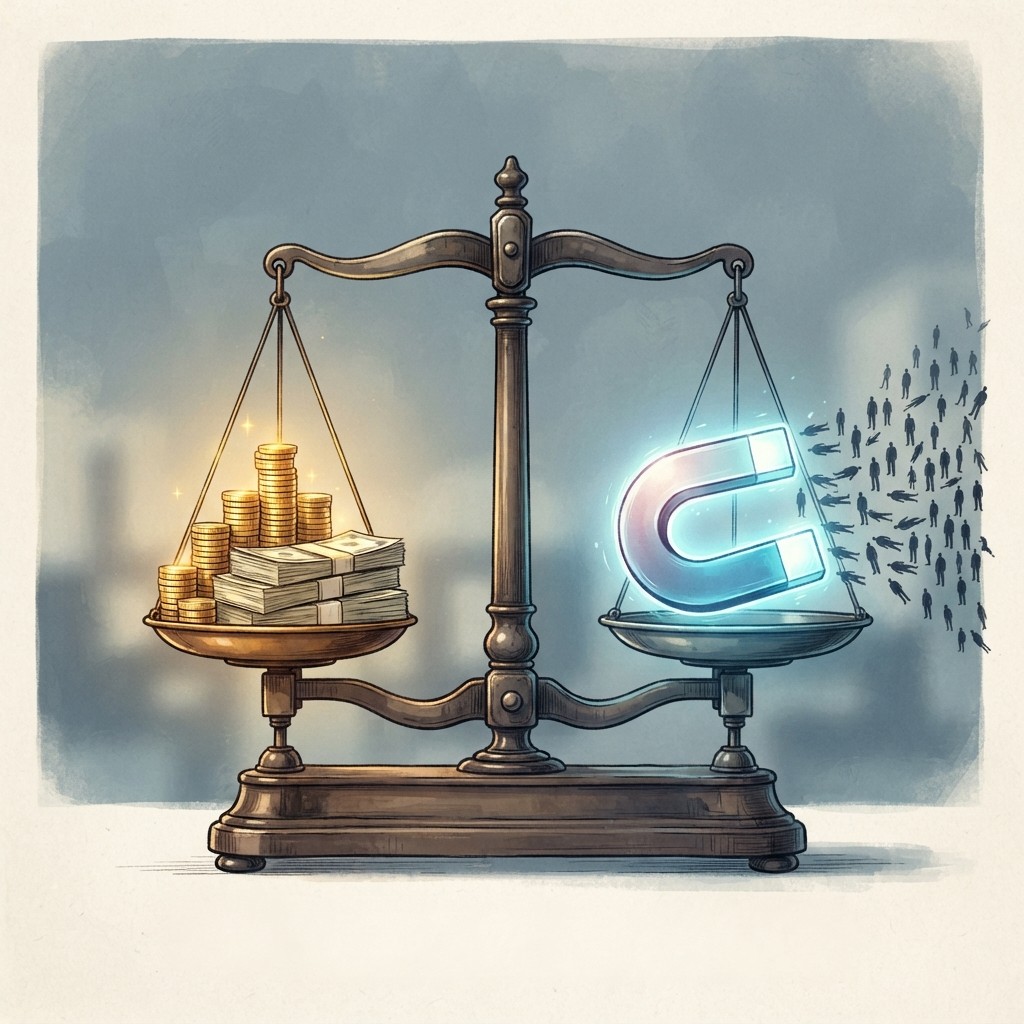
Pairs with the Profit-Engine Map — a ready-to-use strategy tool. Included in the Loss Leader Casebook →
“What share of the units you sell cheap has to come back for the subsidy to be repaid?”
In 1936, a Texas couple opened an insurance company with one strange rule: no agents. Leo and Lillian Goodwin would sell auto policies straight to federal employees, skip the salesman entirely, and pass the saved commission back as a lower price.1 Eighty-eight years later their company was spending over a billion dollars a year on advertising, every year, for at least a decade — more than any other U.S. insurer for most of that run, until rivals caught up.5 Those two facts look like opposites. No salespeople, and the loudest sales pitch in the industry. They are not opposites. They are the same idea, and understanding why is the whole game.
The story everyone tells is that GEICO got cheap by cutting out the middleman in the 1990s and going direct-to-consumer — being direct since 1936 and then learning to shout about it. The 'pivot' to direct selling never happened; the model was direct from day one.2 What changed in the 1990s, under a new CEO, was the volume on the megaphone. And that distinction is not pedantic. It is the difference between a discount and a machine.
The commission GEICO doesn't pay has to go somewhere
A traditional insurer like State Farm pays a network of agents to find you, quote you, and close you. That commission is real money baked into your premium. GEICO has no agents, so on paper it should simply be cheaper by the size of that commission. But a company with no salespeople has a problem the agent-based insurer doesn't: nobody is out there finding customers. The agent's commission wasn't only a cost — it was a customer-acquisition engine. Eliminate it and you've eliminated your growth, too. So GEICO took the money it saved on commissions and spent it on the one thing that can find customers at national scale without a single human knocking on a door: advertising. The gecko is the agent. The Super Bowl spot is the sales call. GEICO didn't escape the cost of acquiring customers — it converted it from a variable commission into a fixed ad budget, and bet it could do the job cheaper.
This is why GEICO was such a clean idea that Warren Buffett, at twenty, took a train to Washington on a Saturday, talked his way in past a custodian, and let an executive named Lorimer Davidson explain it to him for four hours.4 Davidson wasn't selling a discount. He was selling an arbitrage: route around the commission, and you can underprice every agent-based rival forever — as long as your replacement cost of finding customers stays lower than theirs. Buffett never forgot it. Berkshire bought the half of GEICO it didn't already own for about $2.3 billion in cash on January 2, 1996.3
GEICO's edge isn't 'no middleman.' It's that the ad budget which replaces the agent costs less than the commission the agent would have charged — and produces enough premium to justify itself. In 2022, for every dollar GEICO spent on advertising it earned $1.22 in premiums.8 The whole model lives inside that ratio. When ad ROI beats commission cost, the machine compounds. When it doesn't, the machine is just an expense.
What happened when GEICO turned the dial down
If the ad budget is really the engine and not just the noise, then cutting it should stall the car. In 2022 and 2023, GEICO ran exactly that experiment — not as a test, but as a turnaround. Hammered by inflation in claims costs, it slashed advertising to $838.2 million in 2023, roughly $443 million below the year before, a cut of about 35%.57 And here is the part that proves the thesis: GEICO didn't have to guess at the consequence. It wrote it down in its own 10-K. The significant reduction in advertising, the filing said, contributed to a reduction in policies in force — which fell 8.9% in 2022 and 9.8% in 2023.5 Stop buying customers, and customers stop arriving. The 'direct model' was still fully intact the entire time. What had changed was the only thing that ever actually drove growth.
| 2022 | 2023 | |
|---|---|---|
| Advertising spend | ~$1.28 billion | $838.2 million |
| Policies in force | Down 8.9% | Down 9.8% |
| Underwriting result | $1.9 billion loss | $3.6 billion profit |
| The trade revealed | Spend buys growth | Cuts buy profit — and shrink |
Look at the bottom row, because it's the real lesson. The same cut that shrank the policy count also turned a $1.9 billion underwriting loss in 2022 into a $3.6 billion profit in 2023, a combined ratio of 90.7.7 One dial, pointed two directions. Spend, and you grow but bleed; cut, and you profit but shrink. That is not the behavior of a low-cost provider with a structural price advantage — a true low-cost moat keeps winning customers whether or not you advertise. It is the behavior of a business whose growth and whose margin both run through the same ad budget. The 'direct, low-cost model' is the chassis. Advertising is the gas pedal, and GEICO spent 2022-23 discovering how fast the car coasts to a stop without it.
“The significant reduction in advertising expense contributed to a reduction in policies in force.”5
Isn't the low cost still the real moat?
The fair objection: GEICO genuinely is structurally cheaper to run than an agent-based insurer, and that cost edge is durable whether or not it advertises in any given quarter. True — and it's the foundation. Without the commission savings, the ad budget would have nothing to fund. But the honest counter is what the share data shows. GEICO is no longer even the second-largest U.S. auto insurer; A.M. Best's 2023 figures, cited in Berkshire's own 2024 annual report, place it third at about 12.3%, behind State Farm and Progressive.6 It was overtaken by Progressive — a rival that out-advertised it and had moved aggressively on telematics-based pricing while GEICO was pulling back its ad spend to repair margins. A structural cost moat that loses rank the moment you stop advertising isn't a moat that stands on its own. It's a moat that has to be continuously refilled, dollar by advertising dollar. The cost advantage is the reservoir. The advertising is the pump. Turn off the pump and you watch the level drop in real time — which is exactly what GEICO did, and exactly what happened.
Every business that 'cuts out the middleman' is really making a trade, not a saving. The middleman did a job; eliminating him doesn't eliminate the job. Direct-to-consumer brands skip the retailer's margin and spend it on Facebook ads. GEICO skips the agent's commission and spends it on the gecko. The right question about any low-cost, direct model is never 'how do they stay cheap?' — it's 'which cost did they convert, and does the replacement actually cost less than the original?' When the answer is yes, you have a compounding machine. When the conversion ratio slips below one — when the ads cost more than the commissions they replace would have — the 'efficient' model quietly becomes the expensive one, and no amount of brand love will save it.
GEICO makes its money the way it always has — by not paying for a salesman and using the difference to be everywhere at once. The famous discount was never the point; the point was the trade behind it. For a decade the trade worked beautifully: a billion dollars of advertising bought more than a billion dollars of customers, and the gecko looked like a free gift from the universe. Then GEICO turned the dial down to fix its margins, watched a tenth of its customers walk out the door, and quietly proved to anyone reading the 10-K that the moat was never just 'going direct.' It was being willing, year after expensive year, to pay the gecko what an agent would have cost — and a little less.
Companies whose real model isn't the one you think
Profit-Engine Map
A one-page map that pulls a business apart into the hook that gets the customer in the door and the engine that quietly earns the margin. Use it to see where the real profit lives, how the two halves are wired together, and what breaks if the link is cut. Blank to dissect your own P&L; filled as the worked example of a business whose advertised product is not where it makes its money.
Included, filled and blank, in the Loss Leader Casebook. See the set → · Preview the blank →
Sources
Where this comes from — the filings, records, and reporting behind it.
- 1GEICO was founded on September 1, 1936, in San Antonio, Texas, by Leo Goodwin Sr. and his wife Lillian Goodwin, capitalized with $25,000 from the Goodwins and $75,000 from Fort Worth banker Cleaves Rhea, to sell auto insurance directly to federal government employees, bypassing agents.
- 2GEICO's direct-to-consumer model was its original 1936 founding model — eliminating agent commissions to lower premiums — not a 1990s innovation. The 1990s change was a dramatic increase in national advertising spend under CEO Tony Nicely (appointed 1993).
- 3On January 2, 1996, Berkshire Hathaway completed the acquisition of the approximately 49% of GEICO common stock it did not previously own, paying an aggregate consideration of approximately $2.3 billion in cash.
- 4In January 1951, Buffett traveled to GEICO's Washington D.C. headquarters on a Saturday, was let in by a custodian, and met Lorimer Davidson — then 'Assistant to the President' — who spent approximately four hours explaining GEICO's direct-marketing cost advantage over agent-based insurers. Buffett described this meeting in Berkshire's 1995 chairman's letter.
- 5GEICO spent more than $1 billion on advertising annually for at least 10 consecutive years; in 2023 its advertising expenditure fell to $838.2 million — about $443 million less than 2022 — and in its 10-K filing GEICO itself stated that the significant reduction in advertising expense contributed to a reduction in policies in force, with policy counts declining 8.9% and 9.8% in 2022 and 2023 respectively.
- 6According to A.M. Best data for 2023 published in 2024, GEICO's market share was the third largest among U.S. automobile insurers at approximately 12.3%, behind State Farm and Progressive — not second as widely reported.
- 7GEICO posted a $3.6 billion pretax underwriting profit in 2023 (combined ratio 90.7), reversing a $1.9 billion underwriting loss in 2022; the turnaround was driven by rate increases and cost cuts including a ~35% reduction in advertising, confirming that advertising spend is the direct lever on both growth and profitability.
- 8In 2022, GEICO spent $1.5 billion on advertising — the most of any U.S. insurance brand — representing 26% of the top-five insurers' combined ad spend; for every dollar GEICO spent on advertising it earned $1.22 in premiums.
- 9On January 2, 1996, GEICO Corporation became an indirect wholly-owned subsidiary of Berkshire Hathaway as a result of a merger; Berkshire paid an aggregate consideration of approximately $2.3 billion in cash.
- 10In 2022 GEICO spent $1.28 billion on advertising — roughly $800 million less than the prior year — and Progressive's property and casualty subsidiaries logged $1.73 billion in total advertising expenses, making Progressive the largest insurance advertiser that year.
Weighing outside help with a decision like this? Hiring a pricing strategy consultant
More like this — beyond Geico
New Strategically analyses as they publish: the defining moves in business, checked against the record. No noise, and one click to leave.