Pairs with the Flywheel Designer Canvas — a ready-to-use strategy tool, filled for Domino's. Included in the The Flywheel Casebook →
You open the app, tap your usual order, and a little bar fills up: prep, bake, quality check, out for delivery. The Pizza Tracker has followed more than 2.5 billion orders since it launched, the first of its kind built by a national pizza chain.2 It feels like a toy. It is actually a turnstile. Every order that passes through it is an order that did not pass through DoorDash or Uber Eats — and that is the entire point. Domino's didn't build technology to sell software. It built technology so nobody else could stand between it and the person buying the pizza.
The story everyone tells is that Domino's transformed itself from a pizza company into a tech company. A JP Morgan analyst even called it 'a technology company disguised as a marketing company disguised as a pizza company,' and the line stuck.5 But look at what it actually sells. There is no software line on the income statement. In fiscal 2025, supply chain — selling dough, cheese, and sauce to its own franchisees — brought in about $2.99 billion, roughly 60.5% of total revenue of nearly $4.94 billion.1 The rest is mostly royalties and advertising fees. Domino's is a franchise-royalty and supply-chain business. The technology is the moat around it.
Who actually owns the order
Start with the structure, because the structure explains the strategy. About 99% of Domino's stores are franchised.1 The parent company doesn't really make money selling pizza to you — it makes money selling ingredients and collecting a cut from the franchisees who sell pizza to you. That means the most dangerous thing in the world for Domino's is anyone who gets between a franchisee and a customer and takes a slice on the way through. A delivery aggregator does exactly that: it takes a fee, and worse, it owns the customer relationship — the app, the data, the next order. So Domino's spent fifteen years making sure the order starts and ends inside its own pipes. Online and mobile ordering launched in 2007; the Tracker and the Pizza Builder followed in 2008.3 By full-year 2015 more than half of orders ran through digital channels, totaling $4.7 billion.4 Today it is more than 85% of U.S. retail sales.1
That number is usually shown off as a vanity stat — look how digital we are. Read it the other way and it's a defense budget. Every percentage point of orders that lives inside Domino's own app is a percentage point that no third party can tax, intercept, or use to learn the customer better than Domino's does. The Tracker isn't there to soothe your hunger anxiety. It's there to make you open the Domino's app instead of a marketplace where Domino's is one logo in a grid.
| The tech-company story | What's actually happening | |
|---|---|---|
| Where revenue comes from | Software / SaaS | Supply chain (~60.5%) + royalties[[cite:s1]] |
| What the app is for | A product to sell | A wall against aggregator skim |
| Who owns the customer | Whoever has the best UX | Domino's, by keeping the order in-house |
| What digital protects | Margins on software | Franchisee economics it depends on |
AnyWare was advertising. The plumbing was the asset.
For a while the flashiest part was AnyWare: order by tweet, by text, through your Ford's dashboard, your Samsung TV, your smartwatch.5 It earned two billion media impressions and the TV push in late 2015 came alongside 10.5% year-over-year sales growth.5 It looked like gimmickry, and a lot of it was — nobody seriously orders dinner by emoji. But the gimmick rode on top of something real: a single ordering and profile system that any surface could plug into. The smartwatch was theater. The unified backend underneath it was the thing that mattered, because it meant Domino's could meet a customer anywhere and still book the order on its own rails. CEO Patrick Doyle put the framing carefully: 'We are as much a tech company as we are a pizza company' — not instead of, as much as.7 Nearly half of headquarters staff work in technology.7 That is not a software vendor. That is a pizza company that decided the order pipe was too important to rent.
“We are as much a tech company as we are a pizza company.”7
It's worth being precise about the origin myth, because it gets told wrong constantly. The 'Domino's Pizza Turnaround' video aired in December 2009, and Doyle was president of U.S. operations then — he wasn't named CEO until January 2010, after David Brandon resigned.76 The recipe redesign that the campaign celebrated had already begun under Brandon, driven by flat same-store sales and store closures, with 200,000 hours of retraining and a $75 million campaign behind it.6 The point is that the turnaround started as a product fix, not a tech vision. The technology strategy was the second act — and the more durable one.
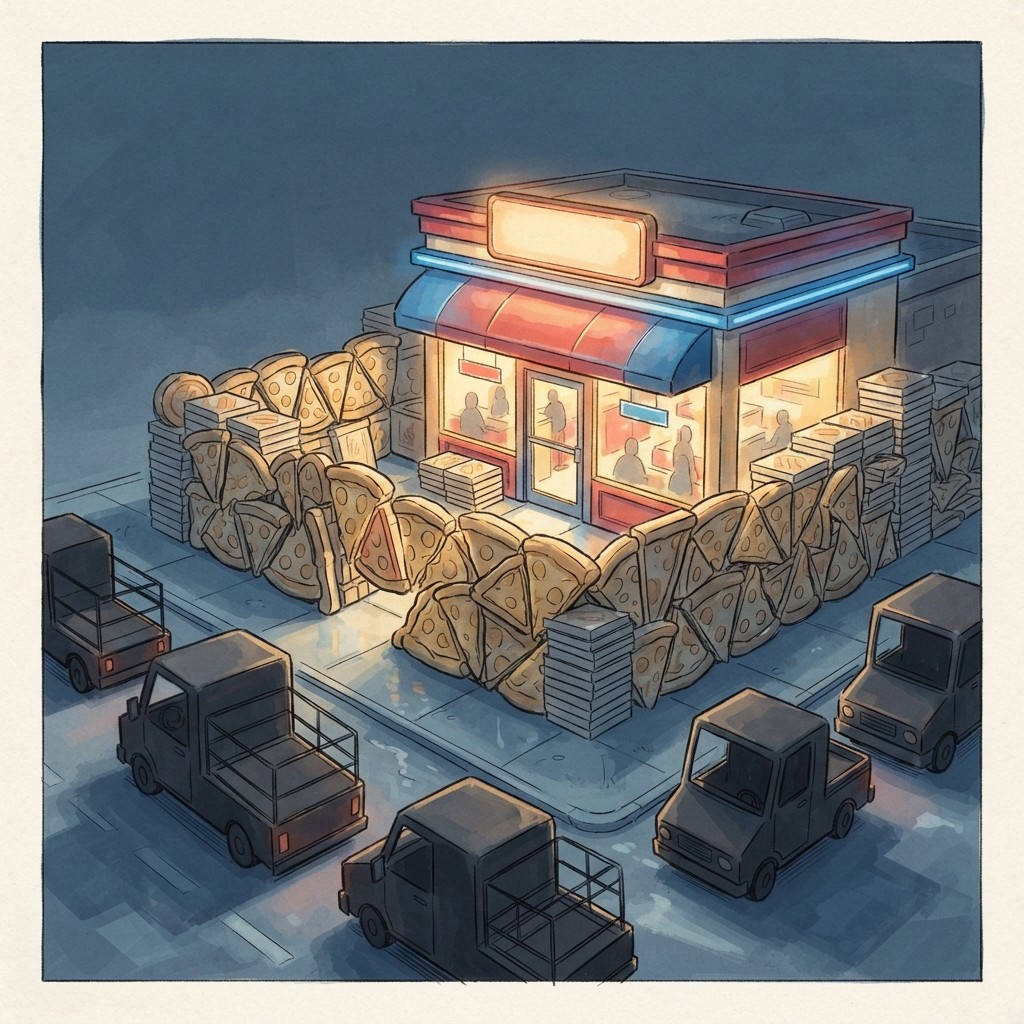
Fortressing: building stores you wouldn't think you needed
The same instinct shows up in physical space. Domino's 'fortressing' strategy packs stores closer together, sometimes close enough that two locations seem to compete with each other. The common assumption is that this is about shaving minutes off delivery. It mostly isn't anymore. The main current driver is carryout — putting a store near enough that picking up your own pizza becomes the easy option.8 And carryout is where the growth is: in 2024, carryout same-store sales grew 6.2% against just 1.1% for delivery.8 Yes, denser stores dilute same-store sales a little, but they improve overall store profitability — and the carryout they generate is largely incremental, not stolen from existing demand.8 Carryout, notice, is the cheapest possible order for a delivery-cost-sensitive business: no driver, no aggregator, just a customer walking in. It's the offline version of owning the order.
When a company brags about becoming a tech company, ask what the technology actually defends. The most valuable thing software can do is rarely to become a new revenue line — it's to keep an existing one from leaking. Domino's built an app, a tracker, and a dozen quirky ordering surfaces not to sell them, but to make sure the order, the data, and the customer never leave its own pipes for an aggregator's. The tell is on the income statement: if the 'tech company' has no software revenue, the technology isn't the product. It's the moat around the product. Look for the leak being plugged before you believe the transformation being sold.
The fair objection is that this is too cynical — that Domino's really did get genuinely good at technology, and that the customer experience is the moat, full stop. That's partly right, and it's the strongest version of the bull case. The Tracker and the app are good; people use them because they work, not only because they're funnelled there. But 'good UX' and 'defensive moat' aren't opposites — the experience is good precisely because Domino's had a structural reason to make it good that its rivals didn't share. A chain that's happy to live inside DoorDash has no reason to obsess over its own app. A chain that earns most of its money from supply chain and royalties, and that would bleed margin to every aggregator it touched, has every reason. The honest counter is that aggregators are real and growing, and Domino's can't wall them out forever; it has had to meet customers on third-party platforms too. But it does so on its own terms, from a position where most of the volume still runs through its own front door. The moat isn't perfect. It's just deeper than anyone else's in the category.
So here is the reframe. Domino's didn't become a tech company that sells pizza. It stayed a pizza company — specifically a supply-chain-and-royalty company — that understood, earlier than its rivals, that the order itself was the asset worth defending. The Tracker, the app, AnyWare, the fortress of stores within walking distance: every one of them is a turnstile pointed the same way, keeping the customer inside the pipes Domino's owns. The genius was never the software. It was realizing that in a business where someone else makes the pizza and someone else delivers it, the one thing you must never let slip away is the moment the customer decides to order.
When the real business hides behind the obvious one
Flywheel Designer Canvas
A one-page canvas for mapping a business's flywheel: the reinforcing loop, how it was started, the second-order loops it spins off, the moat it creates, and how it could spin backward. Use it to diagnose whether you have a real flywheel or a funnel drawn in a circle — and to design one of your own.
Included, filled and blank, in the The Flywheel Casebook. See the set → · Preview the blank →
Sources
Where this comes from — the filings, records, and reporting behind it.
- 1Domino's generated more than 85% of U.S. retail sales in 2025 from digital channels; approximately 99% of global stores are franchised; supply chain revenue was $2,989,529 thousand (≈$2.99B, ~60.5% of consolidated revenues) in FY2025; total revenues were $4,939,994 thousand in FY2025.
- 2Domino's rolled out Pizza Tracker in January 2008 across the U.S. after a December 2007 limited test; it was the first tracker developed and used by a national pizza chain; since its 2008 debut, Tracker has followed more than 2.5 billion orders.
- 3Domino's online and mobile ordering system launched in 2007; the Pizza Tracker and Pizza Builder launched in 2008; today Domino's generates more than 85% of sales via digital ordering channels.Domino's Pizza Inc., Innovations — biz.dominos.com ↗ · 2021-12-13
- 4For full fiscal year 2015, Domino's said orders placed over digital channels hit $4.7 billion; CDO Dennis Maloney stated 'more than half of our orders and our sales are coming through our digital channels'; CEO J. Patrick Doyle attributed the performance to steady technology investment.
- 5AnyWare campaign generated 2 billion earned media impressions; AnyWare TV campaign ran Q3 2015 and generated 10.5% YoY sales growth; a JP Morgan analyst described Domino's as 'a technology company disguised as a marketing company disguised as a pizza company'; AnyWare ordering channels included tweet, text, Ford SYNC, Samsung Smart TV, and smartwatches.
- 6Patrick Doyle was named Domino's Pizza CEO in January 2010 after David Brandon resigned; the pizza recipe redesign process started under Brandon; Domino's spent 200,000 hours retraining employees; the $75 million six-week marketing campaign launched to address flat same-store sales and store closures in 2009; new recipe includes garlic-seasoned crust, bolder tomato sauce, shredded mozzarella.
- 7The 'Pizza Turnaround' documentary video aired in December 2009; Doyle was then-president (not yet CEO); the campaign's official name was 'Domino's Pizza Turnaround'; Doyle stated 'We are as much a tech company as we are a pizza company' at a CEO Summit; nearly half of Domino's corporate headquarters staff work in technology.
- 8Fortressing's main current purpose is to boost carryout by placing stores closer to customers (shortening pickup distance), not solely to shorten delivery times; carryout same-store sales grew 6.2% vs. 1.1% for delivery in 2024; increased store density dilutes same-store sales somewhat but improves store profitability overall; Domino's 2023 Investor Day included a slide on fortressing benefits.
More like this — beyond Domino's
New Strategically analyses as they publish: the defining moves in business, checked against the record. No noise, and one click to leave.