Pairs with the Turnaround Diagnosis Worksheet — a ready-to-use strategy tool. Included in the The Turnaround Casebook →
In late 2009, a major pizza company aired an ad in which its own customers called the product cardboard and ketchup. The company agreed with them. It read the focus-group transcripts on camera, admitted the pizza was bad, and promised it had spent the better part of two years remaking the crust, the sauce, and the cheese.3 It was an extraordinary thing to do, and everyone remembers it. What almost nobody remembers is that the man usually credited for the whole turnaround wasn't even CEO yet.
The story everyone tells is simple: Domino's fixed the pizza, customers came back, the stock went to the moon. And the stock genuinely did. From $11.90 the day Patrick Doyle took over to $206.71 on the day his departure was announced, the shares produced a remarkable run.5 Between 2010 and 2017 — the window the comparison data covers — Domino's appreciated more than 2,000%, outrunning Apple, Amazon, Netflix, and Google over that period.6 But the recipe didn't do that. The recipe stopped the bleeding. Something else entirely turned a bandage into a rocket.
The recipe was the apology, not the engine
Start by getting the timeline straight, because the popular version is wrong in a way that matters. The new pizza was the product of 18 to 24 months of R&D across 2008 and 2009 — and the self-flagellating ad campaign that made it legendary was developed during CEO David Brandon's tenure — with Doyle, then President of USA Operations, serving as its on-camera face.311 The board announced on January 5, 2010 that Brandon would hand over and Doyle would take the chair that March.2 By the time Doyle actually became CEO, the brave decision to own the bad reviews was already three months old and shipping to stores.3 So whatever Doyle's contribution was, it was not the recipe and it was not the apology. He inherited both. His job was the part that came after.
Here's why that distinction is the whole point. A reformulation, however honest, is a one-time event. It resets perception, recovers some lapsed customers, and produces a quarter or two of comparable-sales relief. Then it's priced in. If the recipe were the engine, the chart would show a pop in 2010 and a plateau. Instead it shows a multi-year compounding climb. You do not get more than 2,000% out of a better sauce.6 You get it from a business model the ads never mentioned — digital ordering platforms accounting for the majority of sales, and a franchise royalty engine that scales without owning a single oven.910
“We do not issue cards, extend credit... nor do we earn revenue from, or bear credit risk.”3
The pizza company that was quietly a software company
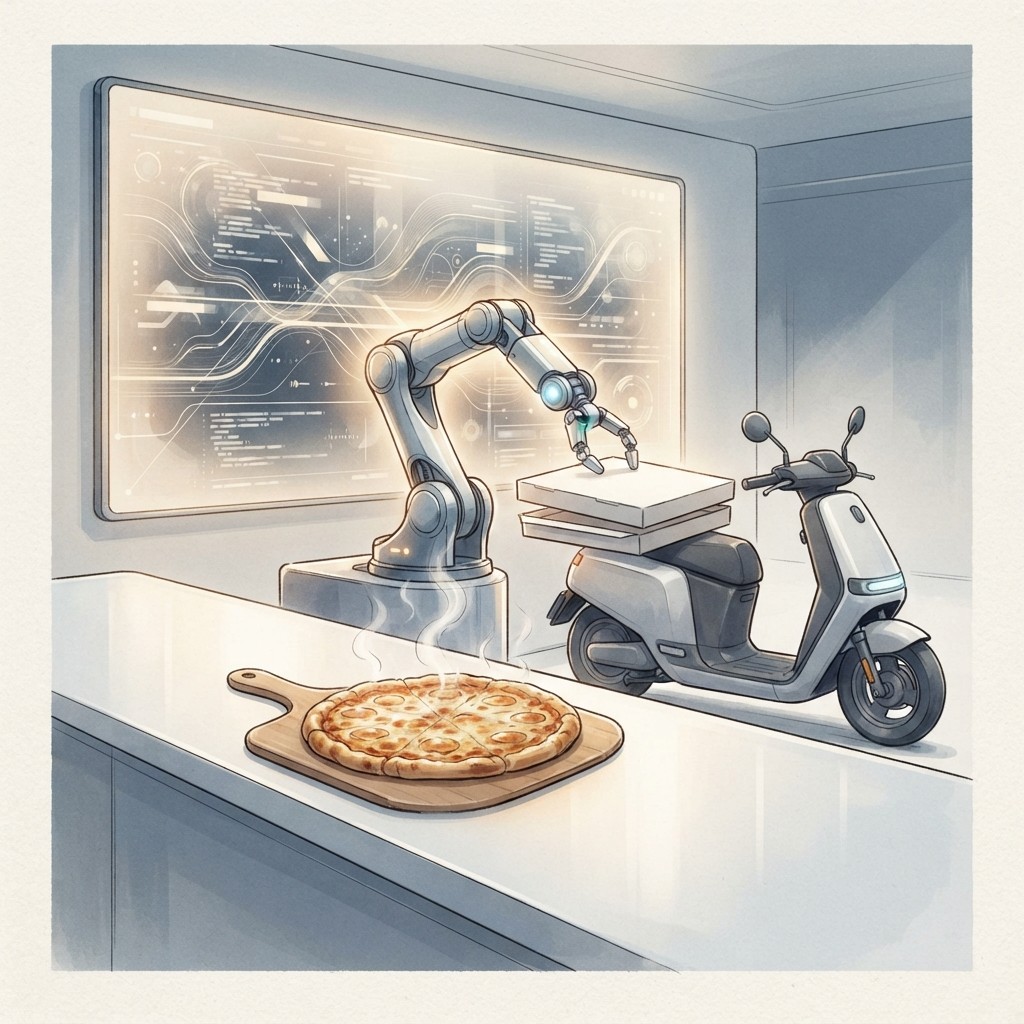
The thesis is this: Domino's post-2010 re-rating wasn't a food story dressed up as a stock story. It was a technology and franchise-economics story that the recipe reset merely made possible. Doyle's actual achievement was building, on top of a credible product, two machines investors love far more than they love pizza — a digital ordering platform that owned the customer relationship, and a franchise-light operating model where the corporate parent collects royalties and runs the supply chain instead of flipping dough.10 One sells a commodity. The other compounds. As Doyle himself acknowledged in this period, "In 2009, we decided that technology was going to be a big deal" — and Domino's went on to employ more people in IT than anywhere else in the company.9
Think about what each model puts on a balance sheet. A company that owns and operates restaurants owns real estate, ovens, labor, and the weather risk of a slow Tuesday. A company that franchises stores and routes their orders through its own software owns a stream of royalty fees and a stream of digital data — high margin, capital-light, and sticky.10 The recipe got people to give Domino's a second look. The app and the franchise model are what made each of those looks worth dramatically more to a shareholder than the slice itself ever was. That's why a pizza ticker could trade like a tech ticker, and outrun the tech tickers.9
| The recipe story | The operating-model story | |
|---|---|---|
| What it changed | Crust, sauce, cheese | How orders flow and who owns the asset |
| Effect on the business | One-time perception reset | Recurring, capital-light royalty + data |
| Time horizon | A quarter or two of relief | A decade of compounding |
| Who set it in motion | Initiated under Brandon | Built out under Doyle |
| What investors paid up for | Better pizza | A franchise-light tech machine |
But didn't $1,000 really become $56,000?
The strongest version of the recipe-saved-everything story leans on the most famous number: $1,000 invested at the 2004 IPO was worth more than $56,000 by February 2020, beating Google over the same stretch.7 That number is real, and it is also flattering in a way the headlines skip. It includes dividends — and Google paid none across the period.7 Strip the payouts back out and the price-only gap narrows considerably. The comparison isn't fraudulent; it's just measuring a pizza company that returns cash against a tech company that reinvests everything, and quietly counting the difference as Domino's brilliance.
There's a second, harder honesty the turnaround chroniclers tend to leave out, and it cuts the other way too. The '2,000%+ since 2010' figure is a window. The flattering windows end at a peak. By mid-2026, DPZ had fallen roughly 37% over the trailing year, with a five-year total return near flat.8 The operating model is still there. The royalties still flow. But a franchise-light tech machine is also a growth stock, and growth stocks get re-rated downward as ruthlessly as they get re-rated up. The same logic that let a pizza company trade like software is the logic now pulling it back toward earth. That's not a contradiction of the thesis. It's a confirmation of it: the market was never paying for the pizza.
The dramatic, photogenic move — the recipe, the mea culpa ad, the founder who 'listened to customers' — is what the story remembers, because it's a scene. But scenes don't compound. The thing that actually drives a decade-long re-rating is almost always structural and boring: who owns the asset, where the margin sits, who owns the customer relationship. When you study a turnaround, separate the apology from the architecture. The apology buys you a second look. Only the architecture turns that look into a number. And be honest about the measurement window — a turnaround that's 'up 2,000%' through a peak and flat over five years is one story told two ways.
Domino's didn't outrun Google by making a better pizza. It made a credible-enough pizza so that customers would stop laughing — and then, while everyone was busy admiring the honesty of the ads, it rebuilt itself into a franchise-light software business that happened to deliver food. The recipe got the applause. The architecture got the multiple. The most expensive lesson in any turnaround is the one the marketing department will never put in a commercial: the thing the public credits is almost never the thing the stock was buying.
When the official story misses the real engine
Turnaround Diagnosis Worksheet
A worksheet that forces a turnaround down to first principles: is this a cash problem, a cost problem, or a strategy problem — and which one will kill you first. It separates the bleeding you must stop this week from the rebuild that takes years. Blank to triage your own situation; filled as the worked example tracing how the story's leader sequenced survival before revival.
Included, filled and blank, in the The Turnaround Casebook. See the set → · Preview the blank →
Sources
Where this comes from — the filings, records, and reporting behind it.
- 1Domino's IPO closed on July 16, 2004, at an offering price of $14.00 per share; the company issued 9,375,000 shares resulting in net proceeds of approximately $119.3 million.
- 2On January 5, 2010, Domino's announced that CEO David A. Brandon would step down effective March 7, 2010, and that J. Patrick Doyle would be named his successor.
- 3Domino's formally announced its new pizza recipe on December 16, 2009, with rollout to all U.S. stores beginning December 27, 2009; the recipe change involved 18–24 months of R&D in 2008 and 2009 covering crust, sauce, and cheese.
- 4J. Patrick Doyle served as CEO and President of Domino's Pizza from March 8, 2010 to June 30, 2018; prior to that he was President of USA Operations from September 2007 to March 2010.
- 5When Doyle took over from Brandon on March 7, 2010, Domino's shares were trading at $11.90; they closed on the day of his departure announcement at $206.71.
- 6Between 2010 and 2017, Domino's stock appreciated more than 2,000%, outperforming Amazon, Apple, Netflix, and Alphabet (Google) over the same period; the Motley Fool's underlying data extends to April 2017 when DPZ was ~$180/share.
- 7A $1,000 investment in Domino's at its July 2004 IPO was worth more than $56,000 as of February 2020 (including dividends), versus a lower figure for Google over the same period—though the comparison favors Domino's partly because Google paid no dividends.
- 8As of mid-2026, DPZ shares have declined roughly 37% over the trailing year, with a 5-year total return of approximately -6%, materially reversing the turnaround-era gains from the 2021 peak.
- 9Between 2010 and 2017 Domino's stock appreciated more than 2,000%, and Doyle focused on digital innovation — Domino's employs more people in IT than anywhere else and over half of sales come from digital platforms — as the more important driver of the outperformance over Amazon, Apple, Netflix and Alphabet.
- 10Domino's generated more than 85% of U.S. retail sales from digital channels in 2025; the franchise model earns royalties generally at 5.5% of domestic franchise retail sales; digital transaction revenues also flow to the company from franchise stores ordering through its technology platforms.
- 11Russell Weiner, who joined as CMO in 2008 under Brandon, led the award-winning 'Pizza Turnaround' campaign and was named Brandweek's 2010 Marketer of the Year; Doyle was President of USA Operations at the time and was the visible on-camera face of the campaign.
More like this — beyond Domino's
New Strategically analyses as they publish: the defining moves in business, checked against the record. No noise, and one click to leave.